eBook - ePub
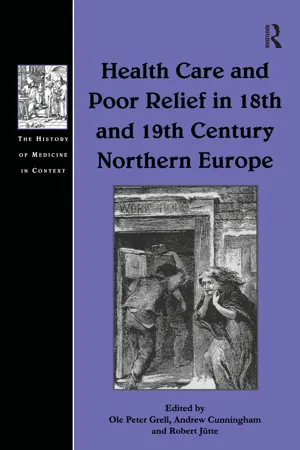
Health Care and Poor Relief in 18th and 19th Century Northern Europe
- 348 pages
- English
- ePUB (mobile friendly)
- Available on iOS & Android
eBook - ePub
Health Care and Poor Relief in 18th and 19th Century Northern Europe
About this book
Throughout history governments have had to confront the problem of how to deal with the poorer parts of their population. During the medieval and early modern period this responsibility was largely borne by religious institutions, civic institutions and individual charity. By the eighteenth century, however, the rapid social and economic changes brought about by industrialisation put these systems under intolerable strain, forcing radical new solutions to be sought to address both old and new problems of health care and poor relief. This volume looks at how northern European governments of the eighteenth and nineteenth centuries coped with the needs of the poor, whilst balancing any new measures against the perceived negative effects of relief upon the moral wellbeing of the poor and issues of social stability. Taken together, the essays in this volume chart the varying responses of states, social classes and political theorists towards the great social and economic issue of the age, industrialisation. Its demands and effects undermined the capacity of the old poor relief arrangements to look after those people that the fits and starts of the industrialisation cycle itself turned into paupers. The result was a response that replaced the traditional principle of 'outdoor' relief, with a generally repressive system of 'indoor' relief that lasted until the rise of organised labour forced a more benign approach to the problems of poverty. Although complete in itself, this volume also forms the third of a four-volume survey of health care and poor relief provision between 1500 and 1900, edited by Ole Peter Grell and Andrew Cunningham.
Part One
General Themes
Chapter One
Health Care and Poor Relief in 18th and 19th Century Northern Europe
Ole Peter Grell and Andrew Cunningham
According to Christ, the poor are always with us (Matthew 26: 11). This had been the case in 16th and 17th century Europe and it certainly remained so in the two centuries we are concerned with in this volume. How did the European governments and states cope with the needs of the poorer parts of their populations, during the Enlightenment and industrialisation? What role did such arrangements for the poor play with respect to maintaining social stability and furthering the interests of the ruling classes? How did provision for the maintenance and health of the poor change under rapidly changing economic circumstances? How did the different states of Europe and their people differ in their attitudes to, and provision for, the poor?
This volume offers some answers to these questions by presenting the basis for a comparative view of health care provision and poor relief in northern Europe in the 18th and 19th centuries. Although complete in itself, the volume is also the third of a four-volume survey of health care and poor relief provision in early modern Europe, 1500-1900.1 In the first two volumes of this series we were particularly concerned with the important role played by the religious impulse in making and shaping provision for the poor in the two centuries after the Reformation. It is clear that, for the most part, the health care provision and poor relief in the north and south of Europe developed along different routes during and after the Reformation and Counter-Reformation. The northern, Protestant, countries came to be characterised by schemes predominantly initiated by local and central governments, while the southern, Catholic, parts of Europe in particular witnessed a reinvigoration of confessional institutions and the creation of new lay and clerical orders dedicated to the poor and the sick.
These two different lines of development continued into the 18th and 19th centuries, although not so directly linked with confessional differences. While in the 15th and early 16th centuries the dynamism of trade and industry had been most evident in the south of Europe, especially in the Italian city states, this state of affairs had begun to change in the course of the 16th century and, as a result, it was the states of northern Europe which by the 17th century, began to lead the way in trade, industry and wealth creation. The Netherlands and Britain were the first to reform their agricultural systems and expand their trade and, in Britain's case, to industrialise. In the course of the 19th century their dominant roles came to be challenged by other northern states, especially Germany and France, as they too underwent agricultural, industrial and trading revolutions. The traditional institutions and arrangements for the care of the sick and poor were themselves put under stress by these developments, especially in the countries where the populations were rapidly expanding. New solutions were needed for both old and new problems.
These two centuries, and especially the 18th century, were a time not only of industrialisation on an unprecedented scale, but also of a revolution in thinking and attitudes, customarily known as the Enlightenment. It was the northern states where these intellectual developments were most advanced, especially in France and some of the German states, but later including Britain, the Netherlands and the Scandinavian countries. Even in the feudally benighted land of Russia attempts were made to introduce enlightened policies and attitudes, but here the movement was led from the top, by the Emperor Peter the Great and the Empress Catherine the Great, and their autocratic versions of Enlightenment did not have a significant effect on the country as a whole. The role that the Enlightenment ideologues played – if any – in modernising poor relief and health care in the northern countries is explored in every chapter of this volume.
The reforms adopted were, for the most part, not very humane by modern standards. There were two primary streams of Enlightenment concern with the health care of the poor and poor relief. From the centralist absolutist German-speaking states, especially Prussia and Austria, came the ideology of Kameralismus which preached that the interests of the state had priority over those of the individual, and that it was in the interests of the state to maximise the population and ensure its productivity. From the individualistic, limited monarchy of England came the ideology of liberalism, which advocated the enlightened self-interest of the ruling class. It is these attitudes, rather than any humane concern for the welfare of the whole of society, which we find underlying the reforms of the period. Hence, from a modern perspective, the reforms were, for the most part, surprisingly harsh towards the poor and to the sick poor. It is only at the very end of the period dealt with in this volume – that is, at the end of the 19th and the beginning of the 20th centuries when we find most states opting (or being obliged to opt) for a model where they treated it as one of their positive duties to care for the health and relief of their poor. In effect there was a transformation in what 'liberal' and 'liberalism' meant in the course of the 19th century. For most of the century it meant putting the freedom of the productive individual first, and making this the model for the behaviour of all members of society. Towards the end of the century, however, it came to mean something much more like its modern-day meaning, in which the rights of all individuals within a society are seen as equal and as deserving fair, if not equal, treatment. Thus for the poor, until at least the mid-19th century, the liberals were the reformers who brought them generally harsher conditions in both health care and poor relief than they had previously experienced.
With the secularisation of world outlook in the wake of the Enlightenment, it might be expected that the motives and reasoning behind the supply of health care and poor relief for the growing populations of the European states would become less based on traditions of Christian charity, whether Catholic or Protestant, and more steered by rationality and the needs of a growing industrial capitalism. To some extent this was true, as we shall see. However, in both Catholic and Protestant countries, we still find extensive voluntary care in this period, clearly based on religious impulses. For instance the Society of St Vincent-de-Paul was founded in Paris in 1833 by a group of concerned young Catholic men around Antoine-Frederic Ozanam in order to help put their vision of a revived Catholicism into practice. Naming their new society after the great French reformer of Catholic welfare provision of the early 17th century, who had founded the Confraternities of Charity, its members resolved to visit the poor in their own homes, the middle-class members of the society giving directly to the poor according to the need they themselves witnessed. Such an action was thought to result in the sanctification of both parties. The movement spread to the Catholic Netherlands, Ireland and elsewhere. Similarly, in Protestant England, the 18th century saw an unprecedented movement, spreading to virtually all significant towns and also at the county level, of founding charitable hospitals (or 'infirmaries') for the poor. The first such 'voluntary hospital', the Westminster Infirmary, founded in 1719, was the creation of High Church Tories excluded from direct political involvement and seeking to exercise Christian charity in their own neighbourhood.2 But subsequently, religious principles were only marginal to the founding and running of these charitable hospitals in England. The upper-class subscribers typically held an annual church service, and the poor patients on their discharge were expected to thank God and the subscribers for their care, but explicitly religious involvement went no further than that. Rather, the structure of an active body of subscribers providing medical care for the 'deserving poor' of their region, was a focused version of wider class relations in England, with the givers wishing to celebrate their own social position while seeking to promote satisfaction with their lot among the labouring classes.
Throughout this period, health care for the poor was inextricably linked with poor relief, a legacy which has had its effects on modern systems of social welfare. In the first place, the richer classes donated the funds for poor relief, but never drew on it themselves. Similarly, the richer classes never attended hospitals as patients. They made their own arrangements for their own medical care, which was brought to them in their own homes. So the hospitals and infirmaries only contained poor people, supported on the contributions extracted in one way or another from the well-to-do. So 'health care' here refers only to provision for the poor and needy of 18th and 19th century European societies, not to the medical arrangements of the wealthier classes. However, the historic link between poverty and disease that is most evident to the modern eye – that disease, especially epidemic disease, can rapidly reduce the wage labourer and his family to poverty, and thus make them dependent on poor relief – was not readily seen, since poverty was primarily seen as a moral failing, not as a consequence of the vagaries of the economic system as a whole. Some governments, such as those of the German states, had seen the maintenance of general social hygiene as one of their duties. In other states, however, it was really only when harsh new Poor Laws had been enacted in the early 19th century that this link between poverty and disease was noticed and acted upon.
A few technical terms are frequently used by our contributors, and need to be noted. First there is the distinction between 'outdoor' and 'indoor' relief. These particular terms were the ones used in England when workhouses had first been established, but they had parallels in other languages. The distinction began as a practical one and ended as a moral one. Indoor relief was assistance given inside an institution such as a workhouse, or possibly a hospital. By contrast, outdoor relief referred to assistance (in cash, kind or medical attendance) given outside the workhouse – that is, in the homes of the poor. As we shall see, there was continued discussion amongst the giving classes as to which form of relief was most effective, not just for the health and subsistence of the poor, but also for their moral and social improvement. The general trend was to reduce outdoor relief, by enclosing in the workhouse the poor who were unable to work (the 'impotent poor') and the sick poor. When, in time, the workhouse came to be used as a deterrent for the ablebodied poor, then only indoor relief was to be given. Hence the poor were encouraged morally to make every effort to fend for themselves rather than become a burden on society as a whole by entering the workhouse. In fact, indoor relief was always more expensive than outdoor relief because workhouses had to be built and managed, so this growing insistence on giving only indoor relief reveals how highly the giving classes valued the deterrent effect of the workhouse on the moral condition of the poor.
The second distinction of poor relief which recurs in these pages is the distinction between the 'deserving' and the 'undeserving' poor – deserving (or...
Table of contents
- Cover
- Half Title
- Title
- Copyright
- Contents
- List of Figures
- List of Tables
- List of Contributors
- Acknowledgements
- Part One General Themes
- Part Two The German States
- Part Three Russia and Scandinavia
- Part Four Britain
- Part Five The Netherlands
- Part Six France
- Index
Trusted by 375,005 students
Access to over 1.5 million titles for a fair monthly price.
Study more efficiently using our study tools.
Frequently asked questions
Yes, you can cancel anytime from the Subscription tab in your account settings on the Perlego website. Your subscription will stay active until the end of your current billing period. Learn how to cancel your subscription
No, books cannot be downloaded as external files, such as PDFs, for use outside of Perlego. However, you can download books within the Perlego app for offline reading on mobile or tablet. Learn how to download books offline
Perlego offers two plans: Essential and Complete
- Essential is ideal for learners and professionals who enjoy exploring a wide range of subjects. Access the Essential Library with 800,000+ trusted titles and best-sellers across business, personal growth, and the humanities. Includes unlimited reading time and Standard Read Aloud voice.
- Complete: Perfect for advanced learners and researchers needing full, unrestricted access. Unlock 1.5M+ books across hundreds of subjects, including academic and specialized titles. The Complete Plan also includes advanced features like Premium Read Aloud and Research Assistant.
We are an online textbook subscription service, where you can get access to an entire online library for less than the price of a single book per month. With over 1.5 million books across 990+ topics, we’ve got you covered! Learn about our mission
Look out for the read-aloud symbol on your next book to see if you can listen to it. The read-aloud tool reads text aloud for you, highlighting the text as it is being read. You can pause it, speed it up and slow it down. Learn more about Read Aloud
Yes! You can use the Perlego app on both iOS and Android devices to read anytime, anywhere — even offline. Perfect for commutes or when you’re on the go.
Please note we cannot support devices running on iOS 13 and Android 7 or earlier. Learn more about using the app
Please note we cannot support devices running on iOS 13 and Android 7 or earlier. Learn more about using the app
Yes, you can access Health Care and Poor Relief in 18th and 19th Century Northern Europe by Ole Peter Grell,Andrew Cunningham in PDF and/or ePUB format, as well as other popular books in History & World History. We have over 1.5 million books available in our catalogue for you to explore.