- 200 pages
- English
- ePUB (mobile friendly)
- Available on iOS & Android
eBook - ePub
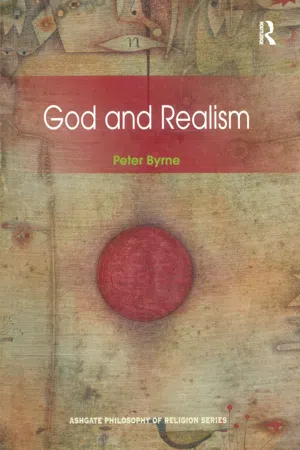
God and Realism
About this book
Peter Byrne's study of God and realism offers a critical survey of issues surrounding the realist interpretation of theism and theology. Byrne presents a general argument for interpreting the intent of talk about God in a realist fashion and argues that judging the intent of theistic discourse should be the primary object of concern in the philosophy of religion. He considers a number of important ideas and thinkers supporting global anti-realism, and finds them all wanting. After the refutation of global anti-realism, Byrne considers a number of important arguments in favour of the notion that there is something specific to talk about God which invites an anti-realist interpretation of it. Here he looks at verificationism, the writings of Don Cupitt, forms of radical feminist theory and the ideas of D.Z. Phillips. The book concludes with a discussion of whether theology as a discursive, academic discipline can be interpreted realistically. Offering a comprehensive survey of the topic and of the leading literature in the field, this book presents key arguments for exploring issues brought to bear upon the realism debate. Students and scholars of philosophy of religion, philosophy of language, metaphysics, theory of knowledge and theology, will find this an invaluable new contribution to the field.
Information
Chapter 1
Theistic and Theological Realism: An Analytic Account
The literature in philosophy of religion and theology is full of discussions of realism. This book is written out of the conviction that there is not much order in these discussions. The debates between theological realists and theological anti-realists generate more heat than light. We need some distinctions to clarify the key terms in the debate. Having made the relevant distinctions, we need an ordered presentation of the arguments for and against the various forms of theological realism we shall distinguish.
An Initial Definition of Realism
The first distinction we need is between types of realism and the various objects of realist/anti-realist analysis. There are disputes about the nature and measure of realism to be applied to religion. There are also disputes about what to apply the measure to. With regard to the latter distinction, we must separate the question of whether theistic belief/ discourse or concepts are to be interpreted realistically from the question of whether theology (here primarily Christian theology) is to be so interpreted. We need the distinction because we must allow that some may think it apt to give a realist interpretation of the fundamental claims or concepts of a theistic tradition such as Christianity while denying this interpretation to the adumbration of these claims in theological reflection. For example, it is conceivable that one might regard as vain and spurious the pretensions of academic theology in Western universities to be an enterprise with a realist thrust, even though one accepted that the more minimal claims of non-reflective believers were capable of realist interpretation. More will have to be said on this distinction at the end of this chapter and in Chapter 7. Until that point is reached, my discussion will concentrate on what is involved in giving the claims and concepts of minimal theism a realist interpretation.
What then is it to give a realist interpretation of the claims and concepts of a minimal theism? Debates between realists and anti-realists are rooted in other areas of philosophy, such as philosophy of scienceand metaphysics. They then get carried over to the philosophy of religion. It is a fact that there is no uniform account of what is at issue between realism and anti-realism in these other areas of philosophy. Susan Haack distinguishes four forms of realism (and their denials) concerning the interpretation of science. To these she adds five metaphysical and epistemological stances (with their opposites) concerning the general nature of truth which also count as forms of realism (Haack 1987: 276 and 287). Her four realist theses about science (‘theoretical realism’, ‘cumulative realism’, ‘progressive realism’ and ‘optimistic realism’) all pertain to the interpretation of scientific discourse and activity. They are hermeneutical theses. This reflects the fact that realist versus anti-realist debates in the philosophy of science concern how to interpret the scientific enterprise. Michael Devitt by contrast sees realism as fundamentally a metaphysical stance. That is to say, realists are philosophers who affirm something about what exists. They affirm that reality exists independently of the mental. Such an assertion – that there is a reality which exists independently of our thoughts or beliefs - is too thin for Devitt. It says nothing about what kinds of things exist independently of the mental. It is compatible with affirming that independent reality is devoid of structure and form and thus with saying that our conceptual activities are responsible for there being distinct kinds and types of things. We would then be, in large measure, constructors of the world we know (see Chapter 2 below for an exploration of this idea). To have any bite, realism must assert that ‘Tokens of most current common-sense and scientific physical types objectively exist independently of the mental’ (Devitt 1997: 23). Realism then makes the concrete metaphysical claim that there are things independent of us which instantiate most of the current common-sense and scientific concepts we employ.
Devitt’s realism is precisely not a hermeneutical thesis. It is not a thesis about the interpretation of discourses. It is a claim about what exists. As such, it is not, in his view, a thesis that can be confirmed or disconfirmed by a priori epistemological or semantic theories in philosophy. One of his ‘maxims’ for conducting the realism dispute is ‘Settle the realism issue before any epistemic or semantic issue’ (Devitt 1997: 4).
There is much that is sensible in Devitt’s definition of realism and the strictures which flow from it. The fundamental question we shall pose under the heading of ‘realism’ is one that bears on the question of what might exist, and particularly on whether a structured, formed world exists independently of our representations. It is also true that many philosophers have wanted to settle this question by first establishing some thesis in epistemology or semantics - as if the uncertainties of debates about what there is can be replaced by the certainties of a priori reflections on the nature of meaning or on the limits of knowledge. Wewill see these pretensions illustrated in a number of the chapters which follow. They are indeed in many instances little more than pretensions, being based on the vain and false belief that common-sense and scientific opinions are less sure than philosophers’ theorising about the nature of meaning or knowledge. There is every reason to be sceptical about philosophers bearing a priori proofs that something cannot be or something else must be. The roots of many of the themes in realist versus anti-realist debates lie in philosophical attempts from Kant onwards to tell us what the limits of knowledge and sense are. Three cheers must be offered for Devitt’s scepticism about the relative uncertainty of the claims which flow from these attempts compared with the certainty of common-sense and scientific claims. But Devitt is wrong to imply that the realist issue cannot be, in some guises and contexts, an hermeneutical one in which semantic and epistemological questions are to the fore. It is with good reason that we ask whether scientific discourse is to be interpreted as the outcome of interactions between human beings and a reality independent of them. Our enquiries will be directed at the extent to which the rise and fall of the theories of science can only be explained by making some reference to human discovery of independent realities. This is a question about the sources of scientific belief, about what processes control the acceptance and rejection of theories and about the kind of meaning scientific statements can have. A primary issue in the interpretation of science will be whether the explanation of the evolution of scientific thought can be explained wholly in terms of realities existing in the human, social world. Proponents of the strong programme in the sociology of knowledge maintain that it can. Realists will be those who claim that this is only part of the story. They will say that it is essential that we make reference to the role real-world influences and factors play in the explanation of the development of science (see Harre 1986: 14). The label ‘realism’ is appropriate for this hermeneutical stance because it concerns how far science does develop in response to the mind-independent real. Haack’s four types of scientific realism are very much concerned with this type of issue. We shall see that when, in Chapter 7, we come to the question of how far the discipline of theology can be given a realist interpretation, it will be matters of explanation and hermeneutics which are to the fore.
There is a relation between the hermeneutical (semantic and epistemological) questions about realism and the bare metaphysical issue of realism raised by Devitt. If we had a proof that no mind-independent reality existed, then that would settle the hermeneutical questions raised under the banner of ‘realism’ in advance. A core realist claim of a metaphysical kind, to be discussed and defended in Chapter 2 below, is a necessary condition for taking the hermeneutical questions raised in realism/anti-realism debates seriously. This claim is to the effect that there is a mind-independent reality and it is a structured,formed reality. We do not impose form and structure on a reality which is in itself devoid of these things (more about this in Chapter 2). What this bare metaphysical claim enables us to do is to take seriously the intent of language users to refer to things of one kind or another in an independent world by means of common-sense and scientific concepts. If the intent behind the use of common-sense and scientific concepts to refer to independent realities of definite kinds cannot be taken seriously, we shall either have to dismiss the talk which enshrines those concepts or we shall have to offer a revisionist interpretation of that talk.
We are here approaching the most fundamental question about theistic discourse which we can raise under the heading of realism versus anti-realism. Can the apparent intent behind talk of God to refer to an entity existing in some sense beyond us and the universe be taken seriously? The realist answers ‘yes’ and the anti-realist ‘no’. Note that we are once more departing from the model for characterising realism offered by Devitt. That model would bid us take the core realist question concerning theism to be: ‘Is there a mind-independent reality corresponding to the concept of “God”?’ Devitt’s definition of ‘realism’ confronts us with the following questions. When we ask of a way of thinking whether it is to be interpreted realistically, are we judging character of the intent (the meaning) behind its terms and concepts, or are we judging whether its governing intent is successful, whether there is an actual correspondence between its types and appropriate extra-mental tokens? As Devitt reviews the merits of a realistic interpretation of common-sense and scientific concepts, he considers himself to be answering the question of whether there really are tokens for most common-sense and scientific types. Transferred to the debate about theism, this way of understanding matters would make opting for a realist interpretation of theistic discourse to be nothing less than deciding that a God of the appropriate kind really existed. A proof that there was no God of the kind the typical believer thinks he or she is worshipping would constitute a proof of anti-realism for theism. This may seem odd. It is surely worthwhile to say that while Richard Swinburne and Quentin Smith disagree over whether God is real, they agree in a realist interpretation of theistic discourse. Contrariwise, while Smith and Cupitt both agree that the God of traditional theism does not exist, the former gives a realist interpretation of theism while the latter does not. What Smith and Swinburne agree on is that the governing intent of theistic discourse and belief is a realist one. Realism brings out the meaning of theism. Cupitt contends that we can reinterpret theism so that it still makes sense, is still a viable intellectual option, without an intent to refer to a God of the appropriate sort.
The import of the questions ‘Are we judging the character of the intent (the meaning) behind its terms and concepts of theism, or are we judging whether the governing intent of theistic discourse is successful,whether there is an actual correspondence between its types and appropriate extra-mental tokens?’ rests on what would follow if we had a proof that there was no God of the appropriate sort. Would theism be impossible as a mode of thinking in that case? Or: would possession of such a proof be irrelevant, since nothing of significance in the presuppositions and meaning of this way of thinking would thereby be lost? If the governing intent of theistic discourse is to refer to a reality existing independently of the mental, then a proof that there was no God beyond human thought would be a refutation of theistic talk. Something of vital significance to the meaning of core theistic claims and concepts would have been lost thereby. This need not entail that nothing could be redeemed from theistic talk. It would be judged a failure as making a successful reference to a God beyond human thought but we might find a reinterpretation which retains some point to it. This is what Julian Huxley does in Religion Without Revelation. According to Huxley, concepts defining the Christian concept of God do not refer to any transcendent being. There is no divine Trinity. Christianity as ordinarily understood is false. But the concepts of Christianity can be reinterpreted. In particular, ‘Son’, ‘Spirit’ and ‘Father’ can be taken, with much loss of original meaning, to refer to naturalistic entities - to human life, to human ideals and to non-human nature respectively (Huxley 1957: 31-3).
The question of the governing intent behind theistic discourse is not to be settled by psychological survey. An answer to it will reflect an understanding of the meaning of theistic claims. This understanding will in part be based on a perception of what kind of thing counts for and against them. It will also reflect a sense of the role they play in the lives of believers. Is that role, we can ask, such that they need to be thought of as having referential import to sustain it? We will see that philosophers of religion disagree on how that last question is to be answered. Despite the fact that philosophers offer conflicting readings of the intent of theistic discourse, we must note that making realism a matter of judging its intent leaves the realist/anti-realist debate philosophically more tractable than otherwise. No clear-cut proofs or disproofs of God’s existence are on the horizon. The realist question, difficult though it is, is not the impossible question of whether there really is a God.
To this point we have established what appears to be one clear question at issue when the realist status of theistic discourse is discussed: ‘Is its governing intent to refer to a mind-independent reality?’ However, the question is too easy. Let us make it more complicated. To establish whether theism is to be interpreted realistically or otherwise we need to show that we can take seriously its intent to refer to a mind-independent entity of an appropriate kind. The appropriate objects of reference for common sense and scientific realism are things and stuffsexisting in spatio-temporal, physical reality. Complications do arise if we ask our realist question about those parts of scientific theorising containing terms purporting to refer to unobservable things, stuffs or structures in nature. An interpretation of science which says that they do not refer (say, because unobservables are ‘convenient fictions’) is an anti-realist one. But so, presumably, is one which says that theoretical terms are roundabout ways of referring to observables (like talk of the ‘average Englishman’). The appropriate tokens of many scientific types for a realism worth its name would be things, stuffs and structures now, or in principle, undetectable by observation (extended by instruments or not). Why is this so? Well, because it appears to be the case that key activities in science, such as explaining and predicting phenomena, depend on our taking concepts such as ‘electron’ or ‘magnetic field’ to refer to aspects of nature which are real yet unobservable. Science appears to be an enterprise designed to uncover the inner workings of nature. It aims, prima facie, to explain nature’s surface goings-on by hypothesising and investigating unobservable things, structures and stuffs.
To make our first realist question about theism at all precise we will have to specify the appropriate object to which theistic concepts appears to refer. We will have to say that the appropriate object is mind-independent and transcendent. So now we might define realism for theistic discourse as: ‘the governing intent behind the concept of God is to refer to an extra-mental, extra-mundane, transcendent entity’. At this juncture problems abound. They stem from the difficulties in initially defining ‘extra-mundane, transcendent’ and the problems increase when we come to apply any such definition to possible and actual versions of theism. It will transpire that it is enormously difficult to attain clarity and agreement on what ‘transcendent entity’ means in these contexts. The nature of transcendence in the definition of theism is something that will be explored in a later section of this chapter.
Global versus Contrastive Realism
So far we have realism toward theism as a stance directed at minimal, core theistic concepts which states that the use of these concepts is governed by an attempt to refer to a transcendent, mind-independent reality. Theistic anti-realists deny this intent. They can do so on at least two kinds of ground. They may be theistic anti-realists because they are global anti-realists. On the other hand, they may be theistic anti-realists while being global realists. In the latter case, they will contrast the realist intent of normal talk about the world with the anti-realist intent of theistic talk. They are then contrastive anti-realists when it comes to theism, citing reasons pertaining to the specific character of theisticdiscourse and thought which make it deserving of anti-realist interpretation.
The global anti-realist is someone who denies the fundamental global realist claim that there is a structured, mind-independent world to which human beings can refer and which makes their statements true or false. It is no easy matter to pin down the precise character of the metaphysical assumption which underpins global realism. A preliminary attempt will be made to do so in this section. More will be said about the issues for and against global realism in Chapter 2.
Our preliminary attempt begins with Haack’s five variants on realism and anti-realism in metaphysics (1987: 283). ‘Minimal realism’ affirms that truth is not definable in terms of what is relative to a community, individual or theory. A proposition is true just in case things are as it says they are. The opposing thesis is ‘radical relativism’. ‘Ambitious absolutism’ states that truth-bearers are non-linguistic entities (for example, propositions rather than sentences) which can be individuated without reference to a language. Its opposite is ‘modest relativism’. ‘Transcendentalism’ is the thesis that ‘truth may outrun us’; that is, that there can be truths beyond human discovery and recognition - even in principle. It is opposed by various forms of ‘verificationism’ (such as positivism and pragmatism). ‘Nidealism’ affirms that the world is not constructed from human mental states or representations and is opposed to forms of ‘idealism’. ‘Scholastic realism’ states that some things really are alike, independent of our categories. By contrast, ‘nominalism’ affirms that our categories of classification are optional, unconstrained by any pre-existent kinds or properties in the world.
In Chapter 2 we shall argue that what is crucial to global realism is a doctrine (styled ‘innocent realism’ after another paper by Haack [Haack 1996]) which is a combination of nidealism and something which is allied to scholastic realism. The doctrine of innocent realism tells us that, for the most part, the world exists independently of us and our representations of it. It is ontologically independent of human beings. It would exist even if there were no creatures like us. It is epistemically independent of human beings in so far as our concepts refer to, and beliefs are made true by, things and characteristics in a world whose nature is not established by those beliefs and concepts. This entails that nidealism will go hand-in-hand with some version of scholastic realism. It will do so to the extent that our minimal global realism maintains that the independent world is not an undifferentiated stuff which is moulded by our beliefs and concepts. Minimal global realism need not take sides in the debate about the nature of truth-bearers that is highlighted by the opposition between ambitious absolutism and modest relativism. It will, however, take sides on radical relativism versus minimal realism. Our minimal global realism will recognise that we make many statements about parts of the world which are independent of human beings. Nidealism in combination withsome form of scholastic realism states that those parts of reality exist and have the characteristics they do independent of the cognitive activities of human beings. They thus constitute truth-makers which are independent of the concepts and beliefs belonging to human communities and individuals. Transcendentalism is then suggested. There can be truths of which we may remain forever ignorant because there is a body of truth-makers which exists quite independent...
Table of contents
- Cover Page
- Title Page
- Copyright Page
- Contents
- GOD AND REALISM
- ASHGATE PHILOSOPHY OF RELIGION SERIES Series Editors
- Preface
- Acknowledgements
- 1 Theistic and Theological Realism: An Analytic Account
- 2 Global or Non-Contrastive Anti-realism
- 3 Scheming
- 4 Realism and Verification
- 5 Cupitt, Postmodernism and All That Jazz
- 6 Contrastive Anti-realism
- 7 A Realist Interpretation of Theology?
- Bibliography
- Index
Trusted by 375,005 students
Access to over 1.5 million titles for a fair monthly price.
Study more efficiently using our study tools.
Frequently asked questions
Yes, you can cancel anytime from the Subscription tab in your account settings on the Perlego website. Your subscription will stay active until the end of your current billing period. Learn how to cancel your subscription
No, books cannot be downloaded as external files, such as PDFs, for use outside of Perlego. However, you can download books within the Perlego app for offline reading on mobile or tablet. Learn how to download books offline
Perlego offers two plans: Essential and Complete
- Essential is ideal for learners and professionals who enjoy exploring a wide range of subjects. Access the Essential Library with 800,000+ trusted titles and best-sellers across business, personal growth, and the humanities. Includes unlimited reading time and Standard Read Aloud voice.
- Complete: Perfect for advanced learners and researchers needing full, unrestricted access. Unlock 1.5M+ books across hundreds of subjects, including academic and specialized titles. The Complete Plan also includes advanced features like Premium Read Aloud and Research Assistant.
We are an online textbook subscription service, where you can get access to an entire online library for less than the price of a single book per month. With over 1.5 million books across 990+ topics, we’ve got you covered! Learn about our mission
Look out for the read-aloud symbol on your next book to see if you can listen to it. The read-aloud tool reads text aloud for you, highlighting the text as it is being read. You can pause it, speed it up and slow it down. Learn more about Read Aloud
Yes! You can use the Perlego app on both iOS and Android devices to read anytime, anywhere — even offline. Perfect for commutes or when you’re on the go.
Please note we cannot support devices running on iOS 13 and Android 7 or earlier. Learn more about using the app
Please note we cannot support devices running on iOS 13 and Android 7 or earlier. Learn more about using the app
Yes, you can access God and Realism by Peter Byrne in PDF and/or ePUB format, as well as other popular books in Teología y religión & Religión. We have over 1.5 million books available in our catalogue for you to explore.