- 232 pages
- English
- ePUB (mobile friendly)
- Available on iOS & Android
eBook - ePub
About this book
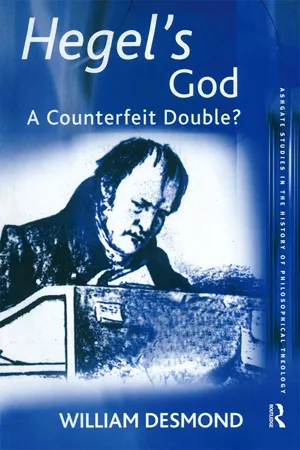
Hegel is widely regarded as one of the major thinkers of the modern era, if not the entire tradition of philosophy. Hegel, like many philosophers, took seriously traditional philosophical perplexities about God, but unlike many modern philosophers he claimed to take the specific characteristic of Christianity into account in his philosophizing. This book presents a new examination, interpretation and critical engagement with Hegel's philosophy of religion, and with his concept of God in particular. William Desmond explores the distinctive stresses of Hegel's approach to God, the influence it has exerted, and the fundamental problems that his approach exhibits.
Information
Chapter 1
Finding a Way to Holistic Immanence: Hegel Between Enlightenment, Greece and Christianity
Kantian Enlightenment: On the Refraction of Transcendence Through Immanent Autonomy
The younger Hegel, broadly speaking, sought to find an immanent way between three influences: first, Enlightenment, especially in the figure of Kant, and its wedding of rational science and moral autonomy; second, Greece, in the glory of its holistic aesthetic culture; third, Christianity, questioned by some for being a ‘positive’, that is, authority-based, religion, and yet incontrovertibly there to be dealt with as an influential cultural and spiritual power. A glance at some of Hegel’s early writings makes evident from the outset the guiding thread I have proposed, namely, the equivocal place of transcendence, and the seeds of a dialectical-speculative systematization of that equivocation. Relative to Kant, the Greek ideal, and the influence of Christianity, we see him diversely reconfiguring religion in terms of an ideal of immanent self-determination, both of humanity and of God. There is a movement from law to love, and through beauty, but overall the reconfiguration of transcendence as other in terms of immanent self-determination allows us to see in these early writings traces of the counterfeiting of the Biblical God and the initial production of the Hegelian double.
‘From the Kantian system and its highest completion I expect a revolution in Germany. It will proceed from principles that are present and that only need to be elaborated and applied to all hitherto existing knowledge’: thus Hegel in a letter to Schelling in 1795.1 Hegel never swerved from the mission of completing that revolution, even if the completion made him also a critic of its instigator, Kant. But first we must step back.
A major consideration to remember is the ambiguous place of religion generally, and Christianity specifically, in the ethos of the late eighteenth century. This ethos shaped a desire for a more rationalized version of religion, when and where religion managed to survive the sceptical assaults to which it was then subject. This reflects the longer arc of modernity. Something about being religious is constitutively ambiguous, and not least the sense of the divine as finally hidden in unapproachable mystery. Our relation to God can easily become frozen into some form of dualism between immanence and transcendence. Some believed this to have happened in the Middle Ages, with an accentuation of the gap between life here immanently in the world and the divine as a ‘beyond’. While Hegel clearly takes his stance in defense of modernity’s affirmation of immanence, rationalizing modernity generally has shown itself impatient with the ambiguities of being religious. The impatience can increase in the measure that they prove stubborn to our rationalizing impulse. We desire to overcome the equivocities of being with a more univocal intelligibility, but religion resists. We might insist that religion meet a more univocal standard of intelligibility, if it is to be respectable in an age for which the seal of reason counts as the most ultimate endorsement. Yet it resists. Those more sceptical will feel confirmed: religion cannot meet the measure of reason. Those more sympathetic will seek to ‘find a place’ for religion in the new rationalized ethos.
‘Finding a place for religion’ – this might describe the desideratum of many thinkers, albeit differently enacted by a Spinoza, or a Kant, or a Hegel. But the project already is witness to the reduced place of ‘being religious’. Being religious either relates in some way to the ‘whole’, or its claim to ultimacy must be compromised. Clearly in more robustly religious ages, to be was to be religious, and this extended in significance to the whole of life. To speak of ‘finding a place’ for religion does not make sense in such an ethos. Religion has no place because all places are occasions, overt or covert, of some religious significance. (We would not even find ‘philosophy of religion’.)2 The tension between the so-called specificity of religion and the significance of religion for our sense of the whole is one of importance for the maturer Hegel, for he does recognize that religion must have something to do with our sense of the whole. In his earlier thought, this is less explicit, though it is a consideration.
The point has relevance to Kant, a figure of immense importance in shaping the discussion of the era as a whole, as well as Hegel’s views. How describe this importance? Crucial is Kant’s qualification of the rationalizing ethos of modernity by the ideal of moral autonomy. Kant accepts modernity as somehow at a higher level of intellectual, moral and spiritual sophistication than previous ages. Intellectually, the developments and successes of modern science are for him incontestable. Newtonianism has given us the truth of nature. We refuse to be kept tied by nature’s strings, but constrain her to answer questions of our devising. We show our rational autonomy, responsibility and superiority by putting such questions as free us from the random gropings of previous epochs. One must not only endorse the successful rationalizing of nature by modern science, but also the moral distinctness, indeed superiority of the human being.
The problem, of course, is that this world is too much a machine, one in which human beings do not, cannot feel entirely at home. If the human being is a finite machine in an encompassing machine, can it be at home with itself, hence free? The issue would not even arise. Must not the human being as moral seem anomalous in the total machine? The question here deals with the relation of first transcendence (Ti) and second (T2); and it borders on the religious, in having bearing on what is ultimate (third transcendence), and the ultimate form of our inhabitation of being. Pascal and Kant are very different thinkers, but the fear Pascal knew in the silent spaces is not always far from Kant. How make sense of the distinctively human if nature is a mechanism, ruled by the cold univocity of mechanically necessary laws? If we are machines, for some dark reason, we think of ourselves as other to machines. Are we free machines? Or more than machines? And if more, how more? Kant will answer: more as moral. Something unconditional is at stake with morality. But how make sense of the unconditional in the total machine?
The issue haunts us in modernity. Our view of nature is inseparable from our own self-understanding, and both from some intimation that perhaps ‘more’ is needed to make fuller sense of these two. If there is nothing sacred about a machine world, what is there sacred about the human being, the profane machine? God is an other always haunting these questions. Kant thought morality gave ultimate significance to the human as human. We are not profane machines but possess moral autonomy, and this last is not any addendum tacked on later to the former. There is a story told that since the Critique of Pure Reason seemed to destroy faith, and since Kant could not stand the thought of disappointing his manservant Lampe, he wrote the Critique of Practical Reason to bring back the faith he seemed previously to have banished. True or not, it was not Lampe that Kant was satisfying but himself. Indeed he had made room for this satisfaction already in his Critique of Pure Reason which only seemed to have destroyed faith. The will for autonomy is the truer face behind the mask of modernity as showing a scientific will to rationalize the world. Kant thought he had already surmounted total mechanism in the explanation of mechanism which traced back ultimately to the transcendental powers of the knower. These are the ultimate sources of the intelligibility we constitute relative to nature. Far from diminishing us, in such a picture we assume an extraordinary place in the ethos of being: sources of intelligible law, and so rational powers a priori; sources also of moral law, since we are self-legislating, even if also the law seems given.
We see something of the double face of modernity: there, the objectification of being as other; here, the subjectification of value, even if, as here with Kant, this subject is transcendental subjectivity, and hence supports the elevation of the human being into the most important being in the universe. This is clearly the result of Kant’s own meditations on purposes in nature. The human being alone is marked by inherent purpose, is the inherent purpose of nature. One can find passages in his Critique of Judgment that remind one of Pascal, as well as Kant’s famous hymn at the end of the Critique of Practical Reason to the two things that fill him with wonder and admiration: the starry sky above and the moral law within.3 Kant is filled with wonder about the starry skies, but the day will come when admiration will congeal into horror at the emptiness of those cold spaces, and men will feel less jubilance than bewilderment at our freakish place in the immensity of the nothing. If Newtonian mechanism is the truth of nature, the place reserved for our hymns to the starry skies is soon claimed by a more disenchanted successor who will not sing of wonder but will shout with revolt.
The ontological sweats generally are kept well down in Kant’s Enlightenment scheme. They may surface in his discussion of radical evil. But these sweats have everything to do with God, and the absence of God, as Hegel will realize more fully, and not only him, but others too like Kierkegaard and Nietzsche. Kant at once makes an onslaught on the pretensions of speculative reason that dreams on an empty ‘beyond’, and also offers an immanent elevation of the human as practical reason into the position of superiority, the only being of intrinsic worth in nature as a whole. In all of this, the position of God becomes more and more ambiguous and precarious. If the ethos of being is exhausted by definition in terms of the twin processes of objectification and subjectification, of mechanism and autonomy, where then is there any place for the divine as other to these? This is the question of transcendence as more (T3), more than the external transcendence of nature (T1), well matched by transcendental subjectivity, and more than human self-transcendence (T2), well answered for, so it seems, in terms of humanity’s autonomous self-determination.
What I called the antinomy of autonomy and transcendence is well illustrated by Kant. Kantian autonomy refers us to our own self-legislation; transcendence refers to an other beyond our determination. If that other is God, transcendence as other exceeds the resources available to us in an ethos ultimately defined by autonomy. The more we stress autonomy as our absolute value, the less regard will we have for the claim of transcendence as other. Just that otherness always seems to work as a limit on our autonomy. If we make autonomy absolute, transcendence must be relativized to us; but if transcendence as other to us is absolute, then we must relativize autonomy. Kant, like many in modernity, is caught somewhere between these alternatives, though drawn to the first side of the dilemma. For autonomy is perhaps the ‘god’ of modernity, a god that, I underscore, Hegel does not repudiate, even though he does try to give, as we will see, a more complex, dialectical version of it in terms of social self-determination. But if God is truly transcendent, and other to us, even if involved in the deepest intimacy of communication, we have to cast question on ‘autonomy’, certainly with respect to any effort to absolutize its claims. We need to think a freedom other than autonomy, in relation to which God as transcendence frees rather than being a mere negating limit. If there are freedoms beyond autonomy, the question of God will appear differently.
You object: Does not Kant deal with the antinomy by formulating his new moral way to God? It might seem so, but it is not quite so. Remember that Kant makes problematical the whole relevance of reason, in its theoretical use, to the question of God. As is well known, he subjected to critique the ‘traditional’ proofs, as understood by eighteenth-century rationalism, and found them all wanting. The most famous of the so-called a priori proofs is the ontological argument: purely from the idea of God as the being greater than which none can be conceived, we can prove with necessity God’s existence. Kant claims to refute this argument, on the basis of an epistemology that essentially claims that a concept as such involves possibility, while claims of existence extend beyond possibility, and this on the basis of evidence gathered from sense experience. On the basis of a concept alone, all one can establish is further possibility, not existence. There is a gap between concept and existence which cannot be bridged by concepts alone. This applies also to the concept of God. Whether Kant gives a good account of the ontological proof, we need not here decide.4 The consequences, however, are extensive. Kant claims that all the other a posteriori proofs, while seeming to be based on evidence within experience, make surreptitious use of the ontological proof, and with this, they also fall – fall, that is to say, with respect to the claim to establish with rational necessity the existence of God.
The younger Hegel seems more taken with Kant’s moral way, but central to the older Hegel will be a speculative rehabilitation of the ontological argument. In the most fundamental sense of the concept or Begriff for Hegel, you cannot establish a gulf between possibility and actuality. The true concept is self-actualizing, and hence it is true only as being, only as being beyond a dualism of possibility and actuality: it actualizes itself. In a sense, the Hegelian concept performs the ontological argument on itself: it gives itself existence by thinking itself. There are many more qualifications to be introduced, but it is important to remember that not everyone acquiesced in Kant’s so-called demolition of the ontological argument. A different view of knowing and being, concept and actuality, asks a different interpretation of it.
The way Kant ‘problematizes’ the role of theoretical, speculative reason in relation to God reveals something essentially double-sided in his way of thinking. This is relevant to Hegel’s dialectical reformulation of double-sided thinking as two sides of a more unitary speculative reason. Where here Kant says ‘no’, over there he seems to say ‘yes’. By ‘over there’ I refer to Kant’s claim that practical reason can do what theoretical reason cannot: establish God’s existence as a necessary postulate. The argument can be summarized. Our moral being, despite the primacy of duty and virtue, cannot be entirely divorced from the search for happiness. But there is a tension, indeed disjunction between happiness and virtue. One can be virtuous and unhappy; one can be happy and not good. And yet the human being is an exigence for both, and the unity of both. How can we think the togetherness of the two? Kant answers in terms of the summum bonum. Note God is not the summum bonum for Kant, as God is, for instance, in Augustine and Aquinas (happiness, as the vision of God, is the supreme good for us, but the supreme good, the possession of which affords happiness, is God). Kant’s approach is not primarily intent on God, but on a disjunction in our own moral being.
This disjunction runs extremely deep. We cannot underestimate what is here at stake. Much of Hegel’s thinking is directed to such deep disjunctions and their overcoming. The disjunction precipitates the archaic perplexity: Why do the wicked prosper, why are the just cast down? The outcry for a fuller justice is present in the scriptures, in some of the heart-rending psalms, and not only there. Kant hides most of this existential pathos, but we should not be fooled by the sober mask of reason. This disjunction threatens the sense of the whole as good – the ultimate good of it all. If there is no happiness merited by the virtuous, there seems something scandalously amiss in the whole. To alleviate this disjunction, on this side of life, Kant appeals to the divine, on the other side of life: God gives a ground of unity relative to which duty and happiness can be brought into perfect accord. On the other side of life, of death, we must postulate, on the basis of our moral being, a being beyond finitude, and indeed our continued being (immortality), to make intelligible the possibility of the completed accord of virtue and happiness. This postulated God is a moral good, who will reward a person with a perfectly just accord between happiness and moral merit – merit itself being determined by the worthiness to be happy established by virtue for the sake of virtue.
Leav...
Table of contents
- Cover
- Half Title
- Title Page
- Copyright Page
- dedication
- Table of Contents
- Preface
- By Way of Introduction: Hegel’s God, Transcendence and the Counterfeit Double
- 1 Finding a Way to Holistic Immanence: Hegel Between Enlightenment, Greece and Christianity
- 2 Philosophy Redoubling Religion: Intimacy, Agon and Counterfeit Reconciliations
- 3 Beyond Double Thinking: Hegel’s Speculative God
- 4 Hegel’s Trinity and the Erotic Self-Doubling God
- 5 Creation and the Self-Doubling of Hegel’s Trinity
- 6 Evil and the Counterfeits of God in History
- 7 God, Spirit and the Counterfeits of Religious Community
- 8 On the Reserves of God
- Bibliography
- Index
Trusted by 375,005 students
Access to over 1.5 million titles for a fair monthly price.
Study more efficiently using our study tools.
Frequently asked questions
Yes, you can cancel anytime from the Subscription tab in your account settings on the Perlego website. Your subscription will stay active until the end of your current billing period. Learn how to cancel your subscription
No, books cannot be downloaded as external files, such as PDFs, for use outside of Perlego. However, you can download books within the Perlego app for offline reading on mobile or tablet. Learn how to download books offline
Perlego offers two plans: Essential and Complete
- Essential is ideal for learners and professionals who enjoy exploring a wide range of subjects. Access the Essential Library with 800,000+ trusted titles and best-sellers across business, personal growth, and the humanities. Includes unlimited reading time and Standard Read Aloud voice.
- Complete: Perfect for advanced learners and researchers needing full, unrestricted access. Unlock 1.5M+ books across hundreds of subjects, including academic and specialized titles. The Complete Plan also includes advanced features like Premium Read Aloud and Research Assistant.
We are an online textbook subscription service, where you can get access to an entire online library for less than the price of a single book per month. With over 1.5 million books across 990+ topics, we’ve got you covered! Learn about our mission
Look out for the read-aloud symbol on your next book to see if you can listen to it. The read-aloud tool reads text aloud for you, highlighting the text as it is being read. You can pause it, speed it up and slow it down. Learn more about Read Aloud
Yes! You can use the Perlego app on both iOS and Android devices to read anytime, anywhere — even offline. Perfect for commutes or when you’re on the go.
Please note we cannot support devices running on iOS 13 and Android 7 or earlier. Learn more about using the app
Please note we cannot support devices running on iOS 13 and Android 7 or earlier. Learn more about using the app
Yes, you can access Hegel's God by William Desmond in PDF and/or ePUB format, as well as other popular books in Theology & Religion & Religion. We have over 1.5 million books available in our catalogue for you to explore.