- 216 pages
- English
- ePUB (mobile friendly)
- Available on iOS & Android
eBook - ePub
About this book
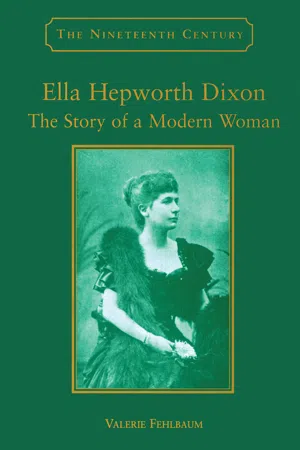
In a career that spanned over forty years, Ella Hepworth Dixon (1857-1932) was alternately journalist, critic, essayist, short story writer, novelist, editor of a women's magazine, dramatist, and autobiographer. After an initial popularity, however, Ella Hepworth Dixon's work, like that of the majority of her contemporaries, remained largely unread for decades. In her new study, Valerie Fehlbaum sheds light on Dixon's life and work, and provides profound insight not only into Dixon herself but into the multifaceted character of the 'New Woman' writer that Dixon typified. The figure of the New Woman as representing new-found intellectual, social, and political freedom came to the fore towards the end of the nineteenth century when the term 'woman' was being interrogated on every imaginable level. In heated debates about woman's nature, primary questions such as 'what is a woman?' and 'what does a woman want?' were accompanied by subsidiary controversies about the precise role she should play in society. Fehlbaum's re-evaluation of Dixon's varied literary output enhances our understanding of this period of radical change for women, and shows that Ella Hepworth Dixon's writing remains as lively and pertinent today as it was when it was first published.
Information
Chapter 1
As I Knew Them: Ella Hepworth Dixon’s Own Story of a Modern Woman
‘Most people of parts (and some of no pretensions) have, at some time or other of their lives, an irresistible desire to publish their reminiscences,’ declared Ella Hepworth Dixon in one of her weekly newspaper columns.1 ‘Usually, to be sure,’ she continued, ‘they leave this adventure into the world of books too late, essaying, when they have nearly reached four-score, to amuse their younger contemporaries with an account of bygone experiences .... We should not wait till we are senile before we begin to talk.’ Why, then, at the age of seventy-five, did Ella Hepworth Dixon herself embark on what she had described elsewhere as ‘that most tiresome of all forms of entertainment – a monologue about oneself?2
Clearly she was not writing for her children, nor, apparently, was she settling old accounts. It may be that she was in a sense tidying up, for she died on January 12, 1932, a year after the publication of her memoirs, and only a month earlier, on December 11, 1931, she had made a will leaving everything except two legacies to her sister-in-law Sybil Maud Dixon, to whom she also dedicated As I Knew Them. Her estate was then valued at £1193-1-6 gross, £996-16-0 net, and on her death certificate3 she is described as a ‘spinster of independent means’, so it seems unlikely that she was writing for fame or money. As she remarked, it is not uncommon to indulge in self-writing, and the 1930s did indeed see a flurry of memoirs by several of Ella Hepworth Dixon’s notable contemporaries, for example Evelyn Sharp’s Unfinished Journey was published in 1933, and Cecily Hamilton’s Life Errant in 1935. Perhaps, as often in her career, Ella Hepworth Dixon was picking up on a trend, and making a success of it.
One further explanation may lie in her claim that ‘the chief danger of memoir-writing is that the author is more apt to “give himself away” to his readers than to give away his contemporaries’4 (my italics). Surely an autobiography is justly expected to reveal more about the writing-self. If, however, there are ‘dangers’ in writing about oneself, how much greater must be the menace of others undertaking the task. ‘It is a dangerous thing to have your life written when you are dead and helpless and can do nothing to protest against the judgement,’5 Mrs Oliphant had declared in her review of Harriet Martineau’s Autobiography. Nevertheless, she had gone on to suggest that ‘there is a still more fatal art ... . This terrible instrument of self-murder is called autobiography’. Ella Hepworth Dixon, I would argue, managed to avoid both perils. Not only did she preclude a biography by anyone else; she also managed to construct a self-protective image of herself. To this end, she appears to have re-read all her writing, selected what she considered relevant and discarded the rest. I have found no trace of diaries, personal papers or letters except for those she uses to validate her anecdotes and a few others in the archives of publishers, in the collected letters of George Meredith, and in a few private collections.
Ella Hepworth Dixon’s subtitle, ‘Sketches of People I have Met on the Way’ at once, however, reveals the fragmentary nature of her text. One could argue that this would be true of any memoirs. Evelyn Sharp likewise in her subtitle, ‘Selected Reminiscences from an Englishwoman’s Life’ (my italics), and in her introduction draws attention to the fact that her reminiscences ‘will not profess to tell the whole story of my life, they will be sincere, I hope, as far as they go.’ Nevertheless, her account is a good deal fuller than Ella Hepworth Dixon’s. The term ‘sketches’ was in fact often used to designate cursory or incomplete studies. Helen C. Black employed it to describe her biographies of ‘Notable Women Authors of the Day’ which had originally appeared in the Lady’s Pictorial before being collected together and published in book form in 1893. Similarly, W. Robertson Nicholl in the ‘Introduction’ to Eliza Lynn Linton’s unfinished autobiography calls her ‘reminiscences of Dickens, Thackeray and George Eliot’ ‘sketches’. These, too, had been commissioned for a periodical and only later collected together in book form. Mary Cholmondeley in her introduction to Under One Roof: A Family Record wrote of her intentions ‘to make a pencil sketch’ of her family and especially of her sister Hester whose diary inspired much of the work. Nearer to our own time, Virginia Woolf also used the term for some autobiographical material she wrote shortly before her death, published posthumously as ‘A Sketch of the Past’ in Moments of Being.
From the outset, then, the reader is cautioned not to expect an autobiography in the conventional sense of an exhaustive womb-to-tomb record of a first-person narrator. Some feminist critics would maintain that in the case of a woman writing about herself this is not unusual. Fragmentation is often seen as characteristic of a woman’s life in general and consequently of her writing. Furthermore, considerable close study of autobiography per se6 over the past twenty years has lead some critics to suggest that the genre is essentially androcentric. The very idea of putting oneself forward as the centre of attention is in itself diametrically opposed to the reticence long considered a feminine virtue and inculcated in women. Thus, it has been argued, male authors, in writing their own histories, contrary to their other works, primarily place the accent on their inner lives, often to show that even out of the public eye they are still Great Men. Women, on the other hand, who are stereotypically more often associated with personal matters, when writing autobiographies almost invariably concentrate, as to a certain extent Ella Hepworth Dixon does, either on their professional or public achievements, or on those around them, especially husbands and children. Nor should this simply be read as more evidence of women’s customary subordination of their own lives to those of others; their intention may be specifically to keep their private selves hidden. In her evaluation of nineteenth century autobiographies by middle-class literary women Mary Jean Corbett remarks, ‘Self-representation becomes its writer’s last performance of a role she writes to protect herself against the deformations of publicity and celebrity, the final mask that will survive her, a mask that can shield the private individual from public view.’7 Although she examines more famous self-representations such as those of Eliza Lynn Linton and Mrs Oliphant, her description of ‘most secular woman autobiographers ... carefully shaping the personae they present and, more especially, by subordinating their histories of themselves to others’ histories’ could equally apply to Ella Hepworth Dixon. Indeed, Mary Jean Corbett almost appears to be quoting the latter when she writes, ‘In this way, the middle-class woman writing autobiography both avoids self-exposure and attains a narrative stance closer to the fiction writer’s; it is not her story she represents, but the story of others as she sees them’ (my italics).
Nevertheless, even if self-writing might be motivated as much by a desire for self-protection as for self-promotion, this is surely not necessarily contingent on one’s gender, and the final outcome of any attempt to recount one’s life might be rather different from the writer’s initial, or professed, intent. Moreover, some critics such as Liz Stanley and, more recently, Linda H. Peterson have accentuated the plurality amongst women writers. Finally, like Jane Marcus after her analysis of the ‘autobiographical acts’ of several public women, including Marie Bashkirtseff and Elizabeth Robins, one is led to ask ‘whether there is indeed any common thread running through women’s autobiographies’.8
A further difficulty in any appraisal of the self-writings of women such as Eliza Lynn Linton, Mrs Oliphant, and, perhaps even more significantly, Marie Bashkirtseff is that they did not live to oversee the publication of their life-stories which, consequently, might have been rather different from the versions which appeared in print. Nor, of course, are such reservations valid only for the writing of women’s lives. The polemic surrounding James Anthony Froude’s revelations from papers entrusted to him by his friend Thomas Carlyle would testify that even one of the century’s Great Men could not control the public image of his life after his death.
Marie Bashkirtseff s Journal caused a sensation when it was first published in 1887 and translated into English two years later, partly because it was considered an absolutely honest unexpurgated account of a woman’s inner thoughts. A recent new edition,9 however, suggests that, in spite of the fact that she wrote the preface herself, much in the actual diary had been specially arranged for sensational publication. Eliza Lynn Linton’s memoirs, My Literary Life, were also published posthumously in 1899, the year after her death, with a ‘Prefatory Note’ by Miss Beatrice Harraden wherein she regrets that her ‘dear friend’ had not started earlier and was no longer there ‘to tone it down’ since ‘he...
Table of contents
- Cover Page
- Title Page
- Copyright Page
- Contents
- List of Figures
- General Editors’ Preface
- Acknowledgments
- Foreword
- 1 As I Knew Them: Ella Hepworth Dixon’s Own Story of a Modern Woman
- 2 Ella Hepworth Dixon and the New Woman
- 3 The Bastille of Journalism’1
- 4 Short Stories of Modern Women
- 5 The Story of a Modern Woman1
- 6 The World of the Theatre’
- Afterword
- Appendix 1 Ella Hepworth Dixon’s Birth and Death Certificates
- Appendix 2 Chronology of Ella Hepworth Dixon’s Literary Career*
- Appendix 3 Chronology of Ella Hepworth Dixon’s Short Fiction
- Appendix 4 Brief Chronology of Marion Hepworth Dixon’s Literary Career
- Bibliography
- Index
Trusted by 375,005 students
Access to over 1.5 million titles for a fair monthly price.
Study more efficiently using our study tools.
Frequently asked questions
Yes, you can cancel anytime from the Subscription tab in your account settings on the Perlego website. Your subscription will stay active until the end of your current billing period. Learn how to cancel your subscription
No, books cannot be downloaded as external files, such as PDFs, for use outside of Perlego. However, you can download books within the Perlego app for offline reading on mobile or tablet. Learn how to download books offline
Perlego offers two plans: Essential and Complete
- Essential is ideal for learners and professionals who enjoy exploring a wide range of subjects. Access the Essential Library with 800,000+ trusted titles and best-sellers across business, personal growth, and the humanities. Includes unlimited reading time and Standard Read Aloud voice.
- Complete: Perfect for advanced learners and researchers needing full, unrestricted access. Unlock 1.5M+ books across hundreds of subjects, including academic and specialized titles. The Complete Plan also includes advanced features like Premium Read Aloud and Research Assistant.
We are an online textbook subscription service, where you can get access to an entire online library for less than the price of a single book per month. With over 1.5 million books across 990+ topics, we’ve got you covered! Learn about our mission
Look out for the read-aloud symbol on your next book to see if you can listen to it. The read-aloud tool reads text aloud for you, highlighting the text as it is being read. You can pause it, speed it up and slow it down. Learn more about Read Aloud
Yes! You can use the Perlego app on both iOS and Android devices to read anytime, anywhere — even offline. Perfect for commutes or when you’re on the go.
Please note we cannot support devices running on iOS 13 and Android 7 or earlier. Learn more about using the app
Please note we cannot support devices running on iOS 13 and Android 7 or earlier. Learn more about using the app
Yes, you can access Ella Hepworth Dixon by Valerie Fehlbaum in PDF and/or ePUB format, as well as other popular books in Literature & Literary Criticism. We have over 1.5 million books available in our catalogue for you to explore.