- 294 pages
- English
- ePUB (mobile friendly)
- Available on iOS & Android
eBook - ePub
About this book
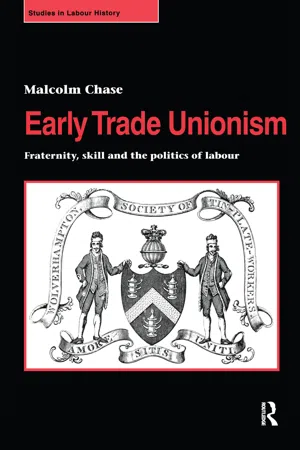
Once the heartland of British labour history, trade unionism has been marginalised in much recent scholarship. In a critical survey from the earliest times to the nineteenth century, this book argues for its reinstatement. Trade unionism is shown to be both intrinsically important and to provide a window onto the broader historical landscape; the evolution of trade union principles and practices is traced from the seventeenth century to mid-Victorian times. Underpinning this survey is an explanation of labour organisation that reaches back to the fourteenth century. Throughout, the emphasis is on trade union mentality and ideology, rather than on institutional history. There is a critical focus on the politics of gender, on the demarcation of skill and on the role of the state in labour issues. New insight is provided on the long-debated question of trade unions' contribution to social and political unrest from the era of the French Revolution through to Chartism.
CHAPTER ONE
Covins and Fraternities a ‘Prehistory’ of Trade Unionism
The broad context1
Evidence for post-Roman urban centres in Britain is effectively confined to London and York. However, new settlements for trade and industry were established in southern and eastern England during the eighth century. If sources permitted, a continuous history of wage labour could be written from this point. Urban development in the rest of the British Isles was slower, but there was a network of urban centres elsewhere in England by the tenth century. By the twelfth century the Scottish burghs were well established as market and trading centres, and the coasts of Wales and southern and eastern Ireland punctuated with significant urban settlements. It was from this base that the urban economy of medieval Britain grew, so that by the sixteenth century there were between 600 and 800 market towns in England alone.
Population growth was vigorous, if slight by modern standards, and around 1300 the population of England and Wales reached a figure of perhaps six million, a level that was not exceeded again until the eighteenth century. However, in the mid-fourteenth century Britain suffered a demographic setback of seismic proportions. Between 1348 and 1375 the Black Death carried off perhaps half of the population. There was a further decline in population in the later fourteenth and fifteenth centuries, with food prices also falling. Initially, urban craftsmen benefited from these trends. However, there was far from a simple rural/urban division in economic fortunes. Much industrial activity, notably in textiles, had been penetrating the countryside since at least the fourteenth century. By the 1420s a combination of diminishing urbangenerated demand and high wages was rendering many products uneconomic compared to those produced in rural areas (and also abroad). London weathered this upheaval better than almost any provincial centre. Its merchants enjoyed significantly better access to capital, essential as commerce and manufacturing restructured. Merchants from York and Bristol, for example, even moved to London, further depleting provincial urban trade. One consequence of the capital’s commercial ascendency was that increasingly the experience of its growing workforce would be out of step with that of provincial urban labour.
The reversal of demographic decline from the late fifteenth century laid the foundations for a more general expansion in the numbers of those partly or wholly dependent upon waged work. The subdivision of land holdings in upland and forest areas of England (where manorial control of land distribution was weak) encouraged the emergence of a dual economy as small cultivators supplemented the modest returns on their efforts by manufacturing work. In lowland areas, where manorial controls were stronger and arable farming predominated, there was both a high demand for labour and a stimulus to enclosure. Hence there emerged significant numbers of landless labourers whose economic choice (apart from beggary) was waged labour either on the land or in the town. Levels of pay were almost invariably higher in towns. However, by the end of the seventeenth century, manufacturers were recruiting shoemakers and knitters in these lowland areas to produce goods for export and the lower end of the domestic market.
State intervention in the urban labour market and in the regulation of beggars and vagrancy, is a prominent feature of the late-sixteenth and seventeenth centuries. Although the 1563 Statute of Artificers remained a benchmark in labour affairs, such legislation might affect the symptoms of change in urban economies but it could do little to influence the sources. With a growth in the supply of labour relative to that of land and capital, real wages fell: by 1611 the purchasing power of the wages received by skilled tradesmen in the building industry of southern England was less than half that of a century before (Wrigley and Schofield 1989, 642). Since labour costs, in a technologically unsophisticated economy, are the largest ingredient in the final price of manufactured goods, the long-term consequences for waged labour were largely negative. Increasing demand for goods and services, and a consequent stimulus to the growth of urban communities, were not matched by any increase in the wages craft workers received, the secular trend of which was downwards. The wages of labourers, roughly two-thirds of those enjoyed by craftsmen, followed the same trend.
Of course the pace of these changes varied between regions and across occupational groups. Regions without a significant urban dimension to their economies (notably non-coastal Ireland and the Scottish Highlands) were barely touched by them. There were sub-regional economies based on mineral industries, such as north-west Derbyshire (lead), Tyneside (coal), and the iron-making areas of wealden Kent and Sussex and later the West Midlands and South Yorkshire, which exhibited distinctive patterns of growth and employment. The development of textiles industries, in what were essentially rural areas such as Ulster and the Lancashire and Yorkshire Pennines, gave rise to special forms of social and economic organization. These, along with parallel rural-based activities in metals, are frequently characterized as protoindustrialization – though historians’ acceptance of the concept is far from universal. There has been a tendency for the most enthusiastic proponents of proto-industrialization to underestimate the social and economic significance of the town-based handicrafts sector. This both exaggerates the ‘backwardness’ of artisan-based production and the extent to which an integrated industrial economy had emerged by 1700. There were, however, significant differences in the ethos and associational lives of waged workers in urban and rural industry. Rural industrial workers were frequently too dispersed to engage in sustained collective action, while the ‘relationship of employer to employee was more often that of creditor to debtor than one expressed in payment of wages’ (Hill 1969, 91). Hence the roots of trade unionism in Britain derive from the traditions of urban craftsmen rather than from rural industrial workers. And thus this survey of the ‘prehistory’ of trade unions takes as its starting point associations of workers in the medieval town.
The guilds, crafts and work
Any account of working life in the medieval town must necessarily start with the guilds. As Sylvia Thrupp has observed:
The occupational gilds of the west are one of the best-known forms of medieval association, familiar both on account of their long post-medieval career, and because they had early lent themselves to the ordering of economic and political life in urban society. Their traditions of corporate charity and piety further attest that they were once genuine communities within the larger community, with a social and religious character transcending mere economic interest and the struggle for power.
(Thrupp 1963, 230)
Some care is needed in using the term ‘guild’ (‘gild’ is a common alternative spelling) and a recurrent feature of recent studies of the subject is the issue of definition. As Swanson (1989, 5) observes ‘it is as vague as the word association’, covering a range of organizations from ‘a handful of people who clubbed together to pay for a light to burn on the altar of their parish church’ upwards. It is generally used to denote an official organization of master craftsmen, but frequently occurs in historical studies as ‘craft guild’, a hybrid term of dubious provenance implying an association embracing or governing the whole of an occupational group. This, as we shall see, is misleading: a guild’s authority over its craft was seldom total.
There are no exact equivalents of the guilds today, though direct linear descendants can be found in the Livery Companies of London and in vestigial survivals in a few other cities (for example the Sheffield Cutlers’ Guild, now a modern trade association, or the Shoreporters’ Society of Aberdeen, originally the Pynours’ Society but now a removals and haulage company run as a mutual partnership). Membership of such associations may (but not invariably) be restricted to a particular occupational group. None of them, however, replicates the functions of their medieval forebears beyond perhaps the promotion of conviviality and fraternal spirit: the religious context and content of a medieval guild’s work is irretrievably absent.
Until very recently historians took little interest in the guilds. Effectively they were consigned to history’s scrap heap, seen as having little relevance to the modern world. Historians in general are apt to concentrate upon new forms of organization or behaviour to the exclusion of continuities amongst old ones. This is particularly the case in Britain. Here guilds have been seen as ceasing to play any meaningful part in economy or society by the early eighteenth century at the latest – in contrast to continental Europe where they survived to the French Revolution and even beyond, for example in Austria and some German states where they were abolished in 1859 and the 1860s respectively. It has also been argued that the particular trajectory taken by Protestant England, towards a market society based on a philosophy of possessive individualism, negated the influence of guilds from an early date: ‘it was in England that the doctrine of freedom of trade and production – the antithesis of guild doctrine – developed earliest and, compared with the rest of Europe, remained strongest in modern times’ (Black 1984, 159). However, there are good grounds for casting doubt upon much conventional wisdom concerning the English guilds. Several recent historians have been impressed by the flexibility of the guilds and have seen their decline after the Reformation as uneven and episodic, with many guilds enjoying a renaissance after 1660.
The medieval guild was primarily an employers’ organization, but with extensive responsibilities for what would now be termed vocational training and consumer protection. In addition, and these were by no means supplementary roles, each guild was closely involved in the civic life and governance of the community of which it was part and, until the upheavals of the Reformation in the sixteenth century, played an integral part in local religious life. Finally, and this is a supplementary aspect, some guild organizations can be seen as anticipating some of the activities of what since the mid-nineteenth century have been called trade unions. Usually, but not invariably, these activities are most evident in organizations which were ancillary and occasionally opposed to the guilds proper. In Eric Hobsbawm’s words:
Social differentiation within or between crafts produced organizations modelled on the pattern of the older gilds or fraternities, but expressing the specific interests of particular sections, notably the journeymen, and a good deal of the traditional pattern was subsequently taken over... into the early trade unions of skilled wage-workers in the industrial period.
(Hobsbawm 1971, 109)
However, a note of caution is needed here. The association of workers in a fraternity separate from the guild which regulated their occupation is not necessarily evidence of polarization between employers and employed, still less of any ‘class-conscious’ thinking. A relatively high degree of mobility, especially in the labour shortages of the late fourteenth and fifteenth centuries, predisposed town dwellers (especially immigrants and their children) to form credit and fraternal networks to replace the support systems of the more intimate rural world. Credit and mutual trust were necessary for economic survival, for workers generally neither owned the materials with which they worked nor received immediate payment for the goods they produced. To be of good standing in the community was therefore vital: it promoted trust, accessed credit and was likely to ameliorate the problems of ill-health and old-age. ‘The most frequently employed means of claiming such status in local society was participation in one or more of the voluntary clubs, generally known as guilds, confraternities or fraternities.’ Gervase Rosser suggests that most urban dwellers beyond the permanently indigent belonged to some form of association, usually occupationally based; and that distinguishing oneself from the indigent was a key motive for association: ‘The many thousands of medieval fraternities defy generalization, but common to them all was an aspiration to respectability’.2
This perception that association powerfully enhanced respectability applied with equal force to later trade unionism. However, it is not an aspect of medieval life to which early historians of guilds were particularly attentive. Working within a mind-set dominated by the emergence of industrial capitalism, they were apt to view associations of journeymen as evidence of modernizing processes. Ironically, although the reluctance of the Webbs to examine guilds and fraternities as part of the history of trade unionism erected unhelpful fences around ‘labour history’, they were right to emphasize the profound ‘otherness’ of work in the medieval world. At the same time, it is difficult to share the prevailing view of most of the twentieth century that the modern history of labour can be neatly fenced off by the ‘Industrial Revolution’.
Among labour historians the power of this convention has been strengthened by an understandable preoccupation with trade unions, a social formation seen as replacing guilds chronologically and fulfilling the function of protecting workers’ interests that guilds performed at best accidentally and imperfectly. In addition, British historians, taking their cue from the Webbs, have long sought to demarcate trade unions off from guilds: ‘We assert, indeed, with confidence, that in no case did any Trade Union in the United Kingdom arise, either directly or indirectly, by descent, from a Craft Guild’ (Webb 1920,14). The Webbs were horrified by cheerfully uncritical antiquarians in the labour movement, notably the bricklayers’ leader and MP George Howell, who evinced an almost romantic interest in supposed connections between guilds and trade unions (Webb 1920, 13; Howell 1878, 1-81). In doing so, and also in seeking to trace the origins of guilds to Anglo-Saxon England, Howell was subscribing to a refinement of the old popular radical notion of the Norman Yoke. The latter hinged on the notion that a wide range of fundamental liberties were established under the Anglo-Saxons, only to be suppressed or curtailed by the ‘alien’ Norman invasion of 1066, to which could also be traced the origins of the aristocracy. The Norman Yoke, though politically most potent in the seventeenth century, was a long time dying. It remained a notable ingredient in the politics of early nineteenth-century radicalism and Chartism and it occasionally resurfaced thereafter, for example in the Clarion movement, contemporary with the early Fabian socialist movement in which the Webbs were very prominent. By the time of the revised 1920 edition of their History of Trade Unionism, the Webbs’ views on the origins of trade unionism had doubtless also been reinforced by an antipathy to contemporary ‘Guild Socialism’, an alternative to Fabianism which proposed the restoration of a guilds system to facilitate workers’ control in industry.
The literature on the labour force of the pre-industrial period is now extensive and its relationship to the later evolution of trade unionism can be considered with some confidence. Such consideration here can only be brief and unlikely to satisfy specialists in the medieval or early modern periods. It is also important to realize that in focusing backwards in this way there is a risk of distortion bordering on violence to the sources.3 It is both futile and falacious to comb through the twelfth to seventeenth centuries with a view to identifying ‘the first trade union’: but by the seventeenth century there is ample evidence of what one of the very few historians interested in the field has termed ‘partially organized labor groups’ (Baker 1973, 382). Though their organization was certainly partial compared to modern trade unions, such groups are recognizable as labour organizations: the broad objectives that brought them together were not only economic but related to their members’ social function as producers rather than as consumers. Furthermore, they were preconceived rather than spontaneous in character. Their aims were variously to discuss grievances and to identify possible solutions to them, to draw up petitions, to select representatives to advance their case, to reach mutually binding agreements aimed at strengthening their economic position, and – though usually only in the last resort – to organize strike action.
The emergence of these kinds of activities alerts us to the development of a mentality in which the formation of separate trade-based organizations for waged labour came to seem both natural and, for the workers anyway, desirable. The historian does need, however, to be cautious. First, as we have seen, occupational-based associations at sub-guild level were common in medieval Britain and are by themselves no reliable indicator of polarizing workplace relations. Second, as Archer (1991, 102) observes, ‘The polemics into which men are drawn in the heat of a particular conflict are not necessarily typical of their normal positions. It is easy to string together isolated instances of conflict to create an impression of polarization.’ However, this is not to suggest that trade and manufacture were pursued in a climate of unalloyed social harmony, which is arguably the cumulative picture in Rappaport’s 1989 study of London artisans, for example. It is over-reliant upon official guild records, documents which naturally tended to be written by those most inclined to conjure up a picture of social composure.
Most early historians of the medieval guilds claimed to identify notable continuities with Roman collegia, a word applied to organized groups of people in a particular trade or line of business, and particularly to occupationally-specific burial societies that existed – notably in the Roman armies – to ensure a decent burial for their subscribing members. Evidence for collegia is to be found in almost every corner of the Roman Empire, Britain included. Given the importance of funeral provision in so many early British trade associations, it is interesting to note how frequently people wished to be buried with their ‘brothers’ – the term is a common one – from the same collegium.4 Recent historical accounts have argued against such connections, stressing that the essentially coercive nature of the Roman labour system contrasts sharply with the situation of urban workers in the medieval period. The real Roman legacy rested in the law of contract, and in the acceptance of the state’s right to intervene in economic matters. Steven Epstein (1991) suggests that the guilds emerged across western Christendom effectively in parallel with waged labour, as a means to recruit, train, retain and control the labour of landless workers. Though the survival of source material is very patchy for the earliest period, these functions are evident in a handful of European towns, London included, in the twelfth century, and become more refined and widespread in the thirteenth. Their durability and efficiency is evident in their having survived the stern test of the Black Death in the fourteenth century. In Scotland, however, occupational guilds – commonly termed incorporations – largely date from the fifteenth and sixteenth centuries, though there were earlier merchant guilds.
Epstein’s wide-ranging synthesis can be criticized on a number of grounds. It is narrowly economistic and oblivious to the breadth and richness of medieval associational life. It largely overlooks the extensive religious functions of the guilds, which as solemn confraternities upheld key features in the religious life of the early towns. It was they, for example, who were charged with the responsibility of performing the Corpus Christi or Mystery Plays of York and other medieval cities and towns (James 1983). Religious functions were not incompatible with the economic ones which medieval guilds fulfilled; and acts of collective worship or recreation (there was seldom a firm dividing line) by masters, men and apprentices would have served to diminish any tensions generated in the workplace. Another deficiency of Epstein’s argument, especially in the British context, is that the emergence of waged labour and the guilds was not monocausal. In many towns regulation of apprenticeship and wages was directly undertaken by civic authority. In some centres guilds developed late (for example Hull, Grimsby and Leeds in the late-fifteenth, sixteenth and seventeenth centuries respectively). Yet waged labour existed in urban communities where there were insuff...
Table of contents
- Cover Page
- Half title
- Title Page
- Copyright
- Contents
- General Editor’s Preface
- Acknowledgments
- List of abbreviations
- Introduction
- 1 Covins and Fraternities
- 2 Trade Associations in the Age of Manufactures
- 3 ‘No Strangers to the Rights of Man’?
- 4 ‘A Young and Rising Commonwealth’
- 5 Across the Frontier of Skill General Unionism
- 6 Trade Unionism and the Early Chartist Movement
- 7 Out of Chartism
- Conclusion: Trade Unions in the Early 1860s
- Bibliography
- Index
Trusted by 375,005 students
Access to over 1.5 million titles for a fair monthly price.
Study more efficiently using our study tools.
Frequently asked questions
Yes, you can cancel anytime from the Subscription tab in your account settings on the Perlego website. Your subscription will stay active until the end of your current billing period. Learn how to cancel your subscription
No, books cannot be downloaded as external files, such as PDFs, for use outside of Perlego. However, you can download books within the Perlego app for offline reading on mobile or tablet. Learn how to download books offline
Perlego offers two plans: Essential and Complete
- Essential is ideal for learners and professionals who enjoy exploring a wide range of subjects. Access the Essential Library with 800,000+ trusted titles and best-sellers across business, personal growth, and the humanities. Includes unlimited reading time and Standard Read Aloud voice.
- Complete: Perfect for advanced learners and researchers needing full, unrestricted access. Unlock 1.5M+ books across hundreds of subjects, including academic and specialized titles. The Complete Plan also includes advanced features like Premium Read Aloud and Research Assistant.
We are an online textbook subscription service, where you can get access to an entire online library for less than the price of a single book per month. With over 1.5 million books across 990+ topics, we’ve got you covered! Learn about our mission
Look out for the read-aloud symbol on your next book to see if you can listen to it. The read-aloud tool reads text aloud for you, highlighting the text as it is being read. You can pause it, speed it up and slow it down. Learn more about Read Aloud
Yes! You can use the Perlego app on both iOS and Android devices to read anytime, anywhere — even offline. Perfect for commutes or when you’re on the go.
Please note we cannot support devices running on iOS 13 and Android 7 or earlier. Learn more about using the app
Please note we cannot support devices running on iOS 13 and Android 7 or earlier. Learn more about using the app
Yes, you can access Early Trade Unionism by Malcolm Chase in PDF and/or ePUB format, as well as other popular books in History & World History. We have over 1.5 million books available in our catalogue for you to explore.