eBook - ePub
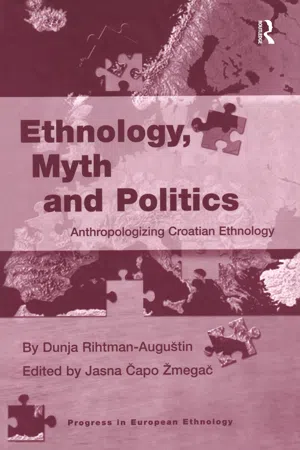
Ethnology, Myth and Politics
Anthropologizing Croatian Ethnology
- 164 pages
- English
- ePUB (mobile friendly)
- Available on iOS & Android
eBook - ePub
Ethnology, Myth and Politics
Anthropologizing Croatian Ethnology
About this book
The book offers a critical overview of Croatian ethnology written by the most prominent Croatian ethnologist/ anthropologist in the second half of the 20th century - Dunja Rihtman-Augustin (recently deceased). She was the first Croatian ethnologist to break with the long established tradition of diffusionist (culture area) studies of her contemporaries and start to anthropologize Croatian ethnology. This book, compiled and completed by Jasna Capo Zmegac, highlights some crucial remarks with regard to the relationship between ethnology and politics. They are formulated as a series of research questions and problems, including: the role of folk culture as mythomoteur, cannonization of the folk culture, nationalization of the peasants in the 19th century and the role of ethnology. This vividly written text offers an exceptional insight into Croatian ethnological developments in the past century, as well as into crucial ruptures in Croatian society which have had important repercussions on ethnological discipline.
Chapter 1
Between Ethnicity and Nation
Similarly to individual variants of Central European Volkskunde, Croatian ethnology, too, identified itself as a national science. To a certain extent, it continues to persist with that identification at the beginning of the Third Millennium. I shall try, therefore, to explain the interweaving of the process of national integration of the Croats with the process of constituting ethnology as a field of scholarship. First of all, I shall ask: When and how did the citizens of the country — which consists of diverse regions in which individuals have, right up until the present day, often identified themselves according to their regional affiliation - start to think of themselves as Croats? Here we are not speaking only of the educated strata of society and the citizenry, but also of those citizens with whom ethnology has always dealt, that is, the peasants and other ordinary people.1
Two Meanings of Being Croatian
Analyzing the processes of Croatian and Serbian national integration in the Croatian lands in the year 1861, Drago Roksandić drew attention to the phenomenon at that time (and, I would say, even today) of regional identification:
In question is the phenomenon of ‘regional nationality’, which is very well known in European historiography. Croatian in the national sense and Croatian in the regional sense are two essentially different articulations of awareness of collective identity (Roksandić, 1991, p. 169).
In the first place, the Croatian regions differ considerably geographically. They differ in the culture and history that formed them. They shared borders with powerful states; within those borders, influences of opposing and usually unfriendly political powers and mutually fairly hostile religions met and clashed, and also permeated each other, almost to the same extent. Nevertheless, or perhaps for that very reason, as cultural and political entities, the Croatian regions possess unquestionable authenticity. The particularities of the regions re-emerged in the newly independent national State since Croatia — under the motto of national unity — was immediately organized on very centralistic lines and showed a clear orientation towards imposition of a uniform national identity.
The integration of a nation is a complex and long-term process. The historian Mirjana Gross (1981) described it as a process during which the localisms and regionalisms of ethnic communities are gradually superseded and a new political community and economic concentration are created, concurrently with the cultural homogenization of the nation. According to the same author, national ideologies and myths emerge in the process, and national values and identity are re-enforced:
Under the concept of ‘national integration’ I understand a process during which the localisms and regionalisms of ethnic communities are gradually superseded, and political communities are created with the development of economic concentration and cultural homogenization of the national community. During this process the feeling of identification of the individual and the group with the national centre is strengthened with the development of national ideologies and myths and value-judgement norms. Consequently, a national awareness is born which does not exhaust itself only in a natural feeling of belonging to the nation, as it does in the ethnic community, but mobilizes the individual to achievement of the objectives of the national community. National awareness invokes a will for life in that community, and its evolvement as a politically free coherent social system. The expression and standard-bearer of the national integration process is the national movement, the initial participators being certain patriotic nuclei, while the movement finally encompasses almost all the social strata and becomes a mass movement (Gross, 1981, p. 180).
Historical research into Croatian national integration shows such a process unfolding in the second half of the 19th century. Croatian historians offer an insight into the individual phases of the process, revealing the thinking and attitudes, and the efforts and activities of individual strata of society in the construction of the national idea and the nation itself. Nonetheless, that brilliant research lacks awareness of the ethnic or national feelings of the lower social strata, the very ones we call ordinary people or, simply, the people. Hence one asks, is ethnology now able to cast some new light on that issue?
National Elites and Early Ethnological Endeavours
Modern South Slavic ethnology emerged simultaneously with the modern national movements. The political movements that prompted national integration were in need of symbols. The national ideologies of the 19th century pleaded for what they believed to be the eternal truth about the authentic symbols of traditional culture that had been created by the people, the Volk. The advocates of national ideas went out among the people in their search for original national values. Many of them organized the collection of material about traditional culture: folk songs and folk stories, folk sayings, folk art, customs and rituals, natural (common) law, way of life...
This was the extensively known process in European culture that Peter Burke called the discovery of popular culture.
Even a cursory look at the development of our science provides an insight into some sort of personal union between the leading personalities of national politics and the forerunners of modern ethnology, or, more precisely, between politicians and the pioneers of systematic ethnological and folkloristic research.
Twenty years prior to the emergence of the movement known in literature as the Croatian (or Illyrian) National Revival in June, 1813 the highly influential Zagreb bishop Maksimilijan Vrhovac sent out a circular in the Latin language to the priests in his diocese, calling on them to start collecting all the Croatian and Slavonian dialect items that can convey information on the richness and nature of the language. He initiated this drive in co-operation with Jernej Kopitar and Josef Dobrovski at the very outset of Slavic studies, within which the research of folklore started to develop:
• Ljudevit Gaj, a Croatian politician who, in 1843, was the first to speak out in the Croatian language in the Croatian Sabor (Parliament) (until then the parliamentary language had been Latin), published the systematic questionnaire intended for historic research, while part of the questions related to the life and culture of the people.
• The first published text by a very significant and influential Croatian politician, Ante StarĆeviĆ, ‘Father of the Homeland’, described wedding customs in his native place (published in the Danica Ilirska magazine in 1845).
• Antun Radić, founder of modern Croatian ethnology, brother to Stjepan Radić, the charismatic leader of the Croatian Peasant Party, was politically active as the ideologue of that party. He was the one who prompted the systematic collection of material on folk life and customs and compiled a brilliant questionnaire for that purpose (1897, reprint 1936a), to which contemporary Croatian ethnologists always return.
This brief and incomplete insight into the connection between people in politics and people who were active researchers - folklorists/ethnologists - offers a completely simple conclusion. The affinity between the ethnological approach and the construction of the Croatian national idea is more than obvious. In any case, the mentioned politicians, along with many other authors/politicians who aspired to a national revival, gave it their legitimate support. We learnt about that at school as the process of the birth of national awareness. However, this would seem to be the time to ask how that political tendency materialized in ethnology? How did Croatian ethnology - and to which extent did it not - contribute to the construction of national values and national symbols?
Self-ascription and Ascription by Others
In an effort to answer those questions, I shall try to uncover something about the situation in the field, among the people, particularly the written information on the real feelings of ethnic and national affiliation of that very people, the ordinary people mentioned above. Those who studied the people and popular culture were convinced that it was among the people, a priori, among the common people, that the treasury of national values, signs and symbols was hidden. Nineteenth century researchers of traditional culture and folklore, in essence people of politics, believed that they knew who the people were, what the people thought, and how they expressed their own ethnic affiliation. All that was needed was to go out into the villages, among the people, and to identify authentic popular creativity and to prompt the awakening of national awareness.
Such an approach to ethnicity and ethnic identification is categorized today as being primordial since it starts out from the assumption that the sense of ethnicity and the nation is found in the depths of origins, language and even the soil. In contrast, I shall commence in this analysis from the category of ethnic identification, since that identification in essence marks the boundaries of ethnicity. Here we find the well-known notion of ascription that was introduced by Fredrik Barth, speaking of ethnic groups and their boundaries. Naturally enough, the 19th century national elites regarded ethnic identity as an unquestionable category: ordinary people were Croats, although they did not actually know it, so they had to be made aware and brought into the nation which had once been much larger, more numerous and more powerful... which was all derived from the legal history of the Croats.
In contrast, it seems to be that the peasants in the individual Croatian regions held only a pale concept of their own national affiliation. Even among the upper social classes, the mentioned regional differences, and also those in culture, language and dialect were more pronounced between the Croats of Central Croatia and the population in the Dalmatian cities and their hinterland, or even that of Slavonia. In any case, there was literature in all three Croatian dialects; it was left to the Illyrians finally to make the selection among them of what would be regarded as the Croatian literary language.
Seeking for ethnic ascription, we will see what the people called themselves and their neighbours in everyday speech in the regions with mixed Croatian (Roman Catholic) and Serbian (Christian Orthodox) or Bosniac (Muslim) populations:
• Žokci, Bunjevci, and Kranjci - thinking of Roman Catholics, today’s Croats or
• Vlasi or RkaĆi - thinking of the Orthodox Christians, today’s ethnic Serbs; or even
• Kranjci, Žtajerci - when speaking of the Slovenians in the various regions; and/or
• Turci or Balije - for Bosnian Muslims.
When studying ethnology under the respected Professor Milovan Gavazzi, we learnt a lengthy list of those regional names or ethnonyms: right up until the present day those ethnonyms have remained present in informal everyday speech as the tools of ethnic identification, but also as stereotypes. During the recent war, some of them were once again invoked in the speech of hatred, with roots in long-past local views of the Others, as a heritage of past stereotypes and prejudices, frictions and conflicts.
Researching the process of the ethnic and national identification of the Croats and Serbs in the Croatian lands in the year 1861, Drago Roksandić draws attention to the political debates in the Croatian Parliament in which Croatian and Serbian politicians, such as the mentioned Kukuljevic and the Patriarch Rajacic of the Serbian Orthodox Church, took part. These politicians tried to define the extent and the mode of expression of Croatian and/or Serbian national identity. Thinking along the lines of Barth’s theory of ethnicity, I conclude that at that important meeting of the Parliament, although more or less tolerant in tone, low-level trench warfare was conducted for the borders of the future national communities that were to enter into the new, modern Croatian political arena.
Of course, these uncertainties in mutual relations could not be limited to Croatia and Slavonia. Confronted with a high degree of dependence between national and territorial integration, both the Croats and the Serbs in the Croatian lands were obliged to face up to a host of questions that were connected with their own Self-identification, the more so because the process of national identification was unavoidably a very slow one in the broad regions of the rural ambiences, limited largely to oral cultural communication (Roksandić, 1991, p. 172).
Folkloristic field practice offered unexpected confirmation of the slowness of that process. During the 1950s, immediately after World War II, groups of researchers from what was then the Institute of Folk Art (now the Institute of Ethnology and Folklore Research) in Zagreb, published the very fruitful results of their research into folklore in Banija in Central Croatia, a border region with mixed ethnic Croatian and Serbian inhabitants. Referring to the archive material of the researchers of that time (Miko Bonifaòié Rozin, Maja BoŽkoviĆ, Olinko Delorko, Stjepan Stepanov), Renata JambreŽiĆ (1992) compiled an extremely interesting study on the ethnic names used in that region and cast light on what was then the actual situation with the ethnic and/or national identity for which I am now searching. It seems that in the 1950s, following the bloody events that took place during World War II, people still used and recognized only the ethnic names of the smaller ethnic groups. The situation could be called pre-national, since it was obviously an example of the mentioned phenomenon of regional nationality. However, one should not ignore the mimicry strategy used by the people interviewed. The population in that region suffered terribly during World War II, so in order to avoid open expression on the national identity that the ruling ideology of Yugoslav Communism tried to reconcile - but also roughly conceal with the slogan of brotherhood and unity - they perhaps resorted to the traditional formulae denoting ethnic affiliation.
Right up until the second half of the 20th century, it was religious and not ethnic denotation that served to mark out the ethnic borders within the mixed Croatian and Serbian population. The peasants in those regions did not speak of their neighbours as Serbs or Croats but as Orthodox or Catholic. Croatian citizens -ethnic Serbs - chose to define themselves as Orthodox believers.2 As far as ethnic Croats were concerned, they were our Orthodox (Christians) - in contrast to those of Orthodox Christian persuasion in Serbia, whom they considered to be Serbs. It was only in the second half of the 20th century - because of the restrictive policy of the Socialist regime and the pressure against expressing religious affiliation -that people slowly started to avoid speaking of themselves as members of one or other faith. It was then, it seems to me, that their ethnic declaration as Serbs or Croats began. With time, the old ethnic terms gave way to the national ones. I would, therefore, venture to say how the forceful Socialist de-Christianization of society contributed to the final integration of the Croatian Orthodox Christians as national Serbs.
From the standpoint of methodology, it is worth mentioning that information on ethnic terms used by the local population in Banija in the 1950s is not included in the field reports in question that, lege artis, are kept in the Documentation Sector of today’s Institute of Ethnology and Folklore Research. That information, which seems so interesting and important to us today, was actually a redundancy in the typical folklore and ethnological material of that time. The data can be found scattered around in optional introductory notes in travel reports and in some personal observations made by the individual researchers. One can only conclude that this type of information was not then considered important or mandatory for the ethnological and folkloristic paradigm, and was a forerunner to contemporary conceptualization of field research.
The Cultural Paradigm in Ethnology/Anthropology
The marginal interest of Croatian ethnology in the national characteristics of traditional culture, and the lack of description of popular life and customs as identifying national phenomena prompted Jasna Čapo (1991) to ask whether Croatian ethnology had really dealt with research into the people/nation or had been largely oriented towards the study of culture. She proved that modern Croatian ethnology, from the time of establishment of the department at the Faculty of Philosophy at the University of Zagreb (in 1924), had, under the powerful influences of its professor, Milovan Gavazzi, unmistakably been focused on research into culture. This orientation gave rise to a host of descriptions of cultural phenomena, as well as of the cultural patterns in the individual Croatian regions and those of the entire Balkans. It happened only sporadically that attention was directed to cultural differences connected with religious practice, but it was a regular occurrence that no explicit indication was given of to which national or ethnic group the cultural elements belonged.
I have already mentioned one of the reasons for avoiding research into the relation between culture and ethnicity. I would call it a political reason. But there was another reason that I need have no hesitation in attributing to ethnological scholarship and the authority of the paradigm on culture. Anthropological and ethnological research into culture, in addition to the numerous definitions of that notion, had persisted in adherence to E. Tylor’s definition of culture as a complex whole. The objective of research - then as now - is the revelation of culture as a specific order of cultural elements that emerge in an autonomous process. It was only in the mid-1990s that Eric Wolf uttered criticism of what had been, until then, a paradigm dear to the hearts of anthropologists and ethnologists:
I suspect that cultural ordering required leadership, control, influence and power, but the phenomena of power wielding in th...
Table of contents
- Cover Page
- Title Page
- Copyright Page
- Table of Contents
- Editor’s Preface
- Author’s Preface
- 1. Between Ethnicity and Nation
- 2. Vuk Karadzic: Past and Present or On the History of Folk Culture
- 3. The Between Real and Imagined Order
- 4. Antun Radie: Peasants into Croats
- 5. Distancing Ethnology from Politics
- 6. Ethnology During Socialism and After
- 7. Ethnology and the Ethnomyth
- 8. Anthropologizing Ethnology
- 9. The Ethno-Anthropologist in his Native Field: to Observe or to Witness?
- 10. The ICTY in The Hague and Anthropological Expertise
- Bibliography
- Index
Trusted by 375,005 students
Access to over 1.5 million titles for a fair monthly price.
Study more efficiently using our study tools.
Frequently asked questions
Yes, you can cancel anytime from the Subscription tab in your account settings on the Perlego website. Your subscription will stay active until the end of your current billing period. Learn how to cancel your subscription
No, books cannot be downloaded as external files, such as PDFs, for use outside of Perlego. However, you can download books within the Perlego app for offline reading on mobile or tablet. Learn how to download books offline
Perlego offers two plans: Essential and Complete
- Essential is ideal for learners and professionals who enjoy exploring a wide range of subjects. Access the Essential Library with 800,000+ trusted titles and best-sellers across business, personal growth, and the humanities. Includes unlimited reading time and Standard Read Aloud voice.
- Complete: Perfect for advanced learners and researchers needing full, unrestricted access. Unlock 1.5M+ books across hundreds of subjects, including academic and specialized titles. The Complete Plan also includes advanced features like Premium Read Aloud and Research Assistant.
We are an online textbook subscription service, where you can get access to an entire online library for less than the price of a single book per month. With over 1.5 million books across 990+ topics, we’ve got you covered! Learn about our mission
Look out for the read-aloud symbol on your next book to see if you can listen to it. The read-aloud tool reads text aloud for you, highlighting the text as it is being read. You can pause it, speed it up and slow it down. Learn more about Read Aloud
Yes! You can use the Perlego app on both iOS and Android devices to read anytime, anywhere — even offline. Perfect for commutes or when you’re on the go.
Please note we cannot support devices running on iOS 13 and Android 7 or earlier. Learn more about using the app
Please note we cannot support devices running on iOS 13 and Android 7 or earlier. Learn more about using the app
Yes, you can access Ethnology, Myth and Politics by Dunja Rihtman-Augustin,Jasna Capo Zmegac in PDF and/or ePUB format, as well as other popular books in Social Sciences & Geography. We have over 1.5 million books available in our catalogue for you to explore.