- 168 pages
- English
- ePUB (mobile friendly)
- Available on iOS & Android
eBook - ePub
About this book
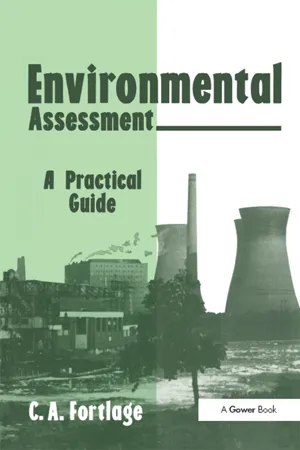
Environmental assessment is a means of counteracting, foreseeing and controlling interference in the environment. All new major developments in Europe and North America are now subjects of scrutiny to prevent them from causing significant harmful effects to the land, sea or air. This book is an essential guide to the process, reviewing the history and background to assessment, summarizing the current legislation and providing useful advice on the skills and management techniques needed for a successful environmental assessment project. Environmental Assessment opens with a review of the US origins of the scheme, definitions and explanations of how the UK has implemented controls. This is followed by the law, rules, regulations and legislation applicable to the UK and the EC directives for the European Community. The author examines management and monitoring, setting up project teams, researching and presenting effective information, as well as calculating and analysing the potential effects of the project. Mitigating measures and alternatives are discussed, as are qualitative assessment techniques. The book has been written for architects, planners and landscape designers, who may be unfamiliar with the techniques, but who are directly involved in shaping the landscape. It would also be a valuable handbook for local planning authority councillors, environmental groups and anyone involved in sensitive development proposals. Although not written as a textbook, environmental students will discover clear jargon-free explanations of and insights into the practice of environmental assessment.
Information
Chapter 1
ENVIRONMENTAL ASSESSMENT PAST AND PRESENT
History and development
Environmental Assessment has always been part of any development process – though not under that name, nor in that form – and it is interesting to look at earlier reports and to see how closely they are related to the present-day practice of environmental study and analysis. The historical assessments are different from modern practice, more because of their simple approach and positive conclusions than because of any great difference in philosophy. The demand for some sort of Environmental Assessment has naturally been made by the sufferers from development rather than by the developers, and among the more publicized contemporary resistances to development are the objections made by the people of south-east England to the Channel Tunnel and the high-speed rail link to London. They may seem unusually well organized, but then they have been there before.
In 1548 a Commission was set up to examine the environmental impacts of the Wealden iron mills and furnaces in Kent and Sussex; this body consisted of four chief assessors and 16 other investigators, and they were required to examine the effect of the proliferating iron mills on the economy of Sussex. Most of their evidence was collected from representatives of the towns and districts, probably much like trade unions and amenity groups today, and the factors they considered were very similar to those that would be studied in a contemporary Environmental Assessment: the number of mills; how much wood they consumed yearly; how much the cost of wood had increased due to shortages; which towns would suffer economically from further development; what trades would suffer from timber shortage; how many jobs would be lost; and why the price of iron was higher than it was when there were fewer mills. Their findings were also much like those of today’s Environmental Assessment: each mill used about 1,500 loads of wood yearly and made no effort to renew the woodland, so that this resource would soon be exhausted; the trades depending on timber for their raw material were in distress (and in the sixteenth century nearly all household goods and gear included wood in their construction); the fishermen had insufficient wood to build boats or for fires to dry themselves after fishing; and more importantly there was not enough large timber for repairing the harbours and houses. The commissioners were as wary as modern assessors in forecasting future effects, but they predicted that job losses and community decay would eventually be enormous if no steps were taken to mitigate the effects of further development. Their recommendations included restrictions on tree felling and a reduction in the number of mills; though whether these were actually carried out is not certain. What makes this early Environmental Assessment startlingly different from a modern study is the fact that the assessment was completed between 13 November 1548 and 14 January 1549, in contrast to Sizewell power station which held the record for the longest planning inquiry.
Environmental Assessment, as we know it today, started in the USA when the expansion of industry which began in the Second World War continued to increase and intensify, and the practices of intensive farming became more widespread. The products and wastes of chemical, manufacturing, and agricultural industries had not previously been so dangerously toxic nor produced in so large a volume as to create serious environmental problems, and the atmosphere, soil, rivers and oceans had been able to absorb them without irreversible damage, while any local effects remained local and did not attract more than specialized protests from naturalists and ecologists who understood the dangers. The post-war expansion created a far different situation, both in the USA and in Europe. It is estimated that in the last 200 years Europe and the USA have been responsible for more environmental destruction than all the rest of mankind since written records began, with the possible exception of the Flood. Even that environmental disaster left no legacy of lethal chemicals for the children of Ham, Shem and Japhet. All ecosystems, including human communities, have thresholds of tolerance for pollution and disturbance beyond which the system may suffer anything from temporary upsets to complete destruction, and the industrial and agricultural practices of post-war industrialists and farmers began to cause environmental damage which crossed these thresholds.
Wide-scale public interest and concern was aroused by Rachel Carson’s book Silent Spring published first in the USA and then in the UK in 1963. The book set out to show the American people how their land and lives were affected by the large-scale and indiscriminate spraying of crops with powerful insecticides and herbicides. She succeeded in making the public aware of the ecological consequences of introducing toxic chemicals into the natural food chains, and the dire effects of cumulative dosage with apparently small quantities of agricultural poisons. The book is awesome reading even today; accounts of the destruction of nearly all wildlife over hundreds of acres polluted with pesticides are still valuable reminders that environmental effects can never be taken for granted. From this beginning arose public concern for the environment (biologists and ecologists had long been aware of the dangers) and, eventually, pressure by the public and environmentalists forced state and federal authorities to exert some control over the release of toxic chemicals into the environment. The control was established by the 1969 National Environment Policy Act, which required Environmental Statements to be prepared for federally-funded or -supported projects which were likely to have impacts on the environment. The exercise of these powers varied from state to state and, in many cases, undesirable developments slipped through the net, interstate impacts being especially hard to control. The US Council for Environmental Quality was charged with the task of developing standard procedures for Environmental Statements, and Europe owes much to the USA for showing the way towards a viable form of environmental control and for pointing out the weaknesses inherent in any system.
This control was much eroded under the Reagan administration, and many environmentally undesirable projects were permitted on economic grounds. It seems hard for Europeans to believe that anyone could seriously suggest pouring millions of gallons of sulphuric acid on to the ground in order to draw off a leachate containing commercial quantities of copper, yet this has been considered to be a viable process in the USA, regardless of the long-term effects on ground water or ecology.
Environmental Assessments can vary enormously in size and scale, depending on the sensitivity of the area and the degree of disruption likely to be caused; the range runs from a manageable disturbance to a village caused by road realignment to the total destruction of irreplaceable fragile ecosystems in the Antarctic caused by the exploitation of minerals. In developed countries there is usually a strong body of informed opinion to counteract any attempt by a developer to slide out from under Environmental Assessment, but in the Third World, and especially in the Antarctic (where the developer is also the national government in charge), the assessment and its findings may be rather less impartial. We have yet to see the introduction of intercontinental or global Environmental Assessments, but, with the increasing level of far-reaching environmental hazards such as ocean dumping of toxic and nuclear wastes, acid rain, nuclear fall-out, ozone deterioration, rain-forest destruction, overfishing, desertification, and other forms of global damage, it is very possible that Environmental Assessments of major developments will be conducted on a scale well beyond our current experience.
Environmental Assessment may be considered as having been accepted in principle at the United Nations Conference on the Human Environment of 1972 at Stockholm when the framework of modern environmental international and national policies was laid down. The Conference generated a concern for the environment which resulted in the 1980 publication of a World Conservation Strategy by IUCN, UNEP, and WWF, and the subsequent launching of a series of national policies on environmental conservation and control, and the slow, controversial but definite progress of the EEC towards formal European legislation. The EEC initiated environmental action programmes in 1973, 1977, and 1983: the principle behind them is that ‘the best environmental policy consists in preventing the creation of pollution or nuisances at source’, leading to the need to consider developments before construction, and the consequent need to create legislation to enforce such consideration. The UK exposition of environmental policy may be found in the set of studies Conservation and Development Programme for the United Kingdom, 1983. While many environmental issues such as the deterioration of water quality, the depletion of fish stocks, and migrant bird trapping, are not subjected to Environmental Assessment unless development takes place, the concern of the general public and (under pressure) the government for environmental issues has been stimulated by the publicity given to these problems. In some cases the existence of such problems has a direct influence on the proposals for a project, especially where the scheme affects scarce natural resources or endangered habitats.
The first intimation of hard legislation in Europe on Environmental Assessment came with the EEC Directive 85/337 which formed the basis for most European national laws on environmental control over new developments. Each member country is allowed to integrate the requirements of the Directive with its own planning control system, but any major departure from the schedules of assessable development or the range of subjects to be covered must be submitted to the Council of the European Communities for ratification. The need for legislation was far more apparent in Europe than in the UK, mainly because of the closer geographical relationship which European countries have with one another and the consequent effect which they have on each other’s environment. This is particularly evident in dealing with environmental impacts such as pollution of the Rhine, the Danube, the Mediterranean, and the Baltic, where heavy chemical industries can discharge waste products which may easily damage their neighbour’s environment. Examples are the discharge of dieldrin to the Baltic from timber works, and the increasing discharge of sewage and industrial effluent into the Mediterranean; so critical have these impacts become that there are projects in hand for cleaning up the Rhine and the Mediterranean, though how far international cooperation can be made to work is not yet clear. The Danube in particular is suffering from the effects of rapid industrial expansion in the Eastern Bloc, where unpurified effluents are being discharged into the river in very large amounts, and huge dam projects1 are changing the ecology of the river and its margins, thus affecting countries beyond their own borders. In Western Europe the EEC has, however, firmly established the principle that ‘the polluter pays’ – a policy which is naturally unpopular with those countries like Britain who contribute pollution to the air and the sea without being on the receiving end of any other country’s pollutants. Britain is, however, the subject of a large number of claims from European countries who have allegedly suffered environmental damage from UK pollution, and it is likely that the case histories of such claims will become the basis of negotiations between countries who are in dispute over international environmental damage. One difficulty is the long time-scale involved in determining such damage, as effects may not be apparent for decades, and possibly not for generations.
It is clear that, with ever-increasing development of more and larger chemical and processing plants, international litigation over pollution claims would reach an uneconomic level of expenditure, both by private firms and national or regional governments. In order to reduce this litigation, and to prevent the occurrence of irremediable environmental damage, the EEC has therefore established the concept and practice of carrying out Environmental Assessments for major projects before they are constructed, rather than relying on international law and public outcry to make good environmental damage, particularly as many types of damage are irreversible. The emphasis on Environmental Assessment in the original EEC Directive is accordingly very strongly directed towards pollution and its consequences, with the impacts of projects on employment, social structure, and economics being given rather less consideration, since these factors are not so likely to produce effects across international boundaries. The EEC Directive gives the main priorities for assessment as human health, the quality of life as it is affected by the environment, the continuing diversity of species, and the maintenance of the whole ecosystem. It is noticeable that these priorities seem to be biased towards the continuance and prosperity of the human race, but since we are still not independent of natural resources the other species of animals and plants should benefit almost equally from Environmental Assessment.
In the UK the problem is not so much that of international impacts, since we tend to hope that no one in Europe will be able to identify the source of any pollution they may suffer, but that of satisfying the voting public and the environmental watchdog organizations that projects are environmentally safe. Some of the potential impacts of a new development are obvious to the lay public – visual intrusion, traffic congestion, severance of land holdings, loss of agricultural land, noise, and changes in property values – whilst others require the services of specialists to measure and assess them – hidden pollution, job losses, economic gains or losses, ecological impacts, and effects on scarce natural resources.
Quite apart from the Environmental Assessment regulations introduced by the Department of the Environment, there are other organizations who regulate environmental matters such as the Nuclear Industry Radioactive Wastes Executive (NIREX) and HM Inspectorate of Pollution (which replaced part of the old Factory Inspectorate), and any Environmental Assessment must satisfy the statutory requirements of these authorities as well as meeting the environmental standards of the local planning authority.
Where the public is aware of possible impacts, the level of opposition to the project depends on the current state of public opinion rather than on a long-term and unbiased appreciation of the environment. In an economy where there is a significant level of unemployment, the effect of a project is usually to increase the number of jobs available and to generate ‘spin-off’ in the form of service and supportive industries, and therefore there is unlikely to be any major opposition from trade unions or the local population. The impacts which usually attract opposition are the impact on the visual quality of the landscape, the pollution and disturbance of the ecology of the area, the land take of houses and agricultural land, and the effect of new infrastructure on human activities.
There have been some attempts in the USA to put a financial tag on each factor in the environment so that environmental impacts can be calculated on a common basis and compared with one another, a method which would also provide a figure which can be used to assess compensation for environmental damage. This has led to such interesting formulae as the rating of a boat at 10 dollars per hour when used for fishing, 5 dollars per hour when used for recreation, and one dollar per hour when moored. Agreement on the value of such activities seems to be almost impossible, and the values would need continual updating, together with seasonal and regional variations to be of any practical use in Environmental Assessment. It is therefore more realistic to deal with each impact in its proper terms, whether these are financial, ecological, social, visual, or political.
The detailed discussion of impacts will be found later in this book, but it should be remembered that each project produces a different range of impacts, both in size, kind, and importance, and consequently a good deal of the emphasis on any one impact depends on current local and political sensitivity. A project which involved the destruction of peat moorland, but provided jobs in return, would meet with approval in northern Scotland, where they have few jobs and much peat, but with strong objections in parts of southern England where full employment and a strong partiality for open landscape are prevalent. Most objections to environmental impacts come from organized groups of people – such as Friends of the Earth, Greenpeace, various conservation societies, and local amenity groups – and it is difficult to know how far they truly represent local or national public opinion. There is thus an obligation to confirm that ideological influences are not distorting the real feeling of the local community.
Meaning of Environmental Assessment terms
The vocabulary of Environmental Assessment is still in a state of development and consolidation; the current meaning of the most usual terms is given here, but like most new disciplines, its practitioners tend to give their own meanings to words and phrases. It is as well to check that everyone on an Environmental Assessment team arrives at a common vocabulary before preparing reports and submissions.
Environmental Assessment
This is the name given to the whole process of gathering information about a project, its possible and probable effects, and the analysis of the data obtained from all sources. As the word implies, it covers much more than the straightforward (or more usually complicated) collection and filing of as much information as can be obtained on all factors relevant to the project. For projects coming under ordinary Town and Country Planning procedures, the developer is responsible for preparing the whole Environmental Assessment, and he is the employer of the Environmental Assessment team. Other Environmental Assessment regulations make the relevant Secretary of State or the developing body responsible for preparing the assessment.
There is no absolute definition of Environmental Assessment as a single concept; it is a compound term embodying ideas and techniques which have developed over many years of increasing concern with the dire consequences of man’s interference with the environment. Even the European Communities’ legislators have not been able to find a single definition, and descriptions of Environmental Assessment can only be made by listing all the factors which must be considered in connection with a proposed development. Originally the word ‘environs’ meant the surroundings or neighbourhood of a place; now the word ‘environment’ has come to be used more in the laboratory sense of the complete set of conditions in which an organism exists, and can cover any situation from the Antarctic perforation of the ozone layer to the local hedgehog’s hibernaculum. Up to the middle of this century, the terms commonly used for the environment referred to single aspects of the planet; expressions such as ‘Nature’, ‘the oceans’, ‘landscape’, ‘the atmosphere’, ‘human settlements’ are typical of earlier writings. As a wider consciousness of the incredibly complex interactions of all natural and man-made factors has developed, so the use of a single comprehensive term has emerged. ‘Environment’ is neither elegant nor very explicit, but it has been accepted internationally as being the set of factors in any given situation, their interactions with each other, and with factors outside the situation. Originally the factors were purely natural ones, but human factors such as ‘cultural heritage’ are now included in the term. It is encouraging to think that the human race (or at least quite a lot of it) has realized that man does not exist as an isolated predator, but is absolutely dependent on his relationships with the rest of the planet, and even with space.
‘Assessment’ is a simpler term to define. Perhaps humankind is slightly less arrogant than...
Table of contents
- Cover
- Half Title
- Title Page
- Copyright Page
- Table of Contents
- List of Figures
- Acknowledgements
- Introduction
- 1. Environmental Assessment past and present
- 2. Legislation
- 3. Schedules 1, 2, and 3
- 4. Management
- 5. The Environmental Assessment Programme
- 6. The Environmental Statement: Schedule 3 Information
- 7. Qualitative Assessment Techniques
- 8. Conclusion
- Index
Trusted by 375,005 students
Access to over 1.5 million titles for a fair monthly price.
Study more efficiently using our study tools.
Frequently asked questions
Yes, you can cancel anytime from the Subscription tab in your account settings on the Perlego website. Your subscription will stay active until the end of your current billing period. Learn how to cancel your subscription
No, books cannot be downloaded as external files, such as PDFs, for use outside of Perlego. However, you can download books within the Perlego app for offline reading on mobile or tablet. Learn how to download books offline
Perlego offers two plans: Essential and Complete
- Essential is ideal for learners and professionals who enjoy exploring a wide range of subjects. Access the Essential Library with 800,000+ trusted titles and best-sellers across business, personal growth, and the humanities. Includes unlimited reading time and Standard Read Aloud voice.
- Complete: Perfect for advanced learners and researchers needing full, unrestricted access. Unlock 1.5M+ books across hundreds of subjects, including academic and specialized titles. The Complete Plan also includes advanced features like Premium Read Aloud and Research Assistant.
We are an online textbook subscription service, where you can get access to an entire online library for less than the price of a single book per month. With over 1.5 million books across 990+ topics, we’ve got you covered! Learn about our mission
Look out for the read-aloud symbol on your next book to see if you can listen to it. The read-aloud tool reads text aloud for you, highlighting the text as it is being read. You can pause it, speed it up and slow it down. Learn more about Read Aloud
Yes! You can use the Perlego app on both iOS and Android devices to read anytime, anywhere — even offline. Perfect for commutes or when you’re on the go.
Please note we cannot support devices running on iOS 13 and Android 7 or earlier. Learn more about using the app
Please note we cannot support devices running on iOS 13 and Android 7 or earlier. Learn more about using the app
Yes, you can access Environmental Assessment by C.A. Fortlage in PDF and/or ePUB format, as well as other popular books in Biological Sciences & Environmental Science. We have over 1.5 million books available in our catalogue for you to explore.