eBook - ePub
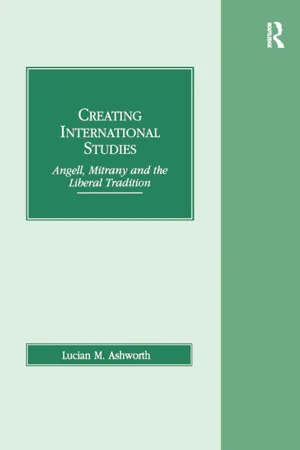
Creating International Studies
Angell, Mitrany and the Liberal Tradition
- 208 pages
- English
- ePUB (mobile friendly)
- Available on iOS & Android
eBook - ePub
About this book
Through a critical evaluation of the works of Norman Angell and David Mitrany, this book explores the liberal roots of the academic discipline of International Relations (IR). Ashworth argues that, far from being the product of timeless realist truths, IR's origins are rooted in liberal attempts to reform international affairs. Norman Angell's work represents the first attempt to develop a comprehensive 'new liberal' approach to the problem of global governance, while David Mitrany's exploration of the problems of international life led him to apply the left-liberal idea of functional government to global governance. Both writers demonstrated the extent to which early twentieth century liberal writers on international affairs had answered the critics of earlier nineteenth century liberal internationalists. The penultimate chapter argues that the realist-idealist 'Great Debate' never happened, and that liberal scholars such as Angell and Mitrany have been unfairly dismissed as 'idealists.' The final chapter evaluates the writings of Angell and Mitrany and claims that the works of both authors can be criticised for theoretical weaknesses common to the liberal paradigm.
Information
1 | Introduction. Liberalism and the Emergence of IR |
References to a tradition of international relations theory are by no means innocent… accounts of a tradition serve to legitimise and circumscribe what counts as proper scholarship
R. B. J. Walker, Inside/Outside:
International Relations as Political Theory
International Relations as Political Theory
Human history becomes more and more a race between education and catastrophe.
H. G. Wells, The Outline of History
At first glance the title of this book may appear misleading and inaccurate to any scholar of International Relations (IR). How, after all, can we talk of creating international studies (or IR. I will be using the terms interchangeably) in the same breath as the liberal tradition when IR has its roots in the works of such pre-liberal masters as Thucydides and Machiavelli? This book is, however, fundamentally a revisionist history. My revisionism is based on two propositions: First, that IR is a twentieth century product of predominantly liberal Enlightenment concerns, and thus the tradition around which the original Anglo-American subject of IR was founded was a largely early twentieth century liberal one. Second, that the so-called realist/‘idealist’ Great Debate never happened – at least not in the way that IR scholars often claimed that it happened – and, thus, realism’s claim to occupy a dominant position in IR because of its success in interpreting events in the 1930’s is deeply flawed.
For many these two propositions may appear obvious, yet the persistence of the myths of an ‘atemporal realism going back to Thucydides’, and of the ‘first Great Debate’ still crop up in mainstream text books with alarming regularity. The first proposition, while revisionist, is not new. Rob Walker, Justin Rosenberg, and others from the more philosophically literate quarters of IR, have already made similar arguments in recent works.1 Yet, it is still revisionist in the sense that the idea that IR owes its existence to a recent twist of the liberal enlightenment project does not garner much support among the IR community in North America, Australia or Europe. The second proposition, however, cuts to the core of IR’s self-image, and more specifically to the self-image of the still dominant (though often intellectually beleaguered) realist paradigm. It is generally accepted that realism came by its domination through a successful refuting of an earlier idealist liberal paradigm. Even amongst opponents of realism, there is usually an acceptance that realism won a Great Debate (see chapter 5 for a discussion of this issue). The implication of this second proposition is that there has never been a proper intellectual refutation of pre-Second World War liberal internationalism within IR, and that consequently their ideas deserve a second look by all those who term themselves either IR theorists or historians of international affairs. This implication ought to become an imperative if, as I argue, liberal internationalism is seen as the founding paradigm of academic IR.
Yet, does not the presence of interest in IR within the works of such pre-Enlightenment writers as Thucydides, Machiavelli and Hobbes immediately invalidate the first proposition? Crucial to my rejoinder to this is the argument that Thucydides, Machiavelli and Hobbes were not predominantly interested in IR at all. In fact, the gleanings from these writers, which are claimed to be examples of IR scholarship, are merely by-products of these writers’ concerns with the proper internal constitution of a polity. This is not to say that they had no interest in inter-polity relations. Just that their interest was confined to what affected their prime concern: the proper form of domestic government.
Thucydides’ work is a long prose tragic poem, built around the theme of the decline of the ethics of moderation in democratic Athens. He spends a crucial part of the beginning of his account denouncing poets, because poetry is apt to distort the truth in the interests of art. This is an important criticism for a Greek, because poetry was regarded as a form of divinely inspired wisdom by the classical Greeks (much as scripture is by most Christians). Thucydides is repairing this fault by writing an account that maintains the heroic stature and moral crises of a poem, but sticks closer to a ‘true’ account and does not ‘distort’ meaning through verse. The discussions, in Thucydides’ account of the moral decline of Athens, of the relations between poleis merely reflects and reinforces Thucydides’ arguments about the sources of dynamism, restraint and corruption within the Athenian polity.2
Similarly, Machiavelli’s discussion of inter-state relations has to be seen as a product of his conception of what a properly virtuous state should look like. Machiavelli is not primarily concerned with things international. The Prince, with its seemingly cynical view of human politics, deals with advice for future creators of states. The seeming amorality of the innovator-prince is just a necessary step in the building of a polity that will, one day, be capable of proper civic virtue. It is interesting to note that Machiavelli, in The Prince, makes a point of condemning the truly evil, personified for Machiavelli by the figure of Agathocles. The importance of a classical-style civic virtue comes out in full force in his Discourses, where yet again discussions of things international are only seen as important when they directly influence the nature of the domestic polity. In sum, Machiavelli has no conception of a separate international realm. Rather, the international is the sum of the polities that make it up, and its importance is restricted to the influence it has on the structure of internal politics.3
The primary interest of Thomas Hobbes was the reformulation of monarchy. This reformulation was a response to the clashes between increasingly absolutist notions of monarchy in the post-renaissance (on the one hand), and the older medieval institutions of Parliament and the rights of subjects (on the other). Hobbes’ insights about human nature are a means towards the end of a justification for monarchy. Indeed, absolutist monarchy was, for Hobbes, a means towards the end of perpetual peace. While Hobbes’ notions of human nature and extra-social conflict inform much of post-Second World War realist thought in IR, his concerns are not with the international sphere, but rather with the proper government of the commonwealth.4
In all three cases, the use of the titbits of interest in the international within Thucydides, Machiavelli and Hobbes amounts to a post-facto scouring of old texts for ancient corroboration for modern ideas. It is as though the realist, like a homeless tramp, had rifled through the garbage of Thucydides, Machiavelli and Hobbes, looking for bits of discarded timber and brick. All the while, the realist has remained oblivious to the three impressive houses (Thucydides’ ethical polis, Machiavelli’s republican civic virtue, and Hobbes’ monarchy), of which the rifled garbage is merely the left-over materials from their construction.
Why does liberal internationalism have a better claim to being the founding paradigm for IR? My argument for this is founded on the opinion that the Enlightenment, beginning in the eighteenth century, had as part of its project of reforming domestic politics a perpetual peace project. This perpetual peace project of the Enlightenment had, as its goal, the extension of the ideas of the liberal Enlightenment beyond the bounds of state into the international sphere. Indeed, it was a proponent of one school of liberal Enlightenment thought, Jeremy Bentham, who originally coined the phrase international, as an aid in the study of a realm that liberals intended to reform out of existence.5 In the late nineteenth and early twentieth century this project became a discipline, whose primary interest was to understand and reform the international sphere. Emerging from popular journalism, the study of history, law and political activism, IR became an academic study in its own right. In contrast to the works of Thucydides, Machiavelli and Hobbes, the early twentieth century IR scholars – Alfred Zimmern, H. N. Brailsford, Norman Angell and David Mitrany – focused their studies of the international sphere on the nature and structure of that sphere, rather than on the international ramifications of the correct form of the domestic sphere. In the next three chapters this point will be discussed in more detail.
Often derided as ‘idealist’ or ‘utopian’, the liberal internationalism that emerged at the end of the nineteenth century had deep roots in the philosophical revolution that has come to be known as the Enlightenment. Far from being ‘idealist’, liberal internationalism at the beginning of the twentieth century was deeply concerned with understanding the world in all its current imperfections. It was, however, fundamentally normative. Indeed, knowledge of the international sphere for the liberal internationalist was not to be sought primarily to improve the techniques of statesmen playing the game of nations (as it was in much of American school realism), but rather the means by which the world could be improved.
It is important here to point out what it is I mean by the Enlightenment. While a recognised period in the intellectual history of the West, it still requires a few words of explanation. Although the roots of the Enlightenment clearly run deep into the soil of Western philosophy, it is the emphasis on movement that distinguishes it from the dominant forms of classic and early modern thought that it replaced. The Enlightenment project was a process that, through the use of reason as a means to reveal truth, would spur on the development of human freedom and progress. It is, as Foucault points out, a search to understand the nature of humanity, the limits imposed on humanity, and the possibilities that exist for transgressing those limits. Definitions of reason, freedom and progress varied from thinker to thinker, for therein lies the diversity of Enlightenment thought, but a common commitment to these values provided a unity that allows us to both capitalise and to use the singular.6 Liberalism, and especially liberal internationalism, is part of the Enlightenment. Liberalism, while interpreting the Enlightenment as a movement for political emancipation, also interpreted freedom as an attribute of the individual. Liberal internationalism hoped to introduce these ideas into the conduct of international affairs.
Up to now I have been carelessly using the title realist to describe a certain group of thinkers in IR, but I have done so without carefully defining what I mean by realist. It is probably important to admit that I have been generalising about what is, after all, a rich a varied paradigm within IR. Perhaps, at the core of realism is the conception that laws of human behaviour are rooted in an unchanging human nature, and consequently realists see the laws of history – of mass human behaviour – as being unchanging. These core ideas, however, are manifest in a number of different ways. There is, however, already a problem with this defining term. That is, that many realists do not agree with it. Indeed, Kenneth Waltz was at pains to argue in his classic Man, the State and War that the concept of human nature was, at best, problematic.7 Here, though, I would counter by claiming that Waltz has not been true to his rejection of the human nature argument. While rejecting explanations based on individual human nature, Waltz goes on to make generalisations about groups (mainly states). For Waltz, therefore, we can generalise about the nature of states, and it is these generalisations that form the core of his view that we have not seen any great change over the centuries in the behaviour of independent political units.8 As a result, it is fairer to say that, while all realists generalise about an atemporal and power-maximising human nature, some (like Waltz) only see this as manifesting itself in group activities. Thus, all realists, implicitly or explicitly, see groups as operating unconsciously under strict laws of history defined by human nature. This leads, in turn, to a second order definition that is more true for later realists in IR, but less so for earlier writers like Carr or Morgenthau. International affairs is often interpreted by realists as being primarily about inter-state relations. States being regarded as the most important social group in the international sphere.
What can be said about realism is, therefore, that there is a belief in a set of natural laws of history, that are in one way or another rooted in human nature. It is part of human nature to want power, therefore politics is about the pursuit of power at the expense of others. Order is maintained, therefore, by a set of arrangements that balance that power.9 The nature and forms of realism will be discussed as part of chapter 5. It is this stress on order, albeit tempered by a second pillar of justice within Hedley Bull’s work,10 that distinguishes realism from liberal internationalism, the latter being concerned with progress through human agency and will. In this respect realism shows its conservative roots. Michael Freeden has defined conservatism as a belief in limiting change to what is organic and natural, and following from this a belief that social order is independent of human will.11 The core of realism seems to copy these concerns. Human nature defines the limits of what can be accomplished in international affairs. Change is possible, but it must be in accord with the realities of the struggle for relative power. Similarly, the atemporal nature of the laws of history, rooted in human nature, means that human will cannot effectively change human society. To be effective change must be an expression of the organic nature of politics, which for the realist boils down to the realities of power. Even E. H. Carr’s conception of realism, despite Carr’s commitment to Marxism, revolves around the idea of a conservative resistance to nonorganic change. Utopianism, in Carr’s political view-point, is fundamentally the manifestation of the conservative’s nightmare: change that ignores the initial conditions of society.
While my intent is to write a revisionist history of the foundation of IR as an academic discipline, my focus is the writings of two liberal internationalist scholars. The first, Norman Angell, has become an aunt sally for many historians of IR, mainly because he was one of the targets of E. H. Carr’s criticism of Utopianism in The Twenty Years’ Crisis. The myth that he claimed, before the First World War, that war was now impossible still seems to hang about his name, despite its ludicrous inaccuracy. The irony is that while Angell is little read today, he wrote a series of international best-sellers in the first part of the twentieth century. Indeed, his classic The Great Illusion was not only a major success in the English speaking world, but was translated into numerous languages (ten alone in the first two years). In fact, it is probably not incorrect to claim that The Great Illusion is the greatest best-seller in the history of books on international affairs.
Angell, aside from his role as publicist for international problems, was also an important advocate of international organisations. He was also one of the first IR scholars to attempt to deal with the causes and consequences of nationalism. To some degree Angell represents the transition between an optimistic and triumphalist nineteenth century liberalism – which had no need for government intervention and international organisation, but had a strong faith in reason – and a more cautious and introspective early twentieth century liberalism (these distinctions will be discussed in chapter 2). The optimistic ‘old’ liberalism, that had been such an influence on the young Angell, had blithely assumed that minimal government control would lead to prosperity for all. The ‘new’ liberalism, that gradually influenced Angell’s writings from the First World War onwards, became the intellectual foundation for the welfare state. Angell’s work will form the subject of chapter 3.
Unlike Angell, who has largely (but not completely) disappeared from serious IR scholarship, David Mitrany still has a place at the IR table. Part of the argument of this book, however, is that Mitrany has also suffered from a general misreading. While Angell diagnosed the problems of early twentieth century international affairs, and advocated international organisation, Mitrany discussed the problems inherent in international organisations as they were currently conceived. He also refocused liberal IR. Mitrany’s thought will be explored in chapter 4. Where Angell was still concerned with the nineteenth century goal of the rule of law, Mitrany shifted towards the issue of need and welfare provision. Both saw change as an inescapable part of the human condition, and both were consequently concerned with the directions in which that change would go. As a result, the writings of both Angell and Mitrany serve normative concerns. These normative concerns found, for both writers, a home in the social democratic reinterpretation of the Enlightenment project, and as a consequence their writings, particularly Mitrany’s, contain within them the seeds of a social democratic alternative to the neo-liberal project that has come to dominate the world around us.
I have chosen Angell and Mitrany as exemplars of the development of liberal internationalism and IR for a number of reasons. I could have decided to explore a whole school of authors involved in the development of liberal IR, but I felt such an approach would give only a cursory understanding of the various authors, while leaving no room for discussing the influences on, and the contexts of, these authors. By concentrating on two I hope to develop a thorough analysis of the thought of both authors, while puting this thought into the context of the particular historical and personal influences that affected their thought.12 Thus, I hope to provide a textual analysis that is sensitive to historical context. I have chosen Angell and Mitrany, not because their thought is necessarily the best or most seminal among the writers of the period, but because of w...
Table of contents
- Cover
- Half Title
- Title Page
- Copyright Page
- Table of Contents
- Preface
- 1 Introduction. Liberalism and the Emergence of IR
- 2 Precursors to Angell and Mitrany: Nineteenth Century Liberal Roads to Peace
- 3 The International Thought of Norman Angell: From the Great Illusion to the Public Mind
- 4 Mitrany and the Emergence of the Functional Approach
- 5 The Inter-War Realist-‘Idealist’ Great Debate. Real or Imagined?
- 6 Angell and Mitrany in Retrospect: Perpetual Peace and the Problems of Reason
- Notes
- Bibliography
- Index
Trusted by 375,005 students
Access to over 1.5 million titles for a fair monthly price.
Study more efficiently using our study tools.
Frequently asked questions
Yes, you can cancel anytime from the Subscription tab in your account settings on the Perlego website. Your subscription will stay active until the end of your current billing period. Learn how to cancel your subscription
No, books cannot be downloaded as external files, such as PDFs, for use outside of Perlego. However, you can download books within the Perlego app for offline reading on mobile or tablet. Learn how to download books offline
Perlego offers two plans: Essential and Complete
- Essential is ideal for learners and professionals who enjoy exploring a wide range of subjects. Access the Essential Library with 800,000+ trusted titles and best-sellers across business, personal growth, and the humanities. Includes unlimited reading time and Standard Read Aloud voice.
- Complete: Perfect for advanced learners and researchers needing full, unrestricted access. Unlock 1.5M+ books across hundreds of subjects, including academic and specialized titles. The Complete Plan also includes advanced features like Premium Read Aloud and Research Assistant.
We are an online textbook subscription service, where you can get access to an entire online library for less than the price of a single book per month. With over 1.5 million books across 990+ topics, we’ve got you covered! Learn about our mission
Look out for the read-aloud symbol on your next book to see if you can listen to it. The read-aloud tool reads text aloud for you, highlighting the text as it is being read. You can pause it, speed it up and slow it down. Learn more about Read Aloud
Yes! You can use the Perlego app on both iOS and Android devices to read anytime, anywhere — even offline. Perfect for commutes or when you’re on the go.
Please note we cannot support devices running on iOS 13 and Android 7 or earlier. Learn more about using the app
Please note we cannot support devices running on iOS 13 and Android 7 or earlier. Learn more about using the app
Yes, you can access Creating International Studies by Lucian M. Ashworth in PDF and/or ePUB format, as well as other popular books in Politics & International Relations & International Relations. We have over 1.5 million books available in our catalogue for you to explore.