- 336 pages
- English
- ePUB (mobile friendly)
- Available on iOS & Android
eBook - ePub
Coaching and Mentoring
About this book
The coaching/mentoring approach is probably the most effective way of helping others to achieve optimum performance in the workplace. Dr MacLennan's book covers the entire subject from basic skills to designing and implementing a tailor-made coaching and mentoring system. He starts by explaining the nature of achievement and the factors that determine it, and then introduces a seven-stage model that will enable managers and supervisors to encourage their people to develop their skills. He examines the problems commonly encountered and shows how to overcome them or, in some cases, turn them to positive account. The book is interactive throughout, using cartoons, humour, self-assessment questions, case studies and illustrations to reinforce the text. A particularly valuable feature is a set of checklists that together summarize the key elements involved. Coaching and Mentoring is, quite simply, a comprehensive manual of the best methods known today of helping people to succeed.
Part I
Foundations
1
INTRODUCING COACHING AND MENTORING
Needs for and benefits of coaching and mentoring
Directing people to ‘Do’ has always produced inferior results compared to inspiring people to want to do. Increasingly we are finding out why. But why makes no profit; how to does. Coaching and mentoring are the ‘how to’.
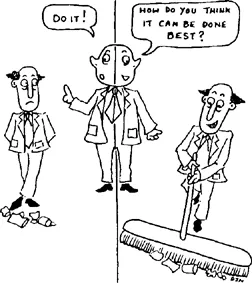
Being told versus being asked
Coaching and mentoring, if provided skilfully, inspire people ‘to want to’. They can provide enormous benefits by satisfying an organization’s needs for:
•Enthusiasm and commitment.
•Productivity and loyalty.
•Flexibility and persistence.
•Responsive crisis management and conscientious crisis prevention.
•Team work and mutual support.
•Creativity and co-operation.
•Managed risk taking and perpetual self-regeneration.
•Staff ownership of problems and responsibility for solutions.
•Adaptability and responsiveness to change.
•Vision and purpose.
•Purposeful, specific and appropriate staff development.
•and so on …
As you go through the material, you will see exactly how coaching and mentoring provide these benefits. But for now, let’s start as we intend to go on by providing a developmental exercise: What benefits do you most need to obtain for your company? What benefits have been missed in the above list?
Definitions and parameters: coaching, self-coaching, mentoring
What is coaching?
Well, it is NOT teaching, instruction or training. The coach does not have to be a relative expert in the field being coached (more on this later). It is not managing. The coach has no responsibility for the performer’s behaviour.

Coaching helps performers unlock their ability
So what is it? A coach is someone available for the performer to learn WITH. Coaching is the process whereby one individual helps another: to unlock their natural ability; to perform, learn and achieve; to increase awareness of the factors which determine performance; to increase their sense of self-responsibility and ownership of their performance; to self-coach; to identify and remove internal barriers to achievement.
EXERCISE
Definitions in every field are dependent on the user, the context and other factors. What is your definition of coaching? Don’t worry that you have not enough knowledge to provide an accurate definition; your definition will evolve with your knowledge base. In fact, making what you recognize to be a naïve definition at this stage will help your motivation to learn more, and give you an indication of how much you need to learn.
The self-coach
Ultra-high performers are typically self-coaches who do all of the above for themselves in any way they can (more on this later). The best performers seem able to self-coach through the most unbelievable adversity. Some analysts even suggest that a history of serious adversity is a prerequisite of outstanding achievement.
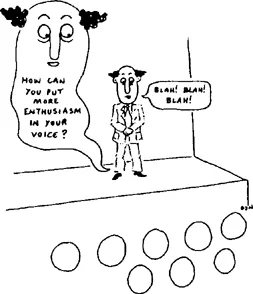
Self-coaching
What is mentoring?
A mentor is someone available for the performer to learn FROM. At least that is the theory. In practice a mentor will be the assigned ‘teacher’ of an individual. There is enormous variation of expectation in the function and behaviour of people bearing the same title – mentor. Some of the roles lead to the following definitions: Mentoring is the process whereby one senior individual is available to a junior –
•To form a non-specified developmental relationship.
•To seek information from.
•To regard as a role model for the purposes of emulation.
•To pick up what the organization/department/company expects.
•To show the performer how the organization works; to ensure cultural compliance.
•To guide the performer through a phase of operational, professional or vocational qualification.
•To provide feedback and appraisal.
•To teach all the relevant facts that will enable the junior individual to perform effectively in an organization.
EXERCISE
What is your definition of mentoring?
The coach–mentor distinction
The two roles are worlds apart and overlapping, depending on which dimension they are compared. In terms of volition, a mentor can be unwitting or even unwilling, but still a successful mentor. How? By a performer choosing a role model at a distance. A coach could never be unwitting, and is unlikely to engage in the process if unwilling.
The roles overlap when a person performs successfully as a coach. He or she is likely to be adopted as a mentor of coaching skills. The reverse is not true. A mentor can never be a coach unless they deliberately adopt the skills involved in successful coaching. Time for honesty. Who were/are your unwitting mentor(s)? Who are/were your ‘witting’ and willing mentors? Who were your favourite coaches? Who were your most effective coaches?
Focus distinction
The coach concentrates on helping the performer learn how to achieve more. The mentor’s aim is to be available for the performer to use as a resource. You will find the answers to the following questions as you go through the book, but generating your own ideas at this stage will give you a clear picture of the process as it unfolds. With what aspects of performance do you think the coach will help? What is the performer most likely to want to learn from the mentor?
Skills distinction
A mentor can fulfil the role quite adequately with basic management, people and training or teaching skills. An effective coach must have the knowledge, technique and skill to help the performer achieve, without directing. As always with definitions, the difference between coaches and mentors is not defined in theory, but in practice. Whatever an organization defines for each role creates the parameters of that role.
Ownership distinction
We will come back to the word ‘ownership’ with irritating frequency. The level of ownership assumed and encouraged in the performer is one of the dimensions on which it is easiest to define the coach–mentor distinction. Coaching assumes more self-responsibility on the part of the performer. Mentoring assumes more performer responsibility than a conventional training course, but not quite as much as a participant-led course.
The coaching continuum diagram below expresses the relationship between level of ownership and the various performance enhancement methods.
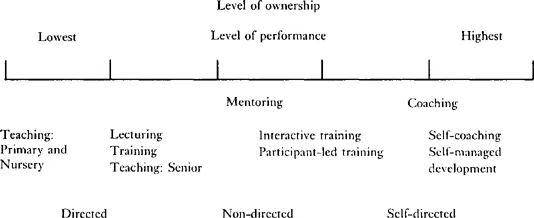
The coaching continuum
Ownership and performance: the connection
The diagram also conveys the level of direction expressed at each level of ownership. Note there is an assumed direct correlation between level of performance, ownership and self-direction in the achiever. How accurate do you think the assumed correlation is? Is it absolute?
On occasion, mentoring can be more performer-centred than coaching but, in general, coaching will be more performer-led and therefore better at facilitating performance enhancement.
Preview and overview of the material
Several assumptions inform this book. Genuine adoption of these assumptions is central to the success of any coaching effort undertaken. The principles of high-level achievement are timeless. But they will only work if practised as actions, as skills, as behaviours. They will not work if merely presented as convincing platitudes. For a company to bring out the best in its staff, it must assume and act on the assumption that its people – its intellectual resources – are its most valuable asset by far. The most powerful force in history is people power. Coaching and mentoring are ...
Table of contents
- Cover
- Half Title
- Title Page
- Copyright Page
- Table of Contents
- Illustrations
- Preface
- Acknowledgements
- Part I Foundations
- Part II The Essentials
- Part III Dealing with Problems
- Appendix: documentation and administration
- References and bibliography
- Index
Trusted by 375,005 students
Access to over 1.5 million titles for a fair monthly price.
Study more efficiently using our study tools.
Frequently asked questions
Yes, you can cancel anytime from the Subscription tab in your account settings on the Perlego website. Your subscription will stay active until the end of your current billing period. Learn how to cancel your subscription
No, books cannot be downloaded as external files, such as PDFs, for use outside of Perlego. However, you can download books within the Perlego app for offline reading on mobile or tablet. Learn how to download books offline
Perlego offers two plans: Essential and Complete
- Essential is ideal for learners and professionals who enjoy exploring a wide range of subjects. Access the Essential Library with 800,000+ trusted titles and best-sellers across business, personal growth, and the humanities. Includes unlimited reading time and Standard Read Aloud voice.
- Complete: Perfect for advanced learners and researchers needing full, unrestricted access. Unlock 1.5M+ books across hundreds of subjects, including academic and specialized titles. The Complete Plan also includes advanced features like Premium Read Aloud and Research Assistant.
We are an online textbook subscription service, where you can get access to an entire online library for less than the price of a single book per month. With over 1.5 million books across 990+ topics, we’ve got you covered! Learn about our mission
Look out for the read-aloud symbol on your next book to see if you can listen to it. The read-aloud tool reads text aloud for you, highlighting the text as it is being read. You can pause it, speed it up and slow it down. Learn more about Read Aloud
Yes! You can use the Perlego app on both iOS and Android devices to read anytime, anywhere — even offline. Perfect for commutes or when you’re on the go.
Please note we cannot support devices running on iOS 13 and Android 7 or earlier. Learn more about using the app
Please note we cannot support devices running on iOS 13 and Android 7 or earlier. Learn more about using the app
Yes, you can access Coaching and Mentoring by Nigel MacLennan in PDF and/or ePUB format, as well as other popular books in Business & Business General. We have over 1.5 million books available in our catalogue for you to explore.