- 326 pages
- English
- ePUB (mobile friendly)
- Available on iOS & Android
eBook - ePub
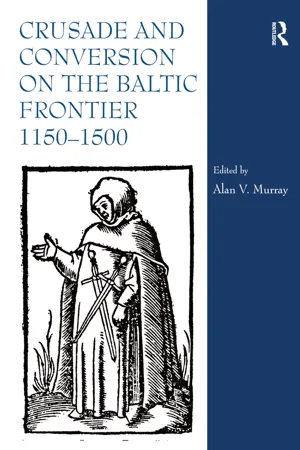
Crusade and Conversion on the Baltic Frontier 1150–1500
About this book
This volume represents a major contribution to the history of the Northern Crusades and the Christianization of the Baltic lands in the Middle Ages, from the beginnings of the Catholic mission to the time of the Reformation. The subjects treated range from discussions of the ideology and practice of crusade and conversion, through studies of the motivation of the crusading countries (Denmark, Sweden and Germany) and the effects of the crusades on the countries of the eastern Baltic coast (Finland, Estonia, Livonia, Prussia and Lithuania), to analyses of the literature and historiography of the crusade. It brings together essays from both established and younger scholars from the western tradition with those from the modern Baltic countries and Russia, and presents in English some of the fruits of the first decade of historical scholarship and dialogue after the collapse of the Iron Curtain. The depth of treatment, diversity of approaches, and accompanying bibliography of publications make this collection a major resource for the teaching of the Baltic Crusades.
Part I
Theory and Practice of the Baltic Crusade
Chapter 1
The Incorporation of the Northern Baltic Lands into the Western Christian World
Tiina Kala
The Character of Incorporation
The incorporation of the northern Baltic lands into the Western Christian world was a long and complex process. It brought about not only the Christianization of the heathen lands and the appearance of new power structures, but also the introduction of a feudal agrarian system, the foundation of towns and technical innovations inter alia. The introduction of this complex of phenomena affected both the territory concerned as well as its population. The former was made to meet the needs of a new lifestyle, and the latter started, gradually, to live according to new rules. Of course, Western institutions were not all established on a tabula rasa. Many of them, for example the feudal agrarian system, administration and law, gradually replaced the former local institutions. Unfortunately there are only some insufficient hints, from both archaeological1 and written data, concerning these former institutions. They are not enough to describe satisfactorily the pre-Christian society of the territory which subsequently began to be called Livonia.2
The formal conversion of local ethnic groups took place for the most part during the first half of the thirteenth century. The new, though still provisional administrative system was also fixed by the 1230s. However, there are several important issues which remain disputable: the actual attitudes of the local peoples towards Christianity, and the relationships between the representatives of the new power, as well as the role of the towns. This is partly due to the scarcity of extant sources produced by the first Christian newcomers, and partly due to the fact that there are no written sources whatsoever produced by the local peoples, not only from the period of Christianization, but, by and large, until the nineteenth century.
Local ethnic groups had no role in the power structures of their native land up to the second half of the nineteenth century. Thus it is very difficult to make any judgement about the actual incorporation of the local peoples into the Christian world in a broader sense. From a purely religious point of view, it is always a matter for discussion to what extent one can consider an agrarian society indisputably Christian, but the peculiarities of the local ethnic situation made the gap between newcomers and converts in the Baltic lands even wider.
The Preconditions for Christianization
There is no simple answer to the question as to what actually motivated the Western Christian world to conquer these lands. There was neither the Holy Sepulchre to be liberated and great treasures to be conquered, nor extraordinarily bloodthirsty tribes to be pacified. There are no sufficient demographic data which would indicate that the conquest of Livonia helped to solve demographic problems of contemporary Germany, as was the case in the conquest of Slavic lands.3 The territories in question were far away, alien and even less heard of than they are nowadays. Of course, religious zeal and an abstract desire for expansion cannot be excluded but there was also practical reasoning to support it.
The ethnic groups encountered by the Christians in the northern Baltic lands were Estonians, Livs and Kurs (Curonians), who spoke Finno-Ugric languages, and Lettgallians, Semgallians and Selonians, who spoke Baltic languages.4 The conquerors originated from Germany and Scandinavia and spoke Germanic languages, which were totally different to those of the natives. Thus, satisfactory verbal communication was almost impossible without a mutual learning of languages. There was never any agrarian colonization from Germany to the northern Baltic lands as there was, for example, to the territories of the Wends or Prussians during the Drang nach Osten. This was at least partly because of the fact that the upper-class newcomers were more interested in the local dependent labour force (which was sufficient) than in a strong free peasantry, The unattractive climate may have also played a role. Thus no assimilation worth mentioning was able to influence the incorporation process.
More convincing conclusions in support of the practical need for Christianization can be gained from an examination of economic relationships. During the twelfth century there was a considerable rise in eastward trade from western Europe.5 One of the most important routes towards Russia in this region was the Düna river (Latv. Daugava, Est. Väina, Russ. Dvina), which flows into the Gulf of Riga. A look at the map shows that it was impossible to sail to the mouth of the Düna if the Osilians and Kurs were determined to prevent it. Both were known for their raids in Scandinavia at least during the eleventh and the twelfth centuries.6 By the beginning of the thirteenth century, their fleets must have corresponded to northern European standards of that period. For the missionaries and crusaders from northern Germany who were sailing eastwards via Denmark and Gotland, Ösel (Est. Saaremaa) and Kurland would have logically been the very first places to conquer and Christianize. In fact, this did not happen. Perhaps it was considered too difficult and dangerous to attack the fleets of Osilians or Kurs directly. During the whole process of conquest and Christianization the most stubborn resistance came from these tribes. So they were gradually forced to surrender after being cut off from the mainland. Ösel and Kurland were the last areas to be formally Christianized, in 1227 and 1230 respectively.7
As far as the pre-Christian power system is concerned, no reliable evidence supports the assumption that some kind of local territorial rulers did not exist.8 On the contrary, several of them (such as Caupo among the Livs and Lembitu among the Estonians) are known by name.9 These rulers must have exercised a certain economic and administrative power over the majority of the population. Otherwise activities such as the construction of strongholds and raids against neighbouring countries would have been impossible. However, the majority of this tribal nobility most probably perished during the fight against the conquerors.10 Thus it is unlikely that there was an integration of the local pre-Christian power system into that of the conquerors.
The Antecedents
There is no reliable evidence as to who the first missionaries in the northern Baltic lands were. They may have arrived both from the west and the east. Nevertheless, it seems quite clear that from the very beginnings of the mission, it was normally not the initiative of a single missionary, but the result of the interest of some prominent ecclesiastical or secular institution or person. The Christianization of Livonia started not from old Christian areas, but from places which had been mission territories themselves not long before, such as the archbishoprics of Hamburg-Bremen, Lund and Uppsala.11 Perhaps this also partly explains their zeal.
According to written evidence, the Christianization of Old Livonia began at the end of the twelfth century. By this time the territories of present-day Estonia, Latvia and Lithuania formed a strip of pagan land between the Western and Eastern Christian worlds, thus constituting a borderland not only between different languages and ethnic groups, but also between different confessions and mentalities. Apart from not being Christian, these territories also lacked the administrative and power structures which would have been up-to-date in the contemporary Christian world,12 and as we have seen, local power structures were most probably limited to the influence of tribal nobility.
A little more is known about the political activities of the local peoples directed both eastwards and westwards. In 1170, Estonians and Kurs attacked Öland, which lay off the south-eastern coast of Sweden. In 1187, 'the eastern pagans' – they are not precisely identified – destroyed Sigtuna in Sweden; in 1203 the province of Blekinge in southern Sweden (then belonging to the Danish crown) was attacked by Estonians.13
In the eleventh and twelfth centuries Christianity was still relatively young in Scandinavia and Russia and the military traditions of pagan times were still alive there. Thus the raids of Christian Russians and Scandinavians can be simply regarded as an expression of their aggressive activities, not part of a crusading plan; they were part of the relationship between the heathens and the neighbouring countries, and cannot be directly connected with the conquest of the thirteenth century.
The first more or less reliably documented attempt to send a missionary to Livonia dates from the 1160s—1170s, when a Cistercian monk, Fulco, from the monastery of Celle in France, was appointed as bishop of Estonia. This happened on the initiative of Eskil, archbishop of Lund, who was a friend of Pope Alexander III (1159-81). Alexander was at that time in exile in southern France and Eskil was not on the best terms with the Danish king, Valdemar I (1157-82).14 So the appointment of Fulco could have been an expression of their mutual political support. At the beginning of the 1170s, Alexander III granted those fighting against the Estonians and other pagans equal indulgencies with those visiting the Holy Sepulchre.15
Although there is no evidence that Fulco ever reached Estonia, a beginning had nevertheless been made. This mission, initiated by a Danish archbishop, is sometimes connected with the conquest of Rügen by the Danes in 1169 and the raid of the pagans to Öland in 1170. In the second third of the twelfth century, Denmark was attacked by the pagan Wends, tribes settled on the southern shores of the Baltic Sea. After becoming king in 1157, Valdemar I seized the initiative together with Absalon, archbishop of Lund, and in 1159-1201 more than twenty campaigns were launched against the Wends.16 By the time of Fulco's appointment the Wends were weakened and it may have been a suitable moment to think about Estonia. Nevertheless, Valdemar's plans in this respect should not be overestimated.
There is evidence of Christian merchants on the River Düna at the beginning of the 1180s.17 The region must have been known to Western merchants earlier, especially in connection with the Russian trade. It would not have been an absolute necessity for the merchants to have this land Christianized, but their need for secure trade coincided with the g...
Table of contents
- Cover
- Half Title
- Title
- Copyright
- Contents
- List of Maps and Tables
- Abbreviations
- Preface
- List of Contributors
- A Note on Names
- Introduction
- Part I Theory and Practice of the Baltic Crusade
- Part II The Crusading Countries of Northern Europe
- Part III The Target Countries
- Part IV Literature and Historiography of the Baltic Crusade
- Crusade and Conversion on the Baltic Frontier 1150-1500: A Bibliography of Publications in English
- Chronology
- Placename Equivalents
- Index
Trusted by 375,005 students
Access to over 1.5 million titles for a fair monthly price.
Study more efficiently using our study tools.
Frequently asked questions
Yes, you can cancel anytime from the Subscription tab in your account settings on the Perlego website. Your subscription will stay active until the end of your current billing period. Learn how to cancel your subscription
No, books cannot be downloaded as external files, such as PDFs, for use outside of Perlego. However, you can download books within the Perlego app for offline reading on mobile or tablet. Learn how to download books offline
Perlego offers two plans: Essential and Complete
- Essential is ideal for learners and professionals who enjoy exploring a wide range of subjects. Access the Essential Library with 800,000+ trusted titles and best-sellers across business, personal growth, and the humanities. Includes unlimited reading time and Standard Read Aloud voice.
- Complete: Perfect for advanced learners and researchers needing full, unrestricted access. Unlock 1.5M+ books across hundreds of subjects, including academic and specialized titles. The Complete Plan also includes advanced features like Premium Read Aloud and Research Assistant.
We are an online textbook subscription service, where you can get access to an entire online library for less than the price of a single book per month. With over 1.5 million books across 990+ topics, we’ve got you covered! Learn about our mission
Look out for the read-aloud symbol on your next book to see if you can listen to it. The read-aloud tool reads text aloud for you, highlighting the text as it is being read. You can pause it, speed it up and slow it down. Learn more about Read Aloud
Yes! You can use the Perlego app on both iOS and Android devices to read anytime, anywhere — even offline. Perfect for commutes or when you’re on the go.
Please note we cannot support devices running on iOS 13 and Android 7 or earlier. Learn more about using the app
Please note we cannot support devices running on iOS 13 and Android 7 or earlier. Learn more about using the app
Yes, you can access Crusade and Conversion on the Baltic Frontier 1150–1500 by Alan V. Murray in PDF and/or ePUB format, as well as other popular books in History & World History. We have over 1.5 million books available in our catalogue for you to explore.