eBook - ePub
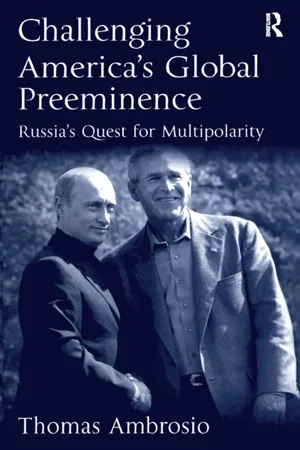
Challenging America's Global Preeminence
Russia's Quest for Multipolarity
- 208 pages
- English
- ePUB (mobile friendly)
- Available on iOS & Android
eBook - ePub
About this book
Examining the shifts in Russian foreign policy and their potential impact on the status and influence of the United States in the international system, this outstanding volume examines why the Kremlin initially sought an alliance with the United States and the internal and external reasons why such a policy was unsustainable. In particular, it looks for an explanation for the post-Cold War vacillations in Russian foreign policy. Russia made several decisions which were perceived domestically as being unacceptable capitulations to American interests. Consequently, a pro-Western foreign policy became incompatible with Russian political culture. The rapprochement following 9/11 was destined to be temporary due to the decision by the Bush administration to invade Iraq. Contributing to the fields of international relations and comparative foreign policy, this study provides a fresh approach to the balance/bandwagon issue and takes into account the global repercussions of the recent war in Iraq. It will be of particular value to specialists in Russian foreign policy, international relations theory, and US foreign policy.
Information
Chapter 1
Russian Foreign Policy in the Post-Cold War Era
There is a Multipolar World on the Horizon.—Yevgeny Primakov1
No country has been more deeply affected by the end of the Cold War than Russia. Radical changes in the Soviet Union’s foreign and domestic policies undertaken by Mikhail Gorbachev in large part led to the collapse of the Soviet state and the emergence of an independent Russia shorn of its outer (Eastern Europe) and inner (former USSR) empires. The legitimizing principles which guided Moscow since the 1917 communist takeover evaporated with little to put in its place. Like its domestic political system, Russia’s ‘grand strategy’ in the international arena required radical adjustment: no longer would the ideological conflict between communism and capitalism serve as the guiding principle of Moscow’s foreign policy.
Russia’s triple transition at the domestic level—social/cultural, economic, and political—has occupied much of the scholarly attention devoted to this country, often to the detriment of investigating Russia’s transition at the international level.2 However, Russian foreign policy in the post-Cold War period is extremely important because of the country’s strategic location at the heart of Eurasia, its history of expansionism and great power aspirations, and its thousands of nuclear weapons. How Russia interacts with the other great powers will help determine the structure of the post-Cold War international system.
Moscow had a number of options open to it as it attempted to define its grand strategy.3 Would Russia join the hegemonic coalition surrounding the United States and further reinforce American unipolarity (bandwagon)? Would Moscow attempt to form an anti-hegemonic coalition and challenge US primacy (balance) or attempt to surmount structural anarchy through international institutions (transcend)? Or, finally, would Moscow retreat into isolationism, content to dominate the former Soviet republics in a new version of the Monroe Doctrine, but largely avoiding great power diplomacy (hide)?
Over a decade has passed since the Soviet Union dissolved and two patterns have emerged out of Russia’s post-Cold War foreign policy. The first is a strange mix of rhetoric, which identifies the importance of cooperation with the United States, and even stronger policy statements, which stress the need to resist American hegemony and promote global multipolarity.
Multipolarity, in this context, is not directly confrontational. It does not call for a new Cold War with the United States or for Russian domination of the international system. Instead, it is inherently defensive in nature: the ultimate aim of multipolarity is to resist American domination of the international system so that Russia is not placed in the role of a junior partner in its relationship with the United States nor would the United States be able to dictate unilateral outcomes which affect Russian security interests. Take, for instance, Russia’s newfound relationship with China and renewed ties to countries Washington has deemed ‘rogue states’ (Iran, Cuba, North Korea, Iraq), challenges to American-backed resolutions in the United Nations Security Council, and a desire to actively block US influence in the southern tier of the former Soviet Union.
The second pattern is a series of dramatic vacillations in Russian foreign policy since 1992. The initial foreign policy strategy of Russian President Boris Yeltsin and Foreign Minister Andrei Kozyrev sought an extremely close relationship with the West and, in particular, America. The Kremlin clearly wanted to make a clean break from decades of confrontation and seemingly sought to bandwagon with the hegemonic coalition. The early optimism during the first year or so of Russian independence was not fulfilled. Rather, the United States and Russia repeatedly found themselves at odds over important international issues such as the war in Bosnia, expansion of the North Atlantic Treaty Organization (NATO), and the America’s penchant for unilateral uses of force. By the mid-1990s, the close partnership offered in 1992 was clearly off the table as the bandwagoner slid into the role of an emerging balancer. This dramatic turn in Russian foreign policy transformed the question from the late 1940s of ‘Who lost China?’ to that of ‘Who lost Russia?’4 From the late 1990s to 2001, Russia continued to openly discuss the need to form a coalition to balance the United States. After the terrorist attacks of 11 September 2001, however, Russia seemingly shifted away from balancing and instead back toward a close relationship with the US. This was called into question by late 2002 with the Bush administration’s plans for the invasion of Iraq. Again, the rhetoric of multipolarity began emanating from Moscow as the perceived dangers of a unilateralist United States precipitated yet another policy shift.
Central Questions
This study will examine Russian foreign policy in the context of its position within the post-Cold War international system. It seeks to explain the following fundamental dilemma: what factor(s) can explain the vacillations in Russian foreign policy evidenced since the collapse of the Soviet Union? In order to answer this question, several additional questions must be raised, each of which deals with how Russian policymakers have defined their country’s foreign policy.
First, how has Russia defined its international grand strategy? There are many definitions of what constitutes a grand strategy.5 Following the lead of Barry Posen and Andrew Ross,6 this volume defines grand strategy as a relatively discrete and coherent argument about a state’s role in the world, which may compete in public discourse with alternate foreign policy visions. Competing grand strategies often disagree on a series of fundamental concepts which shape basic perceptions of the international system, guide the overall boundaries of a state’s foreign policy, and set the limits on available options. In particular, several issues may be in dispute: the identification of specific threats to the security interests of the state in question; the purposes or objectives of the state’s foreign policy; beliefs about the underlying nature of the international system; and the preferred policy and military instruments to achieve the state’s goals. After the collapse of the Soviet Union, Russian policymakers were in an exceptional position to radically redefine their country’s foreign policy assumptions and to promote competing foreign policy visions. Understanding the process by which this occurred, as well as the differing factions amongst the foreign policy elite, will be crucial for explaining changes in Russian foreign policy.
Second, how have Russian policymakers gone about defining both the nature of the international system and Russia’s position within it? This will be a reflection of Russia’s grand strategy, but has important implications for Moscow’s foreign policy. Having recently emerged from the bipolar structure of the Cold War, the developing polar structure of the post-Cold War period has significant implications for defining how Russia interacts with the other great powers. Albeit weakened, Russia remains somewhat of a great power (or, at the very least, a middle power) and is significantly influenced by, and has some measure of influence over, the nature of the international system. Certain polar structures may be more conducive to Russian interests than others. Consequently, understanding the preferences of Russian policymakers in relation to the nature of the international system will be crucial for understanding the emerging pattern of Russian foreign policy.
Thirdly, Russian relations with the United States are critical for defining both its grand strategy and its perceptions of the international system. The United States has emerged from the Cold War as the sole superpower, possessing preeminence in political, military, and economic power. Just as the United States shapes the structure of the post-Cold War international system, Russia’s relationship with the United States helps to define Moscow’s position within that international system (for example, acting within the hegemonic coalition or outside of it) and its range of policy options. Moreover, for nearly fifty years during the Cold War, the USUSSR relationship was the defining characteristic of Soviet foreign policy. It should be no surprise that relations between Moscow and Washington should be prominent in Russia’s attempt to define its post-Soviet foreign policy.
Finally, what are the theoretical implications of the changes in Russian foreign policy? Initially Russia pursued a policy of ‘bandwagoning’ with the United States, only to turn away from this policy and toward one of ‘balancing’. After the September 11th terrorist attacks, Russia appeared to shift again. Even if this policy was not one of fully band wagoning with the US, the rhetoric and policies of balancing were seemingly discarded, only to surface again in the time prior to the American invasion of Iraq. Given these dramatic changes, a careful examination of Russian foreign policy should yield a greater understanding of the balance/bandwagon dichotomy in international relations theory—that is, the propensity of states to align against, or with, a more powerful state. Previous theories of the balance/bandwagon dichotomy, in particular within the post-Cold War context, will both inform and be tested by this study.
The Importance of Russia
Despite continuing problems associated with its transition from the Soviet Union, Russia’s geopolitical position in Eurasia, its relative power vis-à-vis the other successor states to the USSR, and its large number of nuclear weapons make Russia an important player in the world. Moreover, studying Russian foreign policy can yield important insights into the ongoing development of the post-Cold War international system. Russian policymakers were given the opportunity to make a clear break with the past and to develop new paradigms for their post-Soviet grand strategy. Moreover, this process occurred during the transition from one polar structure to another; i.e., from bipolarity to American-dominated unipolarity. Consequently, the Kremlin has been very sensitive to the systemic issues associated with this shift and has served as a bellwether of the relationship between the hegemon (or unipole) and the ‘middle powers’.7
Furthermore, Russian national identity has historically been constructed to promote the state (either in its Tsarist or Soviet forms) as a great power.8 As a result, the nature and scope of Russia’s status in the post-Cold War international system, defined both by the structure of that system and by its relationship with the global superpower, took center stage in its foreign policy debates. How Russia constructed its post-Soviet grand strategy is indicative of how the other great powers have been forced to confront a unique situation: retaining their status and autonomy as great powers in an international system dominated by a preeminent United States.
Argument in Brief
The central argument of this study will be detailed in Chapter 2 and examined in subsequent chapters. Therefore the comments here will be brief.
It will be argued that Russia’s relative support for a policy of promoting global multipolarity (balancing) over continued unipolarity (bandwagoning) is a reflection of two contradictory aspects of the post-Soviet Russian state. The first is deeply connected to Russian national identity: the near simultaneous genesis of the Russian state, empire, and people meant that Russian identity has been inherently connected to its great power status and has promoted the notion that it should play a key role in shaping the geopolitics of the international system. Moreover, the messianic tendencies evidenced during the tsarist period, and later mutated into the promotion of world communism under the Soviets, helped to reinforce the notion that Russia’s place in the international system was that of a great power. With the collapse of the Soviet Union, new paradigms emerged to challenge this idea. However, in the mid-1990s a near consensus emerged with the rise of Yevgeny Primakov as foreign minister and later as prime minister. This returned Russia to the themes of the past and placed great importance on Russia’s great power status. The ‘Primakov Doctrine’, as it came to be known, did not require direct confrontation with the United States, but rather the creation of a more equal relationship between Moscow and Washington. This relationship would ensure that Russian interests and its great power status would be respected, as well as serve as a restraint on American unilateralism.
Conflicting with this notion is the second factor: Russia’s persistent weakness relative to the United States. Although the Soviet Union was able to effectively pursue a policy of balancing during the Cold War, despite also being weaker than its rival, the Russian Federation that emerged in December 1991 is dwarfed by the United States in terms of economics, political stability, military might, and its ability to project power. Despite signals that Russian policymakers have been willing to rethink its military strategy and force-levels to counteract Western (and in particular American) power, Russia’s military troubles and socio-economic turmoil largely precludes such a policy.
It is the interplay between Russian weakness and Russian desires for great power status that has affected Russia’s quest for multipolarity. In the initial post-Cold War period (1992-3), the Yeltsin-Kozyrev foreign policy concept stressed the need for Russia to align itself with the United States. According to this policy, Russia, like post-World War II Japan and Germany before it, should accept that its great power aspirations were discredited by its far-reaching and costly drive to challenge the governance of the international system. Only through a policy of bandwagoning with the US-led hegemonic coalition could Russian interests be secured.
It soon became clear, however, that there was little to no domestic support for such a policy if it meant even the perception of subordinating Russian security concerns to American interests. Instead, a wide range of the Russian foreign policy elite supported a policy of balancing US power and influence. Yeltsin responded by shifting policies and stressing the need for Russia to be taken seriously as a great power. Rather than pursuing a policy of internal balancing, in which Russia would attempt to counteract the US on its own, the Kremlin sought like-minded allies outside the hegemonic coalition to help construct global multipolarity. This policy assumed several forms, including the establishment and strengthening of a sphere of influence within the former Soviet Union, forming an anti-hegemonic alliance with China, improving its relations with countries Washington has deemed ‘rogue’ states (e.g., North Korea, Iran, Cuba, pre-2003 Iraq), and strengthening international institutions such as the United Nations Security Council, on which Russia has a veto.
In the months leading up to the 11 September 2001 attacks in New York and Washington, Russian foreign policy figures began to question whether the construction of multipolarity was a realistic option. Given America’s continued primacy on all indices of power, persistent Russian weakness, and the failure of clear steps toward multipolarity, was it possible that Russia’s policies were counterproductive and doomed to failure? September 11th gave Russian policymakers the opportunity they needed to shift away from multipolarity and back toward support for the United States.
This was short-lived, however. The dispute over American plans to invade Iraq once again called Russia’s international status into question and, noticing the opportunities emerging from the rift between the US and several key European states, Russia chose to align with the anti-invasion camp. In short, Russian foreign policy vacillations in the post-Cold War period can be explained by the Kremlin’s attempt to secure or improve its international status in the face of its own relative weakness. Or, to put it more colloquially, Russian perceptions of how best to ‘punch above its weight class’ have driven Russia’s post-Soviet foreign policy.
In theoretical terms, this study will utilize the case study of Russia to examine the propensity of states to balance against or to bandwagon with a more powerful state. Whether or not states choose alliances on the basis of power differentials (balance-of-power), perceptions of threat (balance-of-threat), opportunities (balance-of-interests), or domestic political needs (balance-of-elites) has played a central role in studies of international relations. Previous approaches to the balance/bandwagon dichotomy, however, have tended to downplay the costs of bandwagoning—the relative costs associated with siding with the stronger state or coalition versus opposing the stronger side or coalition. While this may appear to add little to previous formulations of the decision making process, it includes three...
Table of contents
- Cover
- Half Title
- Title Page
- Copyright Page
- Dedication
- Table of Contents
- List of Figure and Tables
- List of Abbreviations
- Preface
- About the Author
- 1 Russian Foreign Policy in the Post-Cold War Era
- 2 Theoretical Framework: To Balance or Bandwagon?
- 3 Russia Reborn and Contested
- 4 Rejecting the Hegemonic Coalition
- 5 Forming an Anti-Hegemonic Coalition
- 6 Multipolarity through International Institutions
- 7 Russian-American Relations after September 11th
- 8 The Iraq Crisis and the Return to Multipolarity
- 9 Russia, Multipolarity, and the Costs of Bandwagoning
- Bibliography
- Index
Trusted by 375,005 students
Access to over 1.5 million titles for a fair monthly price.
Study more efficiently using our study tools.
Frequently asked questions
Yes, you can cancel anytime from the Subscription tab in your account settings on the Perlego website. Your subscription will stay active until the end of your current billing period. Learn how to cancel your subscription
No, books cannot be downloaded as external files, such as PDFs, for use outside of Perlego. However, you can download books within the Perlego app for offline reading on mobile or tablet. Learn how to download books offline
Perlego offers two plans: Essential and Complete
- Essential is ideal for learners and professionals who enjoy exploring a wide range of subjects. Access the Essential Library with 800,000+ trusted titles and best-sellers across business, personal growth, and the humanities. Includes unlimited reading time and Standard Read Aloud voice.
- Complete: Perfect for advanced learners and researchers needing full, unrestricted access. Unlock 1.5M+ books across hundreds of subjects, including academic and specialized titles. The Complete Plan also includes advanced features like Premium Read Aloud and Research Assistant.
We are an online textbook subscription service, where you can get access to an entire online library for less than the price of a single book per month. With over 1.5 million books across 990+ topics, we’ve got you covered! Learn about our mission
Look out for the read-aloud symbol on your next book to see if you can listen to it. The read-aloud tool reads text aloud for you, highlighting the text as it is being read. You can pause it, speed it up and slow it down. Learn more about Read Aloud
Yes! You can use the Perlego app on both iOS and Android devices to read anytime, anywhere — even offline. Perfect for commutes or when you’re on the go.
Please note we cannot support devices running on iOS 13 and Android 7 or earlier. Learn more about using the app
Please note we cannot support devices running on iOS 13 and Android 7 or earlier. Learn more about using the app
Yes, you can access Challenging America's Global Preeminence by Thomas Ambrosio in PDF and/or ePUB format, as well as other popular books in Politics & International Relations & International Relations. We have over 1.5 million books available in our catalogue for you to explore.