- 282 pages
- English
- ePUB (mobile friendly)
- Available on iOS & Android
eBook - ePub
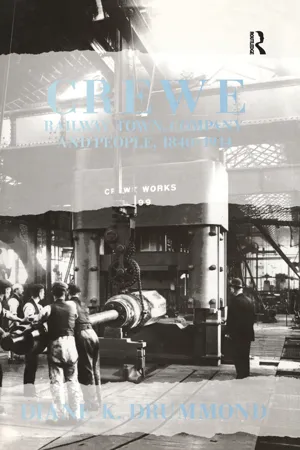
Crewe: Railway Town, Company and People 1840–1914
About this book
This is an important contribution to the new urban history, describing and analysing one of the best examples of a company town in nineteenth-century Europe. This archetypal railway town was built on a green-field site by a railway company in 1842-3. It was a major junction, an administrative centre and an important manufacturing centre. Thus it provides an ideal arena in which to study the relationship between company and people and the effects of this claustrophobic association on emerging economic and social structure and politics in the era of large-scale development and modernisation in Europe and America. Dianne Drummond applies the full range of modern urban-historical approaches in this work. It is a shining example of the ways in which new techniques in research, analysis and comparison can redraw the best-known histories. It will be essential reading for urban historians.
PART ONE
Crewe – Railway Town
CHAPTER ONE
A Railway Town – Growth and Emerging Social Structure
The following chapter examines the origins, physical and demographic growth and social structure of the railway town of Crewe. Much of the material used in this chapter is drawn from a series of 1 in 10 samples of Census Enumerators’ reports for the Crewe area for 1851, 1861 and 1881.1
Railway town – the founding and growth of Crewe
The railway town of Crewe first came into being on 10 March 1843, when some 221 working men and their families had been transferred from the GJR Company’s old works at Edgehill, Liverpool, to the Company’s new works. They formed a novice ‘railway colony’ at the isolated railway junction which was to become Crewe.
The GJR Company had decided to move its locomotive and carriage repair and building workshop to Crewe on 10 June 1840. Existing repair workshops at Edgehill were cramped and situated on the Liverpool – Manchester railway line, some miles away from the GJR Company’s own line. At Crewe, the Company, after its own amalgamation with the Chester-Crewe Railway Company earlier in 1840, owned a large area of land strategically positioned to serve both the existing GJR system, and future projected railway extension2 (Reed, 1982, p. 8).
Crewe, or at least the railway junction which was to become Crewe, therefore developed, as other railway towns, at a ‘… nodal point …’ of routeways, a ‘… natural meeting of the ways …’ as a noted railway historian, O.S. Nock, saw it (Turton, 1969, p. 106 and Nock, 1960, p. 47). However, Crewe was far from being the most natural meeting in the area, and it was only with the events of 1839–40 that Crewe’s future as a railway junction, and therefore eventually as a works site and railway town, was assured.
During the early 1830s, when plans to build a railway (or in fact a number of connecting railways) from Birmingham to join the Liverpool-Manchester railway line were first mooted, a number of different routes were projected. All such routes had to pass through the mid-Cheshire gap, bringing them into the general area where Crewe was to be established. At first, the nearby town of Nantwich was put forward as a point on the projected railway. The Crewe area was only selected after the citizens of Nantwich rejected George Stephenson’s proposals (Chaloner, 1950, p. 19).
Similarly the Chester–Crewe railway, which made Crewe a railway junction when the line was completed in May 1840, was originally planned to join the GJR at Delamere, while the Manchester–Birmingham Railway Board had originally hoped to build a line from Manchester via the Potteries, to meet the GJR at Chebsey to the south of Crewe.
However, bankruptcy on the completion of the first section of the line to Stockport led the Manchester–Birmingham Company to seek aid from the GJR. As a result, they built their line to meet the GJR’s at Crewe. Six days after the Manchester–Birmingham Railway had agreed to this important re-routing of their line, the GJR Company commissioned the famous railway engineer, Joseph Locke, to commence planning the railway works and colony of Crewe.3
Undoubtedly for all the railway companies, centrality and strategic positioning on the railway network was the key factor in determining the siting of the railway works, and therefore railway towns. These companies were the first enterprises that were free to site their workshops without reference to raw material resources, such as iron ore and coal. Possibly, the need to create another resource, a specialist pool of skilled labour, played some small part in the GJR’s decision to re-site the Works in isolation at Crewe. Skilled labour was in short supply, and skilled wages were relatively high during the 1840s, a result of the general growth of the engineering industry during that period (Burgess, 1975, p. 12). If the benefit of gaining a pool of skilled labour was not realized before the establishment of railway towns, it was quickly appreciated soon afterwards. The Manchester–Birmingham Railway Company, which along with the GJR was to become part of the LNWR in 1846, soon realized the advantages in their own railway town of Wolverton. There, the Board reported that: ‘We are beginning to … find … the economic results of the establishment at Wolverton. Not a single person attached to the establishment would be unwilling to perform extra service …’ (Kingsford, 1953, p. 77).
Once the decision to re-site the GJR’s works at Crewe was made, the planning and building of both the Works and colony continued rapidly. Locke’s estimates of the costs of the workshops and cottages were ready for the Board by June. Further land was purchased in July, plans were drawn up and Locke lost no time in commencing the work. Building tenders were agreed upon in April 1841, and by June 1841 machine tools for the Works were being purchased.4
The Works and the colony was finally completed in late August 1842 and, on 10 March 1843, some 221 workmen and their families were transferred to live in the ‘… juvenile city of Crewe …’ (Larkin, 1992, p. 39 and Illustrated London News, III, 23 December 1843, p. 405). At Christmas 1843, a grand tea and ball was held for the Works men and their ‘bonny lasses’. The GJR Company directors did attend, but dined from their workers.
The establishment of the Railway Works had an obvious and immense impact on what was to become Crewe. Before that, the area which consisted of two small townships, Church Coppenhall and Monks Coppenhall, were poor arable areas with a few scattered farmhouses, and a total population of 747 in 1841. With the opening of the Works, the area’s population rose to 2000, with some 1000 men being employed in the Works (see Table 1.1). By 1848, the population of Crewe had expanded to 8000; the population growth rate between the years 1843–48 reaching a level of some 200 per cent.
The national economic depression of the late 1840s had, however, a grave effect on both the Works and the town. Chambers’ Edinburgh Journal of 22 June 1849 records that the number of men employed at the Works had fallen to 500, while the total population equalled only 5066 by 1851. Many of the Company’s houses were, as a result, left unoccupied, and were therefore boarded up.
Economic depression and lack of work further constricted both the number of men employed in the Crewe Works and the size of the general population. This state of affairs continued throughout 1848. In fact, no locomotives were constructed in the Works throughout that year; those which were in the course of construction at the beginning of that year were put into storage. Locomotive production continued slowly throughout 1850 and 1852 (Reed, 1982, pp. 98–9). In 1852, however, there was an upturn in the national economy. The volume of traffic on the Railway Company’s lines began to increase again, and in response, the Company’s Directors began both to re-equip and re-staff the Crewe Works, the number of men employed there again reaching 1150.
The intercensal period of 1851–61 saw a population growth rate of 76 per cent (see Table 1.1). That was less spectacular than the growth that had taken place in the years 1843–51, but, as can be seen from Table 1 in Appendix 1, the rate of increase is nonetheless very high compared with that of other 19th-century towns. By 1861, the population of Crewe was 8801. The significance of the Railway Company in promoting this rapid population growth is indicated by the fact that 59.4 per cent of all Crewe’s household heads were employed by the Company in 1861 (see Table 1.2 on p. 26).
After the spectacular initial growth rates, the greatest rate of Crewe’s growth occurred in 1861–71, the intercensal increase equalling 126 per cent. Undoubtedly, this was the result of the expansion of the Works, itself the effect of the Company directors’ decision to centre all LNWR locomotive construction and repair at Crewe. The Deviation Works and Steel Works were both established during this period. Many men and their families were transferred to Crewe from the LNWR’s old Southern Region locomotive works at Wolverton, and as a result, the number of men employed in the Crewe Works grew from a total of 1150 in 1851 to 3665 in 1871 (as shown in Table 1.1).
Table and Figure 1.1 Crewe: population and employment, 1841–1911
| Year | Population | Decennial population growth | No. of Works men |
|---|---|---|---|
| 1841 | 747 | ||
| 1843 | 2 000 | ||
| 1848 | 8 000 | 1 000 | |
| 1851 | 5 006 | 1 150 | |
| 1861 | 8 801 | +76% | ? |
| 1871 | 19 904 | +126% | 3 665 |
| 1881 | 24 385 | +22.5% | 5 624 |
| 1891 | 32 926 | +35% | 6 225 |
| 1901 | 42 074 | +28% | 7 471 |
| 1911 | 44 960 | +6.8% | 7 183 |
Source: Census Reports of England and Wales, for the appropriate years

By 1872, the Crewe Works was a massive complex based on three separate sites in the town, and employing a large workforce in a number of different industrial processes. The town’s population had grown to 19 904. Population growth rates remained high throughout the century. By 1901, Crewe had a total population of 42 000. However, with the new century, a sharp decline in growth rates occurred. Despite the fact that the intercensal increase equalled 6.8 per cent between 1901 and 1911, a municipal population survey reveals a real loss of population between 1909 and 1911. In the first of these years, 48 350 lived in the town. By 1911 this had fallen to 44 960(Redfern, 1982, p. 6).
This decline in population levels was once again a result of events in the Crewe Works, and an indication of the town’s continued economic dependence on them. From the late 1880s onwards, the overstaffed Works frequently suffered from shortened working weeks and periodic dismissals of large numbers of men. A policy of not employing apprentices once they had completed their time began in the early 1900s and in 1911, after much deliberation, some 500 men were dismissed from the Works.
The physical and spatial development of the railway town
A ‘railway town’ in its creation and its economy, Crewe was no less a railway town in its physical and spatial form. Railway, Works and Company literally ‘shaped’ the town. This was not simply because the GJR Company built the original railway colony, giving it its plain and humble appearance, but, with the small town growing up round the Company’s network of railway lines, station, steam-sheds and workshops, the railway dictated Crewe’s spatial form too. It was as if the new town had been laid over this basic structure of the Company’s ‘grand junction’ of railway lines, railway routes dissecting the settlement bringing the sound, steam and sulphur of locomotives into the streets and homes of the town’s people. In many senses, the railway lines, station, steam-sheds and Works were the real heart of the town. Lines and embankment provided a thoroughfare between the different Company installations, managers and men travelling on the open-sided Crewe cabs that constantly plied the Deviation line. This line ran from the Steel Works end of the Works, passed the Deviation Works and the General Office popularly known as the GO before reaching the Old Works and the Company hospital. In the event of accidents, injured men were carried to the Company’s hospital on Mill Street on the cabs. On pay day, strong boxes containing wages were conveyed to the different sections of the Works. Special platforms had even been built giving access to the line at the bottom of Company officers’ gardens, the Crewe cabs being used to convey honoured guests, including royalty, to the parties held there.
The town’s people of Crewe conducted their lives and day-to-day work in close proximity, even if Works, railway line and town were divided by high brick, often glass-topped, walls. In Crewe, the factory steam gong and the early morning tramp to the Works by thousands of men signalled the start and end of the day. They also marked the quarters of the day, forming a routine not just for the workers and their families, but for all the town folk. The noise and smell of work filled practically every part of Crewe. In fact the streets of the original railway colony were constantly shaken by the drop of the huge steam-hammer that was used in the Works’ forge.
In essence, therefore Crewe was, as a contemporary noted, nothing more than a ‘… mechanical settlement in an agricultural district …’ (Chambers’ Edinburgh Journal, XIII, 22 June 1850, p. 391). The Railway Company created and built the new town, with private contractors only beginning to build there in the 1860s. A description of Crewe in 1849 records that: ‘… The town contains 514 houses, one church, three schools, and one town hall, all belong to the Company’ (Chambers’ Edinburgh Journal, XIII, 22 June 1850, p. 391). Generally these buildings were of a small scale, built in red brick, sometimes rendered, having a neat and ‘very pleasing’, if somewhat plain and monotonous appearance.
The Company’s houses were ‘… of a superior description …’ (Head, 1849, p. 110), imitative of model country cottages and villas, yet still in the shadow of the Works and its chimneys. Company housing provision was also of a very structured form, the various grades of Works’ housing constituting a vision of the hierarchical society that the Company wished to establish in its new town.
The dwelling houses arranged themselves in four classes. First, the villa-style houses of the superior officers; a kind of ornamented Gothic constitutes the house of the next authority; the engineers are domiciled in detac...
Table of contents
- Cover
- Half Title
- Title Page
- Copyright Page
- Dedication
- Table of Contents
- List of tables and figures
- List of plates
- List of abbreviations
- Preface
- Introduction
- Part One Crewe – Railway Town
- Part Two Company and People – At the Works
- Part Three Company and People – Paternalism and Politics in the Town
- Conclusion
- Appendices
- Bibliography
- Index
Frequently asked questions
Yes, you can cancel anytime from the Subscription tab in your account settings on the Perlego website. Your subscription will stay active until the end of your current billing period. Learn how to cancel your subscription
No, books cannot be downloaded as external files, such as PDFs, for use outside of Perlego. However, you can download books within the Perlego app for offline reading on mobile or tablet. Learn how to download books offline
Perlego offers two plans: Essential and Complete
- Essential is ideal for learners and professionals who enjoy exploring a wide range of subjects. Access the Essential Library with 800,000+ trusted titles and best-sellers across business, personal growth, and the humanities. Includes unlimited reading time and Standard Read Aloud voice.
- Complete: Perfect for advanced learners and researchers needing full, unrestricted access. Unlock 1.5M+ books across hundreds of subjects, including academic and specialized titles. The Complete Plan also includes advanced features like Premium Read Aloud and Research Assistant.
We are an online textbook subscription service, where you can get access to an entire online library for less than the price of a single book per month. With over 1.5 million books across 990+ topics, we’ve got you covered! Learn about our mission
Look out for the read-aloud symbol on your next book to see if you can listen to it. The read-aloud tool reads text aloud for you, highlighting the text as it is being read. You can pause it, speed it up and slow it down. Learn more about Read Aloud
Yes! You can use the Perlego app on both iOS and Android devices to read anytime, anywhere — even offline. Perfect for commutes or when you’re on the go.
Please note we cannot support devices running on iOS 13 and Android 7 or earlier. Learn more about using the app
Please note we cannot support devices running on iOS 13 and Android 7 or earlier. Learn more about using the app
Yes, you can access Crewe: Railway Town, Company and People 1840–1914 by Diane K. Drummond in PDF and/or ePUB format, as well as other popular books in History & World History. We have over 1.5 million books available in our catalogue for you to explore.