- 170 pages
- English
- ePUB (mobile friendly)
- Available on iOS & Android
eBook - ePub
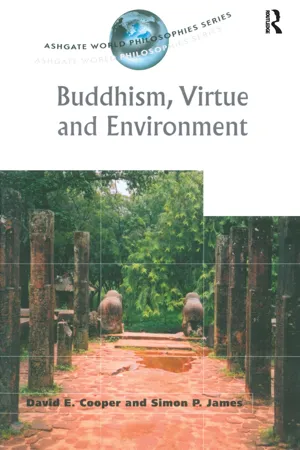
Buddhism, Virtue and Environment
About this book
Buddhism, one increasingly hears, is an 'eco-friendly' religion. It is often said that this is because it promotes an 'ecological' view of things, one stressing the essential unity of human beings and the natural world. Buddhism, Virtue and Environment presents a different view. While agreeing that Buddhism is, in many important respects, in tune with environmental concerns, Cooper and James argue that what makes it 'green' is its view of human life. The true connection between the religion and environmental thought is to be found in Buddhist accounts of the virtues - those traits, such as compassion, equanimity and humility, that characterise the life of a spiritually enlightened individual. Central chapters of this book examine these virtues and their implications for environmental attitudes and practice. Buddhism, Virtue and Environment will be of interest not only to students and teachers of Buddhism and environmental ethics, but to those more generally engaged with moral philosophy. Written in a clear and accessible style, this book presents an original conception of Buddhist environmental thought. The authors also contribute to the wider debate on the place of ethics in Buddhist teachings and practices, and to debates within 'virtue ethics' on the relations between human well-being and environmental concern.
Information
Chapter One
Introduction: Virtue Ethics and Environmental Ethics
Two tendencies
The primary topic of this book is the contribution of Buddhist conceptions of the virtues to environmental attitudes and practice. This is a topic we have been inspired to address by two striking and accelerating tendencies in recent moral philosophy.
The first of these tendencies is the revival of interest in so-called virtue ethics. Although this expression is a contemporary coining, it refers to a style of moral reflection that predominated among Greek and Roman philosophers, was central to medieval Christian ethical discussion, and continued to structure the approach of certain moral philosophers, such as Arthur Schopenhauer. A common perception, however, is that, until a few decades ago, attention to the virtues in modern (seventeenth to twentieth century) philosophy has been slight and, during some periods, almost negligible. For today’s champions of virtue ethics, this neglect is a matter of regret. Myopic attention by professional philosophers to issues of rights and obligations, or to the benefits and harms in which our actions result, has not only elbowed aside a legitimate concern with questions about people’s character and motives. In so doing, it has also closed off avenues of reflection on precisely those moral questions that appeals to rights, obligations, benefits and harms are intended to resolve. (Some milestones in the revival of virtue ethics have been G.E.M. Anscombe (1997), Philippa Foot (1997), and Alasdair MacIntyre (1981).)
The following passage, written by a distinguished scholar and advocate of the ancients’ preoccupation with virtue, eloquently voices the regret felt by some recent philosophers at the relative desuetude into which virtue ethics has fallen in modem times:
For most of the twentieth century there has been no room in conventional moral philosophy for considerations of character and virtue … But they have not gone away … One main reason why twentieth century mainstream moral philosophy has been, until the last decade or so, so barren, and why it has totally failed to engage with other practical concerns, is that it has totally failed to engage with those aspects of commonsense moral thinking which involve virtue and character, and thus has omitted a whole aspect of moral thinking (Annas 1993: 455).
The second tendency that has prompted the topic of this book is peculiar to that branch of moral philosophy known as environmental ethics. This is the frequently expressed conviction that Buddhist thought has a distinctive and important contribution to make to discussion of our proper attitudes towards and treatment of the natural environment. It is to Buddhism, more than to any other major religion, that people inspired by a sense that Eastern thought offers an antidote to an allegedly ‘exploitative’ Western stance towards nature have turned. These days, as a result, one finds many references to ‘green Buddhism’ and ‘ecological Buddhism’.
Some of the literature in which such references are frequent fails, frankly, to rise above ‘New Age’ pieties and rhetoric, its authors seemingly ignorant of certain prima facie difficulties in the way of construing Buddhism as ‘eco-friendly’. (Critics of Buddhism, like Nietzsche and Max Weber, have wondered how a religion focused on enabling people to escape from the world can be much concerned with improving and conserving it.) The emphasis in much of the literature, moreover, has not been on the Buddhist conception of a virtuous life, but upon its general ‘world view’ – in particular, on its alleged vision of the natural world as a single whole of which we humans are integral parts. ‘Buddhism views humanity as an integral part of nature’, asserts one author, ‘so that when nature is defiled, people ultimately suffer’. That is why, he continues, ‘the Buddhist tradition counsels us to treasure and conserve nature, of which humans are an active part’ (Kabilsingh 1996: 147,150).
Other writers, however – aware, perhaps, of the problem of directly linking a general ‘world view’ to more specific environmental attitudes and practices – have looked towards Buddhist conceptions of human virtue in order to identify the religion’s primary contribution to environmental ethics. In the following passage, from the Foreword to a book of essays on Buddhist environmentalism, the author – while mentioning the ‘holistic’ world view – soon emphasizes the Buddhists’ notion of human happiness or well-being, their commitment to certain virtues, and the bearing of these upon attitudes to the natural world:
With its philosophic insight into the … thoroughgoing interdependence of all conditioned things, with its thesis that happiness is to be found through the restraint of desire in a life of contentment…, with its goal of enlightenment through renunciation and contemplation and its ethic of non-injury and boundless loving-kindness for all beings, Buddhism provides all the essential elements for a relationship to the natural world characterized by respect, humility, care and compassion (Bodhi in Sandell 1987: vii).
Passages like the above illustrate, in effect, a suggestion or hypothesis that rather naturally arises when one considers in tandem the two tendencies identified – the revival of virtue ethics and the sense of Buddhism’s vital contribution to environmental ethics. The hypothesis is that Buddhism’s special contribution to environmental ethics is grounded precisely in the form of virtue ethics that it embraces and teaches. It is this hypothesis that the present book explores – in greater detail, we believe, than is to be found in the rather programmatic and promissory statements of the kind illustrated by the passage just cited.
In the remainder of this Introduction, we explain how we are going to understand the nature, scope and limits of both environmental ethics and virtue ethics, and then proceed to a brief overview of the following chapters.
Environmental ethics
In this section we set out what exactly we take environmental ethics to mean. This task is not as straightforward as it might at first seem for there is no universally accepted definition of environmental ethics. Thus one sometimes hears the accusation that some self-proclaimed environmental ethicists are not really environmental ethicists at all since their speculations on, say, the rights of future generations to a healthy environment represent nothing more than extensions of inter-human ethics. Or one sometimes hears the charge that some thinkers labelled environmental ethicists are not really environmental ethicists at all but rather, say, metaphysicians, primarily concerned with the question of what nature is, rather than our moral relations to it.
Since there are several distinct conceptions of what environmental ethics is, we need to specify what exactly we understand by the phrase, and we need to distinguish our understanding from some other conceptions. In a nutshell, we understand environmental ethics as philosophical reflection on how human beings should relate to and act towards non-human life in (more or less) ‘natural’ environments.
This is a wider conception of environmental ethics than some others currently on the market. It is, for instance, more inclusive than views that assume that an environmental ethic is defined as such by virtue of its commitment to the intrinsic value of non-human beings. John Baird Callicott provides an example of one such view:
… how to discover intrinsic value in nature is the defining problem for environmental ethics. For if no intrinsic value can be attributed to nature, then environmental ethics is nothing distinct. If nature, that is, lacks intrinsic value then environmental ethics is but a particular application of human-to-human ethics (Callicott 1995: 2, emphasis in original).
According to Callicott one therefore has two options. Either one values nature for its own sake, and natural beings for their ‘intrinsic value’, the value they have ‘in themselves’; or one values nature not for its own sake, but only for the sake of our interests in using it, as a sink of natural resources, for instance. In the first case, one’s speculations fall within the province of environmental ethics. In the second, they do not.
The question of how intrinsic value should be defined has been hotly debated, not only by environmental ethicists, but by meta-ethicists generally. We do not need to get entangled in these debates here, however. For the moment, we will only point out that although it may indeed turn out that the idea of the intrinsic value of non-human beings must be central to an environmental ethic, at this early stage of our enquiry we see no need to assume that this is the case. Hence, we make no mention of intrinsic value in our broad definition of environmental ethics.
Our conception of environmental ethics is also wider than those accounts which suppose that the discipline represents a ‘paradigm shift’ in ethics, a break from traditional approaches to ethics so radical that an environmental ethic must be considered something quite ‘new’. The classic argument that a genuinely environmental ethic must be something new in this sense was published in 1973 by Richard Sylvan (then known as Richard Routley). The centrepiece of Sylvan’s argument was the following thought experiment. Imagine a people, sometime in the future, who realize that because radiation effects have ruined their reproductive systems they will be the last generation of humans on the planet. In response to this dispiriting realization, they set about ruining the natural environment, tearing down trees, polluting lakes, and eliminating (for the sake of argument, let us assume painlessly) every non-human living thing on earth. They do this, moreover, not for the sheer hell of it, but because, let us suppose, they believe that such actions are necessary in order to survive.
Sylvan maintains that by the lights of traditional Western ethics, these people have done nothing wrong. For, he claims, the dominant Western tradition judges actions as right or wrong only according to whether they affect human beings. And even those minority traditions, such as the ‘stewardship’ tradition, which hold that humans ought to have some concern for how they treat the natural world, only condemn the willful destruction of natural resources. But we can suppose that the last people were not gratuitous vandals but rather acted for what they believed to be the best of reasons. Nevertheless, contends Sylvan, the actions of these last people were clearly wrong, and would be judged to be wrong by a genuinely environmental ethic. Since this conclusion cannot be derived from any of the traditional Western accounts of man’s ethical relation with nature, Sylvan concludes that an environmental ethic must be a radically new sort of ethic, not an extension or modification of a traditional theory (utilitarianism, say, or Kantianism) but an entirely new approach.
We do not intend to appraise Sylvan’s argument here – for our purposes, it is his conclusion that is important. We wish only to note that although it may indeed be the case that environmental ethics must involve a ‘new’ approach to ethical matters in this sense, we will, for the moment, leave such matters open. (Indeed, given our hypothesis that the tradition of virtue ethics has something to contribute to environmental ethics, we find Sylvan’s conclusion prima facie unlikely.)
Thirdly, our conception of environmental ethics is wider than accounts that hold that environmental ethics must be solely concerned with environmental wholes (i.e., ecological systems) and only concerned with individual beings to the extent that they contribute to the good of the whole. The classic statement of such a commitment to ‘holism’ (‘whole-ism’) in environmental ethics was set down in the 1940s by Aldo Leopold in his Sand County Almanac; in recent years his basic position has been defended by several writers, most notably John Baird Callicott.
In his article ‘Animal Liberation: A Triangular Affair’, Callicott (2001) argues that those theories that recognize the moral standing of non-human beings can be divided into two classes. The first class of theory, ‘humane moralisin’, seeks to accord moral standing to all and only those beings that have the capacity to suffer, that is, are sentient. Thus for humane moralists such as Peter Singer, animals should be accorded moral standing on account of the fact that they are sentient beings like us, and hence have interests, most notably an interest in not suffering, that must be taken into account in our ethical reflections. Although he sees such approaches as morally superior to a ‘humanist’ position according to which only humans are granted moral standing, Callicott argues that they are nonetheless an inadequate basis for an environmental ethic. An environmental ethic worthy of the name must instead take a holistic perspective. Specifically, Callicott argues that it must recognize the good of the environment as a whole and accord individual beings value to the extent that they contribute to that good.
The implications of this holistic approach are particularly evident in its account of the moral standing of non-human animals. A humane moralist such as Singer would argue that animals have moral standing simply because they are able to suffer, regardless of the functions they serve in any wider ecological systems. For Singer, one can answer the question of whether a rabbit has moral standing in the absence of any further information regarding the creature’s role in the wider ecological community, its place in food chains, for instance. Callicott, on the other hand, would contend that the moral standing of a rabbit (its value) could not be determined without referring to a wider context of ecological relations. If the rabbit contributes to the good of the biotic community as a whole, by, for instance, supporting populations of rare predators, then it has a positive value. If its species is considered a pest, then it has what might be described as a ‘disvalue’, and efforts to kill it might be not just warranted but even obligatory.
Callicott’s position might be thought to imply that some concerns with the treatment of animals – for example, concerns with the suffering caused them, or with violations of their rights – lie outside the purview of environmental ethics. For, taking a holistic perspective, it would seem that the suffering of animals, for example, is irrelevant to the good of the environmental whole. After all, healthy ecosystems, like all ecosystems, are shot through with the suffering caused by the natural hazards of starvation, disease, parasitism and predation. A world in which the lion lays down with the lamb is nonsense, ecologically speaking.
We do not feel the need to endorse Callicott’s restricted account of environmental ethics at this early stage in our enquiry. Perhaps the best sort of environmental ethic will be holistic in Leopold and Callicott’s sense; but perhaps it will not. And suspending our judgement on this issue, we therefore include issues concerning the humane treatment of animals in our conception of environmental ethics.
So in these respects, our characterization of environmental ethics is wider than some of those currently on the market. (We return to these respects, in a more critical spirit, in Chapters 5 and 6.) But it is narrower than some others. It is, for instance, narrower than conceptions of environmental ethics that do not restrict concern to the living world. We therefore do not intend to address the ethical issues concerning the utilization of the resources of life-bereft planets, for instance. Although these issues are important in their own right (see Hargrove 1986), we rather assume that treatment of inorganic matter is only of moral concern when it impinges on the treatment of life.
Moreover, our conception of environmental ethics is also narrow in the sense that we are primarily concerned with natural rather than unnatural environments. This is not to say that we are concerned only with wild nature. It is only to say that we are not primarily concerned with urban environments and with issues concerning more or less manmade environments, issues concerning the treatment of farm animals, say, or of pets. However, we do not want to impose any definite boundaries here. If there is a line between ‘natural’ and ‘unnatural’ environments it must be a very fuzzy one (is the English countryside manmade or natural?), and we introduce a distinction here, not as a substantive philosophical claim about what makes an environment ‘natural’, but only as a provisional means of restricting the purview of our enquiry.
We will return to the topic of environmental ethics in Chapter 2. It is now time to turn to the matter of virtue ethics.
Virtue ethics
Like the preceding characterization of environmental ethics, the following one of virtue ethics is both fairly lean and fairly liberal. Lean, because further fleshing out and historical illustration is best left to the next chapter; liberal, because we want to avoid any premature straitjacketing of the scope of the book and the begging of contentious questions.
The first thing to say about the expression ‘virtue ethics’ is that it is, in one obvious respect, an unfortunate one. There was a time – our grandparents’, perhaps – when ‘virtue’ was still in everyday use and without any hint of irony. Today, however, it has a distinctly antique ring to it, calling up images of ‘holier than thou’ Victorian moral piety. It would be difficult, in 2004, to convey one’s admiration of a friend by calling him or her ‘virtuous’, for that would suggest to most listeners that the friend subscribed, not without self-congratulation, to such unfashionable values as chastity or abstinence. The traditional antonym of ‘virtue’, ‘vice’, sounds no less dated, except in special contexts where, for example, one speaks of ‘vice rings’ or the ‘vice squad’. People are still described, without irony, as vicious: but the reference, nowadays, is specifically to their spitefulness or readiness to inflict physical harm.
While this is a drawback of the expression ‘virtue ethics’, it is not a serious one. In the mouths of philosophers who use the terms, ‘virtues’ and ‘vices’ refer, as they once did in everyday English, to morally desirable and undesirable traits or dispositions of character – to, for example, courage, honesty, modesty, kindness and their opposites, respectively. Once that is borne is mind, ‘virtue’ and ‘vice’ remain as suitable as any other single words for labelling the aspects of character in question.
Contemporary virtue ethics self-consciously recalls a tradition of Greek and Roman moral thought, in which the primary focus was upon those dispositions of character essential to a good and realized human life. This is so even if some (over) narrow characterizations of virtue ethics, which we will soon encounter, render...
Table of contents
- Cover
- Half Title
- Title Page
- Copyright Page
- Table of Contents
- Acknowledgements
- Abbreviations
- Notes on References and Buddhist Terms
- 1 Introduction: Virtue Ethics and Environmental Ethics
- 2 Virtues and Environment in Western Thought
- 3 Buddhism and Ethics
- 4 Buddhist Virtues
- 5 Buddhism, Virtue and Environment
- 6 Conclusion: the Viability of a Buddhist Environmental Ethic
- Bibliography
- Index
Trusted by 375,005 students
Access to over 1.5 million titles for a fair monthly price.
Study more efficiently using our study tools.
Frequently asked questions
Yes, you can cancel anytime from the Subscription tab in your account settings on the Perlego website. Your subscription will stay active until the end of your current billing period. Learn how to cancel your subscription
No, books cannot be downloaded as external files, such as PDFs, for use outside of Perlego. However, you can download books within the Perlego app for offline reading on mobile or tablet. Learn how to download books offline
Perlego offers two plans: Essential and Complete
- Essential is ideal for learners and professionals who enjoy exploring a wide range of subjects. Access the Essential Library with 800,000+ trusted titles and best-sellers across business, personal growth, and the humanities. Includes unlimited reading time and Standard Read Aloud voice.
- Complete: Perfect for advanced learners and researchers needing full, unrestricted access. Unlock 1.5M+ books across hundreds of subjects, including academic and specialized titles. The Complete Plan also includes advanced features like Premium Read Aloud and Research Assistant.
We are an online textbook subscription service, where you can get access to an entire online library for less than the price of a single book per month. With over 1.5 million books across 990+ topics, we’ve got you covered! Learn about our mission
Look out for the read-aloud symbol on your next book to see if you can listen to it. The read-aloud tool reads text aloud for you, highlighting the text as it is being read. You can pause it, speed it up and slow it down. Learn more about Read Aloud
Yes! You can use the Perlego app on both iOS and Android devices to read anytime, anywhere — even offline. Perfect for commutes or when you’re on the go.
Please note we cannot support devices running on iOS 13 and Android 7 or earlier. Learn more about using the app
Please note we cannot support devices running on iOS 13 and Android 7 or earlier. Learn more about using the app
Yes, you can access Buddhism, Virtue and Environment by David E. Cooper,Simon P. James in PDF and/or ePUB format, as well as other popular books in Theology & Religion & Religion. We have over 1.5 million books available in our catalogue for you to explore.