- 362 pages
- English
- ePUB (mobile friendly)
- Available on iOS & Android
eBook - ePub
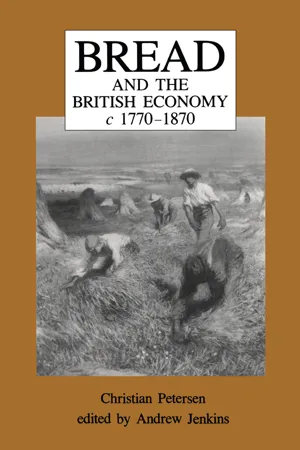
Bread and the British Economy, 1770–1870
About this book
In this ambitious book Christian Petersen has taken a central topic in economic and social history and given it a new sweep and coherence. As the Lord's Prayer suggests, securing an adequate supply of bread was a matter of over-riding concern to everyone until very recently. Bread was always by far the largest single item in the budgets of the poor, but bread could be made from many grains - wheat, rye, barley etc. Christian Petersen describes how in the later eighteenth century the process of replacing other cereals by wheat in bread making was completed throughout Britain. He provides a continuous series of estimates of bread consumption per caput, of bread prices (and, consequently, used in conjunction with population data, of total national expenditure on bread), and of wheat output and net imports. The implications of the changes in techniques of milling and baking that occurred are analysed, and the organisation of the baking and retailing of bread is described. Bread was so central to the economy of individual households and to the national economy as a whole that this book represents a major contribution to the history of the British economy and of British society in the period 1770-1870.
CHAPTER 1
The Bread Question
By 1770, wheat bread had become the chief food of a majority (if only just) of the British people. Over the following century the annual volume of wheat bread consumption increased more than fourfold; its value increased more than fivefold.1 Roughly speaking, about three-quarters of volume growth represented (and permitted) the tripling of the national population during the century, the rest being due to the switch, in certain regions, from other grains and foods to wheat bread. From the 1870s on, thanks to the transformation of worldwide food production and distribution, the mass diet of Britain became more varied; bread gradually lost its singular importance as ‘the staff of life’, becoming one of, and often the mere accompaniment to, many foods. Whatever other, and less prosaic, labels might be attached to it, the century from 1770 to 1870 can be called ‘the age of the wheat loaf’.
Such growth in the bread supply was beyond the imagining of 18th century observers. How it was achieved is discussed in later chapters. But first, the nature and effects of bread dependency will be outlined. The consumer economy of industrializing Britain was dominated, as it had been in the agrarian past, by food and drink, which accounted for perhaps 75 to 80 per cent of all household expenditure (see Appendix 1). In the UK today, a rough equivalent share would be 26 per cent (though there is difficulty in allocating ‘eating out’ expenses).2
Even among the middle classes, expenditure on food was high in relation to income. If seven estimates offered by contributors to The Family Oracle of Health in 1824 are reliable, such families spent between 38 per cent and 60 per cent of all their incomes on food.3 The proportion may have been higher still had allowance been made for the fuel families used in cooking, and for the servants paid to prepare and serve meals.
Among the masses, bread was overwhelmingly the chief food, generally accounting for 40 to 80 per cent or even more of weekly income, according to family circumstances and the prevailing price of the loaf (see Appendix 2). Thomas Ruggles asserted, in 1792, that ‘everybody knows that bread covers at least two-thirds of the expenditure on food’. More than sixty years later, Eliza Acton commented that ‘it is no unusual circumstance for the entire earnings of a poor hard-working man to be expended upon bread only, for himself and family (without their being nourished as they ought to be, even then)’ andEdward Smith recorded that both for indoor and outdoor workers, bread was undoubtedly the principal part of the food of all poor families.4
At national level, the cost of bread was a substantial, and markedly variable, component of GNP. Implicitly, it formed a large part of the costs of agricultural and industrial production, in an economy that was still heavily dependent upon human muscle and dexterity.
Kind
The demand for bread (and for wheat bread particularly) differed from most other demands not only in scale, but in kind. As E P Thompson has observed,5 ‘it is notorious that the demand for corn, or bread, is highly inelastic ...’ And though the consumption of beer was broadly comparable to that of bread, in its scale and normal inelasticity, the price of beer varied little, whereas the price of bread could fluctuate considerably. So that a fluctuating price, combined with high inelasticity, produced sharp swings in the cost of satisfying bread dependency. It was observed that ‘when prices rose labourers might eat the same quantity of bread, but cut out other items in their budgets; they might eat more bread to compensate for the loss of other items.6’ The effect is clearly demonstrated by Dr Richardson’s analysis of the household budgets of Kentish labourers’ families (see Table 1.1).
Table 1.1 Agricultural labourers: distribution of household expenditure on food and drink in Kent, 1793–1838

Source: Richardson thesis p 134; also in Oddy & Miller (eds) p 105.
Conversely, when grain, flour, and bread prices were low, the mass demand for other foods and manufactured goods could increase.Qualitative variation in consumption, though given great importance by Professor Labrousse and his followers in their analysis of ancien regime France, has been comparatively neglected (as Hoskins and Kindleberger have noted7) by historians of the British economy. However, in 1965, A H John argued that low grain prices in England in the first half of the 18th century stimulated the per capita consumption of other foods (including imported tea and sugar) and manufactures,8 thus indicating that consumer expenditure, so far as it can be established, related not so much to a constant ‘shopping list’, but to an expanding or contracting variety of consumables. Thus the notion of a fixed ‘basket of commodities’, though often used in the standard-of-living debate, is a counter-factual. The degree to which consumption expanded or contracted is complicated by other variables, chiefly the purchasing power of the agricultural sector, on the assumption that, if wheat prices were low, farm profits and wages were lower too.9 That variable diminished, however, as the proportion of the population dependent upon agriculture declined. Professor Wrigley’s estimates show the rural agricultural population declining from 60.4 per cent of the total population in 1670 to only 36.3 per cent in 1801.10
Such short run fluctuations apart, however, it seemed axiomatic that, in a primarily agrarian economy, a substantial rise in bread prices, especially if sustained, would cause widespread starvation and death, a point demonstrated by the ‘steeples of mortality’ that followed harvest failures and high prices in much of Europe in 1740, and for instance in Bohemia in 1770 and periodically and regionally in France up to 1854-5.11 That the price of bread (corn) regulated the size, by checking the natural tendency to increase, of a population was central to the scheme of classical economics. Adam Smith acknowledged that the effect on population would be offset if wages rose in step with prices. But given that wages could rise only to a point, beyond which labour would be uneconomic, any sustained increase in bread prices would surely result in the starvation and death of a proportion of the poorest classes. Whereupon the factors of production would return to balance. Malthus’ ‘positive check’ amplified the point, and Ricardo demonstrated that, given the law of diminishing returns, the probability of such a check accelerated as the populatio...
Table of contents
- Cover
- Half Title
- Dedication
- Title Page
- Copyright Page
- Table of Contents
- List of tables
- List of maps
- Foreword
- Introduction
- 1. The Bread Question
- 2. The Wheat Loaf
- 3. Milling and Baking
- 4. The Assize of Bread
- 5. Consumers and Consumption
- 6. Wheat Supply
- 7. Measuring Wheat Consumption
- 8. Value
- Conclusion
- Appendices
- Bibliography
- Index
Trusted by 375,005 students
Access to over 1.5 million titles for a fair monthly price.
Study more efficiently using our study tools.
Frequently asked questions
Yes, you can cancel anytime from the Subscription tab in your account settings on the Perlego website. Your subscription will stay active until the end of your current billing period. Learn how to cancel your subscription
No, books cannot be downloaded as external files, such as PDFs, for use outside of Perlego. However, you can download books within the Perlego app for offline reading on mobile or tablet. Learn how to download books offline
Perlego offers two plans: Essential and Complete
- Essential is ideal for learners and professionals who enjoy exploring a wide range of subjects. Access the Essential Library with 800,000+ trusted titles and best-sellers across business, personal growth, and the humanities. Includes unlimited reading time and Standard Read Aloud voice.
- Complete: Perfect for advanced learners and researchers needing full, unrestricted access. Unlock 1.5M+ books across hundreds of subjects, including academic and specialized titles. The Complete Plan also includes advanced features like Premium Read Aloud and Research Assistant.
We are an online textbook subscription service, where you can get access to an entire online library for less than the price of a single book per month. With over 1.5 million books across 990+ topics, we’ve got you covered! Learn about our mission
Look out for the read-aloud symbol on your next book to see if you can listen to it. The read-aloud tool reads text aloud for you, highlighting the text as it is being read. You can pause it, speed it up and slow it down. Learn more about Read Aloud
Yes! You can use the Perlego app on both iOS and Android devices to read anytime, anywhere — even offline. Perfect for commutes or when you’re on the go.
Please note we cannot support devices running on iOS 13 and Android 7 or earlier. Learn more about using the app
Please note we cannot support devices running on iOS 13 and Android 7 or earlier. Learn more about using the app
Yes, you can access Bread and the British Economy, 1770–1870 by Christian Petersen,Andrew Jenkins in PDF and/or ePUB format, as well as other popular books in History & World History. We have over 1.5 million books available in our catalogue for you to explore.