- 160 pages
- English
- ePUB (mobile friendly)
- Available on iOS & Android
eBook - ePub
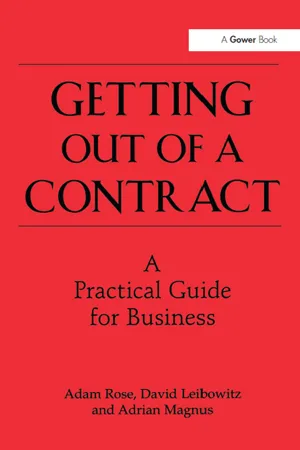
Getting Out of a Contract - A Practical Guide for Business
About this book
This book is written by three commercial lawyers. Their clients often ask them as much for help in getting out of a contract as in getting them into one in the first place. Built around two business case studies, the book highlights the various legal issues that a business must address when faced with a contract it wants to walk away from. In the first instance the business needs to discover whether it is as shackled by a contract as it thinks it is. In many cases a contract is not as binding as it might initially appear - Getting Out of a Contract explains the circumstances in which this applies. It then goes on to explore how to minimize the damage should the agreement be inescapable and helps the reader to understand what the consequences of any actions might be. Written in plain English, the authors manage to demystify complicated aspects of English law for the non-lawyer. This book will help managers to: ¢ address how they make contracts; ¢ avoid making wrong decisions because they fail to appreciate what contracts they actually have or how to get round them; ¢ become more attuned to the legal ins and outs of contracts, enabling them to use lawyers more cost-effectively Company secretaries, finance directors and managers at all levels will find Getting Out of a Contract accessible and an invaluable business planning tool.
1
HOW TO GET OUT OF A CONTRACT
❖
Lawyers are frequently asked to advise on variations of these two questions:
1 Can you help me to negotiate my way into a contract?
2 Can you help me get out of a contract that I am currently in?
The second type of question is posed just as frequently (if not more frequently) than the first. This book will, first, help you to identify whether you are in fact in a contract. We will look at some key relevant terms and laws that might help you to get out of a contract and will conclude with a review of some of the consequences of walking away from your contract should you elect to do so.
In order to help illustrate the legal issues addressed in the book, we will from time to time return to, and work through, two scenarios which are described in this chapter. We have not, simply for the sake of it, used these examples to illustrate every point we make in this book, but we do return to them regularly. We believe that they do, in large part, sum up our clients’ collective experiences, although neither case is meant to reflect any actual experiences of any of our clients, nor is any name used in either case intended to be a reference to any real person or business. The first scenario concerns a supermarket that has contracted to buy baking equipment that it no longer needs or wants. The second scenario concerns a garage that has contracted to maintain a fleet of cars over a period of time. The contract is proving to be unprofitable and the garage now wishes to exit the contract early.
THE BAKERY SCENARIO
Supplier Limited (which, for the sake of brevity, we will refer to as ‘Supplier’) is a supplier of catering equipment. Typical clients include hospitals, schools, restaurants, staff canteens and similar types of places. For this type of client, Supplier is able to provide the full range of catering equipment required, ranging from walk-in freezers down to pots and pans.
Phil is the Managing Director of Supplier. After working for many years in the catering industry, he set up Supplier with the help of a modest bank loan ten years ago. He now has a staff of 25 and a turnover of £6m each year.
Phil has a number of contacts at National Health Service Trusts in his local area. In recent years, Supplier has supplied catering equipment to most of the hospitals, clinics and nursing homes in the local area. Supplier does not manufacture any of the equipment that it sells. Supplies are purchased directly from manufacturers and sold on by Supplier to its customers.
Phil pays his sales staff a basic salary plus commission on sales. The staff are, therefore, encouraged to seek out new business opportunities for Supplier. Over the years, Phil has come to the view that to get the best out of his sales staff, it is important to let them have a relatively free rein.
Jim is a fairly new member of the sales staff. He has only been with the company for 18 months. Jim plays football for a local Sunday league team. Over a beer after one particular match, Jim was introduced to Bill. It was a timely meeting and they found that they had a common business interest. Bill is Facilities Manager for a small supermarket chain (‘Supermarket’) with five local branches.
During discussions, it emerged that Supermarket is looking to start up its own on-site bakery. Currently, Supermarket buys in all bread and cakes. However, the quality is variable. Much of the produce is not as fresh as it could be and the price is too high.
Supermarket is considering a change in strategy. The purchase of sliced bread and packaged cakes will continue. However, in each of its five local stores, Supermarket wants to have the facility to be able to bake a variety of fresh bread and cakes. Hopefully, this will help to keep Supermarket’s customers in the store rather than losing this business to the local bakeries. Jim has some limited knowledge about ovens for industrial use generally, although he has not previously been involved in either the purchase or sale of an oven to be used exclusively for baking purposes. Nevertheless, Jim had managed to impress Bill with some technical jargon and industry knowledge about industrial ovens generally. They agreed to keep in touch.
Jim was excited about the prospect of this potential new source of business. Supplier had never before made any sales to supermarkets. When Jim reported the lead to Phil he was delighted and directed Jim to follow it up.
Supplier purchases ovens from most of the large oven manufacturers, but has a particularly close working relationship with Manufacturer Limited (‘Manufacturer’). Over the years, Supplier has found Manufacturer to be a reliable manufacturer, with competitively priced products. Because of the quantity of business that Supplier places with Manufacturer, Supplier has in the past been able to negotiate favourable discount arrangements with Manufacturer.
Jim contacted Gordon who is his opposite number at Manufacturer. At this stage, the discussions were in fairly general terms. Jim explained that he was looking to buy some baking ovens for sale to a supermarket client. Jim needed to get some idea of the type of oven that would be suitable for supermarket use and the approximate cost.
Gordon reported to Jim that Manufacturer was currently in the process of developing a product (‘Oven 2000’) which he thought might be ideal for supermarket use. Gordon explained that the key features of the ‘Oven 2000’ were:
1 40 shelves (known as ‘grids’)
2 Wheel-in trolleys
3 Over 50 pre-set programmes
4 An easy to use and quick cleaning programme to prevent scaling
5 Sophisticated humidity controller to provide dry heat/steam/combination (as required) – with ability to monitor the inherent moisture content of the food
6 Works off three-phase electricity supply or natural gas
7 Approximate cost £25 000.
The ‘Oven 2000’ was not yet on the market. It was currently undergoing some final testing. However, to try and place some advanced sales, Manufacturer had already produced a sales brochure about the product. Gordon gave a copy to Jim.
Jim had now identified the type of oven which he thought was probably ideally suited to the needs of a small supermarket chain. He arranged a meeting with Bill. Bill explained that matters had moved on since their last discussions. Supermarket was undergoing a re-branding procedure to coincide with the busy Christmas period. Supermarket had already launched a sizeable advertising campaign to bring the re-branding to the attention of the public. Bill explained that just within the last week a decision had been made by the Board to feature fresh bakery products in the campaign. The advertising agency retained by Supermarket had already been instructed to make revisions to their campaign to feature the new fresh bakery produce.
To coincide with the strategy, Bill explained that Supermarket needed baking equipment in each of its five local stores to be up and amning within four weeks (that is, by 10 December). There was now limited time available to do much shopping around. Bill was pleased to learn that Jim had identified an oven that was likely to be suitable for Supermarket’s needs.
In the days that followed, there were a number of discussions concerning purchase of the ovens. Gordon and Jim spoke about the terms of the proposed sale of ovens from Manufacturer to Supplier. Gordon had no direct contact with Supermarket. Jim and Bill spoke about the terms of the sale from Supplier to Supermarket.
The key features of the deal were:
1 Manufacturer would sell five ‘Oven 2000’ ovens to Supplier for £20000 each, less a 10 per cent discount (total of £90 000).
2 Down payment of £50000 by Supplier to Manufacturer on placing order. Balance to be invoiced by Manufacturer to Supplier on delivery.
3 Manufacturer to deliver directly to each of the five supermarkets.
4 Installation would be undertaken by Supermarket locally.
5 Supplier contracted to sell five ‘Oven 2000’ ovens to Supermarket at £25 000 each.
6 Supplier to invoice Supermarket £125000 on delivery.
7 Key personnel at both Supplier and Manufacturer knew that Supermarket needed the ovens in place and up and running by 10 December.
The paperwork in respect of the deal was minimal. Supplier issued a purchase order to Manufacturer with its terms and conditions of purchase on the reverse side. On receipt of the purchase order, Manufacturer issued an invoice to Supplier for £90000. The invoice read ‘£50000 down payment received – balance due on delivery of ovens’. The reverse side of the invoice set out the terms and conditions of sale of Manufacturer.
Supermarket sent a purchase order to Supplier. The order read, ‘For supply of 5 “Oven 2000” @ £25 000 each to be invoiced on delivery. Delivery required by 10 December’. The reverse side of the purchase order set out Supermarket’s terms and conditions of purchase.
On delivery of ovens no. 4 and 5, Supplier submitted an invoice in respect of all five ovens to Supermarket for £125000. The invoice carried Supplier’s standard terms and conditions of sale on the reverse side.
Manufacturer knew that the delivery dates were likely to be tight. The prototype of ‘Oven 2000’ was still undergoing the final stages of testing when the order was placed. The factory workers at Manufacturer’s premises were required to put in a significant amount of overtime in order to complete the order.
The run-up to the Christmas period proved to be highly problematic for all three parties. Manufacturer was working to full capacity on production of the five ovens. Each of the ovens was delivered to the local supermarket branch when it came off the production line.
The first two ovens were delivered prior to 10 December. However, from the moment of installation, there were problems with both ovens. Both were functional in the sense that edible bread and cakes could be baked using the ovens. However, Supermarket was experiencing two practical problems. First, rough and ready manual settings had to be used because the automatic programmes were proving to be unreliable. Second, one of the ovens was scaling up and was proving difficult and time-consuming to clean.
Supermarket made direct contact with Manufacturer in an effort to get the problems resolved and to try to speed up production of the other three ovens.
Supermarket considered that it had no alternative but to continue to bake with the two ovens that had been supplied although the produce was far from the quality expected and the cleaning time between baking sessions was excessive. Oven no. 3 was in working order and was delivered on 10 December.
Ovens no. 4 and 5 were available for delivery on 20 December and were delivered to site. However, there was simply no time to get those bakeries up and running before the New Year period. Staff and management were simply too busy.
In the first week of January, Supermarket management re-grouped to review business over the Christmas period and trading generally. One of the items for consideration was to review how the bakeries had performed. The Regional Director reported that there had been quite serious teething problems with the ‘Oven 2000’ product and that late delivery of ovens 4 and 5 had resulted in two local branches being unable to fulfil promises to customers to provide local bakery produce on site. However, most of the discussions centred upon a review of the in-house bakery strategy generally rather than the more specific problem with the ovens. The evidence suggested that contrary to their initial research, the local Supermarket branches would be unable to compete with the long-established local bakeries. A Board decision was taken to scrap the in-house bakery project.
Bill received a memorandum from the Board with instructions to require the Supplier/Manufacturer to take back all five ovens. The ovens were no longer required. The Supermarket had paid nothing for the ovens as yet and intended to pay nothing for them. Supplier had agreed to invoice Supermarket only after delivery of the ovens. Jim had not been able to negotiate any advanced payment from Supermarket at the time the contract was made. Supermarket was an important new client. Supermarket dictated the terms and would not agree to be invoiced until delivery. Although all ovens have now been delivered, Supplier has not yet received any payment from Supermarket. Bill has made it clear to Jim that Supermarket does not intend to make any payment whatsoever.
Jim consults Phil. Phil is furious that Supplier now finds itself in such an exposed position. He takes control of the position himself and sends a firm letter to Supermarket threatening legal action if £125 000 is not paid within 14 days. The letter states that Supermarket contracted to buy five ovens from Supplier at an agreed price. The ovens have been delivered but no payment has been made.
Bill’s instructions from Head Office are clear. There is no further need for the ovens. They should be collected by the Supplier/Manufacturer and under no circumstances is any payment to be made to the Supplier/Manufacturer.
Bill needs legal advice to find out where Supermarket stands in relation to the demand for payment. He knows that Supermarket has contracted to buy five ovens that it no longer needs or wants.
Phil also needs legal advice. He wants to avoid falling out with Supermarket, but Supplier is coming under pressure from Manufacturer to pay the £40 000 balance of the purchase price that fell due upon delivery. Supplier, remember, is already £50 000 out of pocket having paid a deposit to Manufacturer when it ordered the ovens.
THE GARAGE SCENARIO
George owns and manages a medium-sized garage near the town centre called ‘Rapid Repairs’. The garage has a good selection of new and nearly new Vauxhalls and Fords for sale. It also carries out MOT tests, repairs and services, mainly on Vauxhalls and Fords.
A car rental business called ‘Rent a Car Limited’ has recently opened in the town. Max is the proprietor. George has been trying to persuade Max to buy some of his cars.
George has a good selection of cars and they are competitively priced. Max tells George that he is not looking to add any more cars to his fleet ju...
Table of contents
- Cover
- Half Title
- Title Page
- Copyright Page
- Dedication
- Table of Contents
- Preface
- 1 How to get out of a contract
- 2 Is there a contract?
- 3 Are you a party to the contract?
- 4 What are the key relevant terms?
- 5 Competition law issues
- 6 Termination for breach
- 7 Misrepresentation and waiver
- 8 Remedies for breach of contract
- 9 Negotiating your way out
- 10 Post-termination issues
- Cases in book
- Bibliography
- Index
Trusted by 375,005 students
Access to over 1.5 million titles for a fair monthly price.
Study more efficiently using our study tools.
Frequently asked questions
Yes, you can cancel anytime from the Subscription tab in your account settings on the Perlego website. Your subscription will stay active until the end of your current billing period. Learn how to cancel your subscription
No, books cannot be downloaded as external files, such as PDFs, for use outside of Perlego. However, you can download books within the Perlego app for offline reading on mobile or tablet. Learn how to download books offline
Perlego offers two plans: Essential and Complete
- Essential is ideal for learners and professionals who enjoy exploring a wide range of subjects. Access the Essential Library with 800,000+ trusted titles and best-sellers across business, personal growth, and the humanities. Includes unlimited reading time and Standard Read Aloud voice.
- Complete: Perfect for advanced learners and researchers needing full, unrestricted access. Unlock 1.5M+ books across hundreds of subjects, including academic and specialized titles. The Complete Plan also includes advanced features like Premium Read Aloud and Research Assistant.
We are an online textbook subscription service, where you can get access to an entire online library for less than the price of a single book per month. With over 1.5 million books across 990+ topics, we’ve got you covered! Learn about our mission
Look out for the read-aloud symbol on your next book to see if you can listen to it. The read-aloud tool reads text aloud for you, highlighting the text as it is being read. You can pause it, speed it up and slow it down. Learn more about Read Aloud
Yes! You can use the Perlego app on both iOS and Android devices to read anytime, anywhere — even offline. Perfect for commutes or when you’re on the go.
Please note we cannot support devices running on iOS 13 and Android 7 or earlier. Learn more about using the app
Please note we cannot support devices running on iOS 13 and Android 7 or earlier. Learn more about using the app
Yes, you can access Getting Out of a Contract - A Practical Guide for Business by Adam Rose,David Leibowitz in PDF and/or ePUB format, as well as other popular books in Business & Business General. We have over 1.5 million books available in our catalogue for you to explore.