- 140 pages
- English
- ePUB (mobile friendly)
- Available on iOS & Android
eBook - ePub
About this book
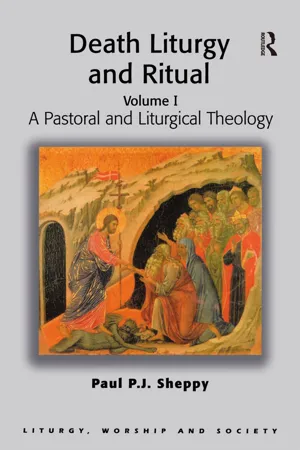
This title was first published in 2003: Death Liturgy and Ritual is a two-volume study of Christian funerary theology and practice, presenting an invaluable account of funeral rites and the central issues involved for compilers and users. Paul Sheppy writes from direct experience of conducting funerals and of drafting liturgical resources for others. In Volume I: A Pastoral and Liturgical Theology, Sheppy argues that the Church ought to construct its theological agenda in dialogue with other fields of study. He proposes a Christian statement about death that finds its basis in the Paschal Mystery, since human death must be explained by reference to Jesus' death, descent to the dead, and resurrection. Using the three phases of van Gennep's theory of rites of passage, the author shows how the Easter triduum may be seen as normative for Christian liturgies of death. The companion volume, Volume II: A Commentary on Liturgical Texts, reviews a wide range of current Christian funeral rites and examines how they reflect both the Church's concern for the death and resurrection of Christ and the contemporary secular demand for funerals which celebrate the life of the deceased.
Information
Topic
Theology & ReligionSubtopic
Christian TheologyCHAPTER 1
Introduction to Volume I
The contemporary milieu and a personal reflection on methodology
At the beginning of the twenty-first century funeral rites in much of the Western world face a crisis. This crisis springs from a variety of factors: the changing nature of belief about death and what (if anything) lies beyond; the change in many places from burial to cremation as the predominant means of disposal; the loss of communal customs and practices in the massive shift to urbanization; and the experience (particularly in Britain) of the twenty-minute “funeral slot” in which the ritual agenda is expected to be completed.1 These constraints are increasingly assumed and those officiating at funerals have to manage the ritual event in circumstances unimaginable to those of previous generations.
Christian liturgists, who inherit traditions shaped by the theologies and social customs of nearly two thousand years, have a number of choices as they attempt to respond to this emerging situation.
A conservative approach would be to change nothing – apart, perhaps, from some modernisation of the language. On such a view, the unchanging truth of Christian faith stands secure in the midst of the maelstrom. In all the uncertainty, the liturgy points safely and unswervingly where it has always pointed.
Change and decay in all around I see,
O Thou, who changest not, abide with me.2
At the other end of the scale we might find an approach to death that abandons traditional Christian theology. Those adopting such a line might argue that Christian theology was predominantly shaped in a pre-modern world. Where it failed to accept the challenges of modernity, it came to be perceived as increasingly irrelevant – even untrue. A fortiori, a similar (but greater) fate awaits any theology that fails to embrace the post-modernist analysis.
It may not surprise the reader to discover that having drawn these two boundaries I want to argue a case somewhere in the middle. In the course of this book I shall try to respond to contemporary understandings of the world, since I share the view that theology has to engage with the same world that we all inhabit and experience. At the same time, I shall not assume that the insights of other disciplines leave no room for theological reflection and critique. As a Christian minister committed to theological and liturgical engagement, I regard the story of Jesus as central (though not exclusive) in God self-disclosure; and as a Christian believer and worshipper, I make best sense of the world through the Christian story of faith. This is not an understanding shared by the majority of people today – nor has it ever been. Yet, in the words of Martin Luther’s great affirmation, “Here I stand, I can do no other”.
From earliest times human beings have marked death by solemn observance in funeral rites. Our contemporary dilemma is that the religious associations with death are less commonly adhered to in the West than they have been in the past. Most mourners attending a funeral will expect the service to provide a summary of the deceased’s life; the Christian officiant, invited to take the funeral, will have an additional – even different – agenda. For the Christian death is not simply a closure, it is a gateway to something new. The Christian does not simply look back; death provides an opportunity for hope. It is a call not simply to review what has happened, it is a call also to anticipate the resurrection.
This book will address death from theological and liturgical perspectives, but will do so on the understanding that theology and liturgy are never isolated activities. Theology is inevitably an exercise within or over against tradition; as such it is an engagement with others as well as with God. Liturgy is equally a communal experience; beyond the texts lies the worship of the Christian community.3 Even the hermit prays in community, for prayer is made in company with the saints of every time and place. Nonetheless, this book is a confessional pilgrimage. I cannot travel alone and yet no one else can make my journey for me – even though they make it with me. I travel to death, and I shall die my death.4
This bipolarity between the communitarian nature of academic debate and personal nature of one’s mortality will be expressed by the device of engaging with the work of colleagues in a variety of disciplines while writing in the first person. We shall need to understand the insights of those who examine death from within the life and social sciences. In hearing what they say, we shall need to ask how their questions and conclusions impinge on the concerns of theology and liturgy. From such discourse, I hope to suggest both a theoretical framework and some practical applications for the funeral liturgist. These proposals will not be in the nature of final conclusions, but will carry a far more provisional character.
In part, this will be because I do not expect to arrive at theological or liturgical statements that will be complete. Beyond me the journey goes on, and I hope simply to participate in a continuing debate.
More importantly, I am mindful that what is axiomatic for the quantum physicist holds true beyond the confines of that discipline. At the subatomic level, matter does not exist with certainty at definite places, but rather shows tendencies to exist. Atomic events do not occur with certainty at definite times and in definite ways, but rather show tendencies to occur. As we investigate the nature of matter, we do not find isolated basic building blocks, but a complicated web of relationships between the various parts of the whole. These relationships always include the observer in an essential way so that the classical ideal of an objective description of nature is no longer valid. In atomic physics we can never speak about nature without speaking at the same time about ourselves.
If we were to recast the last two sentences so as to speak of theology rather than physics, we would perhaps discover the extraordinary challenge confronting us. “The classical ideal of an objective description of God is no longer valid. In theology we can never speak about God without speaking at the same time about ourselves.” This is not to make of theology an exercise in applied psychology any more than it would be to make atomic physics such an activity. Rather, we may find it inappropriate to rely exclusively on the traditional categories of classical Christian theism as though theology were an exercise external to the theologian.
When we turn later to consider the doctrine of the resurrection of the body, we shall need to address questions of continuity and discontinuity. Similarly, throughout this book I shall want to find continuity and discontinuity with the mainstream of Christian tradition and doctrine. How we manage the balance and shift will reveal our ability to live in the changing philosophical framework of our contemporaries who reject the old ways and affirmations. Hear them we must, if we are to converse with them. Converse with them we must, if we are to reach them. Reach them we must, if we are not to abide alone like the seed that bears no harvest (cf. Jn 12.24). At the same time, if after our dialogue we remain convinced by certain theological expressions of faith, we must be content to give our testimony simply and without arrogance – even if it brings us into contention with colleagues from other disciplines (and from our own!).
This book’s principal concern is to show how theological and liturgical studies give meaning and direction to what the Christian Church does when someone dies. Using the methodology of interdisciplinary dialogue, I hope to indicate ways in which liturgists and officiants can remain faithful to the central story of the death and resurrection of Jesus while ministering in the pastoral setting of death and bereavement.
The contemporary shift
For the liturgist who surveys the historical evidence for how death has been marked in the past, there is a variety of sources. Liturgical texts provide an indication of the Church’s official practices. Diaries (especially those of parish clergy) show how local variations meet specific instances of death. Public records (including, of course, newspaper reports and in more recent times film and video) add an extra-ecclesiastical dimension. To this last category we may with some caution add that of literature. Novelists, playwrights and poets may for their own purposes exaggerate what they describe, but they work within the context of their own social experience and for that reason provide another commentary which fills out the general picture.
The history of the Western observance of death as we glean it from the public (as opposed to church) record indicates that until comparatively recently, religious (and in particular Christian) practice has predominated. In Europe, with its tradition of state churches, this will not unduly surprise us. In North America, despite the formal separation of church and state, we may imagine that the early European immigrant-settlers brought the practices to which they were accustomed from the societies they were leaving.
Yet by the time of the American War of Independence and the emergence from colonial status, there were other social changes afoot. In Europe the Enlightenment formalised and made respectable scepticism about and opposition to the claims of religion and the Church’s easy assumption of political power and overwhelming intellectual control underwritten by spiritual authority. The Industrial Revolution brought with it huge shifts of population from small rural communities where everyone knew everyone else to huge conurbations of relative personal anonymity. The urban parish priest could no longer expect to know every member of his parish, and could no longer control church attendance in the manner of the country parson.
That anonymity and loss of first-hand pastoral contact had huge implications for the conduct of funerals. The service books assumed a local setting in which the priest, the deceased and the mourners were known to one another. The opening rubrics of the funeral service in the 1662 Book of Common Prayer run as follows:
Here is to be noted, that the Office ensuing is not to be used for any that die unbaptized, or excommunicate, or have laid violent hands upon themselves.The Priest and Clerks meeting the Corpse at the entrance of the church-yard, and going before it, either into the Church, or towards the Grave, shall say, or sing …
In the urban context with its mobile population the priest still might easily be able to ascertain whether the deceased had committed suicide. However, he might have had rather more difficulty knowing beyond the simple questioning of the mourners whether the deceased had been baptised or excommunicated. The shift from rural and pastoral intimacy to urban and industrial anonymity had vast implications. It is not difficult to see how the complaint, so regularly made in our own time, that funerals are impersonal arises. The busy urban priest who may be asked to conduct a hundred or more funerals a year has little chance of offering the pastoral care which mourners understandably feel to be their right.
In addition, there is an increasing emphasis on personal rights giving rise to an accompanying sense of grievance which, if not met, can only apparently be assuaged by recourse to the legal processes of the courts. The funeral director and the funeral officiant are increasingly seen as purveyors of a professional service with whom the bereaved enter into a contract for the provision of that service. Where mistakes are made, a growing number of mourners are looking for financial redress.
Death and control
Not the least of the changes that has occurred in the management of death has been in the area of control. Death is increasingly understood as involving issues of control. When death comes, it is frequently construed as a failure or inability of doctors to prolong life. When someone dies in hospital (particularly during or after surgery) we want to know why; and the first people we look at are the doctors. Doctors themselves often collude with this reading of events, and in order to ward off criticism or blame use language that avoids suggestions of control. “We lost Mr Smith on the table,” they say. To lose something (or in this case someone) is unfortunate, but all of us from time to time lose something. It is beyond our control, we are not to blame; it just happens.
However, the language of control is not so easily dismissed, especially when it is reinforced by the signs of power and control which we encourage doctors to display: white coats, diplomas on the wall, the consultation which is arranged to the convenience of the clinician rather than that of the patient, the assumption that the hospital is an arena in which there are experts who know and patients who must undergo treatment. All of these indicators propose a competence to which we must submit, and because generally those indicators are justified, we willingly do so. Our co-operation, however, is based on an assumption of care. There is a duty of care, implicit in visiting the doctor, and made explicit when we sign consent forms, which is offended when things go wrong. Often, that offence is not really justified. Those charged with our treatment have done their best, have consulted widely and have exercised diligence and skill. Despite this, the patient dies. On occasion, there have been mistakes that should not have occurred, and at this point lawyers enter and suggest that there should be compensation for what has gone wrong. It is a small step from that understandable reaction to the extreme litigiousness which looks for blame and compensation at every twist and turn. Sometimes, there is nothing to be learned except that death is inevitable. If not at this time, at some time death will come and no doctor or lawyer will stop it.
The excessive preoccupation with control, blame and compensation introduce additional stress in bereavement. Anger is allowed full expression – is even inflated – with consequent difficulties in coming to terms with the finality of death and with the need to move forward. Such a result has implications for the pastoral officiant who may find the preparation of the funeral made considerably more difficult by an all-consuming agenda of “blame and claim” obscuring the Christian proclamation of forgiveness and hope even in death.
The mechanization of death
If the notions of control and blame have implications for the pastoral liturgists, they are not the only shifts in popular attitudes to death that have occurred in recent times. We are right to observe the change in the arena of n...
Table of contents
- Cover
- Half Title
- Title Page
- Copyright Page
- Dedication
- Table of Contents
- Acknowledgements
- 1 Introduction to Volume I
- 2 Ritual Blunder
- 3 Medicine and the Law
- 4 The End of Life
- 5 Death in the Community
- 6 The Human in Christ
- 7 A Passage from Death to Life
- 8 Past and Present
- 9 Conclusion
- Select Bibliography of Non-liturgical Texts
- Index of Scripture Passages
- Index of Names
- General Index
Trusted by 375,005 students
Access to over 1.5 million titles for a fair monthly price.
Study more efficiently using our study tools.
Frequently asked questions
Yes, you can cancel anytime from the Subscription tab in your account settings on the Perlego website. Your subscription will stay active until the end of your current billing period. Learn how to cancel your subscription
No, books cannot be downloaded as external files, such as PDFs, for use outside of Perlego. However, you can download books within the Perlego app for offline reading on mobile or tablet. Learn how to download books offline
Perlego offers two plans: Essential and Complete
- Essential is ideal for learners and professionals who enjoy exploring a wide range of subjects. Access the Essential Library with 800,000+ trusted titles and best-sellers across business, personal growth, and the humanities. Includes unlimited reading time and Standard Read Aloud voice.
- Complete: Perfect for advanced learners and researchers needing full, unrestricted access. Unlock 1.5M+ books across hundreds of subjects, including academic and specialized titles. The Complete Plan also includes advanced features like Premium Read Aloud and Research Assistant.
We are an online textbook subscription service, where you can get access to an entire online library for less than the price of a single book per month. With over 1.5 million books across 990+ topics, we’ve got you covered! Learn about our mission
Look out for the read-aloud symbol on your next book to see if you can listen to it. The read-aloud tool reads text aloud for you, highlighting the text as it is being read. You can pause it, speed it up and slow it down. Learn more about Read Aloud
Yes! You can use the Perlego app on both iOS and Android devices to read anytime, anywhere — even offline. Perfect for commutes or when you’re on the go.
Please note we cannot support devices running on iOS 13 and Android 7 or earlier. Learn more about using the app
Please note we cannot support devices running on iOS 13 and Android 7 or earlier. Learn more about using the app
Yes, you can access Death Liturgy and Ritual by Paul P.J. Sheppy in PDF and/or ePUB format, as well as other popular books in Theology & Religion & Christian Theology. We have over 1.5 million books available in our catalogue for you to explore.