- 163 pages
- English
- ePUB (mobile friendly)
- Available on iOS & Android
eBook - ePub
About this book
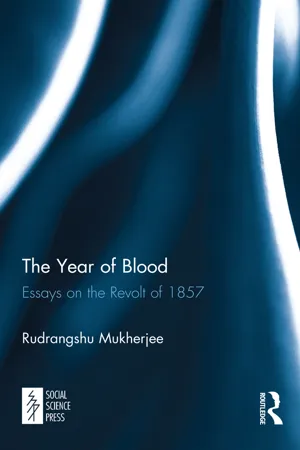
Rudrangshu Mukherjee places the 'soldier-peasant' at the forefront of the Revolt. Violence has rarely been described with so much realism and subtlety. The imaginative use of primary source materials adds clarity to accounts such as the massacre in Satichaura Ghat and the trial of Mangal Pandey. The layers of complexity that defined the relationship between the rulers and the subjugated are also exposed.
Trusted by 375,005 students
Access to over 1.5 million titles for a fair monthly price.
Study more efficiently using our study tools.
Information
MANGAL PANDEY
BRAVE MARTYR OR ACCIDENTAL HERO?
CHAPTER ONE
29 March 1857
It could have been any ordinary Sunday in the cantonment of Barrackpore. The month was march, an odd time in terms of the weather in Bengal. It was nearly the end of spring. It was hot but summer was still a few weeks away. In the early morning and after sunset a cool breeze came in from the river. John Kaye, who in the 19th century wrote a history of 1857 that even today commands magisterial authority, described the peaceful conditions of Barrackpore in very evocative terms:
On the banks of the Hooghly River, sixteen miles from Calcutta by land, is the great military station of Barrackpore. It was the headquarters of the presidency division of the army … There, on the green slopes of the river, stood, in a well-wooded park, the country seat of the governor-general … As the sun declined on the opposite bank, burnishing the stream with gold, and throwing into dark relief the heavy masses of the native boats, the park roads were alive with the equipages of the english residents. There, visitors from Calcutta, escaping for a while from the white glare and the dustladen atmosphere of the metropolis, consorted with the families of the military officers … It was a pleasant, a gay, a hospitable station; and there was not in all India a Cantonment so largely known and frequented by the english.1
The sepoy lines in Barrackpore were quiet during the afternoon of 29 March in 1857. Most of the sepoys were lounging around, and the white officers were in their bungalows enjoying their siesta before preparing to go out with their families to attend evensong. Nobody anticipated that the serenity was about to be disrupted and history about to be made.
In the late afternoon, a sepoy of the 34th Native Infantry, wearing his regimental jacket but in a dhoti instead of the regulation trousers, appeared before the quarter-guard. It was obvious that he was greatly agitated. He had with him a loaded musket and his talwar. He belonged to the 5th Company and his name was Mangal Pandey. He strode around in the quarter-guard, shouting to his comrades. He asked the bugler to sound the assembly and yelled at his comrades to join him: ‘Come out, you bhainchutes, the Europeans are here! Why aren’t you getting ready? It’s for our religion! From biting these cartridges we shall become infidels. Get ready! Turn out, all of you! You have incited me to do this and now you bhainchutes, you will not follow me!’2 This kind of open insolence was not common among sepoys, and a naik quickly carried the report of Mangal Pandey’s disorderly conduct to Sergeant Major James Hewson. The naik, in his report to his white superior officer, added that Mangal Pandey was under the influence of bhang.
In a few minutes, Hewson was dressed and was at the parade ground. He summoned the jemadar of the company and demanded to know why the sepoy had not been arrested. The jemadar explained his helplessness, ‘What can I do?’ he said. ‘The naik has gone to the adjutant. The havildar is gone to the field officer. Am I to take him myself?’3 Hewson ordered him to fall in his guard with loaded weapons. Hewson later recalled that some of the men grumbled and that the jemadar did not insist on the men falling in or loading.4 As the sergeant-major approached Mangal Pandey, the latter took aim and fired. The ball missed Hewson who took shelter behind the bell-of-arms (a bell-shaped building where weapons were stored). A couple of sepoys tried to persuade Mangal Pandey to surrender his weapons. By this time the adjutant, Lieutenant Baugh had arrived on horseback. The incident was now poised to take an even more dramatic turn.
Baugh galloped into the quarter-guard shouting, ‘Where is he? Where is he?’ He was warned by Hewson, ‘To your left! Ride to the right, Sir, for your life. The sepoy will fire at you!’ Mangal Pandey did exactly that and hit Baugh’s horse, which collapsed. Baugh extricated himself, drew one of his pistols from the saddle holster and ran towards Mangal Pandey who was reloading his musket. Baugh fired from around 20 yards and missed. He then drew his sword and rushed towards the sepoy.5 According to Baugh’s recollection, he had proceeded about halfway when Mangal Pandey drew his talwar. Baugh looked back to see where his horse was as he wanted to get his other pistol but the animal had wandered off. He decided to engage the sepoy and he was joined by Hewson, sword in hand.
Hewson’s recollection of the encounter is significant enough to be flagged for later consideration. He remembered:
Mungul Pandy made a cut with a tulwar at me, but did not strike me. He struck the adjutant [Baugh]. The next cut I received myself … At the same time I was knocked down from behind by one or two blows from a sepoy’s musket. I could not recognize the features of the man who struck me; he was regimentally dressed. On rising I advanced again towards. [Pandey] and caught him by the collar of the coat with the left hand. I struck him several times with my sword and received another cut from his tulwar. I was again knocked down from behind.6
Baugh, in his turn, had received a cut on his left hand, which disabled it. He had another deep cut on his neck and a gash on the back of his head from a musket butt. More serious harm to Baugh and Hewson was prevented by Sheikh Paltu, a Muslim sepoy, who held Mangal Pandey by his waist while the British officers escaped from what could have been their deaths. The saviour of Baugh and Hewson released Mangal Pandey only when members of the quarter-guard threatened to shoot him if he did not let go of Mangal Pandey.’7
The commanding officer of the 34th Native Infantry. Steven Wheler, now appeared in the parade-ground. He ordered the jemadar to arrest the defiant sepoy. The jemadar replied, ‘The men won’t go.’ Wheler repeated the order twice and the jemadar told his men to advance. They proceeded a few paces, stopped and refused to go any further. Wheler realized the futility of trying to enforce his order. He later told the court of inquiry:
Someone, a native in undress, mentioned to me that the sepoy in front [was] a Brahmin, and that no one would hurt him. I considered it … a useless sacrifice of life to order a European officer, with the guard, to seize him, as he would no doubt have picked off the European officers, without receiving any assistance from the guard itself. I then left the guard, and reported the matter to the Brigadier.8
By now the news of the commotion in the parade ground had reached Major-General John Hearsey who commanded the Presidency Division. The news was brought to him by a lieutenant whose hands and clothes were partly covered in blood.9 Hearsey called his two sons, who were officers of native infantry regiments, and the three of them left immediately for the parade ground. As they galloped in, they found the parade ground crowded with ‘sepoys in their undress and unarmed’. There were some British officers around, including Brigadier Charles Grant and the station commander, Major Ross, but they seemed unable to deal with the problem. The General asked why the sepoy had not been arrested and he was told that the guard would not take orders. Hearsey rode towards the guard with the words, ‘We’ll see about that.’ Someone warned, ‘His musket is loaded,’ to which Hearsey’s retort was ‘Damn his musket!’ His elder son called out to him, ‘Father, he is taking aim at you.’ General Hearsey’s reply to his son was, ‘If I fall, John. rush upon him and put him to death.’ Hearsey then rode up to the quarter-guard. He pointed his pistol at the jemadar and said, ‘The first man who refuses to march when I give the word is a dead man. Quick march!’ He then went towards Mangal Pandey; the guard followed while his sons covered the jemadar with their pistols. It was now Mangal Pandey’s turn to act. This is what he did, in the words of Hearsey:
It appeared the mutineer had suddenly altered his mind, I suppose seeing there was no chance of escape … He turned the musket muzzle towards his own breast hurriedly, touching the trigger with his toe. The muzzle must have swerved, for the bullet made a deep graze, ripping up the muscles of the chest, shoulder and neck, and he fell prostrate; we were on him at once. The guard calling out—‘He has shot himself.’ A Sikh sepoy of the guard took his bloody tulwar from under him, for in falling he partly covered his sword with his body. His regimental jacket and clothes were on fire and smoking. I bid the jemadar and the sepoy to put the fire out, which they did … Dr Hutchinson being present, it was soon ascertained that the wound, though severe was superficial, and the man was conveyed to the hospital … 10
One could say that as Mangal Pandey left the parade ground for the hospital, he moved away from history into myth. He did not die of his wounds. He was tried. The verdict was a foregone conclusion. He was hanged a few days later, on 8 April. His actions created a name for the mutinous sepoys of 1857: the British officers called them Pandies.
One incident on a fateful Sunday in March. Was it linked to what was to happen in north India in the summer of the same year? Who was Mangal Pandey and why did he act the way he did? What were the cartridges that he had spoken about? Why did he say he was acting for ‘our religion’? These are some of the questions that the rest of the chapters look at.
NOTES
This was first published by penguin Books (India, 2005).
1 J.W. Kaye, History of the Sepoy War 1857–58, i. 494.
2 Testimony of Sheikh Paltu quoted in G.W. Forrest, Selections from the Letters, Despatches and other State Papers Preserved in the Military Department of the Government of India, 1857–58, 4 vols, i, 124 (henceforth, Selections).
3 Selections, i, 117.
4 Ibid.
5 Selections, i, 117–18, 121 and 130.
6 Selections, i, 118–19.
7 Ibid.
8 Selections. i, 147–48.
9 C. Hibbert, The Great Mutiny: India, 1857, 68.
10 Selections, i, 109–12.
CHAPTER TWO
Life of a Sepoy
Even one hundred and forty-eight years after the event and after a considerable amount of research on the subject, we have little or no precise knowledge about Mangal Pandey. There is a name and there is an action. There is no record about where he came from. Who were his parents? Was he married? When was he recruited and by whom? Answers to all these questions are unknown and speculative. Mangal Pandey has no curriculum vitae to put up to the board of history. He could have preserved this anonymity, like innumerable other sepoys, had he not shot at his superior officers in Barrackpore. His was an unexpected intrusion into history.
The best that can be done to retrieve Mangal Pandey from obscurity is to place him in a particular context. When the English East India Company began to make a bid for political power in south India and in Bengal in the middle of the 18th century, they began recruiting Indian soldiers to strengthen their own meagre armed forces. The number of recruits began to increase as the British embarked on a career of conquest and empire-building in India in the 19th century. The Bengal Army to which Mangal Pandey belonged can be dated roughly to the post-Plassey period when the British began recruiting in Bengal and Bihar to...
Table of contents
- Cover
- Half Title
- Title Page
- Copyright Page
- Dedication
- Table of Contents
- List of Illustrations
- Introduction: In Pursuit of a Revolt
- The Azimgarh Proclamation and Some Questions on the Revolt of 1857 in the Northwestern Provinces
- ‘Satan Let Loose Upon Earth’: The Kanpur Massacres in India in the Revolt of 1857
- The Sipahi and the Sepoy Mutinies
- Two Intellectual Traditions of the Revolt of 1857: A Study of Popular Resistance
- Responses to 1857 in the Centenary Year
- Mangal Pandey Brave Martyr or Accidental Hero?
- Bibliography
- Index
Frequently asked questions
Yes, you can cancel anytime from the Subscription tab in your account settings on the Perlego website. Your subscription will stay active until the end of your current billing period. Learn how to cancel your subscription
No, books cannot be downloaded as external files, such as PDFs, for use outside of Perlego. However, you can download books within the Perlego app for offline reading on mobile or tablet. Learn how to download books offline
Perlego offers two plans: Essential and Complete
- Essential is ideal for learners and professionals who enjoy exploring a wide range of subjects. Access the Essential Library with 800,000+ trusted titles and best-sellers across business, personal growth, and the humanities. Includes unlimited reading time and Standard Read Aloud voice.
- Complete: Perfect for advanced learners and researchers needing full, unrestricted access. Unlock 1.5M+ books across hundreds of subjects, including academic and specialized titles. The Complete Plan also includes advanced features like Premium Read Aloud and Research Assistant.
We are an online textbook subscription service, where you can get access to an entire online library for less than the price of a single book per month. With over 1.5 million books across 990+ topics, we’ve got you covered! Learn about our mission
Look out for the read-aloud symbol on your next book to see if you can listen to it. The read-aloud tool reads text aloud for you, highlighting the text as it is being read. You can pause it, speed it up and slow it down. Learn more about Read Aloud
Yes! You can use the Perlego app on both iOS and Android devices to read anytime, anywhere — even offline. Perfect for commutes or when you’re on the go.
Please note we cannot support devices running on iOS 13 and Android 7 or earlier. Learn more about using the app
Please note we cannot support devices running on iOS 13 and Android 7 or earlier. Learn more about using the app
Yes, you can access The Year of Blood by Rudrangshu Mukherjee in PDF and/or ePUB format, as well as other popular books in History & Indian & South Asian History. We have over 1.5 million books available in our catalogue for you to explore.