
- 288 pages
- English
- ePUB (mobile friendly)
- Available on iOS & Android
eBook - ePub
About this book
Over the last two decades the importance of Self Managed Learning (SML) has become increasingly recognized. This book shows how it has revolutionized learning in organizations such as Ericsson, PPP Healthcare and Sainsbury's, and how it has contributed to wider organizational change. The book consists of four Parts. Part I places SML against the backdrop of changing global trends and the organizational responses to them. It examines how these have led to the need for people to be more self managing and provides an overview of an SML programme. Part II shows SML programmes in action by presenting case studies from nine very different organizations which have used this approach. Part III looks at SML methods in more depth by concentrating on strategic learning contracts, learning groups and how SML can be supported. Finally, Part IV concludes and looks to the future. Rigorously researched, Self Managed Learning in Action demonstrates that this important approach can be used in a wide variety of contexts and cultures, in the private sector and in the public sector, and for a wide range of staff.
Part I
Setting the Scene
Introduction to Part I
This book focuses on Self Managed Learning. It provides, in Part II, an array of case material and evidence of the success of well-organized Self Managed Learning (SML) programmes. This part introduces the background to SML and the thinking that underpins it.
It’s flattering that many organizations make claims to be doing Self Managed Learning. However, when we investigate such claims we often find that the term ‘self managed learning’ is used as a label for various approaches that do not provide really effective learning. The reasons for this include:-
- the organization has seen the term ‘self managed learning’ used and decides it would be a nice title for some self development activity that it plans to offer;
- the organization reasons that stopping formalized learning activity would save money and effort and so labels what it is doing as ‘providing opportunities for people to manage their own learning’;
- consultants decide to re-label their packaged learning offerings as self managed learning in order to increase sales.
We also come across people who have read about effective SML programmes and try to replicate their success without learning what SML really means. We hope that this text will stimulate people to think about the SML approach but we make no claims that it provides an instant recipe book for running programmes.
In Part I of the book we provide an introduction to the approach so that readers can approach Part II with sufficient background on SML. If you have already read some of our previous writings (for example Cunningham 1999) you might want to dive straight in to Part II – or use Part I as a quick reminder about SML.
Chapter 1 makes a generalized case for thinking along SML lines. Its twin themes are the social and organizational context and the learning issues that underpin SML practice.
Chapter 2 outlines the basic structures of SML programmes. These are explored in more detail in Part III. The main aim in Chapter 2 is to make certain that readers have enough background knowledge about Self Managed Learning to read the chapters in Part II.
Reference Material
References in the text are deliberately biased to our own writings as these show precise links to SML practice and readers can track back if they want to explore specific issues more widely. We have overlapped little with previous writing except in Part I where we need to provide a basis for people to read Part II.
1
Background and introduction
Introduction
Here are some comments from participants on Self Managed Learning (SML) programmes. First from ICL:
- The benefits were enormous’
- ‘It has heightened my self awareness’
- ‘Broke out of my comfort zone’
- ‘Really helped’
- ‘Thinking time’
- ‘Very useful peer network’
- ‘A process and framework to improve my skills’
The second series of quotes are from managers in Cable & Wireless:
- ‘The group encouraged me to try things I wouldn’t have thought of – and they worked’
- ‘It’s highly beneficial to work out goals with objective listeners and get feedback’
- ‘Members of my group accomplished what they set out to achieve – and more’
- ‘SML brings the benefit of candid and confidential opinions’
- ‘Other participants push and motivate you to achieve the impossible’
- ‘SML helped me to prioritize my goals and values, and to check my progress’
- Through SML I came to realize that learning is not tied to attending school’
- ‘Very helpful in teaching me to take charge of my career growth’
- ‘Found it easier to resolve problems’
These statements (from two in-house evaluation studies) show a variety of benefits of Self Managed Learning. Later chapters will explore how these benefits can come about. We hope to show readers that these benefits are not unusual – and that they exceed what can be achieved through other approaches to helping people to learn.
SML has developed over a period of more than twenty years and is now becoming widely used, as the cases studies in Part II will show. Self Managed Learning grew, in part, out of a reaction to the waste and irrelevance of much of the didactic and authoritarian education and training of the 1960s/1970s. As its name suggests, SML has provided people with the wherewithal to take charge of their own learning. It has also provided a basis for connecting individual learning to organizational needs. What the name does not convey is the collective dimension of the approach – the notion that real ‘self managing’ requires collaborative learning and not a wholly individualistic approach. In this respect SML is also a reaction against sloppy, poorly designed self development methods.
Learning and Development – Problems in Organizations
Top managers, HR directors and trainers may be starting to accept the simple truth that people are self managing anyway (though some ‘self manage’ better than others). For instance, people can be sent on courses, and to that extent controlled, but they will choose what they learn. Time and again in evaluation studies it’s evident that this is so. Research going back to the 1950s has shown, for example, that managers may go on a course about being better leaders (more people-oriented, etc.) but within a few weeks they are behaving in exactly the same way as they did before attending the course (see, for example, Fleishman 1953). The reasons for this are various, including personal cynicism, superficial learning and the influence of the person’s boss (‘forget all that fancy nonsense you were told on that course – this is how I want you to manage your staff’).
Often trainers, on finding that training does not work, have redoubled their efforts to control people. In one organization the trainer in charge of presentation skills courses was able to show from his end of course feedback how extremely popular the courses were with attendees. However, evaluations of people’s performance six months after the course showed little change. His solution was to offer top-up courses, advanced courses, etc. The notion that more training might not be the answer never entered his head.
The problem here is not that helping people to learn presentation skills is a bad thing, but that individuals were being sent on the course; it was too generalized to respond to individual needs and it did not fit with people’s personal strategies, for example in their careers. Many organizations have tried to overcome these problems with the use of personal development plans. Here the person is expected to meet annually with their manager to agree a development plan for the coming year, often based on an appraisal or performance review.
Indeed the organization mentioned above had such a process in place. However, as with most organizations, the scheme did not work very well. The personal development plan was usually a superficial, last minute part of the appraisal interview and was often driven by personal weaknesses already identified in the interview. Hence the notion of learning was attached to a need to address one’s deficits and had severe negative overtones.
A final point on appraisals is that, despite attempts to make them more user-friendly, they are more often than not controlled by the appraiser. Hence they are out of keeping with a more self managing/empowering culture.
The Context of Self Managed Learning
We hope to show in later chapters how we have made the SML approach work. The rest of this chapter provides some background material as a basis for those later chapters. It specifically outlines issues under the following headings:
- social and organizational factors that support the use of SML
- learning issues.
We have not attempted to make a comprehensive analysis of all the factors that have influenced our thinking. Rather we have tried to give a few pointers as to why we believe that SML provides what is needed – by individuals and by organizations.
Social and Organizational Factors that Support the use of SML
Part of our thesis is that SML fits both the mood and the needs of the times – and it is based on timeless qualities. Some social historians have argued that many of the social arrangements of the last two centuries are just a temporary aberration brought on by, amongst other things, the Industrial Revolution. Bridges (1995) has taken a specifically critical stance toward our concept of a job, the word used to refer to a task, as in when your plumber says ‘I can’t come today – 1 have another job on.’ Today we take a job to mean a paid position of employment; in effect, aggregating a range of tasks into a package (often defined in a ‘job description’). In the future, Bridges sees tasks as being important but not the notion of a job. Hence he makes an explicit challenge to the future of employment, as we may see less jobs (in the twentieth-century sense) and more emphasis on paying people to carry out tasks.
Some commentators have argued that just to be employed is too risky in a changing world and that people need to be employable. If you take Bridge’s critique seriously then being employable is not sufficient since employment as we know it may reduce severely over the coming years. Even less trenchant critics of ‘the job’, such as Charles Handy (1994), argue that there will be less full-time employment available in the future. What people do need is the ability and the opportunity to work. Such work can be, for instance, on a self employed basis or as part of a partnership. The ability to be able to work in the new world may be related to the ability to self manage.
Put simply, as shown in Figure 1.1, we are moving from a focus on employment and employability to a focus on self managing. This is therefore one obvious link to SML – the process of learning needs to match the needs of the work environment.

Figure 1.1 Work trend
Interestingly the balance of research seems to show that self managing and the move away from ‘jobs’ can have beneficial consequences for individuals. For instance, research at the Institute of Work Psychology at Sheffield University (quoted in The Times, 10 January 1996) shows that workers on short-term contracts tend to be psychologically better adjusted than their colleagues with so-called permanent jobs. Temporary workers were more certain about their future, more satisfied with their jobs and in better psychological health than their ‘permanent’ colleagues in the same line of work.
The idea of ‘self managing’ seems to be becoming ever more appealing to organizations. At the individual level, people are being exhorted to manage their own careers and their own development. On a wider scale, there has been a growing demand for individuals to take on a ‘self employed attitude’ (for example in the RSA’s Tomorrow’s Company project: RSA 1994). Such an attitude could be seen as consonant with the notion of self managing.
Some of these ideas are outcroppings of the 1980s concept of ‘enterprise’ – the idea of people standing on their own feet and looking after themselves, and not being mollycoddled by the organization. However, there are some who wish to avoid the overly individualistic overtones of ideas like the ‘self employed attitude’. One dimension of this is in the growth of self managed teams. Here, in its ideal form, we can see a balance of the individual and the collective. The person manages themselves in the context of collaboration with others to achieve collective goals.
Self managing, in many ways, seems superior to the idea of empowerment. For example, there is little agreement on what ‘empowerment’ means despite its extensive use in the popular management literature. Everyone is, to some extent, self managing and SML mobilizes this natural orientation. The use of self managed teams is becoming more common yet organizations often struggle to facilitate the effective functioning of these teams. A key reason is the continued reliance on training methods that do not allow individuals and teams to ‘self manage’ their own learning. Figure 1.2 shows some connections between self managing teams and SML. The specific ways in which SML meets these principles are discussed more fully in Chapter 2.
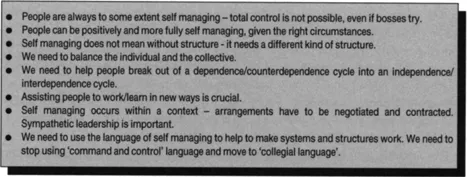
Figure 1.2 Principles common to SML and self managed teams
A World that is Moving toward Self Managing
The term ‘Self Managed Learning’ conveys to most people only the process by which a person goes about learning something. Within this view, it differs from other ways of learning something, most noticeably in that the ‘something’ that is learnt is chosen by the learner. Those who have had experience of Self Managed Learning programmes are likely to recognize another outcome of the process – that participants become self managing learners. That is to say, there has been another level of learning. By going through the SML process they have learnt not only those things they chose to learn but also a lot about learning.
When there is something they need to learn in the future, they will no longer have to rely on training departments or their managers to provide a course or workshop; they will be able to take the initiative themselves and go about their learning in an active, systematic and effective manner. This is of great benefit to anyone. It is especially valuable today when the explicit or implicit messages coming from organizations are that people need to look after their own careers, their own development, and to do so in an ever-changing context where there always seems to be something new to be learnt. In some cases organizations are simply abdicating their responsibility to those who work for them; in other cases, organizations are at a loss to know how to enable people to keep up with the changes, and the consequent need to learn new things. Either way, those who are able to manage their own learning are at an advantage.
The ‘self managing’ theme is also being sounded in those organizations that have cut management layers while changing over to team working. In some cases, the brave new world of self managing work teams is heralded with a rhetorical flourish as a strategic decision. In others, it is the inevitable result of there being too few managers to go round. In both cases, the working experience is very d...
Table of contents
- Cover
- Half Title
- Title
- Copyright
- Contents
- Preface
- Acknowledgements
- Part I Setting the Scene
- Part II Putting it into Practice
- Part III Making Self Managed Learning Work
- Part IV Conclusions
- References
- Index
Trusted by 375,005 students
Access to over 1.5 million titles for a fair monthly price.
Study more efficiently using our study tools.
Frequently asked questions
Yes, you can cancel anytime from the Subscription tab in your account settings on the Perlego website. Your subscription will stay active until the end of your current billing period. Learn how to cancel your subscription
No, books cannot be downloaded as external files, such as PDFs, for use outside of Perlego. However, you can download books within the Perlego app for offline reading on mobile or tablet. Learn how to download books offline
Perlego offers two plans: Essential and Complete
- Essential is ideal for learners and professionals who enjoy exploring a wide range of subjects. Access the Essential Library with 800,000+ trusted titles and best-sellers across business, personal growth, and the humanities. Includes unlimited reading time and Standard Read Aloud voice.
- Complete: Perfect for advanced learners and researchers needing full, unrestricted access. Unlock 1.5M+ books across hundreds of subjects, including academic and specialized titles. The Complete Plan also includes advanced features like Premium Read Aloud and Research Assistant.
We are an online textbook subscription service, where you can get access to an entire online library for less than the price of a single book per month. With over 1.5 million books across 990+ topics, we’ve got you covered! Learn about our mission
Look out for the read-aloud symbol on your next book to see if you can listen to it. The read-aloud tool reads text aloud for you, highlighting the text as it is being read. You can pause it, speed it up and slow it down. Learn more about Read Aloud
Yes! You can use the Perlego app on both iOS and Android devices to read anytime, anywhere — even offline. Perfect for commutes or when you’re on the go.
Please note we cannot support devices running on iOS 13 and Android 7 or earlier. Learn more about using the app
Please note we cannot support devices running on iOS 13 and Android 7 or earlier. Learn more about using the app
Yes, you can access Self Managed Learning in Action by Ian Cunningham,Ben Bennett in PDF and/or ePUB format, as well as other popular books in Business & Business General. We have over 1.5 million books available in our catalogue for you to explore.