- 262 pages
- English
- ePUB (mobile friendly)
- Available on iOS & Android
eBook - ePub
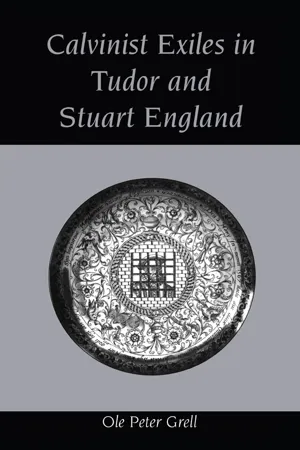
Calvinist Exiles in Tudor and Stuart England
About this book
This volume is a synthesis of the research articles of one of Europe's leading scholars of 16th-century exile communities. It will be invaluable to the growing number of historians interested in the religious, intellectual, social and economic impact of stranger communities on the rapidly changing nation that was Elizabethan and early Stuart England. Southern England in general, and London in particular, played a unique part in offering refuge to Calvinist exiles for more than a century. For the English government, the attraction of exiles was not so much their Reformed religion and discipline as their economic potential - the exiles were in the main skilled craftsmen and well-connected merchants who could benefit the English economy.
CHAPTER ONE
A new home or a temporary abode? Dutch and Walloon exiles in England
For the Reformed diaspora of the sixteenth century, southern England in general and London in particular played a unique part in offering refuge to Calvinist exiles for more than a century. London’s and England’s popularity among Dutch and Walloon Protestants leaving the Spanish Netherlands, and Huguenots fleeing France, was only matched or temporarily exceeded by that of Geneva for evangelical, French and Italian refugees, and by that of Emden for Dutch and Walloon exiles, and then only for a few decades around the middle of the sixteenth century. 1
The foundation of the stranger churches in London in 1550 under their own superintendent, the Polish reformer, Johannes a Lasco, had been encouraged by leading figures within the English government and the Church of England who wanted to carry the English Reformation further. The exiles were supported not only by leading evangelicals within the Church of England, such as Bishop John Hooper, but also by Archbishop Cranmer who saw the example of the exiled, Reformed communities not only as a potentially beneficial example for the English church, but also as serving to prevent the spread of Anabaptism among the immigrants themselves, but perhaps more importantly from them to the English host population.2
Following the brief Catholic interlude during the reign of Mary, when more than 200 members of the London Dutch community sought temporary refuge in Emden, the accession of Elizabeth in 1559 encouraged the strangers to seek to re-establish their churches in London. Initially the negotiations between leaders of the community and Elizabeth’s chief adviser, Sir William Cecil, were far from promising, but eventually the stranger churches were allowed to resume their services. However, the total independence of the Church of England granted them in 1550 was no longer on offer from the English government. The foreign communities were allowed to retain their own discipline, but were placed under the jurisdiction of the bishop of London. That this, in the first instance, turned out to be Edmund Grindal who was positively inclined towards the refugees, having himself spent years in exile under Mary, undoubtedly made this restriction easier to accept for the strangers. For the English government the attraction of the exiles was no longer their Reformed religion and discipline, but rather the economic potential of their community, consisting of highly skilled craftsmen and merchants who might help transfer important skills which could prove beneficial to the English economy.3
This economic rationale, which after some hesitation had convinced Elizabeth and her chief ministers to encourage the resettlement of the Dutch and Walloon immigrants in London, quickly led to a close cooperation between the leaders of the Reformed churches in London and the English government in establishing new communities of godly immigrants in a number of provincial towns in southern England during the 1560s. Most of these towns had witnessed a rapid economic and demographic decline during the sixteenth century and were keen to receive an injection of highly skilled craftsmen who might help invigorate the local economy. Thus, the Dutch community in Austin Friars in London were instrumental in establishing communities in Sandwich (1561) and Maidstone (1567), and undoubtedly assisted in the creation of the Dutch and Walloon communities in Norwich (1565) and Colchester (1568–69).4
Considering the dramatic increase in the number of refugees who arrived from the Netherlands in the wake of the failed attempt of a Reformed reformation during the so-called Wonderyear of 1566,5 which was further accelerated by the violent repression of Protestantism by the Duke of Alva and his Council of Troubles between 1567 and 1572,6 this was evidently a sensible solution for the Elizabethan government, as well as for the foreign churches in London. It took the pressure off the capital where the arrival, especially after 1567, of considerable numbers of refugee craftsmen in particular might easily unsettle the often volatile native population of apprentices and craftsmen in the City and generate xenophobia towards the stranger churches in particular. Similarly, it lightened the financial burden for the stranger churches in the capital, who often struggled to find enough capital to assist the many, often destitute, new arrivals from the southern Netherlands.
For the Elizabethan authorities it remained a problem throughout most of the Queen’s reign to balance the perceived economic benefit from this Calvinist immigration with the worries it produced in the host population, especially in London. Periodically strong popular fears were voiced to the effect that the capital was being swamped with waves of new refugees who would undercut the livelihoods of the native population by taking over their work at lower rates. Throughout her reign it remained an essential part of the Queen’s strategy to try to contain such escalating xenophobia within the host population by ordering returns of aliens to be compiled in the capital. This was done, more often than not to dispel the hysterically inflated figures concerning the size of the alien population in the capital which circulated at intervals. Simultaneously, of course, these returns compiled by the individual aldermen or their deputies in the wards, provided Elizabeth with a realistic assessment of the number of aliens within the City, their abode and occupation. Discretion was a major concern for the Elizabethan administration when returns were ordered. At each occasion, in 1568, in 1582–83 and finally in 1593, the Privy Council emphasized that the greatest care should be taken when the information was collated. This should be done to prevent general xenophobia and individual troublemakers within the host population from taking action against the immigrants in order that the refugee communities should not be caused unnecessary anxiety.7 Undoubtedly popular perception in London was strongly influenced by the considerable number of immigrants who arrived after Alva’s anti-Protestant campaign had commenced in 1567. If numbers were, indeed, high only a fraction appears to have stayed on in London. A fair number, encouraged by the English authorities and the leaders of the stranger churches in London, left to join the provincial Dutch/ Walloon communities in southeast England, while others quickly returned to the Continent, initially to join the immigrant comunities in Germany, but later after the start of the Dutch Revolt in 1572 to settle in the rebellious provinces of Holland and Zeeland.
From the outset the emigration from The Netherlands was complex, not only in motivation – being religious, as well as economic – but also in terms of destination. The refugees were constantly on the move. Initially they found safe havens in Emden, London and southern Germany. Most of these places were in both communication and traffic excellently placed for retaining close contacts with family and friends in The Netherlands. Obviously with the optimism surrounding the events leading to the Wonderyear of 1566 many refugees wanted and were able to return quickly to their country or region of origin, only to seek renewed exile either in the cities which had previously given them refuge or in some of the other major centres for the Reformed exodus, when the Wonderyear proved a failure. Once more the revolt in 1572 encouraged re-emigration, while the Pacification of Ghent in 1576 prompted a large scale return initially to the northern provinces of Holland and Zeeland in particular and somewhat later, from 1580 onwards, to the southern provinces where the returning exiles joined the semi-clandestine churches ‘under the cross’, especially in the cities of Antwerp, Bruges, Ghent and Brussels. Meanwhile a stream of Reformed refugees were fleeing France as a consequence of the St Bartholomew Massacre (1572), often joining the exiled communities established by their French-speaking, Walloon coreligionists in Germany and England.
Finally, the fall of Antwerp in 1585 and the other major cities in the southern Netherlands once more caused new waves of religious refugees to leave these areas. It has been estimated that half the population of Antwerp, around 38,000 people, left the city within four years of its surrender to the Duke of Parma, Alexander Farnese.8 This time, however, the majority settled in the rebellious United Provinces, even if considerable numbers reached both England and Germany. Gradually, however, the exiled communities in Germany and England saw members return to the Dutch Republic, especially after 1590 when Philip II of Spain lifted the embargo against Dutch shipping and goods to the Iberian Peninsula while simultaneously changing his military strategy in The Netherlands away from the costly offensive warfare of the 1580s towards a cheaper defensive policy which made it possible for him to intervene in the Wars of Religion in France. The Dutch took full advantage of this opportunity and recaptured a considerable amount of territory from the Spaniards, including the cities of Deventer and Zutphen in 1591, securing the borders of the young Republic, opening up routes between Germany and Holland, while blockading the Flemish coast. This all served to enhance the growing economic preponderance and mercantile strength of the Dutch Republic, which in turn encouraged many emigrant merchants, who had previously settled in Germany and England, to return to the Netherlands.9
Obviously, an accurate estimate of the size of this emigration is extremely difficult to make, bearing in mind the complex web of emigration and re-emigration which often continued for generations and did not end until the first decades of the seventeenth century.10 Combining data from the research of Geoffrey Parker and J. Briels, Jonathan Israel has recently estimated the first major wave of Reformed emigrants to leave the Netherlands in the period 1567–72 to have comprised around 60,000 people, while the second wave, post–1585, may have consisted of 100,000 or even as many as 150,000 people.11 Undoubtedly Israel is correct when concluding that these two waves were among the four great west European migrations of the early modern period and that the ...
Table of contents
- Cover
- Half Title
- Dedication
- Title Page
- Copyright Page
- Table of Contents
- List of tables
- List of figures
- Preface
- 1 A new home or a temporary abode? Dutch and Walloon exiles in England
- 2 The French and Dutch congregations in London in the early seventeenth century
- 3 A friendship turned sour: Puritans and Dutch Calvinists in East Anglia, 1603–1660
- 4 From uniformity to tolerance: the effects on the Dutch church in London of reverse patterns in English church policy, 1634–1647
- 5 Merchants and ministers: the foundations of international Calvinism
- 6 From persecution to integration: the decline of the Anglo-Dutch communities in England, 1648–1702
- 7 The schooling of the Dutch Calvinist community in London, 1550–1650
- 8 Tribute and triumph: Dutch pageants and Stuart coronations
- 9 Calvinist agape or Godly dining club?
- 10 Plague in Elizabethan and Stuart London: the Dutch response
- 11 The attraction of Leiden University for English students of medicine and theology, 1590–1642
- Index
Trusted by 375,005 students
Access to over 1.5 million titles for a fair monthly price.
Study more efficiently using our study tools.
Frequently asked questions
Yes, you can cancel anytime from the Subscription tab in your account settings on the Perlego website. Your subscription will stay active until the end of your current billing period. Learn how to cancel your subscription
No, books cannot be downloaded as external files, such as PDFs, for use outside of Perlego. However, you can download books within the Perlego app for offline reading on mobile or tablet. Learn how to download books offline
Perlego offers two plans: Essential and Complete
- Essential is ideal for learners and professionals who enjoy exploring a wide range of subjects. Access the Essential Library with 800,000+ trusted titles and best-sellers across business, personal growth, and the humanities. Includes unlimited reading time and Standard Read Aloud voice.
- Complete: Perfect for advanced learners and researchers needing full, unrestricted access. Unlock 1.5M+ books across hundreds of subjects, including academic and specialized titles. The Complete Plan also includes advanced features like Premium Read Aloud and Research Assistant.
We are an online textbook subscription service, where you can get access to an entire online library for less than the price of a single book per month. With over 1.5 million books across 990+ topics, we’ve got you covered! Learn about our mission
Look out for the read-aloud symbol on your next book to see if you can listen to it. The read-aloud tool reads text aloud for you, highlighting the text as it is being read. You can pause it, speed it up and slow it down. Learn more about Read Aloud
Yes! You can use the Perlego app on both iOS and Android devices to read anytime, anywhere — even offline. Perfect for commutes or when you’re on the go.
Please note we cannot support devices running on iOS 13 and Android 7 or earlier. Learn more about using the app
Please note we cannot support devices running on iOS 13 and Android 7 or earlier. Learn more about using the app
Yes, you can access Calvinist Exiles in Tudor and Stuart England by Ole Peter Grell in PDF and/or ePUB format, as well as other popular books in History & World History. We have over 1.5 million books available in our catalogue for you to explore.