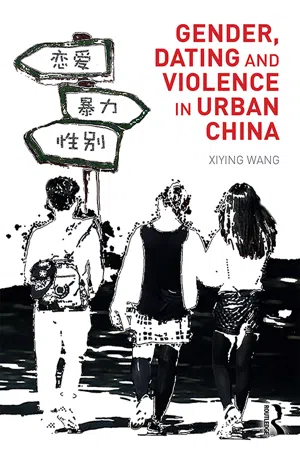
This book explores young people's experiences of, and views on, dating, gender, sexuality, sexual hegemony and violence within dating relationships. Based on interviews and focus groups conducted in Beijing over a decade, and focusing especially on dating violence, the book reveals provides insights into a wide range of issues of gender and sexuality in contemporary China. It shows how young Chinese people's attitudes and behaviors are changing as urban China develops rapidly, and how their experience of dating violence and meaning-making are affected by age, gender, location and class.
- 224 pages
- English
- ePUB (mobile friendly)
- Available on iOS & Android
eBook - ePub
Gender, Dating and Violence in Urban China
About this book
Information
1 Discovering dating violence in China
Two anecdotes
1998 winter: unspeakable secret
In the winter of 1998 I was a master’s degree student in a prestigious university in Beijing. One early morning one of my best friends came back to the dormitory in tears. She told me that she had gone out to a disco with a male friend the previous night and had stayed out late, and so could not come back to the dormitory because of the midnight curfew. Her male friend invited her to his place and she agreed, mainly because it was cold outside and she just wanted to find a place to kill time and wait for the dormitory to reopen. To her surprise, as soon as they arrived at his place, her male friend started to make moves on her. At first she remained friendly but she firmly said no, but her male friend just would not listen. He grabbed her, pushed her to the bed and attempted to kiss her and coerce her into sex. She tried her best to fight back and protect herself, during the physical struggle losing a necklace she treasured very much, a gift from her mother. Luckily, she managed to escape and walk all the way back to our dormitory, crying.
I was shocked when I listened to her and was wide awake that very early morning, but I did not know why our discussion quickly shifted to how she might get the necklace back. Maybe because she felt that the discussion was going nowhere, she simply concluded: ‘He is such a jerk!’ Maybe it was too painful for her to talk about the details and her feeling of being hurt, betrayed, and ashamed. Neither of us was equipped with the concept of ‘dating violence,’ ‘sexual coercion’ or ‘attempted date rape,’ which might define the experience of injustice and violation. It never occurred to us that we should do something, such as call the police, call the counseling center, etc., to seek help and fight for justice. We did not even discuss how we could teach ‘the friend’ a lesson and prevent him from hurting other women. After that morning, we never discussed the incident again – it seemed that forgetting, ignoring, and remaining silent was the best way to deal with it. It became a secret. This secret bothered me for a long time.
2014 fall: heroine without satisfaction
In the fall of 2014, Winnie was a female master’s degree student in Xi’an. One day during lunch time, in an isolated place on campus, she saw a young couple: a man was furiously roaring at a woman, grabbing and shaking her shoulders violently, and the woman, who was much shorter and smaller than the man, was crying and almost fainting. Winnie wanted to intervene, and she took out her cell phone to video the incident. She asked the woman if she needed help. The man then grabbed Winnie’s cell phone, deleted the video and asked her to leave. Reluctant to leave, Winnie accused the man of ‘not being human.’ Suddenly the man turned back to Winnie, put his hands around her throat and punched her several times in the face. At one moment Winnie felt that she was almost dead. When she came back to her senses, her face was covered with blood.
Winnie immediately called the police but, to her surprise, the couple held hands as they explained the situation to the policemen. The policeman blamed Winnie for interfering in another couple’s business, and warned the man he could be arrested for such violent behavior. An ambulance came and took Winnie to the hospital, and the doctors examined her and confirmed that she had fractures of her nose and left cheekbone and that one front tooth was broken and another was loose. She also had a big black left eye.
Winnie felt that the policeman had blamed both sides and then had let the man go too easily, and she was determined to fight for justice. For three months she sought help from relatives and friends, women’s rights organizations, legal assistance, etc., and finally she managed to arrange a legal mediation with the man, who apologized to her and paid her 60,000 renminbi (RMB) as compensation. However, Winnie could not feel satisfaction. She still felt uneasy at the results, for two reasons. First, she felt that it was not the abusive man but his parents who had paid the compensation, as the man was also a master’s degree student, and she felt that he had not taken full responsibility for his actions. Second, she felt bad for the man’s girlfriend who, it seemed, could not fight for justice herself, and was worried about her since she was not sure whether the man had learned any lesson or would stop behaving violently. These remained unsolved problems for her.
***
For Winnie and me, experiencing incidents like this could become life-changing opportunities. I was a volunteer counselor at the Youth Hotline from 1998 to 2002 and received phone calls about the troubles of dating relationships from young people all over China. I became aware of such violent elements as the first incident presented above and as young people expressed their feelings of being trapped in toxic dating relationships. In 2001, I first learned of the concept of ‘dating violence’ from English-language literature on the subject, and I was thrilled finally to find a name for the violent behaviors and interactions within dating relationships. In 2002 I went to the University of Hong Kong to pursue a PhD and chose to study dating violence among young people in Beijing, from a qualitative feminist perspective. Since then, fighting against gender-based violence has become my life-long project and commitment.
In 1998 the concept of domestic violence had only been introduced into China for a few years, but now it has become a buzzword and almost everyone knows its connotations. In 2003, the Huang Jing case became the first documented date rape case in China. Huang Jing was a 21-year-old primary school teacher, who had been found naked, bruised, and dead in a bed in her dormitory on February 24, 2003, after spending a night with her then 26-year-old boyfriend. Chinese feminists organized all kinds of activities to support Huang Jing’s mother in her appeal for justice. It was this case that introduced the concepts of ‘dating violence’ and ‘date rape’ in China. Soon scholars started to pay attention to violence in other types of intimate relationships. The concept of gender-based violence has been introduced into China much more recently, and young feminist activists learn the intersectional approach to understand different forms of oppression are linked – both in their structure and also in how they relate to one another – to expand the understanding of violence against women. They have not limited themselves to studying the domain of domestic violence but also have been willing to fight against all kinds and types of such violence, including dating violence, violence in lesbian, gay, bisexual and transgender (LGBT) relationships, gender-based school bullying, sexual harassment and violence, and child (sexual) abuse, etc.
After the 2014 incident presented above, Winnie told me that she had intervened because she had participated in some training about gender awareness raising and gender-based violence, and she felt that it was her responsibility to help victimized women and stop the violence when she saw what was happening. She also told me that once her friend had seen another couple fighting on a street and had called to ask her how to help. Unlike me, who had been a passive listener 16 years previously, Winnie was equipped with the concept of gender-based violence and was more willing to take action to change the situation, though her tactics might need to be further improved. After the incident, Winnie became more actively involved in the women’s movement, since she felt that she could not achieve justice without her feminist sisters’ help. She participated in a series of activities, such as those against campus sexual harassment,1 critiques of sexism and gender discrimination on the popular CCTV Spring Festival Gala TV show,2 performance art for sexuality education,3 etc.
Like many other young feminist activists, Winnie belongs to a well-educated, courageous, creative, and fearless generation of young women who have grown up in the Reform Era under the one-child policy. ‘Instead of pursuing lucrative corporate positions, getting married and having children,’ they ‘choose to become full-time women’s rights campaigners’ (Xiao, 2015), deciding not to tolerate sexism and gender discrimination within the current system and not to campaign quietly. Performance art is their strategy for pursuing gender equality and opposing all kinds of violence against women and girls in China. This group of young feminist activists is becoming the future and direction of the Chinese feminist movement.
China has experienced earth-shaking changes in the past two decades. In 2010 China took over from Japan as the world’s second largest economy.4 At the same time, the gap between China’s rich and poor is now one of the world’s highest, surpassing even that in the USA, according to a report by the University of Michigan in 2014.5 The gender gap and the rural–urban gap are also expanding. As the capital and center of Chinese Communist Party (CCP) political authority, Beijing was chosen as the research site for this present study. Beijing is a significant city with a rapidly developing cosmopolitanism, an important historical background, and significant cultural hybridity. On the one hand, Beijing maintains the comprehensive socialist bureaucracy and strong social institutions, and is politically conservative; on the other hand, Beijing has embraced the irresistible forces of modernization and globalization and has become a cosmopolis.
Idealization and uncertainty, two important characteristics of romantic love (Jankowiak, 1995), are not only fully expressed in young people’s dating lives but in other aspects of this city as well. A survey among young professionals in Beijing presented a list of the four most unsatisfactory factors of living in the city: expensive housing, lots of traffic, high living costs, and pollution. In spite of these problems, a lot of young people choose to live in Beijing because they think of it as the political, economic and cultural center of China, with a better professional environment and more resources and opportunities for them to achieve upward mobility (30-Groups, 2011). On a personal level, they have more opportunities to meet interesting ideal dates, and have more exciting dating experiments.
This is a book about young people, their aspirations and ambitions, hopes and dreams, loves and violence, intimacy and sexuality – about their intimate relationships and everyday lives in the city of Beijing, filled as they are with uncertainty, temporality, and instability. This book presents a socio-cultural script of young people’s dating lives and describes in detail how they accommodate and resist the hegemony of dating, gender, and sexuality. The objectives of this qualitative feminist study are to explore how young people give meaning to dating violence and do their gender and sexuality through it; and to throw light on the socio-cultural transformation of gender, sexuality, femininity, and masculinity from those of Maoist China (1949–76) to those of post-socialist China (1989–now). This book addresses the following questions:
1 What constitutes dating violence? How do young people in Beijing cope with the contradictions, conflicts, and violence in establishing dating relationships?
2 How do young people in Beijing do their gender and sexuality in dating relationships to negotiate tradition and establish themselves as modern men and women? How do young people in Beijing accommodate and resist dating, gender, and sexual hegemony?
3 How does the passion to pursue individual agency and desire continue to invigorate socio-cultural transformation in post-socialist China, a country that has been subject to a strong state, a powerful market, and cultural hybridity?
4 What is the intersectional self? How can a theory of Chinese intersectionality be constructed? How can we use Chinese intersectionality to understand young people’s everyday lives of love and violence, gender and sexuality?
When love hurts
Dating is a Western word and modern phenomenon, which has no corresponding term in Chinese. Two terms may be used: one is yuehui, meaning ‘joint activity’; the other is lian’ai, applied to romantic relationships, with most lian’ai practices still closely relating to mate selection and future marriage, so that the term is similar in meaning to the English word courtship.6 In the process of collecting data, both words were used, often interchangeably but sometimes according to particular situations. Sometimes young people also use casual terms such as haola (‘to like each other’), zaiyiqi (‘to be together’), yuepao (‘hook-up date’) and many others to refer to different dating practices. Here ‘dating’ is defined as a heterosexual relationship involving joint activities, including social activities (such as shopping, going to movies, having dinner together, etc.) and/or physical intimacy (such as holding hands, kissing, bodily touching, sex, etc.), either just for recreation or with an explicit or implicit intention to continue the relationship until break-up or marriage. It can be as casual as a one-night stand or as serious as cohabitation or engagement.
Dating violence is defined as aggressive behavior of intimate dating couples, involving act and/or injury, including attack and self-defense; it includes physical assault, verbal and psychological aggression, and sexual coercion, according to the classification of Straus et al. (1996).7 This book is focused on heterosexual dating relationships, though I fully acknowledge that violence also exists in homosexual dating relationships, and in some sections in this book I make some reflections on LGBT issues. However, violence within LGBT couples is not the focus of the book. Special attention needs to be paid to it elsewhere.
Dating violence, as an academic term, was formally introduced into Mainland China by Ai Xiaoming in 2003. At the conference of the Anti-Domestic Violence Network (November 25, 2003), held by the Chinese Law Society, Ai Xiaoming raised the concepts of dating violence and date rape (yuehui qiangjian), called on the media to pay attention to violence in dating relationships rather than only focusing on domestic violence, and mobilized support for developing education against dating violence among high school and college students. I also wrote an article entitled ‘Youth is Suffocated by Dating Violence,’ published on June 8, 2004 in the China Youth Daily, a well-known newspaper for adolescents and young adults all over China (Wang, 2004). On the same day, it appeared on all the biggest Internet commercial domains in China, such as Sina.com, Sohu.com, and Yahoo.com, etc.
This book takes the standpoint of challenging four common myths of dating violence in public discourses. First, I challenge the traditional approach of researching different types of violence separately, and argue that the boundaries of physical, psychological, verbal, and sexual violence are blurred, so that sometimes one violent incident may include elements of different types of violence.
Second, I challenge the idea that only severe violence counts as violence. I argue for the importance of researching the spectrum of violence, including both ‘minor,’ ‘trivial’ violence and long-term, severe violence. In fact, ‘minor’ and ‘trivial’ violence extensively exist in young people’s daily lives and has been ignored. The most common depiction of dating violence in China is ‘failed dating and murder,’ which appears everywhere in the media. Such bloody, violent descriptions in the media resemble horror stories or movies more than reflections on the overall social phenomenon. They usually attribute murders to failures of love and the abnormal personalities of the criminals, and regard these as rare and isolated incidents, with no relation to the conflicts and violence that occur in regular dating lives. This stereotypical depiction of violence makes it difficult to raise people’s awareness about the spectrum of violence and to prevent ‘minor’ violence from escalating into ‘severe’ violence.
Third, I challenge the dichotomy of ‘abusive...
Table of contents
- Cover
- Half Title
- Title Page
- Copyright Page
- Dedication
- Table of Contents
- List of illustrations
- Acknowledgements
- Abbreviations
- 1. Discovering dating violence in China
- 2. Chinese intersectionality: A critical review of gender-based violence research and gender studies in China
- 3. Dating landscape, power struggles, and love geography
- 4. Sassy girl and tender boy: The transformation of doing gender
- 5. Virginity loss, sexual coercion, and the unfinished sexual revolution
- 6. Remapping the landscape of dating, gender, and violence
- Methods: Researching a sensitive topic
- Glossary
- Bibliography
- Index
Trusted by 375,005 students
Access to over 1.5 million titles for a fair monthly price.
Study more efficiently using our study tools.
Frequently asked questions
Yes, you can cancel anytime from the Subscription tab in your account settings on the Perlego website. Your subscription will stay active until the end of your current billing period. Learn how to cancel your subscription
No, books cannot be downloaded as external files, such as PDFs, for use outside of Perlego. However, you can download books within the Perlego app for offline reading on mobile or tablet. Learn how to download books offline
Perlego offers two plans: Essential and Complete
- Essential is ideal for learners and professionals who enjoy exploring a wide range of subjects. Access the Essential Library with 800,000+ trusted titles and best-sellers across business, personal growth, and the humanities. Includes unlimited reading time and Standard Read Aloud voice.
- Complete: Perfect for advanced learners and researchers needing full, unrestricted access. Unlock 1.5M+ books across hundreds of subjects, including academic and specialized titles. The Complete Plan also includes advanced features like Premium Read Aloud and Research Assistant.
We are an online textbook subscription service, where you can get access to an entire online library for less than the price of a single book per month. With over 1.5 million books across 990+ topics, we’ve got you covered! Learn about our mission
Look out for the read-aloud symbol on your next book to see if you can listen to it. The read-aloud tool reads text aloud for you, highlighting the text as it is being read. You can pause it, speed it up and slow it down. Learn more about Read Aloud
Yes! You can use the Perlego app on both iOS and Android devices to read anytime, anywhere — even offline. Perfect for commutes or when you’re on the go.
Please note we cannot support devices running on iOS 13 and Android 7 or earlier. Learn more about using the app
Please note we cannot support devices running on iOS 13 and Android 7 or earlier. Learn more about using the app
Yes, you can access Gender, Dating and Violence in Urban China by Xiying Wang,Wang Xiying in PDF and/or ePUB format, as well as other popular books in Social Sciences & Regional Studies. We have over 1.5 million books available in our catalogue for you to explore.