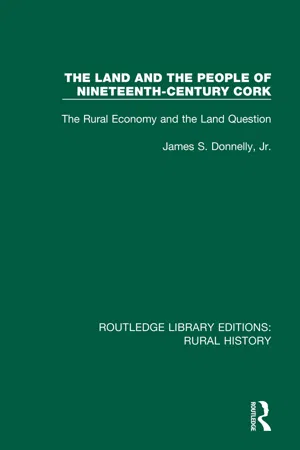
First published in 1975. Using estate records, local newspapers and parliamentary papers, this book focuses upon two central and interrelated subjects – the rural economy and the land question – from the perspective of Cork, Ireland's southernmost country. The author examines the chief responses of Cork landlords, tenant farmers and labourers to the enormous difficulties besetting them after 1815. He shows how the great famine of the late 1840s was in many ways an economic and social watershed because it rapidly accelerated certain previous trends and reversed the direction of others. He also rejects the conventional view of the land war of the 1880s, arguing that in Cork it was essentially a 'revolution of rising expectations', in which tenant farmers struggled to preserve their substantial material gains since 1850 by using the weapons of 'agrarian trade unionism', civil disobedience and unprecedented violence. This title will be of interest to students of rural history and historical geography.
eBook - ePub
The Land and the People of Nineteenth-Century Cork
The Rural Economy and the Land Question
- 452 pages
- English
- ePUB (mobile friendly)
- Available on iOS & Android
eBook - ePub
The Land and the People of Nineteenth-Century Cork
The Rural Economy and the Land Question
About this book
Trusted by 375,005 students
Access to over 1.5 million titles for a fair monthly price.
Study more efficiently using our study tools.
Information
INDEX

Abatements see Rents, reductions in
Abercromby, Sir George, 185
Aghada, 133, 326
Agrarian outrages, 265–8, 282–6, 291, 295, 322–30, 361, 377–8
Agriculture: subdivision of holdings, 13–16, 59–62, 158–63; technical improvements and their effect on demand for labour, 19; production before great famine, 26–44; deflation of 1815–36, 45–6; index numbers of prices in Dublin market (1812–40), 45; victualling contracts, 45–6; neglect of improvements, 62–6; improvements before great famine, 66–9; financial problems of landlords as deterrent to improvements, 68–72; production during great famine, 76–9; prices during great famine, 79–81; index numbers of prices (1840–51), 80; Irish grain exports to Britain (1843–9), 81–2; effect of great famine, 130–1; trends (1851–91), 132–72; decline in tillage after 1851, 133–5; extension of pasture farming, 135–7; prices of butter and store cattle, 135–6; effect of railways, 137–8; dairying, 138–41; dairyman system, 141–5; production and prices (1851–76), 145–58; depression of 1860–4, 146–8; prosperity of 1865–76, 148–50; production and prices (1876–91), 150–8; downturn of 1877–9, 150–1 251–9; adverse climatic conditions in 1880s, 151–3; collapse of butter prices, 153–7; trends in livestock prices, 157–8; demesne farming, 163–5; landlord improvements, 165–9; defects in quality of farming, 169–72; leases, 200–2; effect of crises on emigration after great famine, 231–2; increasing use of machinery after 1860s, 235; labourers’ unionism, 236–9; labourers’ resentment against machinery, 240; production and utilization of milk in County Cork (1854–80), 246–7; recovery of prices in 1880, 262–4; relative prosperity of 1881–4, 293–5; depression of 1884–7, 308–11; effect of foreign competition, 311–13; recovery of cattle prices (1888–90), 363–4; farmers’ difficulties in 1890, 364–6; bad seasons of 1891–2, 366–7, stagnation of production in Ireland after 1910, 384
Aldworth, Richard, 53
Anderson, Sir John, reduces his rents, 49
Anderson mills, 34
Applebe, Edward A., land agent of 3rd...
Table of contents
- Cover
- Half Title
- Title Page
- Copyright Page
- Dedication
- Table of Contents
- ABBREVIATIONS
- ACKNOWLEDGMENTS
- INTRODUCTION
- I THE RURAL ECONOMY, 1815–45
- II THE GREAT FAMINE, 1845–51
- III AGRICULTURE, 1851–91
- IV THE LAND QUESTION AND ESTATE MANAGEMENT, 1850–80
- V LIVING STANDARDS, 1851–91
- VI THE LAND WAR: FIRST PHASE, 1879–84
- VII THE LAND WAR: SECOND PHASE, 1884–92
- CONCLUSION
- BIBLIOGRAPHY
- INDEX
- Maps
Frequently asked questions
Yes, you can cancel anytime from the Subscription tab in your account settings on the Perlego website. Your subscription will stay active until the end of your current billing period. Learn how to cancel your subscription
No, books cannot be downloaded as external files, such as PDFs, for use outside of Perlego. However, you can download books within the Perlego app for offline reading on mobile or tablet. Learn how to download books offline
Perlego offers two plans: Essential and Complete
- Essential is ideal for learners and professionals who enjoy exploring a wide range of subjects. Access the Essential Library with 800,000+ trusted titles and best-sellers across business, personal growth, and the humanities. Includes unlimited reading time and Standard Read Aloud voice.
- Complete: Perfect for advanced learners and researchers needing full, unrestricted access. Unlock 1.5M+ books across hundreds of subjects, including academic and specialized titles. The Complete Plan also includes advanced features like Premium Read Aloud and Research Assistant.
We are an online textbook subscription service, where you can get access to an entire online library for less than the price of a single book per month. With over 1.5 million books across 990+ topics, we’ve got you covered! Learn about our mission
Look out for the read-aloud symbol on your next book to see if you can listen to it. The read-aloud tool reads text aloud for you, highlighting the text as it is being read. You can pause it, speed it up and slow it down. Learn more about Read Aloud
Yes! You can use the Perlego app on both iOS and Android devices to read anytime, anywhere — even offline. Perfect for commutes or when you’re on the go.
Please note we cannot support devices running on iOS 13 and Android 7 or earlier. Learn more about using the app
Please note we cannot support devices running on iOS 13 and Android 7 or earlier. Learn more about using the app
Yes, you can access The Land and the People of Nineteenth-Century Cork by James S. Donnelly Jr in PDF and/or ePUB format, as well as other popular books in History & 19th Century History. We have over 1.5 million books available in our catalogue for you to explore.