Natural Fiber Textile Composite Engineering
eBook - ePub

Natural Fiber Textile Composite Engineering

  1. 360 pages
  2. English
  3. ePUB (mobile friendly)
  4. Available on iOS & Android
eBook - ePub

Natural Fiber Textile Composite Engineering

About this book

Natural Fiber Textile Composite Engineering sheds light on the area of the natural fiber textile composites with new research on their applications, the material used, the methods of preparation, the different types of polymers, the selection of raw materials, the elements of design the natural fiber textile polymer composites for a particular end use, their manufacturing techniques, and finally their life cycle assessments (LCA). The volume also addresses the important issue in the materials science of how to utilize natural fibers as an enhancement to composite materials. Natural fiber-reinforced polymer composites have been proven to provide a combination of superior mechanical property, dielectric property, and environmental advantages such as renewability and biodegradability. Natural fibers, some from agricultural waste products, can replace existing metallic and plastic parts and help to alleviate the environmental problem of increasing amounts of agriculture residual.

The book is divided into four sections, covering:

  • applications of natural fiber polymer composites
  • design of natural fiber polymer composites
  • composite manufacturing techniques and agriculture waste manufacturing
  • composite material testing methods

The first section of the book deals with the application of textile composites in the industry and the properties of the natural fibers, providing an understanding of the history of natural fiber composites as well as an analysis of the different properties of different natural fibers. The second section goes on to explain the textile composites, their classification, different composite manufacturing techniques, and the different pretreatment methods for the natural fibers to be used in composite formation. It also analyzes the composite material design under different types of loading and the mechanism of failure of the natural fiber composite. The effect of the fiber volume fraction of different textile structures is explained.

The third section of the book, on composite manufacturing techniques and agriculture waste manufacturing, concerns the natural fiber composite manufacturing techniques, agricultural waste, and the methods of their preparation to be used successfully in the composite, either in the form of fibers particles or nanoparticles. The book then considers the testing methods of the different composite components as well as the final composite materials, giving the principle of the testing standards, either distractive or nondestructive.

This book attempts to fill the gap between the role of the textile engineer and the role of the designer of composites from natural fibers. It provides important information on the application of textile composites for textile engineers, materials engineers, and researchers in the area of composite materials.
Trusted by 375,005 students

Access to over 1 million titles for a fair monthly price.

Study more efficiently using our study tools.

Information

Year
2017
Print ISBN
9781771885546
eBook ISBN
9781351800334

PART I
APPLICATION OF NATURAL FIBER POLYMER COMPOSITES

CHAPTER 1


APPLICATION OF TEXTILE COMPOSITES


CONTENTS

1.1 History and Evolution
1.2 SWOT Analysis of Natural Fiber Composite
1.3 Materials for Natural Fiber Composites (NFPC)
1.4 Importance of Use of Natural Fiber Composites
1.5 Life Cycle Assessments (LCA) of NFPC
1.6 Some Applications of NFPC
1.7 Spot Light on Manufacturing Technology of NFPC
Keywords
References

1.1 HISTORY AND EVOLUTION

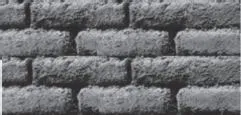
The natural fibers have been used as a composite material by the ancient Egyptian. They mixed Nile mud with straw for the manufacturing of the bricks and producing stronger bricks after baking them in sun [1, 2, 3], as illustrated in Figure 1.1. The mud bricks were widely speeded technology in ancient world for building brick houses. Burning the bricks gave them more strength. It was claimed that the compression strength of such bricks may reach 19 cN/mm2 [4]. The composition of the mud bricks consists of clay, silt, sand and straw. So, the history of consuming natural fibers in composites started at least 3000 BC. Also, natural fibers and mud formed walls of homes of farmers in several rural areas parts of the world. Bamboo, stem fibers, wood, and other natural fibers were used for formation of mats which were utilized in the building materials. For the woven walls, as strengthen material, such as straw or hemp were used. Building of a roof involved several types of natural fibers, for instance bamboo to form a grid, covered by palm leaves to close the openings of the grid and then pasted by mud on both sides forming a multi-laminate composite.
FIGURE 1.1 Mud bricks.
The composite material is manufactured by several creatures. The insects teach us how to build a composite material: wasps build mud nest, paper wasps prepare their nest using wood fiber as reinforcement and their saliva as matrix forming hexagonal cells. Ovenbirds build their nests by collecting mud and manure to create a spherical shaped like then baked by the sun to create a hardened shelter [5, 6, 7].
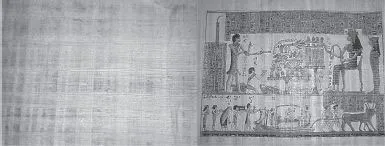
Another example of application of Natural fiber composite was developed by the ancient Egyptians 2000 BC by inventing the papyrus. They used the inside layer of the stem of the papyrus plant, sliced it into long stripes, laid side by side forming laminate, then covered by another stripes laid 90° on the top of the first laminate, both laminates will be immersed in water and pressed together for 21 days. The plant juice, which is glue material, will bond the two laminates together forming laminated composite after being dried in sun, as seen in Figure 1.2.
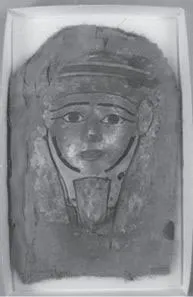
Another application of the natural fiber composite is the face mask which was usually used to cover the faces of Egyptian mummies. Funerary mask, like the one shown below, were placed over the wrapped mummy as an idealized representation of the deceased. This is the example of multi laminate natural fiber composites. Figure 1.3 illustrates face mask from Ptolemaic period (300–30 BC).
FIGURE 1.2 Papyrus composite paper.
FIGURE 1.3 Face mask (Brooklyn Museum).
This mask symbolizes a complex composite material. It was made by wrapping a head shaped core (probably made from mud or straw) with layers of linen and papyrus impregnated with glue. The mask is of five-layers composite. Inner two layers were made of linen plain weave fabric, Papyrus paper on top of second linen weave covered by clay layer then the last layer which is smooth surface made of fine clay to be painted [8].
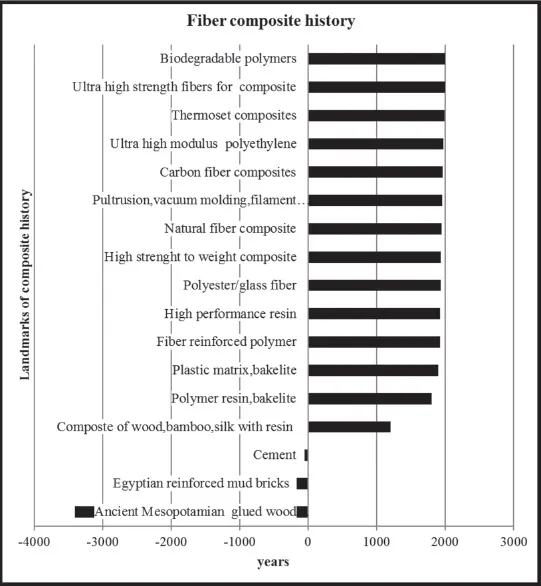
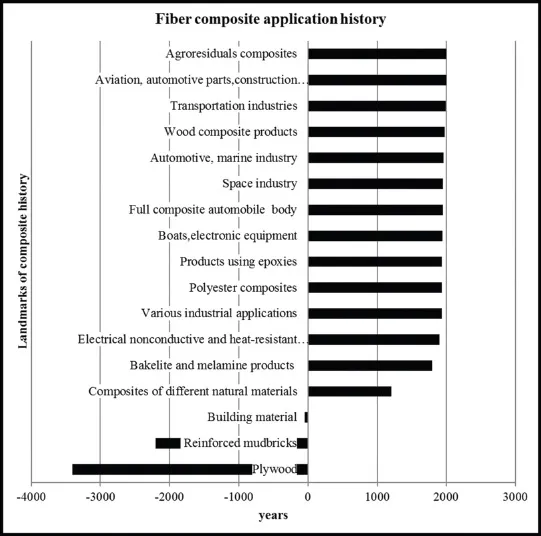
These diminutive examples of the application of composite material using natural fibers prove that the progress of the composites is not strictly modern by invention. The scientific progress over the years gives the composite applications a great evolution, especially when the new chemical resins were developed as well as the several types of manmade fibers. Referring to Figure 1.4 the landmark of composite material and its applications history. The use of natural fibers for technical composite applications has recently been the subject of the intensive research and found the enormous requests [9, 10, 11, 12, 13, 14, 15, 16, 17, 18, 19, 20, 21, 22, 23, 24, 25, 26].
FIGURE 1.4 Composites and their applications history.

1.2 SWOT ANALYSIS OF NATURAL FIBER COMPOSITE

The SWOT analysis of the natural fiber composite identifies the four critical elements of the analysis, Strengths, Weaknesses, Opportunities and Threats. The purpose of the SWOT analysis is to assess the strength and weakness of using natural fiber composites, advantages, and the are...

Table of contents

  1. Cover
  2. Half Title
  3. Title Page
  4. Copyright Page
  5. Table of Contents
  6. List of Abbreviations
  7. Preface
  8. About the Author
  9. Acknowledgments
  10. Dedication Page
  11. Introduction
  12. PART I: APPLICATION OF NATURAL FIBER POLYMER COMPOSITES
  13. PART II: DESIGN OF NATURAL FIBER POLYMER COMPOSITES
  14. PART III: COMPOSITE MANUFACTURING TECHNIQUES AND AGRICULTURE WASTE MANUFACTURING
  15. PART IV: COMPOSITE MATERIAL TESTING METHODS: FIBER, YARN, FABRIC, POLYMER AND COMPOSITE
  16. Index

Frequently asked questions

Yes, you can cancel anytime from the Subscription tab in your account settings on the Perlego website. Your subscription will stay active until the end of your current billing period. Learn how to cancel your subscription
No, books cannot be downloaded as external files, such as PDFs, for use outside of Perlego. However, you can download books within the Perlego app for offline reading on mobile or tablet. Learn how to download books offline
Perlego offers two plans: Essential and Complete
  • Essential is ideal for learners and professionals who enjoy exploring a wide range of subjects. Access the Essential Library with 800,000+ trusted titles and best-sellers across business, personal growth, and the humanities. Includes unlimited reading time and Standard Read Aloud voice.
  • Complete: Perfect for advanced learners and researchers needing full, unrestricted access. Unlock 1.4M+ books across hundreds of subjects, including academic and specialized titles. The Complete Plan also includes advanced features like Premium Read Aloud and Research Assistant.
Both plans are available with monthly, semester, or annual billing cycles.
We are an online textbook subscription service, where you can get access to an entire online library for less than the price of a single book per month. With over 1 million books across 990+ topics, we’ve got you covered! Learn about our mission
Look out for the read-aloud symbol on your next book to see if you can listen to it. The read-aloud tool reads text aloud for you, highlighting the text as it is being read. You can pause it, speed it up and slow it down. Learn more about Read Aloud
Yes! You can use the Perlego app on both iOS and Android devices to read anytime, anywhere — even offline. Perfect for commutes or when you’re on the go.
Please note we cannot support devices running on iOS 13 and Android 7 or earlier. Learn more about using the app
Yes, you can access Natural Fiber Textile Composite Engineering by Magdi El Messiry in PDF and/or ePUB format, as well as other popular books in Technology & Engineering & Science General. We have over one million books available in our catalogue for you to explore.