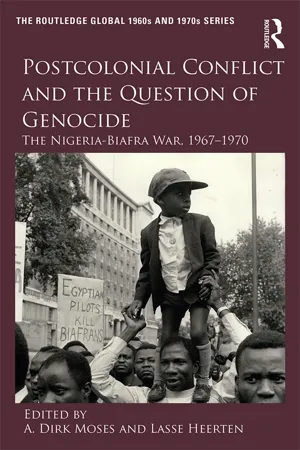
This volume is the first, comprehensive and balanced historical account of the momentous Nigeria-Biafra war. It offers a multi-perspectival treatment of the conflict that explores issues such as local experiences of victims, the massive relief campaigns by humanitarian NGOs and international organizations like the Red Cross, the actions of foreign powers with interests in the conflict, and the significance of the international public sphere, in which the propaganda and public relations war about the question of genocide was waged.
eBook - ePub
Postcolonial Conflict and the Question of Genocide
The Nigeria-Biafra War, 1967–1970
- 466 pages
- English
- ePUB (mobile friendly)
- Available on iOS & Android
eBook - ePub
Postcolonial Conflict and the Question of Genocide
The Nigeria-Biafra War, 1967–1970
Section II
A Global Event
6
The UK and ‘Genocide’ in Biafra
The UK and ‘Genocide’ in Biafra
In late August 1968, just after it launched a ‘final offensive’ to defeat the ‘Biafra’ rebels, the Federal Military Government of Nigeria (FMG) announced it would allow an international observer team into the country to show that it was not pursuing a campaign of genocide against Igbos in Biafra.1 It did so under some pressure to take such a course of action: the British government had signalled strongly that its continued support for the FMG, including arms supplies, would depend on the FMG’s acceptance of observers. From September 1968 until the end of the war in January 1970, a small team of observers from the United Kingdom (UK), Canada, Poland, Sweden, the Organisation for African Unity (OAU) and the United Nations (UN) operated in FMG-controlled territory and repeatedly reported that no genocide was taking place in the country. The British government used those findings to justify its policy of support for the FMG.
The observer team hardly features in recent discussions of the Nigeria-Biafra war, or even in some older pieces.2 Only Suzanne Cronje discussed it at much length, in The World and Nigeria.3 Yet it is curious that the observer team was sent at all, as it is an indication of how much pressure the UK itself was under as a result of the claims that a genocide was being perpetrated against Biafrans.
This article explains why the UK pressed for the FMG to invite observers into Nigeria, highlighting the need for the British government to rebut accusations that it was abetting genocide in Nigeria, especially by continuing to supply arms to the FMG. These accusations generated concern within the government despite the fact that the UK had not yet acceded to the 1948 Convention on the Prevention and Punishment of the Crime of Genocide. Their concern stemmed not from questions about the UK’s conformity to the legal norm against genocide, but instead from doubts about its conformity with the social norm against genocide.
This article first sets out the argument that there are two norms against genocide, a legal one (embodied in the 1948 Genocide Convention) and a social one. The main part of the article then reveals the decision-making and diplomacy regarding the creation of the observer team as disclosed in the relevant papers in the UK national archives. The social norm created pressures on the government to take action that it viewed as inimical to its interests (such as imposing an arms embargo on the FMG), and thus it needed specifically to rebut the claims of genocide to relieve the pressure. The section also shows how the observer team’s conclusions were used by the UK government to justify its policy (and to resist any changes to it), while activists and observers argued the observer team was biassed. This case illustrates how and why it is difficult to use observer teams to ensure an ‘objective’ determination of whether genocide is taking place or not.
The Social and Legal Norms Against Genocide
This article uses the concept of ‘norms’ when assessing the impact that the claims about genocide in Nigeria had on British foreign policy. Norms are ‘collective expectations about proper behaviour for a given identity’.4 Norms can have different impacts on states: they can require action (to comply with the norm), constrain action (again, to comply with the norm) and enable action (which could be justified as in compliance with the norm).5 However, norms may also have little or no impact on states: in other words, states’ behaviour may not conform with the norm at all, and they may resist pressure or incentives to take action in accordance with the norm. This may be because the costs of so doing are perceived to be greater than the costs of not conforming to the norm. There are also different types of norms—legal, social, professional, cultural and so on—and they may have different influences on states.6
As I have argued elsewhere, there are two norms against genocide, a legal one and a social one.7 The legal norm is set out in the genocide convention, which provides a definition of genocide and a set of rules by which states are to punish and prevent genocide. The definition of genocide in the convention is widely considered to be constricting, with its demanding requirement to prove ‘intent to destroy’. Furthermore, the convention does not mandate any particular action with respect to ‘prevention’, instead setting out certain requirements regarding the punishment of individuals for carrying out acts of genocide.
The UK’s attitude towards the genocide convention was lukewarm in 1948, and for twenty years afterwards. It abstained in the UN sixth committee vote on the convention, and then very nearly abstained from voting on it in the General Assembly, because of concerns that acceptance of the convention into British law would require changes to the laws on granting asylum and the cabinet had not agreed to this. Though the UK did in the end vote for the convention, the British delegate told the UN General Assembly that the UK’s vote was without prejudice to the right to grant asylum.8 The UK did not sign the convention,9 and only moved to accede to it after Harold Wilson became prime minister in 1964. Until then, a bureaucratic standoff between the foreign office (in favour of accession due to the reputational costs of remaining aloof) and the home office (adamant that there was no support for changing the UK’s law on asylum) had prevented accession. Wilson, however, supported accession and after he assumed office, his government put the convention forward for approval by Parliament, though not until 1968.10 The main debate on the convention in the House of Commons took place in February 1969; the UK formally acceded to it on 30 January 1970.
There is little evidence of British government concern about any legal requirements that the UK might have vis-à-vis Nigeria as a result of accession to the genocide convention. Indeed, the foreign office was confident that accession would not lead to claims that the UK was violating the convention by supporting the FMG, because the observer team had proven that FMG was not committing genocide.11 Had the observer team not been dispatched to Nigeria and found no evidence of genocide, then it is possible that when the UK acceded to the convention, it could have been accused by Biafra’s supporters of contravening its legal obligations.12 But there is no evidence in the files in the UK national archives or parliamentary debates to suggest that the question of accession to the convention was linked to decisions about the observer team.
What this indicates is that the legal norm played little to no role in the British government’s considerations of either its vulnerability to criticism over its policy regarding Nigeria, or its defence of its policy. Nor did the legal norm figure highly in public contestation of the policy. Instead, the case of the UK and genocide in Biafra illustrates the impact that social norms can have on foreign policy-making.
The social norm against genocide entails a wider definition of genocide: in public parlance, genocide usually just means large-scale killing (as happened in Cambodia under the Khmer Rouge regime, for example). The social norm also requires a response going beyond the legal norm: genocide is seen as raising ‘a legal, political and moral obligation, an irrevocable imperative that cannot be pushed aside but must be acted on’.13 In the last two decades, this has entailed an expectation that states will take measures to stop genocide, measures which ultimately should include the use of coercive military force if that is what it takes to stop the killing. But before the end of the Cold War—when ‘humanitarian intervention’ was beyond the limits of acceptable action in international affairs14—the social norm against genocide meant that governments should take action short of intervention, such as imposing arms embargoes or criticizing countries in international fora. Indicators of the social norm in discourse include the use of the term genocide to describe killings without reference to the genocide convention definition, and use of the related argument that a government’s policy has to change to try to stop the killings. Whether and how the government does so indicates the norm’s impact: did the norm enable, require or constrain action? To investigate the way the social norm impacted British policy vis-à-vis Nigeria, I have analyzed the public discourse (declarations by the government, debates within Parliament, newspaper editorials), reviewed the relevant official documents in the UK national archives and read the memoirs of the key British actors involved in the discussions.
The UK and the Nigeria-Biafra War
On 30 May 1967, the military ruler of the Eastern Regions of Nigeria (‘Biafra’), Odumegwu Ojukwu, announced the secession of Biafra from the Nigerian federation, and its independence as a sovereign state. He did so following the massacre of perhaps 30,000 Igbos in the north of the country in September 1966,15 and his declaration of independence told the people of Eastern Nigeria that ‘[you are] aware that you can no longer be protected in your lives and in your property by any government based outside Eastern Nigeria’.16 In response, the federal government (also military-ruled) imposed a blockade on Biafra and attempted to regain control of the region by military means. It did not do so until January 1970.
Initially, after Ojukwu had declared Biafran independence, the Wilson government adopted a ‘neutral’ position, though it continued to fill the Nigerian government’s orders for supplies of arms.17 But British support for the FMG soon became clear, reflecting an understanding of its national interests.
Those interests were economic in the first place: ‘secession would threaten the security of the 3,500 subjects in the Eastern region and put investments at risk, especially in the oil industry’.18 Shell-British Petroleum was a major investor in Nigeria, and over a tenth of British oil imports came from Nigeria.19 When the Six-Day War broke out in the Middle East in June 1967, the importance of securing oil imports from Nigeria was reinforced. Second, the British feared the implications of the breakup of states in Africa: ‘if the principle of secession on a tribal basis were once accepted there would be chaos on the [African] continent’.20 Third, there were ‘geopolitical concerns’. Nigeria was potentially a major power in Africa; a breakup of the federation would reduce such power—and allow France and its francophone allies in the region to exercise more influence. The UK also needed to balance Soviet support for the FMG (the Soviets were also selling arms to it).21
Arms sales were justified by the government because it
was undoubtedly right to help an ex-colony and fellow Commonwealth country when it faced secession … to change our policy now when both sides have reached virtually irreconcilable positions, would have a catastrophic effect on our relations with the Federal Government and would put our interests in Nigeria in jeopardy.22
In August 1968, in Parliament, the secretary of state for commonwealth affairs, G...
Table of contents
- Cover
- Title
- Copyright
- Contents
- List of Figures
- List of Contributors
- Introduction
- SECTION I Genocide and the Biafran Bid for Self-Determination
- SECTION II A Global Event
- SECTION III Trauma and Memory
- Index
Trusted by 375,005 students
Access to over 1.5 million titles for a fair monthly price.
Study more efficiently using our study tools.
Frequently asked questions
Yes, you can cancel anytime from the Subscription tab in your account settings on the Perlego website. Your subscription will stay active until the end of your current billing period. Learn how to cancel your subscription
No, books cannot be downloaded as external files, such as PDFs, for use outside of Perlego. However, you can download books within the Perlego app for offline reading on mobile or tablet. Learn how to download books offline
Perlego offers two plans: Essential and Complete
- Essential is ideal for learners and professionals who enjoy exploring a wide range of subjects. Access the Essential Library with 800,000+ trusted titles and best-sellers across business, personal growth, and the humanities. Includes unlimited reading time and Standard Read Aloud voice.
- Complete: Perfect for advanced learners and researchers needing full, unrestricted access. Unlock 1.5M+ books across hundreds of subjects, including academic and specialized titles. The Complete Plan also includes advanced features like Premium Read Aloud and Research Assistant.
We are an online textbook subscription service, where you can get access to an entire online library for less than the price of a single book per month. With over 1.5 million books across 990+ topics, we’ve got you covered! Learn about our mission
Look out for the read-aloud symbol on your next book to see if you can listen to it. The read-aloud tool reads text aloud for you, highlighting the text as it is being read. You can pause it, speed it up and slow it down. Learn more about Read Aloud
Yes! You can use the Perlego app on both iOS and Android devices to read anytime, anywhere — even offline. Perfect for commutes or when you’re on the go.
Please note we cannot support devices running on iOS 13 and Android 7 or earlier. Learn more about using the app
Please note we cannot support devices running on iOS 13 and Android 7 or earlier. Learn more about using the app
Yes, you can access Postcolonial Conflict and the Question of Genocide by A. Dirk Moses, Lasse Heerten, A. Dirk Moses,Lasse Heerten in PDF and/or ePUB format, as well as other popular books in History & 20th Century History. We have over 1.5 million books available in our catalogue for you to explore.