Analyzing Shakespeare's views on theatre and magic and John Dee's concerns with philosophy and magic in the light of the Italian version of philosophia perennis (mainly Marsilio Ficino, Pico della Mirandola and Giordano Bruno), this book offers a new perspective on the Italian-English cultural dialogue at the Renaissance and its contribution to intellectual history. In an interdisciplinary and intercultural approach, it investigates the structural commonalities of theatre and magic as contiguous to the foundational concepts of perennial philosophy, and explores the idea that the Italian thinkers informed not only natural philosophy and experimentation in England, but also Shakespeare's theatre. The first full length project to consider Shakespeare and John Dee in juxtaposition, this study brings textual and contextual evidence that Gonzalo, an honest old Counsellor in The Tempest, is a plausible theatrical representation of John Dee. At the same time, it places John Dee in the tradition of the philosophia perennis-accounting for what appears to the modern scholar the conflicting nature of his faith and his scientific mind, his powerful fantasy and his need for order and rigor-and clarifies Edward Kelly's role and creative participation in the scrying sessions, regarding him as co-author of the dramatic episodes reported in Dee's spiritual diaries. Finally, it connects the Enochian/Angelic language to the myth of the Adamic language at the core of Italian philosophy and brings evidence that the Enochian is an artificial language originated by applying creatively the analytical instruments of text hermeneutics used in the Cabala.
eBook - ePub
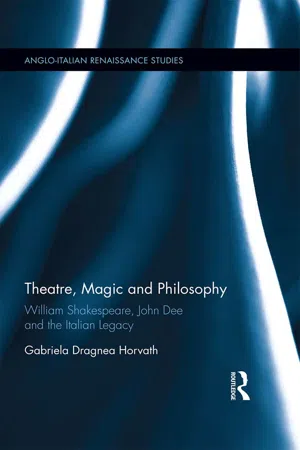
Theatre, Magic and Philosophy
William Shakespeare, John Dee and the Italian Legacy
- 256 pages
- English
- ePUB (mobile friendly)
- Available on iOS & Android
eBook - ePub
Theatre, Magic and Philosophy
William Shakespeare, John Dee and the Italian Legacy
About this book
Information
Part I
Conceptual framework and historical insights
1 Perennial philosophy
Before exploring the actualization of perennial philosophy in early modern England, it is imperative to clarify its name and outlines. The philosophical trend revived in Florence by Marsilio Ficino (1433–1499), and Giovanni Pico della Mirandola (1463–1494), has been given various names: Florentine Platonism, Renaissance Christian Platonism, Renaissance Neo-Platonism, Hermeticism, Christian Cabala or occult philosophy in tune with H.C. Agrippa’s De occulta philosophia libri tres (1533). Each of these names privileges one of the sources assimilated by this orientation or its esoteric dimension. The term philosophia perennis, adopted by W. Schmidt-Biggemann for the entire tradition he amply discusses in his homonymous work, comes from the book De perenni philosophia (1540) of the Vatican librarian Agostino Steucho (1496–1549). This denomination, pertinent to an intellectual movement predicated on the transcultural and transhistorical unity of truth, avoids the partial labels applied to it in the past, and it will be deployed in this book, both in its Latin and in its English version.
The origins of this orientation go back to the synthesis of Judaism and Platonism achieved by Philo of Alexandria (20 B.C.E.–50 C.E.) who upheld the priority of the Jewish heritage codified in the Bible over any competing Greek philosophies, and the ascendency of the Adamic or Adamite language, in which the first man conversed with God, over any other language. This primordial idiom was the instrument of creation, as God called things into being and was used by Adam to give names to all cattle, to the birds of the air, and to every wild animal (Genesis, 2:19–20), which made him co-participant in the creation. Philo assumed that the Adamic language gave an insight into the essence of things, by interpreting it as the deeper meaning of the Platonic doctrine of ideas.1 Philo’s writings were used by Clement of Alexandria and Origen to establish the foundation of Christian doctrine and were translated into Latin by Ambrosius (c. 340–397). Plotinus (c. 204/5–270), Porphyry (c. 234–c. 305), Iamblichus (245–c. 325), Proclus (412–485 AD) and Augustine of Hippo (354–430) contributed to enrich and transmit this line of thought. In the Middle Ages, perennial philosophy was represented by original figures like John Scotus Eriugena (c. 800–c. 877), who translated the corpus of the Pseudo-Dionysius, Robert Grosseteste (c. 1175–1253), Albert the Great (1193–1280) and Roger Bacon (c. 1214–1294). Muslim thinkers like Al-Khindi (+866) and Al Rhazali (Al Ghazel 1058–1111) belong to this trend, and their works inspired the European thinkers through the medieval and early modern times. Marsilio Ficino and Giovanni Pico also cite Albumasar (787–886) and Avicenna (c. 980–1037) among their sources.
Preannounced by Petrarca, Coluccio Salutati and Leonardo Bruni, the revival of perennial philosophy in the Renaissance was initially due to Nicholas of Cusa (1401–1464). Marsilio Ficino achieved a new synthesis establishing affinities between Plato, Moses and Hermes Trismegistus based on the hypothesis that Hermes Trismegistus was a real Egyptian character, a contemporary of Moses and a receiver of a divine revelation, like Plato himself. Ficino also acclaimed magic as the instrument the philosophers can use to redeem nature and humanity from the fall. Giovanni Pico della Mirandola opened a new avenue by incorporating the Jewish Cabala. Following him, Johannes Reuchlin (1455–1522) became an accomplished Christian cabalist and contributed to spread the ideas of the Italian thinkers beyond the Alps, where other representatives of the perennial philosophy are Johannes Trithemius (1462–1516), Heinrich Cornelius Agrippa von Nettesheim (1486–1535), Paulus Ricius (d. 1541), Paracelsus (Philippus Aureolus Theophrastus Bombastus von Hohenheim, 1493–1541), Guillaume Postel (1510–1581), Johann Weyer (1515–1588) and Jakob Böhme (1575–1624). The trend continued in Italy with Francesco Giorgio Veneto (Zorzi) (1466–1540), Girolamo Cardano (1501–1576), Giovanni Battista Della Porta (1535–1615) and Giordano Bruno (1548–1600).
The modern conception of philosophy as the actual guardian of reason, to quote Heidegger,2 does not help in approaching this trend, which needs to be understood on its own terms. For instance, Ficino’s assumption that Hermes Trismegistus was an Egyptian prophet, denied successively with logical and philological arguments by Isaac Casaubon, Francesco Patrizi and Hermann Conring,3 cannot be dismissed as a historical aberration, as it contributed to viewing theology and philosophy as two recipients of divine revelation and therefore granting philosophy the status of theology. It could be more appropriately interpreted as a creative error that actuated a significant turn of mind in the Renaissance.
The same applies to approaching the foundational narrative of perennial philosophy, according to which God imparted his wisdom to Adam in the Garden of Eden; Adam’s successors transmitted it after the fall in a line that included Noah and his progeny, and after the destruction of the Tower of Babylon, the entire treasure of divine knowledge was split and reworded in various languages. This myth had a series of important consequences. First, perennial philosophy was not centered on questioning the truth, but worked on the presupposition that all knowledge, being derived from the Edenic revelation, was grounded in a unique, eternal truth, manifest in the immutability of the spiritual realms emanated from God, a spirit himself, actually the supreme spirit, according to Marsilio Ficino.4 This explains the essential optimism of this trend, spelling out as confidence in the human capacity to apply the obtained divine wisdom for the betterment of the contingent world, and its spirituality, a concept interpreted by W. Schmidt-Biggemann as the philosophical mirror of monotheistic theology.5
Second, being a philosophia adepta, a received philosophy, it accesses knowledge either by communication with its creator, that is by revelation, or by the written tradition, since it was through the chain of wisdom manifested in history that the original Adamic revelation could be reconstructed. This stimulated a philological look into the past and justified the philosophers’ effort to absorb and harmonize all dissenting traditions, including Aristotelian philosophy.6 Agostino Steucho explained this in the dedication to Pope Paul III of his De philosophia perenni: “Plato and Aristotle, the princes of philosophy, both present us with one philosophical commitment: the knowledge and worship of God.”7
Third, by the aspiration to encompass all of the transmitted knowledge, perennial philosophy proposed itself as a universal science, underpinned by (1) the unity of theology and philosophy, with the latter working within the framework of theological presuppositions and deriving its postulates from the serenity of faith;8 (2) the unity of revelation and science, whereby revelation takes precedence over science, if its divine origin is taken seriously;9 and (3) the unity of philosophy and poetry, since imagination is viewed as the faculty that allows the philosopher to access spiritual truths and the word appears as the powerful instrument of creation in conformity with the Genesis and the inception of St. John’s Gospel.10 The adept of this trend contributed to theo-philosophical speculation, experimented and paved the way to science, but was also close to the poeta vates through the visionary capacities of his soul. This explains why Marsilio Ficino and Giovanni Pico included Homer, Hesiod, Orpheus and Virgil in their lineage of wisdom. Working on ancient texts, whose authors, according to Marsilio Ficino “… wrapped the sacred mysteries of these matters divine in poetic veils to prevent them from becoming mixed up with matters profane” (Theologia Platonica, Book XVII, Chapter 1), enabled this philosopher to develop a poetic mind-set along with logical-analytical reasoning. The highest status he could reach was participation in God’s ideas, which meant uncovering the primordial causes, the archetypes of creation. This could be done both by enabling the soul, through a special discipline, to get a spiritual insight into God’s plan of creation, or by deciphering the formal characteristics of natural things, interpreted as the seminal reasons, the externalized divine archetypes, systematized as the doctrine of signatures, that would reveal the principles of divine creativity. Consequently, there was an increased interest in the study of nature as place of actualization of the divine ideas, in semiotics as the art of interpreting these signs reading the book of nature, and in classifying the parts of creation according to criteria of compatibility or incompatibility known as sympathy and antipathy.
Another interesting feature of this trend is the unity of theory and practice. The knowledge accessed by the philosopher was meant to be applied for the transformation of nature, hence the centrality of magic as an umbrella term for theories, rituals, experiments and arts aimed at curing the world from its decay status, and the interest of philosophers in medicine, astrology, alchemy, applied mathematics, botany, physiognomy, optics and other disciplines that pertain today to the domain of science.
The postulates of perennial philosophy have implications for historical research. E. Garin’s statement that “the universal man of the Renaissance was above all someone who lost track of the boundaries between the various fields of knowledge and action”11 implies a post-Enlightenment high regard of distinctions that did not make sense for the creative minds of early modernity who understood theory and practice, religion, science and arts as naturally integrated. The debated intellectual profile of a personality like Giordano Bruno, for instance, who was a playwright, a philosopher and a precursor of science, becomes congruent. Since the philosopher gets access to divine wisdom by participation and reception, he takes the esoteric dimension of the revealed knowledge for granted and does not conceive of any opposition between science and occultism.
In Tudor England, perennial philosophy developed by reevaluating native medieval figures like that of Roger Bacon, and by assimilating its new expression from continental thinkers, like the Italians Marsilio Ficino, Pico della Mirandola, Francesco Giorgio Veneto, Girolamo Cardano, Giovanni Battista Della Porta, Giordano Bruno, the Germans Johannes Trithemius, Johann Weyer, Cornelius Agrippa, the German Swiss Paracelsus (Philippus Aureolus Theophrastus Bombastus von Hohenheim) and the French Guillaume Postel. This process involved a restricted number of intellectuals, it was gradual and often in tension with official culture and religious ideology. Just like in Italy, it flourished outside the universities, where Aristotelianism was dominant, and it became popular in the noble circles and in diluted versions in the middle class.
The first English scholars who traveled to Italy and were introduced to the new ideas were Thomas Linacre (c. 1460–1524), William Grocyn (1466–1519), John Colet (1467–1519), William Latimer (c. 1467–1554) and William Lily (c. 1468–1522), cited as the founders of English humanism and authors of what S. Jayne calls the Tudor Hellenization of Christianity.12 Their interpretation of the Florentine philosophy is an interesting example of critical selection of inputs coming from a different culture. Colet is a case in point. He studied patristic, canon and civil law, exchanged letters with Ficino, was familiar with his translations, the Epistolae, the Theologia platonica and the commentaries on the Pseudo-Dionysius; he knew Pico’s Heptatlus, but was attracted by Savonarola’s preaching and according to S. Jayne “he was interested in the Platonic theology in so far as it explained and illuminated for him matters of Christian theology, and especially of interpretation of the Bible.”13 Colet’s reaction to Ficino’s Epistolae is probably the most convincing illustration of the initial English response to the Florentine philosophy: “Repeatedly in the Epistolae Ficino urges his correspondents to the study of philosophy as the road to wisdom. Colet replies sourly the road to wisdom is justice and good actions.”14
Linacre was initiated into humanism by Angelo Poliziano, he was introduced to Lorenzo de’ Medici and his sons Piero and Giovanni (the future Pope Leo X), but his vocation for medicine made him learn more from his encounters with the physician, botanist and humanist Nicolaus Leonicenus (1428–1524) and with Hermolaus Barbarus (1454–1493), who seems to have acquainted him deeper with Aristotle, Pliny and Galen.15 Grocyn had a fascination with the Pseudo-Dionysius he discovered in Italy, probably motivated by the initial false assumption that he was St. Paul’s convert, but he was more attracted by Aristotle than by Plato. Thomas More (1478–1535)...
Table of contents
- Cover
- Half Title
- Title Page
- Copyright Page
- Dedication
- Table of Contents
- Acknowledgements
- Note on the text
- Abbreviations
- Introduction
- PART I Conceptual framework and historical insights
- PART II God, man, nature and the arts
- PART III The sense of wonder
- PART IV Vision and spirits
- PART V The power of words
- Bibliography
- Index
Trusted by 375,005 students
Access to over 1.5 million titles for a fair monthly price.
Study more efficiently using our study tools.
Frequently asked questions
Yes, you can cancel anytime from the Subscription tab in your account settings on the Perlego website. Your subscription will stay active until the end of your current billing period. Learn how to cancel your subscription
No, books cannot be downloaded as external files, such as PDFs, for use outside of Perlego. However, you can download books within the Perlego app for offline reading on mobile or tablet. Learn how to download books offline
Perlego offers two plans: Essential and Complete
- Essential is ideal for learners and professionals who enjoy exploring a wide range of subjects. Access the Essential Library with 800,000+ trusted titles and best-sellers across business, personal growth, and the humanities. Includes unlimited reading time and Standard Read Aloud voice.
- Complete: Perfect for advanced learners and researchers needing full, unrestricted access. Unlock 1.5M+ books across hundreds of subjects, including academic and specialized titles. The Complete Plan also includes advanced features like Premium Read Aloud and Research Assistant.
We are an online textbook subscription service, where you can get access to an entire online library for less than the price of a single book per month. With over 1.5 million books across 990+ topics, we’ve got you covered! Learn about our mission
Look out for the read-aloud symbol on your next book to see if you can listen to it. The read-aloud tool reads text aloud for you, highlighting the text as it is being read. You can pause it, speed it up and slow it down. Learn more about Read Aloud
Yes! You can use the Perlego app on both iOS and Android devices to read anytime, anywhere — even offline. Perfect for commutes or when you’re on the go.
Please note we cannot support devices running on iOS 13 and Android 7 or earlier. Learn more about using the app
Please note we cannot support devices running on iOS 13 and Android 7 or earlier. Learn more about using the app
Yes, you can access Theatre, Magic and Philosophy by Gabriela Dragnea Horvath in PDF and/or ePUB format, as well as other popular books in Literature & Literary Criticism. We have over 1.5 million books available in our catalogue for you to explore.