Cities are built over the remnants of their past buried beneath their present. We build on what has been built before, whether over foundations formalising previous permanency or over the temporal occupations of ground. But what happens when you shift a city - when you dislodge its occupation of ground towards a new ground, bury it and forget it?
Focusing on Berlin's destruction during World War II and its reconstruction after the end of the war, this book offers a rethinking of how the practices of destruction and burial combine to reform the city through geography and how burying a city is intricately tied to forgetting destruction, ruination and trauma. Created from 25 million cubic meters of rubble produced during World War II, Teufelsberg (Devil's Mountain) is the exemplar of the destroyed city. Its critical journey is chronicled in combination with Berlin's seven other rubble hills, and their connections to constructing forgetting through burial. Furthermore, the book investigates Berlin's sublime relation to Albert Speer's urban vision to rival the ancient cities of Rome and Athens through their now shared geographies of seven hills. Finally, there is a central focus on the role of the citizens who cleared Berlin's streets of rubble, and the subsequent human relationships between people and ruins.
This book is valuable reading for those interested in Architectural Theory, Urban Geography, Modern History and Urban Design.
As Berlin lay in ruins at the end of WWII, the immense task of clearing the rubble from the streets fell to the Trümmerfrauen (rubble women) and the accompanying girls, boys and men. The carting and off-loading of millions of cubic metres of rubble undertaken by them is a story of their labour in both the reconstruction and the burying of their city. Referencing an archive of photographs I have collected over many years, this chapter addresses a population working within the ruins to salvage both their city and their humanity devastated by war.
Rubblescape – working in ruins
To understand how a large part of Berlin was buried, one must begin with the city’s destruction by the Allied bombing campaign (1942–1945) during World War II. Walking through Berlin after the end of the war in Europe (7 May 1945) and surveying the scale of the damage, Winston Churchill pondered the onslaught unleashed on the city. For a moment, such empathy with the tragedy that had befallen Berlin and its people was possible (though this soon changed as more of the atrocities committed under the Nazi regime emerged). The graphic images of Berlin’s destruction are overwhelming. Carpet bombing resulted in a city filled with ghostly shells spewing debris, blurring street and building, merely hinting at what happened to the inhabitants. Within this absence of what could be called a city (materially crushed and void of utility) was perhaps a moment where Churchill, self-assured in victory over Nazi Germany, mindful of the millions of Jews murdered and the 60 million lives lost, could question, momentarily, the Allies’ own policy of air war obliteration of German cities.
Watching documentary films of Berlin recorded immediately after World War II is a numbing experience, an experience of disbelief in which the spectacle of material destruction overshadows the horrors of the human cost in terms of lives lost. Black-and-white footage shows the devastation via street views, flyovers and contrasting camera angles of a city fallen out of gravity create an historical distance, keeping the images firmly in the past. Films in colour, on the other hand, show the immediacy of the time, bringing the destruction into the present and heightening its realness: views of buildings spilling out onto the street, piles of red bricks, ravaged trees and wild vegetation claiming the ruins. People walk on pathways carved through the rubble and disappear behind its mounds, while others emerge from this landscape. There are also a number of feature films, such as Roberto Rossellini’s Deutschland im Jahre Null (Germany in Year Zero, 1948) that centres on a family’s ability to survive in this environment, and especially the struggle of a young boy, Edmund Köhler, to come to terms with growing up in a city consumed by destruction, exploitation and the reality of an uncertain future.1 Through the boy’s eyes, Rossellini portrays the city as a series of obstacles to survival among the ruins. The boy runs errands for shadowy figures, buying items on the black market, and is exposed to (implied) paedophilia as other children enjoy a paradise playground of rubble and debris. The boy’s streetwise survival is interwoven with his silent suffering, innocence and attempts to understand the recent past as his search for answers is thwarted. The film ends on the day of Edmund’s grandfather’s funeral, where he climbs to the top floor of a bombed-out building and falls to his death. We are left unsure whether the boy’s suicide is prompted by his grandfather’s death or whether Rossellini sees the boy as symbolising the guilt and dissolution of society as a whole. The film is a stark reflection of Berlin’s (and Germany’s) post-war years. In The Sound of Ruins, Lutz Koepnick describes Renzo Rossellini’s sound in the film: ‘In allowing nondiegetic music and voices to guide our paths to the diegetic space of Berlin ruins, Rossellini at once stirs and restrains the viewer’s affect’2 (2008, 199). Rossellini’s film describes a family’s struggle to survive in a city immersed in rubble. In my mind, the boy embodies the resilience that was to characterise German post-war society caught in a vacuum of depression and melancholy. The boy’s suicidal fall links to a nation fallen to incomprehensible depths. Any re-emergence from the horrors and tragedy of the war are bound up with answering the questions of the young.
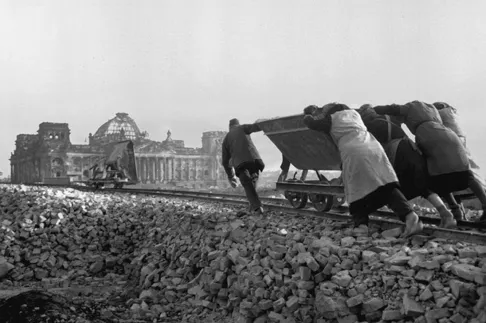
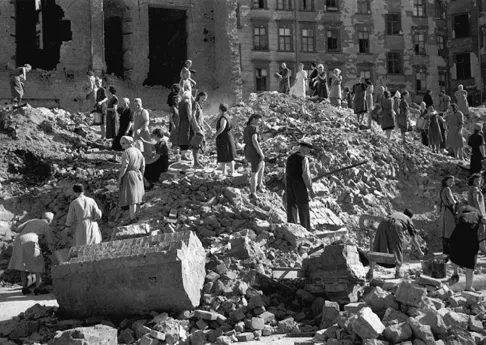
A series of archive photographs depicting life among the ruins in post-war Berlin portray, various forms of tragedy. These black-and-white pictures show men and women working in the ruins of their city, removing the rubble from streets and destroyed buildings. This immense task fell mainly to the women and men who had survived the war and, later, to soldiers returning from Russian and Allied prison camps. The photographs show workers pushing rubble-filled trucks along temporary tracks laid over vast mounds of debris (Trümmerbahnen, rubble railways), their backs bent by the exertion. Elsewhere, women form chains from the top of the mounds down to street level, passing buckets laden with rubble between them. Evident in every image is the acute reality of their labour and the combinations of people working together to form an interconnected entity.
Other photographs show women chiselling mortar from bricks that are stacked in huge rows for the reconstruction of buildings. Combustible materials such as wooden beams, floorboards, doors and frames do not appear in the images, burnt to ashes by the intense heat generated during the firestorms that engulfed the city after the bombing raids. If not melted into puddles, malleable metals such as lead and copper (roofing, guttering, electrical wiring) were pulled from the rubble for recycling, along with reinforcing rods and steel beams. What is compelling about these photographs is the way they capture the immense task and the manual labour undertaken by the women and men working to rescue their city from ruination. Fragile bodies of flesh and bone are counterpointed with the material mass of stone, brick and steel. Within each movement the women and men undertake, destruction passes between their bodies. Each photograph takes on a fascination with regard to the overall spectacle of ruination, yet each image captures a traumatic scene. As materials traverse the process of physical labour, a working through of inconsolable destruction emerges. Another compelling aspect is the difference in the women’s work clothes. Some wear dresses, shoes and sandals, while others have protective overalls, boots and gloves. The acute shortage of clothes and footwear meant that many women and men worked in the rubble with whatever they had.
Figure 5Feldbahnloren Konigsplatz 1948, F Rep.290–0172325, Landesarchiv Berlin
Photo: Ewald Gnilka
The photographs I have sourced overwhelmingly depict more women working in the rubble than men. Whether this reflects the choice of the mainly male photographers, who thought it novel to photograph women working among the rubble, or whether it reflects the reality of the labour available, is debatable. With more than 3.5 million German soldiers killed and many imprisoned after the war, the photo graphs could be seen as evidence of who was left to carry out the work. Collectively the photographs show the destruction of a city and the role women played in clearing rubble from the streets. According to Susan Sonntag in On Photography: ‘Photo graphic images are pieces of evidence in an ongoing biography or history. And one photograph, unlike one painting, implies that there will be others’3 (173, 130). Sonntag’s view of photographs as ‘pieces of evidence’ can be contested with regard to the reality of the time in which they were taken. In her book Mythos Trümmer frauen (The Rubble Women Myth), Leonie Treber explores the idea that the rubble women were a mythical social construct needed at the time to show to the outside world the German people’s resilience in the face of adversity and their ability to rebuild from the ashes of destruction.4 This view is supported, Treber argues, by the relatively small portion of women engaged in clearing the rubble. She estimates that a mere 5% of the total workforce clearing the streets of rubble were women, and, furthermore, that they worked only for a brief period immediately after the war.
Figure 6Trümmerfrauen Hagelberger Strasse Kreuzberg 1949, F Rep.290–0184802, Landesarchiv Berlin
Photo: Durniok
Although this contestation of the numbers of Trümmerfrauen may be read as an attempt to downgrade their actual value in Berlin’s early reconstruction,5 they can be explored in less critical terms as positive post-war propaganda images in a country on the brink of moral and physical collapse. In this view, what is important is the active presence of these women in the ruins of their city, taking back some form of control from a war created and dominated by men (and supported by women?) with their capacity for terror, killing and destruction. Each photograph illustrates a system for reordering the immense disorder of their destroyed city. The complexities we normally associate with the city (its infrastructure, workplaces, cultural institutions and homes that support the population) have all but vanished. Each image is a reminder of the fragility of the city and our existence within it.
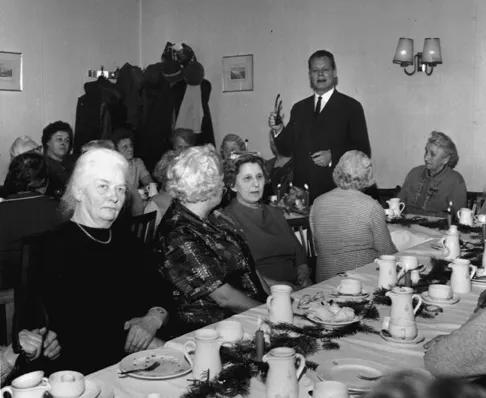
The occupation of the Trümmerfrauen within the ruins reinforces the absence of a city; their physical connection to Berlin’s ruination forms their continuity with the city; its survival as a place for living is linked to their own. Differing although not challenging Treber’s Trümmerfrauen myth, I am concerned not with using statistics to dispute their contribution, but with asserting their role as much as the men’s. A series of photographs from 1965 shows the then Berlin Mayor Willy Brandt (who became Chancellor in 1969) addressing a gathering of women in the Schultheiss-Restaurant at Fehrbelliner Platz in Wilmersdorf. These are the Trümmerfrauen who formed the Club der Trümmerfrauen as a name for their social gatherings. On a separate occasion, twenty years later in 1985, the then Mayor Eberhard Diepgen is seen hosting a reception in their honour at Schöneberg Town Hall. The Club der Trümmerfrauen as a social entity can also be seen as marking their history and role in Berlin’s reconstruction. The presence of Brandt and Diepgen may be taken as evidence of the debt society owes to these women in the early reconstruction of Berlin, and as politicians it may simply be lip service. In my mind, what is important and clear is that by setting up their association, these women were affirming their role – it was both social and political.
Figure 7Club der Trümmerfrauen Schultheiss-Restaurant Fehrbelliner Platz Bezirk Wilmersdorf, 07.12.1965, F Rep.290–109578 Landesarchiv Berlin
Photo: Bert Saß
The political dimension can be highlighted with reference to the physical absence of memorials to the role of the Trümmerfrauen in Berlin’s reconstruction. While actively looking for physical remembrance, I have so far encountered two statues dedicated to their work. One is to be found in the Marx-Engels-Forum in Berlin’s Mitte district; cast in bronze, this small statue of a standing figure on a plinth is hard to find due to its obscure location in the park. A second statue stands in the Hasenheide Park. Much larger than the Trümmerfrauen statue in the Marx-Engels-Forum, this statue carved from stone and unveiled in 1956 is likewise obscurely sited within the park and partially hidden by overgrown bushes. The statue consists of a seated figure dressed in a headscarf, a cloak and smock and clogs holding a hammer in her lap. The naïvely rendered aesthetic of the Trümmerfrauen statue contrasts with the consciously ascribed aesthetics...
Table of contents
Cover
Half Title
Title Page
Copyright Page
Table of Contents
List of figures
Preface: the view
Acknowledgements
Introduction: reflecting – above and below
1 Ruins: self-portraiture, capturing, forgetting
2 Memoirs: self-anaesthesia, cultural forgetting
3 Burial: abandoning the city, physical forgetting
4 Disappearance: planting the forest, natural forgetting
5 New ground: unearthing Teufelsberg, against forgetting
Conclusion: remembering – undoing forgetting, the reveal
Bibliography
Index
Trusted by 375,005 students
Access to over 1.5 million titles for a fair monthly price.
Study more efficiently using our study tools.
Frequently asked questions
Yes, you can cancel anytime from the Subscription tab in your account settings on the Perlego website. Your subscription will stay active until the end of your current billing period. Learn how to cancel your subscription
No, books cannot be downloaded as external files, such as PDFs, for use outside of Perlego. However, you can download books within the Perlego app for offline reading on mobile or tablet. Learn how to download books offline
Perlego offers two plans: Essential and Complete
Essential is ideal for learners and professionals who enjoy exploring a wide range of subjects. Access the Essential Library with 800,000+ trusted titles and best-sellers across business, personal growth, and the humanities. Includes unlimited reading time and Standard Read Aloud voice.
Complete: Perfect for advanced learners and researchers needing full, unrestricted access. Unlock 1.5M+ books across hundreds of subjects, including academic and specialized titles. The Complete Plan also includes advanced features like Premium Read Aloud and Research Assistant.
Both plans are available with monthly, semester, or annual billing cycles.
We are an online textbook subscription service, where you can get access to an entire online library for less than the price of a single book per month. With over 1.5 million books across 990+ topics, we’ve got you covered! Learn about our mission
Look out for the read-aloud symbol on your next book to see if you can listen to it. The read-aloud tool reads text aloud for you, highlighting the text as it is being read. You can pause it, speed it up and slow it down. Learn more about Read Aloud
Yes! You can use the Perlego app on both iOS and Android devices to read anytime, anywhere — even offline. Perfect for commutes or when you’re on the go. Please note we cannot support devices running on iOS 13 and Android 7 or earlier. Learn more about using the app
Yes, you can access Buried City, Unearthing Teufelsberg by Benedict Anderson in PDF and/or ePUB format, as well as other popular books in Architecture & Architecture General. We have over 1.5 million books available in our catalogue for you to explore.