eBook - ePub
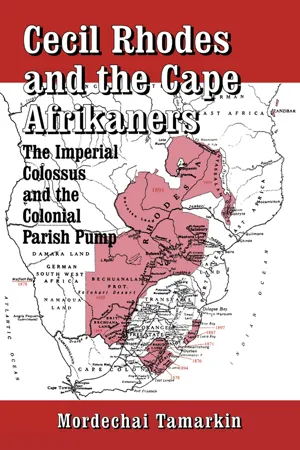
Cecil Rhodes and the Cape Afrikaners
The Imperial Colossus and the Colonial Parish Pump
- 344 pages
- English
- ePUB (mobile friendly)
- Available on iOS & Android
eBook - ePub
About this book
This study of the relationship between Cecil Rhodes and the Cape Afrikaners fills many gaps in his political biography. Previous biographers have rarely consulted the abundant Cape Afrikaner sources that this book refers to and which contribute to a better understanding of Rhodes' political career. Rhodes, who appeared on the political scene of the Cape Colony in the 1880s, played an important role in the shaping of the political outlook of the Cape Afrikaners during the last two decades of the century.
1
The bridegroom and the bride
Cecil John Rhodes and the Afrikaner Bond, the first fully fledged party representing Cape Afrikaners’ interests, made an almost simultaneous appearance on the Cape Colony’s political scene. On 31 October 1878, Jan Hendrik Hofmeyr and others founded in the western Cape the Zuid Afrikaansche Boeren Bescherming Vereenigen (Farmers’ Protection Union) (ZABBV) to promote and defend farmers’ interests.1 In mid-1879 Stephanus Johannes du Toit from Paarl called for the establishment of an Afrikaner Bond, as a more embracing and ambitious political organisation.2 In 1880-81 this organisation came into being.3 In a congress held in Richmond in May 1883 the two organisations amalgamated to form the Afrikaner Bond en Boeren Bescherming Vereeniging.4 As a result of the 1884 general election the Bond became the dominant political party in the Cape, and Cape Afrikaners made a dramatic appearance on the local political stage. The Bond was primarily concerned with the promotion of the material interests of its predominantly rural constituents.
On 1 September 1870, at the age of 17, Cecil John Rhodes landed in South Africa in search of fame and fortune.5 By 1880 he had made a small fortune in the diamond fields at Kimberley and had also spent sufficient time in Oxford to be influenced by the spirit of British imperialism prevailing in certain quarters in this British intellectual Mecca.6 In 1881, he entered the Cape House of Assembly, as a Member for Barkly West, one of the constituencies of the newly annexed Griqualand West.7 This would prove to be the first step in a determined pursuit of political fame.
By 1890 the two novices in the Cape political arena, Rhodes and the Afrikaner Bond, had struck a political alliance which secured Rhodes the premiership of the colony. The next chapter will attempt to give an account of the political courtship which culminated in 1890 in a seemingly strange political marriage between Rhodes and the Afrikaner Bond. Why did Rhodes court the Bond, and Cape Afrikaners more generally, so persistently and so enthusiastically? And perhaps more importantly and intriguingly, why did the Bond respond so willingly and unreservedly? However, to understand the courtship and the marriage, we must first become acquainted with the bridegroom and the bride. They are the subject of the present chapter.
THE BRIDEGROOM
While this study is not another attempt to resolve the mystery of Rhodes’s personality, a working outline of Rhodes’s motivation is essential to the understanding of his approaches to the Cape Afrikaners, and to the Afrikaner Bond in particular.
Rotberg, in his recent voluminous and exhaustive biography of Rhodes, argues against the conventional wisdom, shared by most of Rhodes’s numerous biographers, that he was motivated, in all his later endeavours, by the imperial vision which had captured his soul in the second half of the 1870s. Thus, he discounts Flint’s argument that Rhodes’s entry into the Cape Parliament was part of a long-term strategy. The following is Rotberg’s account:
In 1881, Rhodes, the successful amalgamator, the advocate of railways and of the rationalization of diamond mining, entered the lower house of the parliament of the Colony of the Cape of Good Hope. Ten months later, after completing his degree at Oxford, Rhodes returned to South Africa to make money from diamonds, to advance his political career, and to develop and then enlarge upon an array of projects which together, after a time, constituted Rhodes’s personal imperial imperative.8
Rotberg takes a similar view of Rhodes’s vision of northern expansion, arguing that in the early 1880s he was not motivated by ‘the promise of regions beyond the Limpopo’.9 He also adopts this incremental interpretation regarding Rhodes’s relations with the Afrikaner Bond:
The support of the Bond … was essential. But it is incorrect to suggest that Rhodes shifted ground politically in the 1880s solely in order to accomplish his dreams of northern glory. As before, and as almost always, Rhodes was a tactician, an incrementalist. He had ideas and visions, but those ideas were options, and Rhodes always toyed simultaneously with several desirable objectives.10
Presenting Rhodes in the early 1880s as a mere tactician runs against the evidence used by the priests of the conventional wisdom. In the first place, there is Rhodes’s famous first will from 1877. As puerile and naive as it may seem to our post-colonial, post-imperial cynical eyes, it should be taken seriously as representing young Rhodes’s inner motivation. After all, what can be more serious than a young man in his early twenties contemplating his death and writing a will and testament? In this will, Rhodes instructed that his worldly possessions be used for the establishment of a secret cociety to be charged with the following tasks:
The extension of British rule throughout the world … the colonization by British subjects of all lands where the means of livelihood are attainable by energy, labour and enterprise, and especially the occupation by British settlers of the entire continent of Africa, the Holy Land, the Valley of the Euphrates, the islands of Cyprus and Candia, the whole of South America, the islands of the Pacific not heretofore possessed by Great Britain, the whole of the Malay Archipelago, the seaboard of China and Japan, the ultimate recovery of the United States of America as an integral part of the British Empire.11
That this will represented a deeply-seated motivation rather than an emotional outburst is proven by the fact that five years later Rhodes saw fit to entrust its execution to a more trustworthy agent.12
On 2 June 1877, Rhodes put the following thoughts in writing:
It often strikes a man to enquire what is the chief good in life; to one the thought comes that it is a happy marriage, to another great wealth, to a third travel and so on; as each seizes the idea, for that he more or less works for the rest of his existence. To myself thinking over the question the wish came to render myself useful to my country.13
A friend from his Kimberley days wrote in his memoirs: ‘On Wednesday, the 23rd May, 1877, Cecil Rhodes confided to me the objects to which he intended to devote his life, and he did devote it …’.14 Jameson, Rhodes’s close friend and confidant, recalled that, as early as 1878, ‘Cecil Rhodes, then a man of twenty-six or twenty-seven, had mapped out, in his clear brain, his whole policy just as it has since been developed’.15 And Sydney Shippard remembered that in early 1878 he and Rhodes ‘discussed and sketched out the whole plan of British advance in south and central Africa’.16 Rotberg’s remark that Shippard did not ‘indicate whether the details of the plan bore any real resemblance to the eventual shape of Rhodes’ activities’ is hardly relevant. Neither is the claim that Rhodes, at the time of the Bechuanaland crisis of 1884–85, ‘had no real sketch of “Rhodesia” in his head’,17 a proof that his vision of imperial expansion developed incrementally. In fact, Ralph Williams, who wrote that Rhodes, at that time, ‘knew nothing of the country’ (Rhodesia), also writes that ‘it was the lake countries of Tanganyika and the lakes to the north of it which Rhodes then wished for and his primary object was to keep the road thither open’.18 L. Michell tells us that around 1881 Rhodes was seen with his hand on the map of Africa declaring: ‘That is my dream, all English’.19 In fact, this evidence may serve as a proof that, in pursuit of his grand imperial design, Rhodes was a reductionist rather than an incrementalist. Indeed, that he did not have a detailed plan for expansion, or that he viewed ‘Rhodesia’ as a corridor to Tanganyika does not undermine the argument that already by the late 1870s Rhodes was primarily motivated by his imperial African dream.
It is hardly surprising that Rhodes’s vision of imperial expansion unfolded gradually and did not follow his original plan closely. As a freelance imperialist he could not, of course, fulfil his dream as deus ex machina. Geopolitical circumstances, economic conditions and numerous constraints affected Rhodes’s fortunes as an empire-builder. However, it is quite clear that, over and above contextual constraints and tactical exigencies, the combined impact of the intellectual frontier at Oxford,20 the economic frontier in Kimberley and the imperial frontier in southern Africa produced in young Rhodes a most compelling, indeed obsessive sense of imperial mission. This sense of mission became a most powerful driving force. It guided him and served as an ideological cement giving meaning and coherence to his multifarious activities. Thus, with Rhodes, imperial vision had preceded imperial practice. Imperial vision was not an incremental outcome of tactical exploits and successful responses and reactions. Rather, operative plans, tactics and strategy served a vision which had possessed Rhodes long before his first imperial endeavour. True, Rhodes was tactical and responsive. However, it is difficult to account for the zeal and determination of his reaction to the crisis in Bechuanaland in 1883–85, to take one example, unless we accept the compelling vision which drove him. Even Rotberg agrees that ‘it is impossible to ignore, dismiss, or deride...
Table of contents
- Cover
- Half Title
- Title Page
- Copyright Page
- Dedication
- Table of Contents
- Preface
- Abbreviations
- Introduction
- 1 The bridegroom and the bride
- 2 Courtship, 1880s
- 3 The marriage, 1890–95
- 4 The divorce, 1896–98
- Conclusion
- Bibliography
- Index
Trusted by 375,005 students
Access to over 1.5 million titles for a fair monthly price.
Study more efficiently using our study tools.
Frequently asked questions
Yes, you can cancel anytime from the Subscription tab in your account settings on the Perlego website. Your subscription will stay active until the end of your current billing period. Learn how to cancel your subscription
No, books cannot be downloaded as external files, such as PDFs, for use outside of Perlego. However, you can download books within the Perlego app for offline reading on mobile or tablet. Learn how to download books offline
Perlego offers two plans: Essential and Complete
- Essential is ideal for learners and professionals who enjoy exploring a wide range of subjects. Access the Essential Library with 800,000+ trusted titles and best-sellers across business, personal growth, and the humanities. Includes unlimited reading time and Standard Read Aloud voice.
- Complete: Perfect for advanced learners and researchers needing full, unrestricted access. Unlock 1.5M+ books across hundreds of subjects, including academic and specialized titles. The Complete Plan also includes advanced features like Premium Read Aloud and Research Assistant.
We are an online textbook subscription service, where you can get access to an entire online library for less than the price of a single book per month. With over 1.5 million books across 990+ topics, we’ve got you covered! Learn about our mission
Look out for the read-aloud symbol on your next book to see if you can listen to it. The read-aloud tool reads text aloud for you, highlighting the text as it is being read. You can pause it, speed it up and slow it down. Learn more about Read Aloud
Yes! You can use the Perlego app on both iOS and Android devices to read anytime, anywhere — even offline. Perfect for commutes or when you’re on the go.
Please note we cannot support devices running on iOS 13 and Android 7 or earlier. Learn more about using the app
Please note we cannot support devices running on iOS 13 and Android 7 or earlier. Learn more about using the app
Yes, you can access Cecil Rhodes and the Cape Afrikaners by M. Tamarkin in PDF and/or ePUB format, as well as other popular books in History & World History. We have over 1.5 million books available in our catalogue for you to explore.