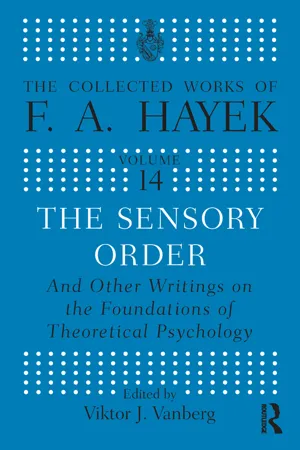
The Sensory Order, first published in 1952, sets forth F. A. Hayek's classic theory of mind in which he describes the mental mechanism that classifies perceptions that cannot be accounted for by physical laws. Hayek's substantial contribution to theoretical psychology has been addressed in the work of Thomas Szasz, Gerald Edelman, and Joaquin Fuster.
eBook - ePub
The Sensory Order and Other Writings on the Foundations of Theoretical Psychology
- 404 pages
- English
- ePUB (mobile friendly)
- Available on iOS & Android
eBook - ePub
The Sensory Order and Other Writings on the Foundations of Theoretical Psychology
THE “KNOWLEDGE PROBLEM” AS
THE INTEGRATING THEME OF
F. A. HAYEK’S OEUVRE
An Introduction to The Sensory Order
by Viktor J. Vanberg
by Viktor J. Vanberg
Among F. A. Hayek’s numerous publications, The Sensory Order (hereafter TSO) is undoubtedly the most unusual. After all, from someone known as an economist and social philosopher, one would hardly expect a treatise on the “Foundations of Theoretical Psychology.” And, indeed, to Hayek’s disappointment, for the first decades after its appearance, TSO received hardly any attention, neither from psychologists nor from social scientists. Psychologists did not suspect Hayek, the social theorist, to have anything important to contribute to their discipline, and Hayek’s colleagues in the social sciences did not expect his thoughts on “theoretical psychology” to be of relevance to their concerns.
True, several early reviewers took notice,1 and Hayek received a number of personal reactions from friends and colleagues. A sympathetic response to the unpublished typescript came from Ludwig von Bertalanffy.2 Erwin Schrödinger3 expressed his general agreement but voiced some reservations.4 John C. Eccles pointed to the complementarity of Hayek’s thoughts and his own neurophysiological theory but expressed his skepticism “in respect to the main thesis” of the book.5 In a long, encouraging letter, John Z. Young6 noted the affinity of Hayek’s thoughts to Donald O. Hebb’s neurophysiological theory,7 and in a short letter, Hebb acknowledged the agreement in the “general direction” of their respective approaches.8 Ye t all this fell far short of what Hayek had hoped for,9 and as he expressly stated, most disappointing for him was the reserved response of the two persons whose opinion he cared particularly about: Karl Popper and Konrad Lorenz.10
A turning point in the reception of TSO—reflected with some delay in the citation counts11—came in the 1980s, and it was Walter B. Weimer,12 a psychologist at Pennsylvania State University, who played some role in this.13 Weimer, who had come across Hayek’s book and recognized its relevance for the ongoing debate in cognitive psychology,14 wrote a letter to Hayek in the fall of 1976 saying: “Nearly a quarter of a century ago you published TSO. Now psychologists are quite slow, especially in recognizing anything of significance, but a few of us have taken notice of your work and the opinion is beginning to form that you have written a prolegomenon which is necessary for any future cognitive psychology.”15 The specific purpose of Weimer’s letter was to invite Hayek to a conference on “cognition and the symbolic process.”16 As he phrased it, “if there were any way in which we could persuade you to attend, and/or present some of your ideas, it would delight us and help spread the interest in your ‘other’ research.”17 The proceedings of the conference, which was held in May 1977 at Pennsylvania State University, including a panel on TSO, were finally published in 1982, with Weimer’s “Introduction to the Theoretical Psychology of TSO” (Weimer 1982) and Hayek’s contribution, “The Sensory Order after 25 Years.”18
Most significant for the increase in the attention TSO gained was the recognition Hayek’s contribution to theoretical psychology received from two prominent neuroscientists, Gerald Edelman19 and Joaquin M. Fuster.20 Fuster, a professor for Psychiatry and Biobehavioral Sciences at UCLA, had, already in the spring of 1976, written a letter to Hayek in which he stated:
For almost twenty years I have been engaged in research on the central nervous system at the University of California. … It is becoming obvious that the principles of classical sensory physiology (neurons specializing in external feature detection, etc.) are no longer applicable to the neuronal transactions that take place at cortical level. Instead, it appears that the theoretical principles enunciated by you in “TSO” are remarkably useful for understanding the neural and behavioral phenomena that we are observing. The concept of sensory “classification,” as you utilize it in your theoretical discourse, is the most appropriate that I have encountered for interpreting a variety of experimental data related to visual representation in the inferotemporal cortex. In fact, I have adopted your theoretical approach as part of the rationale for a new series of investigations of cortical neuron discharge which I am now undertaking.21
In his 1995 book, Memory in the Cerebral Cortex, Fuster publicly praised Hayek’s pioneering contribution to cognitive neuroscience:
The first proponent of cortical memory networks on a major scale was neither a neuroscientist nor a computer scientist but, curiously, a Viennese economist: Friedrich von Hayek (1899– 1992). … Although devoid of mathematical elaboration, Hayek’s model clearly contains most of the elements of those later models of associative memory … that, with their algorithms, have not come any closer than it does to solving those problems in a neutrally plausible manner. It is truly amazing that, with much less neuroscientific knowledge available, Hayek’s model comes closer, in some respects, to being neurophysiologically verifiable than those models developed 50 to 60 years after his. (Fuster 1995, 87ff.)22
In similar terms Gerald M. Edelman, recipient of the 1972 Nobel Prize in Physiology or Medicine, expressed his admiration for “Friedrich von Hayek, an economist who, as a young man, thought quite a bit about how the brain works” (Edelman 2004, 22). Having read TSO he remarked in 1982 about its author: “What impressed me most is his understanding that the key to the problem of perception is to comprehend the nature of classification. … I think the essence of his analysis still remains with us; the problem of perception, at the level of its necessary conditions, is a problem of classification.”23
It seems that the recognition Hayek’s psychological thoughts found in cognitive neuroscience24 was needed to alert economists to the fact that TSO may also deserve to be taken seriously by scholars whose primary interest is in Hayek’s economics and social philosophy. Even if it is still, as Caldwell diagnosed in 1997, “particularly among economists, Hayek’s least appreciated book” (1856), economists have begun to take notice of TSO—including Nobel Laureates Douglass North and Vernon Smith25—and the literature devoted to the subject is growing.26 Essentially two issues figure prominently in this literature. This is, on the one hand, the question of how Hayek’s contribution is to be assessed in light of the context of modern neuroscience and, on the other hand, the issue whether, and if so to what extent, Hayek’s thoughts on the “Foundations of Theoretical Psychology” must be regarded as an integral and foundational part of his oeuvre, a part that is important for a deeper understanding of his economic and social philosophy. As the present edition of TSO is part of Hayek’s Collected Works, it seems appropriate to concentrate in this introduction on the second issue. My aim is to show that TSO has, indeed, its systematic and highly significant place in the development of the socioeconomic paradigm that Hayek elaborated over the six decades of his active literary production. Before I turn to this task (in sections 4ff.), I shall first take a look at the genesis of TSO (section 1), its central problem (section 2), and its theoretical core (section 3).
1. The Origins and the Writing of TSO
With his reference to the fact that Hayek, “as a young man, thought quite a bit about how the brain works,” Edelman alludes to the essay “Beiträge zur Theorie der Entwicklung des Bewußtseins” that Hayek wrote in 1920, but that remained unpublished until quite recently.27 Hayek refers to this essay in his preface when he describes TSO as “the outcome of an idea which suggested itself to me as a very young man when I was still uncertain whether to become an economist or a psychologist” (115),28 adding: “The paper in which as a student more than thirty years ago I first tried to sketch these ideas, and which lies before me as I write, I was certainly wise not to attempt to publish at the time, even though it contains the whole principle of the theory I am now putting forward” (115).29
On several occasions Hayek has commented on the circumstances under which he wrote the essay, the purpose of which he described as “an attempt to create a basis for a general physiological explanation of consciousness phenomena by investigating the simplest conscious experiences, particularly those of a sensory nature, and explaining them in terms of the operation of established physiological laws” (321). In interviews he recalled that he “wrote most of that first draft” in the winter of 1919–20 in Zurich,30 where he “worked for a few weeks in the laboratory of the brain anatomist von Monakow,31 tracing fiber bundles through the different parts of the human brain” (Hayek 1994, 64), and audited lectures at the University of Zurich.32
Hayek’s early interest in physiological psychology,33 an area that seems far remote from the subjects of the works that made him famous, appears less surprising in light of his family background (Hayek 1994, 37ff.). As he described it: “I come from a purely biological tradition. My grandfather was … gymnasial professor in biology; my father was a botanist. My two brothers, one became an anatomist, the other a chemist.”34 Late in his life, Hayek would come to speak of himself as a “verpatzter Biologe”—a “would- be biologist”—who had been induced by the circumstances after WWI to shift his interest from his family’s natural science background to economics.35 One of the circumstances that caused his shift in interest was, as Hayek (1994, 44) puts it, the fact that the “great disturbances of war got me more interested in economics,” combined with his coming across Carl Menger’s Grundsätze der Volkswirtschaftslehre,36 the boo...
Table of contents
- Cover Page
- Halftitle
- Title Page
- Copyright Page
- Table of Contents
- Editorial Foreword
- The “Knowledge Problem” as the Integrating Theme of F. A. Hayek’s Oeuvre: An Introduction to The Sensory Order
- THE SENSORY ORDER: AN INQUIRY INTO THE FOUNDATIONS OF THEORETICAL PSYCHOLOGY
- Preface
- Table of Contents
- Introduction, by Heinrich Klüver
- I. The Nature of the Problem
- II. An Outline of the Theory
- III. The Nervous System as an Instrument of Classification
- IV. Sensation and Behavior
- V. The Structure of the Mental Order
- VI. Consciousness and Conceptual Thought
- VII. Confirmations and Verifications of the Theory
- VIII. Philosophical Consequences
- OTHER WRITINGS ON THE FOUNDATIONS OF THEORETICAL PSYCHOLOGY
- Contributions to a Theory of How Consciousness Develops
- What Is Mind?
- Within Systems and About Systems: A Statement of Some Problems of a Theory of Communication
- The Sensory Order after 25 Years
- Name Index
- Subject Index
Trusted by 375,005 students
Access to over 1.5 million titles for a fair monthly price.
Study more efficiently using our study tools.
Frequently asked questions
Yes, you can cancel anytime from the Subscription tab in your account settings on the Perlego website. Your subscription will stay active until the end of your current billing period. Learn how to cancel your subscription
No, books cannot be downloaded as external files, such as PDFs, for use outside of Perlego. However, you can download books within the Perlego app for offline reading on mobile or tablet. Learn how to download books offline
Perlego offers two plans: Essential and Complete
- Essential is ideal for learners and professionals who enjoy exploring a wide range of subjects. Access the Essential Library with 800,000+ trusted titles and best-sellers across business, personal growth, and the humanities. Includes unlimited reading time and Standard Read Aloud voice.
- Complete: Perfect for advanced learners and researchers needing full, unrestricted access. Unlock 1.5M+ books across hundreds of subjects, including academic and specialized titles. The Complete Plan also includes advanced features like Premium Read Aloud and Research Assistant.
We are an online textbook subscription service, where you can get access to an entire online library for less than the price of a single book per month. With over 1.5 million books across 990+ topics, we’ve got you covered! Learn about our mission
Look out for the read-aloud symbol on your next book to see if you can listen to it. The read-aloud tool reads text aloud for you, highlighting the text as it is being read. You can pause it, speed it up and slow it down. Learn more about Read Aloud
Yes! You can use the Perlego app on both iOS and Android devices to read anytime, anywhere — even offline. Perfect for commutes or when you’re on the go.
Please note we cannot support devices running on iOS 13 and Android 7 or earlier. Learn more about using the app
Please note we cannot support devices running on iOS 13 and Android 7 or earlier. Learn more about using the app
Yes, you can access The Sensory Order and Other Writings on the Foundations of Theoretical Psychology by F.A Hayek, Viktor J. Vanberg in PDF and/or ePUB format, as well as other popular books in Business & Business General. We have over 1.5 million books available in our catalogue for you to explore.