![]()
Chapter 1
Introduction
- The relation of Finnish to other languages
- Finnish and Finland, past and present
- The basic characteristics of Finnish
- What are the special difficulties?
1.1 The relation of Finnish to other languages
The Finnish language is a member of the Finno-Ugric language family. This is quite different from the Indo-European family, to which languages such as English, French, German, Russian, Swedish, Persian and Hindi belong. Only four of the major Finno-Ugric languages are spoken outside Russia: Finnish, Estonian, Hungarian and the Sámi (‘Lappish’) languages in the north of Finland, Norway and Sweden and the far north-west of Russia. The term Lappish is derogatory. The Sámi languages spoken in Finland are North Sámi, Inari Sámi and Skolt Sámi, with some 1,800 speakers altogether.
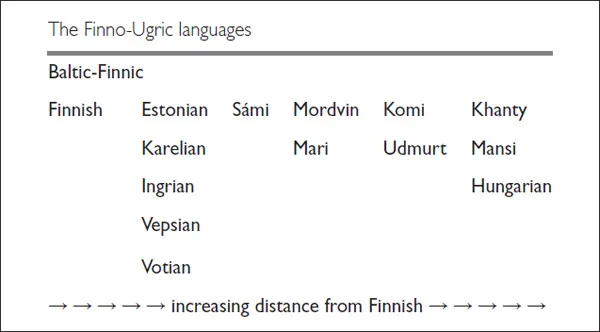
The languages most closely related to Finnish are Estonian, Karelian, Ingrian, Vepsian and Votian, which are all spoken around the south and east of the Gulf of Finland. Of these Finnic languages, Finnish and Estonian are spoken most widely. These two are so similar in grammar and vocabulary, so closely related, that after some practice Finns and Estonians can understand each other’s languages especially when they are spoken slowly. If we group together the other traditionally acknowledged Finno-Ugric languages according to their relations to each other and to Finnish, we have the following picture:
Finnish and Hungarian are thus quite distant from each other, and the relation between these two languages can only be established on historical linguistic grounds. Roughly speaking, Finnish is as far from Hungarian as English is from Persian.
Samoyed languages are spoken by a few small groups of people in the north of Russia, especially in western Siberia. The Finno-Ugric languages and the Samoyed languages constitute the Uralic language family. The number of speakers of Uralic languages varies considerably. Six Uralic languages have more than 500,000 speakers: Hungarian (14–15 million), Finnish (5.5 million), Estonian (1 million), Mordvin (800,000), Mari (500,000) and Udmurt (500,000). Komi has 350,000 and Karelian 35,000 speakers. Several Uralic languages have very few speakers, and their future is gravely endangered. This is true of all four remaining Samoyed languages (30,000), and of Khanty (10,000), Mansi (900), the ten Sámi languages spoken in the Nordic countries (60,000), Ingrian (300), Vepsian (4,000) and Votian (20).
Since 2010 Meänkieli (30,000), often considered a northern dialect of Finnish, is acknowledged as a national minority language in the northern Swedish province of Tornedalen. Likewise, from 2010 Finnish is acknowledged as a national minority language in certain areas of Sweden. Since 1997 Kven (5,000), an old dialect of northern Finnish, is a minority language in the northern Norwegian provinces of Tromsø and Finnmark.
1.2 Finnish and Finland, past and present
In early 2017 the size of Finland’s population was 5.5 million people. Finnish is the native language of 4.9 million people, 88.7 per cent of the population. There is a group of 290,000 Swedish-speaking Finns (5.3 per cent), who are guaranteed the same basic language rights as the Finnish-speaking majority by the country’s constitution, about 1,800 Sámi-speaking people, 10,000 Roma people (of whom some speak Romany; the language is gravely endangered), about 5,000 people using Finnish sign language as their first language and about a thousand Tatars (800 speakers at various levels of proficiency). More recent language minorities are Russian (725,000), Estonian (49,000), English (19,000), Somali (19,000) and Arabic (22,000). Some 500 languages were spoken in Finland at the end of 2016 by some 354,000 persons.
Finland is officially a bilingual country, whose national (i.e. official) languages are Finnish and Swedish. Waves of emigration have resulted in large Finnish-speaking minorities, particularly in North America (both the United States and Canada) and in Sweden. In Sweden today there are approximately 300,000 to 450,000 speakers of Finnish (at various levels of proficiency), i.e. about the same number as there are Swedish-speaking Finns in Finland. Because Finnish is an officially recognized minority language in Sweden with its own norm-issuing authorities, Finnish as a whole is a pluricentric language, i.e. a language with official status in more than one country.
The earliest archaeological remains unearthed in Finland ar...