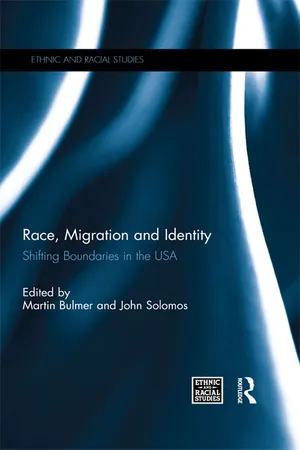
The chapters in this collection cover diverse aspects of the changing meanings and boundaries of race, migration and identity in the contemporary United States. The situation in the USA has been the subject of intense policy and political debate over the past decades and the papers in this volume provide an important insight from a wide range of analytical perspectives. They provide an insight into the changing dynamics of race and migration in the contemporary environment, combining conceptual analysis with original empirical research. The concerns of this volume address global questions of relevance as well as those specific to the USA. This book was originally published as a special issue of Ethnic and Racial Studies.
- 208 pages
- English
- ePUB (mobile friendly)
- Available on iOS & Android
eBook - ePub
About this book
Information
Introduction
Over the five decades since its foundation, Ethnic and Racial Studies has provided a space for the publication of the latest research by scholars of race, ethnic relations and racism. In this Themed Issue of the journal, we have included nine papers which cover diverse aspects of the changing meanings and boundaries of race, migration and identity in the contemporary USA. Although we make no claim that the various papers share a common analytical frame or empirical focus we hope they highlight some key themes in the current scholarship and research. All the papers included here draw on original empirical research and address questions of relevance globally as well as in relation to the USA.
Race, migration and identity are common themes which run through all the papers in this thematic issue. The first paper by Carlos Vargas-Ramos provides an insight into the shifting patterns of racial identification among Puerto Rican migrants to the USA. Vargas-Ramos explores in particular the ways in which conceptions of whiteness and race are not fixed and change through the process of migration. This theme of shifting conceptions of race and migrant status is also addressed by Takeyuki Tsuda and Anthony Ocampo. Tsuda’s paper focuses on the mobilisation of ideas of racial citizenship among later-generation Japanese Americans. Tsuda highlights the tension between the search for inclusion and the experience of being racialised others in American society. Ocampo’s study of second-generation Filipinos links up in some ways with Tsuda’s account, although it is interesting to note that there are differences in the experiences of Japanese and Filipino Americans.
This group of papers is followed by a study by Richard Alba, Tomas Jimenez and Helen Marrow on Mexican Americans and intragroup heterogeneity. The authors draw on the experience of Mexican Americans to emphasise the need to look at specific migrant groups as intrinsically diverse in both history and contemporary composition. Frank Samson’s paper is also focused on Latino immigrants, in particular the ways in which their political opportunities are shaped by racialised processes. Samson’s account outlines the importance of segmented political assimilation in the context of partisan political identification. The paper by Deenesh Sohoni and Jennifer Medez focuses on new areas of migrant settlement in order to explore the ways in which ethnic and migrant boundaries are being reconfigured.
A somewhat different angle is provided by Carol Walther’s analysis of the role of ideas about skin tone in the selection of sperm donors. Although this paper is more specific in focus, it highlights the complexities of biracial and tri-racial stratification among sperm donors.
The final two papers in this issue focus on the shifting boundaries of race in contemporary US society. Cortney Warren focuses on ideas of physical body appearance among white, black and Latina college students. The final paper in the issue is by Douglas Massey and Jayanti Owens and focuses on an analysis of mediators of stereotype threat among black college students. These papers reflect the tendency of research to be conducted among ethnic minority students in the higher education sector.
This themed issue will be followed later in the year by another themed issue that will focus on questions about race and ethnicity in UK society. We hope that the two issues taken together will provide an opportunity for readers to think about similarities and differences between the two societies, thereby advancing the cause of comparative sociology.
Martin Bulmer
University of Surrey
University of Surrey
John Solomos
University of Warwick
University of Warwick
Migrating race: migration and racial identification among Puerto Ricans
Carlos Vargas-Ramos
Abstract
The pattern of racial identification among Puerto Ricans is not uniform. It varies depending on where they live. Most identify as white, but more do so in Puerto Rico than in the USA. This paper addresses the impact that living alternatively in the USA and in Puerto Rico has on racial identification among Puerto Ricans. Using Public Use Microdata Sample data from the American Community Survey and the Puerto Rico Community Survey 2006-2008, I find that while there is no single pattern of impact, those more grounded on the island’s racial system are more likely to identify as white in the USA, while those less grounded in Puerto Rico are more likely to identify as multiracial or by another racial descriptor. On their return to the island, they revert to the prevalent pattern of racial identification, while still exhibiting effects of their sojourn on their racial identity.
Census data on Puerto Ricans and race manifest the contingent nature of racial identity and identification and how specific racial formations impact an individual’s understanding of race and racial identification. Despite contemporary projections of Puerto Ricans as a multiracial people (Dávila 1997), in fact a mulatto nation (Torres 1998; Duany 2002), the majority of Puerto Ricans portray themselves as white in the context of official statistics. This is the case for both Puerto Ricans on the island and in the USA. Their location, however, determines the proportions by which they identify as white or as something else.
Presently, more than half of the 8.3 million people who identify as Puerto Ricans live in the USA. Moreover, there is a recurrent movement of migrants between the island and the USA, with net migration reaching the hundreds of thousands between decades (Rivera-Batiz and Santiago 1996; Duany 2002; Acosta-Belén and Santiago 2006). Understandings of race and racial identification are likely to be challenged when migrants change social milieus with contrasting or conflicting racialization experiences. Considering the large and recurrent population movement between Puerto Rico and the USA, it is pertinent then to address how a people may be impacted when a large segment of the population is exposed to an alternative system of racial understanding.
Census data serve to illustrate how individuals adapt to different racial formations given the importance of census-based racial identification in shaping public policies and racial representations. These official statistics highlight how differently race is constructed by Puerto Ricans on the island and in the USA, and how specific individuals (i.e. migrants) behave when facing the census.
Responding to the race question in US Census Bureau questionnaires presents a specific contextual moment that reflects practices of racial self-representation in both Puerto Rico and the USA. Engaging this race question is a paradigmatic exercise in the process ‘by which racial meanings are decided, and racial identities are assigned, in a given society’ (i.e. racial formation) (Winant 1992, p. 183). Race has been a crucial factor in the USA since its founding. The question on race continues to be included in census questionnaires in the USA because of congressional mandates to monitor compliance with federal civil rights legislation (Nobles 2000). For Puerto Rico, the question on race was only incidentally reintroduced in census questionnaires in 2000 after the local government requested the US Census Bureau treat Puerto Rico as a state for the purposes of data collection and analysis, not because of specific concerns over the protection of civil rights of racial minorities. Consequently, the Census Bureau used the same questionnaire it used in the USA, but translated into Spanish.
In 2000, people in Puerto Rico had the first opportunity to engage in an extraneous bureaucratic process of racial self-representation in which they could declare, in the privacy of their own home, beyond immediate social scrutiny, their own racial identity but according to categories determined by governmental agencies outside their specific cultural setting. Prior to that year, race was established and recorded by a government agent (i.e. enumerator). In the USA, racial self-identification in the privacy of one’s home was introduced in 1980. Under these circumstances, people on the island overwhelmingly identified as white; in the USA, people of Puerto Rican origin or descent responded differently.
A racial statistics puzzle
In 2010, more than three-quarters of people in Puerto Rico identified as white. Most Puerto Ricans in the USA also identified as white, but only among 53 per cent of the population (Table 1). The difference of more than twenty percentage points among those who identified as white on the island and in the USA is wide; just as wide as the difference among those who did not choose one of the racial categories offered by the Census Bureau in its questionnaires. Whereas only 8 per cent of Puerto Ricans on the island identified with some other race, 28 per cent did so in the USA. Much smaller differences were observed among those identifying as black, Asian or American Indian or with two or more races (i.e. multiracial)....
Table of contents
- Cover
- Half Title
- Series
- Title
- Copyright
- Contents
- Citation Information
- Notes on Contributors
- 1. Introduction
- 2. Migrating race: migration and racial identification among Puerto Ricans
- 3. ‘I’m American, not Japanese!’: the struggle for racial citizenship among later-generation Japanese Americans
- 4. Are second-generation Filipinos ‘becoming’ Asian American or Latino? Historical colonialism, culture and panethnicity
- 5. Mexican Americans as a paradigm for contemporary intra-group heterogeneity
- 6. Segmented political assimilation: perceptions of racialized opportunities and Latino immigrants’ partisan identification
- 7. Defining immigrant newcomers in new destinations: symbolic boundaries in Williamsburg, Virginia
- 8. Skin tone, biracial stratification and tri-racial stratification among sperm donors
- 9. Body area dissatisfaction in white, black and Latina female college students in the USA: an examination of racially salient appearance areas and ethnic identity
- 10. Mediators of stereotype threat among black college students
- Index
Trusted by 375,005 students
Access to over 1.5 million titles for a fair monthly price.
Study more efficiently using our study tools.
Frequently asked questions
Yes, you can cancel anytime from the Subscription tab in your account settings on the Perlego website. Your subscription will stay active until the end of your current billing period. Learn how to cancel your subscription
No, books cannot be downloaded as external files, such as PDFs, for use outside of Perlego. However, you can download books within the Perlego app for offline reading on mobile or tablet. Learn how to download books offline
Perlego offers two plans: Essential and Complete
- Essential is ideal for learners and professionals who enjoy exploring a wide range of subjects. Access the Essential Library with 800,000+ trusted titles and best-sellers across business, personal growth, and the humanities. Includes unlimited reading time and Standard Read Aloud voice.
- Complete: Perfect for advanced learners and researchers needing full, unrestricted access. Unlock 1.5M+ books across hundreds of subjects, including academic and specialized titles. The Complete Plan also includes advanced features like Premium Read Aloud and Research Assistant.
We are an online textbook subscription service, where you can get access to an entire online library for less than the price of a single book per month. With over 1.5 million books across 990+ topics, we’ve got you covered! Learn about our mission
Look out for the read-aloud symbol on your next book to see if you can listen to it. The read-aloud tool reads text aloud for you, highlighting the text as it is being read. You can pause it, speed it up and slow it down. Learn more about Read Aloud
Yes! You can use the Perlego app on both iOS and Android devices to read anytime, anywhere — even offline. Perfect for commutes or when you’re on the go.
Please note we cannot support devices running on iOS 13 and Android 7 or earlier. Learn more about using the app
Please note we cannot support devices running on iOS 13 and Android 7 or earlier. Learn more about using the app
Yes, you can access Race, Migration and Identity by Martin Bulmer,John Solomos in PDF and/or ePUB format, as well as other popular books in Social Sciences & Sociology. We have over 1.5 million books available in our catalogue for you to explore.