![]()
Introduction
Martin Bulmer and John Solomos
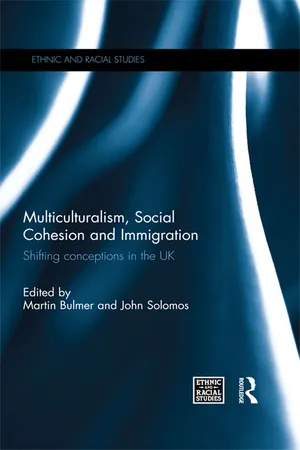
This themed issue brings together a range of papers that explore the changing dynamics of multiculturalism, social cohesion and immigration in contemporary British society. The past two decades have seen intense debate about these issues both within governmental and political institutions as well as in the wider society. Indeed it can be argued that since 2001 no other set of issues has attracted as much attention within British society as a whole as well as in the major cities and urban conurbations. There has been intense public debate about the changing boundaries of culture and identity in an increasingly ‘super-diverse’ environment. Linked to this debate has been the continuing preoccupation with the impact of immigration on social cohesion and community relations. This is a preoccupation, as Alana Lentin usefully highlights in her contribution to this themed issue, that can be seen across a diverse range of societies apart from the UK. It has been the subject of both policy-related and media debates, focusing on both national as well as more local issues.
Although all the papers in this volume were accepted through our regular peer review process, we felt that there would be some added value in bringing them together in a themed issue that highlights both the linkages between the papers as well as the diversity of issues that they cover. The first two papers provide an overview of key themes and debates and outline some of the wider processes at the heart of contemporary debates. Alana Lentin’s paper is a critical exploration of debates about post-race, post-politics and multiculturalism. It covers a range of societies and does not limit itself to the situation in the UK, although the specificities of the British experience are part of her analytical frame. Lentin’s account of contemporary debates about ‘post-race’ and ‘multiculturalism’ helpfully situates contemporary debates within a broader analytical and political frame. This is followed by a paper by Patrick Sturgis, Ian Brunton-Smith, Jouni Kuha and Jonathan Jackson that is concerned with the question of ethnic diversity, segregation and the social cohesion of neighbourhoods in London. This is a question that has come to the fore in global cities such as London over the past two decades as they become ‘super-diverse’. The paper by Sturgis et al. questions some of the commonly held assumptions about the relationship between ethnic diversity and social cohesion. In testing this relationship empirically they are able to add to the discussion that has been initiated by the work of Robert Putnam among others on this issue.
The opening two papers are followed by two empirically focused accounts of the shifting dynamics of interethnic relations within British society. Thomas Fletcher and Karl Spracklen provide a nuanced insight into the cultural interactions, often involving alcohol, within the culture of cricket that symbolize the boundary of inclusion and exclusion of British Pakistani Muslims in the sport. Drawing on an in-depth ethnographic account, Fletcher and Spracklen provide an insight into the role of everyday cultural practices in shaping and challenging ethnic and racial boundaries. The next paper by James Laurence follows up on this account of cricket by exploring more generally the ‘contact and threat hypothesis’ as an analytical tool for understanding the complexities of ethnic diversity in the UK. Eschewing easy simplifications, Laurence argues that with increasing patterns of diversity it is likely that processes of threat and contact may be occurring at the same time. His account highlights the need for more systematic research in order to better understand the complexities of contact between ethnic groups in specific settings.
The next two papers focus on the changing dynamics of national identity formation in one part of the UK, namely Scotland. The paper by Frank Bechhofer and David McCrone provides an overview of the willingness of the Scots and the English to accept claims to national identity by people born elsewhere. Drawing on research in the contemporary political environment, they seek to understand the role that divergent political institutions in Scotland and England have had on the acceptance or rejection of claims to national identity. This is followed by Lani Russell’s paper, which explores the ways in which the introduction of diversity management in a Glasgow workplace is seen through the lens of whiteness. The construction of whiteness in all various forms has taken a range of forms in the UK and this study provides an insight into the complexities of meaning attached to whiteness as a symbolic category.
The experiences of specific communities provide the common focus of the next two papers. The paper by Bin Wu and Hong Liu is an exploration of the ways in which class consciousness and solidarity among Chinese migrant workers in Italy and the UK has evolved and changed. The comparative focus of the research brings out some important differences as well similarities in the construction of class identity. The paper by Marco Giudici focuses on the position of Italians in post-devolution Wales. Giudici’s account analyses the shifting language about migration and national identity in Wales at a time when questions about nation-formation intersect with other claims to identity.
The concluding two papers in this themed issue focus more specifically on the situation in England. Tom Vickers moves away from the institutional focus in others papers by looking at the ways in which anti-racist activists have engaged with the issue of asylum rights organizing in England. His account situates anti-racist mobilization within a wider social and political context. The final paper by Charles Leddy-Owen focuses on the ways in which both essentialized and precarious English identities are expressed in the contemporary social and cultural environment.
As Editors of Ethnic and Racial Studies, we remain impressed by the quality of scholarship and research that is being carried out in this fast-evolving field of scholarship. We are also aware that the subjects that we cover in this journal are ones that require a range of theoretical perspectives and methods if we are to understand the changing dynamics of contemporary societies. We hope that the papers included in this themed issue help to advance our understanding of what is happening in the UK and in other societies.
![]()
Post-race, post politics: the paradoxical rise of culture after multiculturalism
Alana Lentin
Declarations of the end of race ignore the continuing impact of racism upon socio-economic inequality in ‘racial states’. Nevertheless, the idea of post-racialism has gained ground in a post-9/11 era, defined by a growing suspicion of diversity. Clearly racialized, this suspicion is couched in cultural-civilizational terms that attempt to avoid the charge of racism. Hence, attempts to counteract the purported failure of multiculturalism in Europe today pose culturalist solutions to problems deemed to originate from an excess of cultural diversity. This is part of a deepening culturalization of politics in which the post-race argument belongs to a post-political logic that shuns political explanations of unrest and widening disintegration in favour of reductive culturalist ones. The culturalization of politics is elaborated by relating it to the displacement of the political that originated with the nineteenth-century ascendance of race, thus setting ‘post-racialism’ firmly within the history of modern racism.
Introduction
Arguments on both sides of the political spectrum have been heard over recent times in support of the idea that society is ‘post-race’ (Gallagher 2008). The election of Barack Obama to the US Presidency in 2008, for example, has been taken by those on both the left and the right to mean that race has ceased to pose a barrier to opportunity. For the centre left, this is a good thing that convinces us of its intrinsic non-racialism and sustains the general belief that racism is mainly an irrationality now overcome. For those on the right, Obama’s election and other examples of minority successes, prove not only that racism was overblown but that, due to the unjustified support given to minorities in the wake of civil rights in the USA, those who are really discriminated today are members of the displaced white majority.
Theoretically, these debates are inscribed in the discourse of racelessness (Goldberg 2002) that seeks to relativize racism and downplay the salience of its experience for non-whites. The post-race argument is not equivalent to one that would advocate for a post-racist society. The proponents of the post-race stance do not claim that race is no longer an issue because racial equality has been attained. For many among them, racial equality is well off their list of priorities; for others, including anti-affirmative action lobbyists such as the Republican African-American Ward Connerly, it is actually hindered by ‘harping on’ about race. Both dismiss the claims of the racialized as ‘political correctness’. Furthermore, they see these claims as hegemonic, superseding those of the (for some more legitimate) white majority and leading to ‘reverse racism’, of which Barack Obama’s election is the ultimate proof.
Left-liberal opponents of this right-wing stance nonetheless sustain the post-race argument by using Obama’s election or the fact of the existence of a black middle class to downplay racism. Their belief in the equality afforded by the ideal of meritocracy and the proof that (some) non-whites have now benefited from it blinds them to the racial discrimination that continues for most racialized people unaffected by the social mobility of a few of their numbers. As argued on This Week in Race (2009):
If the disproportionate levels of success in the White community are not rooted in hard work and merit, then what could possibly account for the discrepancy? The answer, of course, is systemic imbalance and a fundamental lack of justice, which, naturally, is difficult for Whites to embrace, since it calls into question their privilege.
While these debates are most prominent in the USA (Hollinger 2011), they have their variants across the west. The idea of postracialism is most closely allied to the orthodoxy that multiculturalism has failed, and that overly tolerant approaches to cultural difference has fuelled separation and encouraged extremism among racialized groups.
The success of the post-racial idea, from both its right- and left-wing perspectives, in entering common sense has nonetheless been accompanied by the spread of overtly racist political declarations and policies from Arizona to Amsterdam, leading us to question the extent to which these societies are truly beyond race. The expulsion of the Roma from France in the summer of 2010 and their ongoing trouncing in the encampments of Naples (Aradau 2009); the imposition of headscarf and burka bans in France and the Netherlands; the proposition to reverse the EU Schengen agreement in the face of the flight of North African migrants during the ‘Arab Spring’ of 2011; the introduction of racial profiling to curb ‘illegal’ migration in the state of Arizona; and the deaths of ‘failed’ asylum seekers in detention and deportation that continue to punctuate the race-related news are but some recent examples. These increasingly normalized events are juxtaposed with the by now de rigeur distancing from multiculturalism expressed by political leaders across Europe, Australia and Canada that serve, unwittingly perhaps but conveniently, to buttress such overtly racist policy. When British Prime Minister David Cameron (BBC News Online 2011) claims that multiculturalism has failed because it has led to the toleration of ‘these segregated communities behaving in ways that run counter to our values’, specifying Muslim organizations who fail to tackle extremism, he legitimates the heightened suspicion, disciplining and exclusion of racialized minorities, in particular Muslims, who are deemed to pose an internal threat to the security and moral integrity of western nations.
While it may appear paradoxical that these incidences of racism coexist with examples of racism overcome – the election of a black president in the US most notably – I argue that the notion that we are post-racial is in fact the dominant mode in which racism finds discursive expression today across a variety of contexts. Whereas post-racialism has been interpreted from a variety of perspectives, including the anti-racist vision of a non-racial future (cf. Gilroy 1998), the post-racial as I am using the concept, refers to the ways in which, by bypassing or denying race as an adequate means of making sense of discrimination, we risk ignoring how allied concepts such as culture and diversity have been incorporated into the denial of the significance of racism. Above all, the declaration of the death of multiculturalism, repeatedly reiterated by European political leaders, the liberal intelligentsia and the mainstream press in recent years, should be understood as inscribed in a post-racial logic that both disaggregates the problem of ‘too much diversity’ (Goodhart 2004) from racism and purportedly heralds in a new era in which the excessively tolerated subjects of multicultural generosity have, to paraphrase Enoch Powell, come to hold the ‘whip hand’ over the white majority.
In order to makes sense of these shifts, narrow interpretations of race need to be enlarged to encompass the ways in which race and racism, culture and culturalism have become intertwined or, in some cases, made interchangeable. Culture, which as Robert Young (1995) reminds us has always been racial and vice versa, is naturalized to work like race from the anti-multiculturalist perspective, a phenomenon already observed by Martin Barker (1981) in his work on the new culturalist racism that emerged in tandem with Thatcherism in the UK in the early 1980s. Currently, the proposed replacement of multiculturalism with ‘integration’ should be understood therefore not as a critique of highly criticizable multiculturalist policies, but of lived multiculture per se; that is of the racial/ethnic/cultural diversity, or what some have described as the multiculturality (Parekh 1999), of post-immigration societies. The debate on multiculturalism can be understood as being inscribed in a post-racial logic because those who oppose multiculturalism see it as having been imposed by racial and ethnic minoritieswhose demands for recognition were prioritized over all other concerns. Proponents of this point of view oppose any action taken to point out or alleviate discrimination against the racialized as discriminating against the majority of whites, portrayed as excluded by hegemonic elites intent on pushing a guilt-assuaging multiculturalist agenda (Bruckner 2010). Taking this approach is said to be vindicated by the evidence of ‘homegrown’ terrorists and other ungrateful dissenters who have benefited from such generosity only to use it against their benevolent, if naïve, hosts.
Despite the attack on multiculturalism, solutions to societal problems said to emanate from an excess of culture of the ‘wrong kind’, are themselves proposed in culturalized terms. Rather than interpret the problems that have been attributed to permissive multiculturalism and excessive ethno-racial diversity as political, economic or social in origin – for example as a response to the effects of de-industrialization, foreign policy or institutionalized discrimination – they have been overwhelmingly regarded as cultural and therefore resolvable only through culture. This may be understood as being due to a culturalization of politics in which cultural, rath...