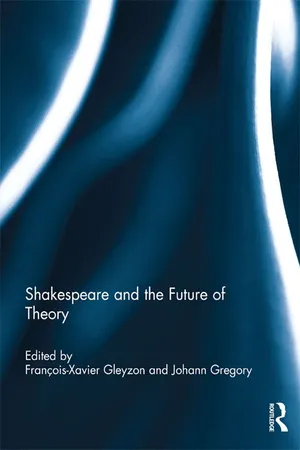
Shakespeare and the Future of Theory convenes internationally renowned Shakespeare scholars, and scholars of the Early Modern period, and presents, discusses, and evaluates the most recent research and information concerning the future of theory in relation to Shakespeare's corpus. Original in its aim and scope, the book argues for the critical importance of thinking Shakespeare now, and provides extensive reflections and profound insights into the dialogues between Shakespeare and Theory. Contributions explore Shakespeare through the lens of design theory, queer theory, psychoanalysis, Derrida and Foucault, amongst others, and offer an innovative interdisciplinary analysis of Shakespeare's work. This book was originally published as two special issues of English Studies.
- 200 pages
- English
- ePUB (mobile friendly)
- Available on iOS & Android
eBook - ePub
Shakespeare and the Future of Theory
About this book
Information
Thinking through Shakespeare: An Introduction to Shakespeare and Theory
Johann Gregory and François-Xavier Gleyzon
Shakespeare continues to write us.1
“Shakespeare and Theory”—where to begin? “[T]here is no period so remote as the recent past”, Irwin declares in Alan Bennett’s play, The History Boys.2 Let’s start there. Why not return to the London Olympics 2012? Let’s zoom in to the beginning of the opening ceremony, entitled “The Isles of Wonder”. The actor Kenneth Branagh—on a green hillock of Peter Jackson’s Shire—is dressed as the Industrial Revolution’s engineer, Isambard Kingdom Brunel. The soundtrack: Edward Elgar’s “Nimrod” variation. The text: William Shakespeare’s The Tempest. In a play within a play, Branagh, dressed in nineteenth-century top hat and black suit, speaks to an audience of similarly dressed men triumphantly:
Be not afeard. The isle is full of noises,
Sounds, and sweet airs, that give delight and hurt not.
Sometimes a thousand twangling instruments
Will hum about mine ears, and sometimes voices
That if I then had waked after long sleep
Will make me sleep again; and then in dreaming
The clouds methought would open and show riches
Ready to drop upon me, that when I waked
I cried to dream again. (The Tempest, 3.2.130–8)3
Branagh’s sentimentalising tone was not dissimilar to Henry V’s “St Crispin’s Day” speech in his film: a rousing speech written by the Bard of Avon, spoken by a famous British knighted actor who “brings to life”, as the television commentator put it, a famous British civil engineer (who had in fact commissioned his own “Shakespeare Room”4 ), and accompanied by the music of a British composer.5 How very British. What a “delight”! The London Mayor, Boris Johnson, admitted, “I don’t blub much, but there were tears from the beginning last night.”6 In the aftermath of the ceremony, viewers, journalists, bloggers and tweeters attempted to make sense of it all.
Critics who admit to taking an openly theoretical approach to Shakespeare—and many others—will attest that whenever we speak, write or act we always say, write or do more than we mean to. As Catherine Belsey writes in Shakespeare in Theory and Practice, “[j]ust as in daily life we commonly signify more than we intend, give ourselves away so the saying goes, so texts too may reveal more than their authors supposed.”7 This is the problem and joke of Alice’s predicament at the Mad Hatter’s Tea Party: she hopes that “say[ing] what you mean” is “the same thing” as “mean[ing] what you say.”8 There was a similar abundance of signification during the opening of the Olympic ceremony. One web user insisted in a comment on a blog post concerning the performance of the speech, “I think people posting on here analyse something that is not meant to be analysed so much. The Olympic ceremony was just meant to convey a potted history of Britain, with no hidden meanings or special messages intended.”9 However, the point with the ceremony was not so much what it was using Shakespeare to try to say, but what it failed, or chose not, to give voice to. Tellingly, the London Mayor conceded in an interview, “there wasn’t much about empire but you know, hey, maybe that wouldn’t have been entirely that right thing to shove in there.”10 USA Today reported on the Shakespeare speech:
For Shakesepeare [sic] expert James Shapiro, an English professor at Columbia University, it was a strange choice.
Shapiro says the lines were taken from Caliban’s speech in one of Shakespeare’s final plays, The Tempest. Caliban, a half-man, half-beast, says the words when he’s about to kill a colonialist ruler who took the Isles [sic] away from Caliban.
“Why you would choose Caliban’s lines as—in a sense—a kind of anthem for the Olympics, I’m not sure,” Shapiro said. “If you gave those lines some thought, especially in the light of the British Empire, it’s an odd choice.”
The lines are quite beautiful, and I guess they wanted to rip them out of context and talk about how magical a place the British Isles are.11
As the USA Today phrases it, the selection was “strange”—Shakespeare’s word for the uncanny.12 For a literary critic, theorist or English literature student with an ounce of post-colonial theory, Branagh’s Mad-Hatter performance at this moment in the ceremony will undoubtedly be seen as uncanny, recognisable yet uncomfortable, familiar and strange. Shakespeare’s text goes on meaning more than intended by the ceremony organisers here especially because more openly theoretical readings of Shakespeare were apparently ignored.13
The Tempest has been read by critics, theatre directors, playwrights and theorists as a powerful space to think through (post-)colonial situations.14 In Caliban’s Voice, Bill Ashcroft writes:
Interestingly, the possibilities for reading this play in terms of the political and cultural relationship between Caliban and Prospero date from the last century. J.S. Phillpot’s introduction to the 1873 Rugby edition of Shakespeare [published just fourteen years after Brunel’s death] notes that “The character may have had a special bearing on the great question of a time when we were discovering new countries, subjecting unknown savages, and founding fresh colonies.”15
Given the possibilities of thinking through Shakespeare, what makes the selection “odd”, as Shapiro phrases it, then, is not that Shakespeare was chosen to provide an anthem for the Olympic Games—after all, as Terence Hawkes proposes, so often, “Shakespeare doesn’t mean: we mean by Shakespeare.”16 But, for the Olympics, the speech involved Caliban’s voice and dream being re-appropriated to articulate a dream to do with British history and culture that systematically glossed over and repressed Britain’s colonial past. Stephen Greenblatt commented in his famous reading of The Tempest in Learning to Curse that the “rich, irreducible concreteness of the verse compels us to acknowledge the independence and integrity of Caliban’s construction of reality”: the play does not invite us to “sentimentalize this construction … but we cannot make it vanish into silence”.17 The sentimental use...
Table of contents
- Cover
- Half Title
- Title
- Copyright
- Contents
- Citation Information
- Notes on Contributors
- 1. Thinking through Shakespeare: An Introduction to Shakespeare and Theory
- 2. Shakespeare by Design: A Flight of Concepts
- 3. Of Cause
- 4. “After the Takeover”: Shakespeare, Lacan, Žižek and the Interpassive Subject
- 5. Wordplay in Shakespeare’s Hamlet and the Accusation of Derrida’s “Logical Phallusies”
- 6. Storm at Sea: The Tempest, Cultural Materialism and the Early Modern Political Aesthetic
- 7. Listening to the Body …: Transitioning to Shakespeare and Theory
- 8. Performing Disability and Theorizing Deformity
- 9. Ship of Fools: Foucault and the Shakespeareans
- 10. “Untimely Ripp’d”: On Natality, Sovereignty and Unbearable Life
- 11. Syllogisms and Tears in Timon of Athens
- 12. Opening the Sacred Body or the Profaned Host in The Merchant of Venice
- Index
Trusted by 375,005 students
Access to over 1.5 million titles for a fair monthly price.
Study more efficiently using our study tools.
Frequently asked questions
Yes, you can cancel anytime from the Subscription tab in your account settings on the Perlego website. Your subscription will stay active until the end of your current billing period. Learn how to cancel your subscription
No, books cannot be downloaded as external files, such as PDFs, for use outside of Perlego. However, you can download books within the Perlego app for offline reading on mobile or tablet. Learn how to download books offline
Perlego offers two plans: Essential and Complete
- Essential is ideal for learners and professionals who enjoy exploring a wide range of subjects. Access the Essential Library with 800,000+ trusted titles and best-sellers across business, personal growth, and the humanities. Includes unlimited reading time and Standard Read Aloud voice.
- Complete: Perfect for advanced learners and researchers needing full, unrestricted access. Unlock 1.5M+ books across hundreds of subjects, including academic and specialized titles. The Complete Plan also includes advanced features like Premium Read Aloud and Research Assistant.
We are an online textbook subscription service, where you can get access to an entire online library for less than the price of a single book per month. With over 1.5 million books across 990+ topics, we’ve got you covered! Learn about our mission
Look out for the read-aloud symbol on your next book to see if you can listen to it. The read-aloud tool reads text aloud for you, highlighting the text as it is being read. You can pause it, speed it up and slow it down. Learn more about Read Aloud
Yes! You can use the Perlego app on both iOS and Android devices to read anytime, anywhere — even offline. Perfect for commutes or when you’re on the go.
Please note we cannot support devices running on iOS 13 and Android 7 or earlier. Learn more about using the app
Please note we cannot support devices running on iOS 13 and Android 7 or earlier. Learn more about using the app
Yes, you can access Shakespeare and the Future of Theory by François-Xavier Gleyzon,Johann Gregory in PDF and/or ePUB format, as well as other popular books in Literature & Literary Criticism. We have over 1.5 million books available in our catalogue for you to explore.