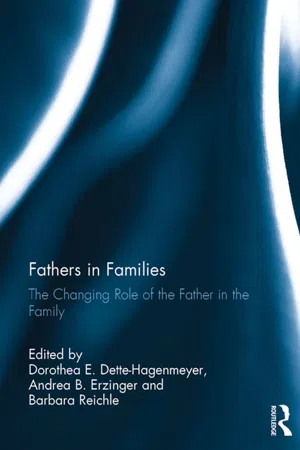
The role of the father in a family and for his children has varied greatly throughout history. However, scientific research into fatherhood began relatively late at the end of the 1960s and early 1970s, with a strong focus on the impact of the father on child development. This book focuses on the role of the father in the contemporary two-parent heterosexual family. Of eight longitudinal studies from several Western countries, six focus on the socialization outcomes of the children, and two concentrate on parental satisfaction. Although the father is in focus, family dynamics cannot be conclusively described without a look at the mother and parental interaction. Therefore, all of the studies examine mothers and their role in the family system. Thus, the book gives a contemporary insight into the father and his role in changing family dynamics. This book was originally published as a special issue of the European Journal of Developmental Psychology.
eBook - ePub
Fathers in Families
The Changing Role of the Father in the Family
- 160 pages
- English
- ePUB (mobile friendly)
- Available on iOS & Android
eBook - ePub
Fathers in Families
The Changing Role of the Father in the Family
About this book
Information
Family structure, maternal employment, and change in children’s externalizing problem behaviour: Differences by age and self-regulation
Natasha J. Cabrera, Sandra L. Hofferth, and Gregory Hancock
Human Development and Quantitative Methodology, University of Maryland, College Park, MD, USA
This study used a latent difference score growth model to investigate how changes in family structure (biological father and stepfather residence) and maternal employment are associated with American children’s externalizing problem behaviours (EPB) from ages 4–10 and whether these associations vary by children’s level of self-regulation. For all 4-year-old children, living with a biological father at age 4 was associated with reductions in EPB at ages 4–6 and later years, with no variation by child self-regulation. Living with a stepfather at age 4 was associated with higher levels of EPB at age 4; however, for less-regulated children, stepfather residence at ages 4 and 8 was associated with reductions in EPB between ages 4–6 and 8–10, respectively. Greater employment hours were associated with increased EPB in the next 2 years for less-regulated children of all ages; however, except for the age 4–6 transition, there was a lagged association that reduced behaviour problems after 2 years and outweighed short-term increases.
Research on American school-age children and adolescents shows increased levels of externalizing problem behaviour (EPB) from low levels in the 1970s to high levels in 1999 (Achenbach, Dumenci, & Rescorla, 2003; Collishaw, Gardner, Maughan, Scott, & Pickles, 2012). These rates are alarming, given that EPB is the most common and persistent form of childhood maladjustment with long-term lasting effects (Campbell, 1995; Campbell, Shaw, & Gilliom, 2000). Although the causes of this increase include multiple individual and family-level factors, the centrality of the home in children’s development is undisputable. The psychological literature has rightly focused on the parent–child relationship as an important contributor to children’s behaviour. Other aspects of the home have received less attention in the psychological literature, but have emerged in the sociological literature as important influences on US children’s development, namely maternal employment and family structure (e.g., father/stepfather residence). Recently, these aspects of family life have undergone dramatic shifts. From the 1970s to 1990s, the labor force participation of married mothers with a preschool age child increased from 37% in 1975 to 62% in 2009 and the proportion of children living with a biological mother and father declined from 77% in 1980 to 59% in 2010 (U.S. Census Bureau, 2012). These family structure changes (e.g., fathers exit or step fathers enter the family) as well as changes in maternal employment are important to consider in understanding changes in children’s behaviours because they are likely to reduce the amount and quality of time parents have with their children, which may disrupt behaviour especially for children with limited regulatory skills (Bachman, Coley, & Carrano, 2011; Grusec, 2011; Rubin, Burgess, Dwyer, & Hastings, 2003).
Research linking family structure and maternal employment to children’s EPB is limited in several ways. First, research on maternal employment focuses on the first years of life and pays less attention to the later childhood period (Han, Waldfogel, & Brooks-Gunn, 2001). Second, although research has shown that father residence in early childhood is linked to children’s adjustment in adolescence (Cabrera, Cook, McFadden, & Bradley, 2012), less is known about how father residence might be linked to children’s EPB across the early childhood period, especially during transitional periods which represent change and turmoil for some children (Cavanagh & Huston, 2008). Family changes might be especially trying during transitions into middle childhood or adolescence (Bachman et al., 2011; Cavanagh & Huston, 2008). Third, it is unclear how the entry of a stepfather influences children’s behaviour across early childhood. Fourth, children’s ability to cope with change in light of their self-regulatory behaviours has not been considered in past research (Cummings, El-Sheikh, Kouros, & Buckhalt, 2009). To address these gaps, we use data from the 1979 National Longitudinal Survey of Youth (NLSY79) (Center for Human Resource Research, 2004) to seek answers for the following questions: (1) are father/stepfather residence, maternal employment and child’s self-regulation associated with children’s EPB at age 4; (2) are father/stepfather residence and maternal employment associated with change in children’s EPB differently across ages 4–10 and (3) does the association between father/stepfather residence and maternal employment and change in EPB vary by children’s level of self-regulation?
CHANGES IN CHILDREN’S EPB
Externalizing behaviours, normative among toddlers, decline with age. As children get older, they are able to regulate their emotions and communicate their feelings with others. By school entry, most children (more than 70% by some national estimates) are age-appropriately compliant, prosocial and cooperative; only a small proportion (12% by some accounts) continues to show antisocial behaviours (NICHD Early Childcare Research Network, 2004).
CONTRIBUTION OF FAMILY STRUCTURE TO CHANGES IN EPB
We frame this paper using resource theory that parents with more resources (e.g., human capital, including education and income) are able to invest more in their children (e.g., providing cognitively stimulating experiences) than those with fewer resources (Haveman & Wolfe, 1994). Thus, children living in two-parent households are likely to have access to more resources, including parental time and stimulating experiences, than those who live with just one parent. Moreover, living in two-parent households with one’s biological father can facilitate father–child interactions, which have been shown to be linked to children’s social competence (Cabrera, Shannon, & Tamis-LeMonda, 2007; Tamis-LeMonda, Shannon, Cabrera, & Lamb, 2004). Not only are children living with just their mothers less likely to interact with their biological fathers, but they are also more likely to experience a new father figure, which might be beneficial (e.g., bringing additional resources to the household) or detrimental (e.g., creating emotional upheaval) (Amato, 1993).
Research in the last decade has shown that children who grow up living with both parents are less likely to exhibit EPB than children who do not (Hetherington & Stanley-Hagan, 1995; Hofferth, 2006). Magnuson and Berger (2009) found that children living in single-mother and social-father families exhibited increased behaviour problems over time, although another study found this association to be stronger for white than black children (Fomby & Cherlin, 2007). There is also evidence that changes in family structure are positively associated with behavioural problems (Osborne & McLanahan, 2007). Also, a recent study found that compared to children who did not reside with their fathers, children who resided with them in early childhood reported having a better father–child relationship, which was predictive of fewer EPB in adolescence (Cabrera et al., 2012).
However, studies to date have utilized an aggregate measure of father involvement—the proportion of time in a two biological parent family—which can underestimate the effect because it cannot ascertain that the EPB was related to particular transition of interest (e.g., entry of a stepfather) that may have occurred years before the EPB was assessed (Fomby & Cherlin, 2007; Magnuson & Berger, 2009; Osborne & McLanahan, 2007). Additionally, current methods cannot detect sleeper effects; that is, changes in behaviour may show up several years later. For example, instability in early childhood has been linked with outcomes in middle childhood (Cavanagh & Huston, 2008). In this study, we improve on past studies by including a measure of behaviour soon after the family changes and by examining delayed associations.
CONTRIBUTION OF MATERNAL EMPLOYMENT TO CHANGES IN EPB
Maternal employment can increase resources to the family and reduce maternal stress and hence improve parenting and reduce child EPB. But, it can also reduce the available time mothers have to spend with their children, which may lead to an increase in EPB. Research has shown that maternal employment has a positive influence on children’s behaviour, but after the child’s first year (Han et al., 2001). Because mothers fit their employment around their child’s schedule (Sayer, Bianchi, & Robinson, 2004), the income gained may offset much of the potential negative impact on children (Coley et al., 2007). However, older children may demand more time and attention from their parents than younger children, and thus it is possible that maternal employment may influence children differently across the early childhood period. Mothers with long hours of work might be more fatigued and less...
Table of contents
- Cover
- Half Title
- Title
- Copyright
- Contents
- Citation Information
- Notes on Contributors
- Introduction: The changing role of the father in the family
- 1. Family structure, maternal employment, and change in children’s externalizing problem behaviour: Differences by age and self-regulation
- 2. Predicting adolescents’ parent–child relationship quality from parental personality, marital conflict and adolescents’ personality
- 3. Intergenerational transmission of maternal and paternal parenting beliefs: The moderating role of interaction quality
- 4. Parents’ depressive symptoms and children’s adjustment over time are mediated by parenting, but differentially for fathers and mothers
- 5. Gender-specific macro- and micro-level processes in the transmission of gender role orientation in adolescence: The role of fathers
- 6. Effects of different facets of paternal and maternal control behaviour on early adolescents’ perceived academic competence
- 7. Couples’ evaluations of fatherhood in different stages of the family life cycle
- 8. Paternal involvement elevates trajectories of life satisfaction during transition to parenthood
- Index
Trusted by 375,005 students
Access to over 1.5 million titles for a fair monthly price.
Study more efficiently using our study tools.
Frequently asked questions
Yes, you can cancel anytime from the Subscription tab in your account settings on the Perlego website. Your subscription will stay active until the end of your current billing period. Learn how to cancel your subscription
No, books cannot be downloaded as external files, such as PDFs, for use outside of Perlego. However, you can download books within the Perlego app for offline reading on mobile or tablet. Learn how to download books offline
Perlego offers two plans: Essential and Complete
- Essential is ideal for learners and professionals who enjoy exploring a wide range of subjects. Access the Essential Library with 800,000+ trusted titles and best-sellers across business, personal growth, and the humanities. Includes unlimited reading time and Standard Read Aloud voice.
- Complete: Perfect for advanced learners and researchers needing full, unrestricted access. Unlock 1.5M+ books across hundreds of subjects, including academic and specialized titles. The Complete Plan also includes advanced features like Premium Read Aloud and Research Assistant.
We are an online textbook subscription service, where you can get access to an entire online library for less than the price of a single book per month. With over 1.5 million books across 990+ topics, we’ve got you covered! Learn about our mission
Look out for the read-aloud symbol on your next book to see if you can listen to it. The read-aloud tool reads text aloud for you, highlighting the text as it is being read. You can pause it, speed it up and slow it down. Learn more about Read Aloud
Yes! You can use the Perlego app on both iOS and Android devices to read anytime, anywhere — even offline. Perfect for commutes or when you’re on the go.
Please note we cannot support devices running on iOS 13 and Android 7 or earlier. Learn more about using the app
Please note we cannot support devices running on iOS 13 and Android 7 or earlier. Learn more about using the app
Yes, you can access Fathers in Families by Dorothea Dette-Hagenmeyer,Andrea Erzinger,Barbara Reichle in PDF and/or ePUB format, as well as other popular books in Psychology & Developmental Psychology. We have over 1.5 million books available in our catalogue for you to explore.