This volume, originally published in 1980 discusses the way in which distinguished historians such as Gibbon, Ranke, Macaulay, De Tocqueville, Marx, Maitland, Bloch, Namier, Wheeler, Butterfield and Braudel have regarded and tackled their discipline. As well as chapters by individual authors who are experts on their chosen historian, there is a substantial introduction by the editor which serves as the basis for a discussion about the problems involved in the writing of history.
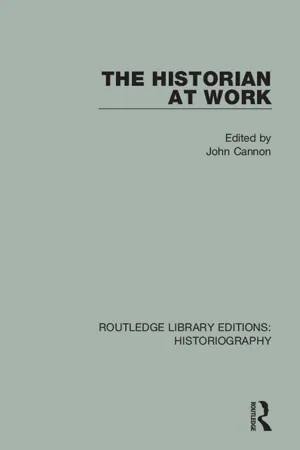
- 220 pages
- English
- ePUB (mobile friendly)
- Available on iOS & Android
eBook - ePub
The Historian At Work
1 | The Historian at Work |
‘Great abilities’, declared Dr Johnson in his confident way, ‘are not requisite for an historian; for in historical composition, all the greatest powers of the human mind are quiescent.’ Fifty years later, Thomas Babington Macaulay, in an essay for the Edinburgh Review, was of the opposite opinion. ‘To write History respectably’, he observed, ‘is easy enough; but to be a really great historian is perhaps the rarest of intellectual distinctions.’1
Such a pronounced disagreement is not wholly to be explained by the fact that Johnson was not an historian while Macaulay, in 1828, aspired to be one.2 There is not, perhaps, much point in debating how intelligent an historian has to be: intelligence does not come amiss in any human activity. More useful is whether a particular kind of intelligence is needed and what are the problems in historical study that demand intelligent consideration. This is all the more necessary because there exists among the general public a suspicion that historical writing is really a brisk and straightforward business of finding out what happened and putting it down, but that historians pretend that it is full of difficulties in order to protect their own mystique.
The temptation may be to agree with Johnson. Historical study does not demand the kind of mind that one expects, say, in philosophers and mathematicians. Historians are said to mature slowly: G. G. Coulton, the mediaevalist, did not obtain his first university appointment until he was 61, but was still lecturing at the age of 88. What historians do need is a combination of talents that is a little rare. They must be capable of tasks of often minute and repetitive drudgery – working out accounts, searching for genealogical evidence, adding up votes, recording place-names, computing crimes, comparing baptisms and burials – without allowing it to blunt their intellect. They must retain, amid these inescapable chores, the capacity to see the wood for the trees: to stand back from the evidence they have so painstakingly amassed and ask interesting, important and perhaps irreverent questions. One of the most celebrated of twentieth-century historians, Sir Lewis Namier, had just this combination of talents: he was as much at home discussing the distribution of property in Huntingdon in 1754 as the great clash of Teutons and Slavs that has convulsed modern Europe.
But the prime reason why the study of history is a demanding one is that so much is necessarily left to the discretion of the historian. His first task is to decide what problem or period he is to examine. Gibbon pondered several subjects, including a History of Switzerland, before he hit upon the one which brought him fame. Although the historian can seek advice from his friends, the choice is ultimately his alone: if he chooses a dull or overworked subject, he is likely to fail. Often the single most important decision the historian takes is to decide his field of postgraduate study, since this may well lead to a lifetime of work on related problems. It is difficult to believe that a history of Switzerland, however distinguished, could have brought Gibbon such lasting acclaim.
Having embarked on his chosen theme, the next problem the historian faces is the accumulation and selection of evidence. The process of selection is of particular importance. The historian is essentially a bringer of order to the past, a perceiver of patterns. The events of the past are myriad in number, most of them neither recoverable nor of interest. Even the tiny fragment which survives in the shape of historical evidence presents the most bewildering variety of sequences, connections, relationships, parallels, contrasts and irrelevancies. In order to function at all, the historian must simplify.3 At every turn, he is forced to resort to historical shorthand. Imagine what an infinite confusion of persons and events is brutally summarised in the phrase ‘the fifteenth century’. Historians who would be embarrassed to think in terms of centuries take refuge in ‘crucial decades’. It is not that they really believe that history moves in such obligingly manageable chunks of time but that they need desperately to impose some order on their sprawling materials. So we talk of ‘Christendom’, ‘the absolute monarchies’, ‘the ruling classes’, ‘the great powers’ and on to such weather-beaten conglomerates as ‘the Renaissance’, ‘the Enlightenment’ and ‘the industrial revolution’. With each phrase we trample upon the subtleties and complexities of the past. But, dislike these categories as many of us do, deride them for their crudity as most of us can, it is hardly possible for history to be written without them. Time after time, iconoclasts have set out to destroy them, only to find that they rise again to discomfit their assailants.
If to simplify is the first task of the historian, the second is to resist oversimplification – to qualify, reserve, distinguish and discriminate. We debate, apparently everlastingly, whether ‘bastard feudalism’ is an apposite term, whether ‘a revolution in government’ is too bold a claim for Thomas Cromwell’s work, whether Romanticism is a concept of any value to the historian. We argue whether Dr A has pushed his thesis too far and whether Professor B has done justice to the counterarguments. Like a sculptor, we chisel away at a granite block until it takes a shape we can recognise in the historical past.
It has been suggested that there are two kinds of historians: those who construct patterns and theories and those who destroy them, the synthesisers and the demolition men. J. H. Hexter, in a characteristically ebullient phrase, has called them the splitters and the lumpers:
Historians who are splitters like to point out divergencies, to perceive differences, to draw distinctions … they carry around in their heads lists of exceptions to almost every rule they are likely to encounter. They do not mind untidiness and accident in the past; they rather like them. Lumpers do not like accidents … instead of noting differences, lumpers note likeness; instead of separateness, connection. The lumping historian wants to put the past into boxes.4
In fact, every historian needs to be both lumper and splitter, formulating his hypothesis and then doing his best to punch holes in it, preferably before the reviewers do. In the last analysis, it must be for the historian himself to decide whether he has struck a fair balance between simplifying and oversimplifying. If he does not simplify enough, he runs the risk of being chaotic, unintelligible, unreadable, even unpublishable: if he simplifies too much, he will bore and distort. There is neither litmus paper nor light meter to guide him: it is a matter for his judgement.
The question of how much to leave out is particularly acute when we are dealing with the larger problems of historical interpretation. It arises from the seamless web of history, that intricate network of relationships which has led some philosophers to deny that historical explanation can have any validity. ‘The strict conception of cause and effect appears to be without relevance in historical explanation,’ wrote Michael Oakeshott: since no historian can offer a complete account of change, he cannot offer any account.5 The first time I read this I was greatly alarmed, not least because it seemed to threaten the livelihood of myself and my colleagues; but, upon reflection, it appears to me to be based upon a fairly simple misunderstanding – that the only true account of an event must be a total account. In everyday life, we have accounts which, though not total, are perfectly adequate to the question asked. It is not a false answer to the question ‘How was she knocked down?’ to reply that she was knocked down by a drunken taxi-driver. We all understand that, given unlimited time, we could improve upon the explanation by adding that the taxi-driver had been driven to drink by the demands of the Electricity Board, or even that he would not have been there at all had not his father met his mother thirty years before in Beccles and been attracted by her red hair.
Even if we are satisfied that historical explanation is possible, it remains rather difficult. We have to break the links of causation some-where and we have to content ourselves with distressingly approximate explanations. Suppose we are asked why the Austrians attacked the Serbians in 1914.6 Though we understand that there must have been thousands of motives involving millions of people, a lecturer who began by remarking that he would deal only with the first seven hundred factors would not greatly endear himself to his audience, however much they ought, in theory, to admire the rigour of his approach. We therefore disregard the motives of thousands of soldiers who were ‘doing their duty’ or ‘obeying orders’, and concentrate on the views of Count Berchtold, who was Austrian foreign minister. We restrict ourselves to four or five fundamental causes, leaving the audience to understand that the last word has not been said upon the subject. But the selection of what are the four or five fundamental causes is for the historian to make: it does not make itself. Nor is there any way of demonstrating, beyond doubt, that we have chosen the right causes or put them into the right order. In fact, a number of academic controversies have arisen from taking causes which had previously been regarded as of only marginal importance and promoting them to a higher order in the explanation.
This element of judgement, which I am emphasising, is peculiarly necessary in the task of evaluating evidence. Sir Herbert Butterfield once remarked that it was a mistake for the historian to regard himself as a judge when his proper role was that of a detective.7 But though it is not the historian’s duty to pass sentence, he is certainly under an obligation to review the evidence. The compilation of evidence, difficult though it may be, is usually much easier than the evaluation and assessment of it.
There are countless hazards in deciding how much weight can be placed upon particular evidence. Though the evidence itself may be true, it may be unrepresentative; it may be at variance with other evidence; it may answer only an aspect of the question posed, and that not necessarily the most important. At a second stage comes evidence which has been warped by political, religious or other prejudice. A famous example of touching up events out of all recognition is the sinking of the French warship Vengeur in the action of the Glorious First of June in 1794. According to the account given by Bertrand Barère to the Convention, the Vengeur went down with all hands, the tricolour flying and the guns blazing revolutionary defiance. More than forty years later, proof was forthcoming that in fact the Vengeur had struck her colours, two hundred of the crew were saved, and the captain was on an English vessel eating cold mutton pies when his ship went down. Thomas Carlyle, who had been taken in by Barère’s version, added a hasty revision to his French Revolution, ‘with resentful brush’.8 Truth is always a casualty in wartime, and a more modern legend credited the Royal Air Force with shooting down 185 German planes on 15 September 1940 at the height of the Battle of Britain. Though political and national bias is fairly easily detected, there are other forms which are more insidious. The reports of the Royal Commissions on the Poor Law in 1834 and the employment of children in mines in 1842 have been shown to be tendentious, the motive in these cases being largely humanitarian. In a third category, one which the historian comes across surprisingly often, is evidence which has been deliberately planted to deceive: it may come from a compulsive liar or an occasional liar;9 from a forger, or the victim of a forger.10
Even when we are dealing with what we might call uncontaminated evidence, the interpretation may be very uncertain. Let us take an example. In England in the Seventeenth Century, Maurice Ashley quoted the story of a farm labourer, who was turned away from the field of Marston Moor muttering, of king and Parliament, ‘What, has them two fallen out then?’ What are we to make of that? Can the historian legitimately infer that the lower orders of Stuart England knew little of and cared nothing for the concerns of the governing class? Or is it that, by some quirk, the views of the local village idiot have been preserved to confuse posterity?11
The difficulty is that in evaluating his evidence, the historian can appeal, for the most part, only to probability and common sense, neither of which is a very precise yardstick. Even the revised version of the Vengeur episode might be queried by the argument that all English eye-witnesses had conspired to discredit French valour. Rarely can historical probability be expressed in mathematical terms, and the definition of common sense as the opinion of the average intelligent man does not get us very far, since average intelligent men display a great gift for disagreeing. Scholars from other disciplines are often shocked at the crudity of the historian’s approach and complain of the low standard of historical verification. The historian must bear this reproach as best he can, because it derives from the nature of his subject: he must not be goaded into claiming an accuracy which the material he uses will not normally permit.
Some of my professional colleagues will, I am sure, feel that this exposition is quite unnecessary and far removed from anything they experience when engaged in the writing of history. Indeed, there are very distinguished historians who are impatient with any discussion of historical method, as though it served only to make the historian self-conscious. They remind one of trapeze artists who can perform only provided they never look down. Professor Richard Cobb, in Second Identity, has expressed this point with engaging vivacity:
I do not know what history is about, nor what social function it serves. I have never given the matter a thought. There is nothing more boring than books and articles on such themes as ‘What is History?’, ‘The Use of History’, ‘History and Something Else’.12
This is delightful swashbuckling stuff and, of course, it would be tedious if we all gave up writing history in order to concentrate on historiography. But, coupled with the advice to get on and consult the documents, it smacks of the Rankean thesis that all historians need to do for the past is to explain ‘how it really was’.13 The writing of history is not, however, a straightforward activity like growing mushrooms or tracing gas leaks, which can be performed quite adequately in an unreflecting way.
The thesis that historical composition is comparatively simple can itself contribute to error if it discourages historians from examining the assumptions on which their work is based. Weeks of careful and painstaking research can be ruined by the unguarded acceptance of false assumptions.14 The historian must, for example, always consider to what extent the answers to his questions are determined by the categories of evidence he is consulting: those who devote their time to the investigation of police and criminal records need to remind themselves of the many thousands of unrecorded acts of kindness and sympathy if they are not to finish up with a distorted and melancholy view of human nature.15 In the same way, those who exploit the vast treasure trove of information contained in Royal Commissions and government inquiries must remember that these sources have an inherent bias towards gloom, since governments do not often set up commissions to inquire into harmony and contentment.16 The cahiers de doléances, submitted to the Estates-General in 1789, are a magnificent source for French society on the eve of the revolution, but they cannot tell us the whole truth since they are concerned mainly with what was wrong in that society.
One objection to the amount of emphasis I have placed on the historian’s discretion is that it flirts dangerously with the view that historical writing is basically subjective: that all history is, in essence, the product of the historian’s mind, and therefore that all historians may be equally right or wrong. This is, if I understand it, the chief criticism levelled by Professor G. R. Elton at parts of E. H. Carr’s What Is History?. Carr, in Elton’s judgement, puts excessive emphasis on the role of the historian and underestimates the extent to which the evidence itself determines the conclusions reached. I agree with Elton in disliking the distinction Carr makes between facts and historical facts: indeed, I can hardly think of a form of words more likely to cause confusion. All that I take Carr to mean is that a neglected or disregarded fact may be turned into an interesting fact by being incorporated into an historical exposition.17 But I am not sure that Professor Elton’s o...
Table of contents
- Cover
- Half Title
- Title Page
- Copyright Page
- Original Copyright
- Table of Contents
- Preface
- Acknowledgements
- 1 The historian at work
- 2 Edward Gibbon
- 3 Leopold von Ranke
- 4 Thomas Babington Macaulay
- 5 Alexis de Tocqueville
- 6 Karl Marx
- 7 Frederic Maitland
- 8 Marc Bloch
- 9 Lewis Bernstein Namier
- 10 Mortimer Wheeler
- 11 Herbert Butterfield
- 12 Fernand Braudel
- Index
Trusted by 375,005 students
Access to over 1.5 million titles for a fair monthly price.
Study more efficiently using our study tools.
Frequently asked questions
Yes, you can cancel anytime from the Subscription tab in your account settings on the Perlego website. Your subscription will stay active until the end of your current billing period. Learn how to cancel your subscription
No, books cannot be downloaded as external files, such as PDFs, for use outside of Perlego. However, you can download books within the Perlego app for offline reading on mobile or tablet. Learn how to download books offline
Perlego offers two plans: Essential and Complete
- Essential is ideal for learners and professionals who enjoy exploring a wide range of subjects. Access the Essential Library with 800,000+ trusted titles and best-sellers across business, personal growth, and the humanities. Includes unlimited reading time and Standard Read Aloud voice.
- Complete: Perfect for advanced learners and researchers needing full, unrestricted access. Unlock 1.5M+ books across hundreds of subjects, including academic and specialized titles. The Complete Plan also includes advanced features like Premium Read Aloud and Research Assistant.
We are an online textbook subscription service, where you can get access to an entire online library for less than the price of a single book per month. With over 1.5 million books across 990+ topics, we’ve got you covered! Learn about our mission
Look out for the read-aloud symbol on your next book to see if you can listen to it. The read-aloud tool reads text aloud for you, highlighting the text as it is being read. You can pause it, speed it up and slow it down. Learn more about Read Aloud
Yes! You can use the Perlego app on both iOS and Android devices to read anytime, anywhere — even offline. Perfect for commutes or when you’re on the go.
Please note we cannot support devices running on iOS 13 and Android 7 or earlier. Learn more about using the app
Please note we cannot support devices running on iOS 13 and Android 7 or earlier. Learn more about using the app
Yes, you can access The Historian At Work by John Cannon in PDF and/or ePUB format, as well as other popular books in History & Historiography. We have over 1.5 million books available in our catalogue for you to explore.