As Cyprus experienced British imperial rule between 1878 and 1960, Greek and Turkish nationalism on the island developed at different times and at different speeds. Relations between Turkish Cypriots and the British on the one hand, and Greek Cypriots and the British on the other, were often asymmetrical with the Muslim community undergoing an enormous change in terms of national/ethnic identity and class characteristics. Turkish Cypriot nationalism developed belatedly as a militant nationalist and anti-Enosis movement. This book explores the relationship between the emergence of Turkish national identity and British colonial rule in the 1920s and 1930s.
eBook - ePub
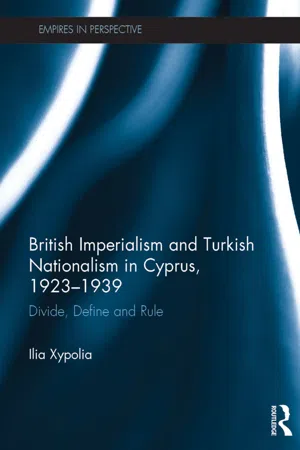
British Imperialism and Turkish Nationalism in Cyprus, 1923-1939
Divide, Define and Rule
- 190 pages
- English
- ePUB (mobile friendly)
- Available on iOS & Android
eBook - ePub
British Imperialism and Turkish Nationalism in Cyprus, 1923-1939
Divide, Define and Rule
1Introduction
Hegel, in his Lectures on the Philosophy of History, claimed that the periods of non-conflict are the blank pages in history books. This is valid also in the case of Cyprus. One should consider the gallons of ink that have been spilled for the history of Cyprus, while almost nothing has been written about the interwar period. The two decades between the two world wars found the island under the rule of the British Empire and in relative peace. Thus, this period has not attracted the interest of many scholars. This book aims to capture how the ostensibly stagnant landscape of the politics on the island was decisive for the emergence of the national identity for the Muslim Cypriot community.
This book offers a critical exploration into the prehistory, in the sense of a background to the struggles generally depicted as beginning in the 1950s, of Turkish nationalism in Cyprus. It attempts to highlight that the interwar period was still of paramount importance not only in the history of Cyprus but also in the history of the whole region of the eastern Mediterranean. The reality of the two nationally awakened communities of the island from the 1950s onwards began to take place in the 1920s. The vast majority of the Cypriots were Christian Orthodox and, since the early nineteenth century, have self-identified as Greeks. However, the Muslim minority of the Cypriot inhabitants had not acquired any national identity until the interwar period. During this period a major transformation took place in the identity of the Muslim community of the island, a shift from a religious to a national identity. This shift had serious repercussions in the later events that followed in the postwar era.
In order to examine this shift, I focus on the context wherein this national identity emerged: the social, ideological, cultural, political and international context. This context was set by British rule. Turkish Cypriot politics during the period of British rule in Cyprus has not been the most popular field of research. Even the scholars who are engaged with the Cyprus issue tend to focus on the Greek Cypriot politics of the period, ignoring the interesting dynamics of the politics of the Muslim Cypriot community.
This book looks back to the interwar period, to which the causes of conflict in Cyprus can be traced. It explores the extent to which the British policy of ‘divide and rule’ in Cyprus contributed to the development of Turkish Cypriot nationalism on the island, making the Turkish Cypriot elites embrace the tenets of the Turkish security programme in the eastern Mediterranean, and the Turkish Cypriot people define themselves as ‘patriotic Turks’. Turkish Cypriot nationalism had specific characteristics as a nationalist movement, and its intensification took place in the 1950s. In addressing this question, British, Cypriot, Turkish and Greek sources are all analysed.
This study aims to explore the special relationship between imperialism and nationalism in Cyprus. As stated earlier, Turkish Cypriot nationalism was not born in a vacuum, and in that sense it has to be understood within the context that was set by the British. The main research question that this book seeks to address is this: to what extent did British imperial rule affect the emergence and development of a Turkish Cypriot national identity? The question is formulated in this way in order to arrive at a balanced analysis of the whole situation and avoid coming to hasty conclusions and dogmatic statements about the influence of British imperialism on the formation of the Turkish Cypriot national identity.
The structure of the book
The main themes of this research – nationalism, identity, religion and imperialism – run in parallel in the following chapters. The main themes are inextricably linked in the endeavour to investigate and explore in depth the research question. The method of presentation of the argument and the findings of the book, as Marx has suggested, should definitely be different from the method of enquiry.1 Therefore, the plan of the book is as follows. The following chapter provides a historical background, along with some considerations on Turkish nationalism and the ethnic origins of the Muslim Cypriots. The purpose of this chapter is to make clear how certain contested and ambiguous terms and notions, such as nation and identity, are going to be used in the book, and the chapter is therefore essential for us to proceed with our analysis. Paraphrasing what the ancient Greek philosopher Socrates said, we should first define the concepts, and then we can start to communicate.
Having clarified the operational definitions of the terms and the notions to be used, we proceed to the third chapter of the book, concerning the international context. In this chapter we discuss the wider context of the period, which had serious repercussions for the turn of events in Cyprus. In particular, it is argued that the changing international context affected events in Cyprus in two ways. The first is that it altered the geostrategic importance of the island for the British Empire. The second, and extremely important, factor was the gradual success of the Kemalist revolution in Turkey, which created a successful example that the Muslim community of Cyprus could attune to. In order to illustrate both these factors we focus on the evolving British perceptions of two of the aspiring regional powers, Italy and Turkey.
In the fourth chapter, we turn our focus on the island itself. In particular, we examine the events of the period within the Cypriot socio-economic context, which therefore involves discussing the urbanisation of Cypriot society and the so-called modernisation that British rule initiated. In the fifth chapter, in addition to the social and economic context, we look at the ideological and cultural context. This is a vital aspect to consider in order to fully understand the transformation in the collective identification of the Muslim community of the island. The focus is upon the educational system, drawing particular attention to changes in the history textbooks.
In the sixth chapter, we focus on the political context. In doing so, I analyse the political participation of the Muslim community in the political bodies of the island. I also examine the relations that the Muslim community had with the British administration and its Greek counterpart. All these interactions will be examined in a political context. The focus is on the representation of the Muslim community in the local administrative bodies of the Legislative Council, the Executive Council and the Advisory Council.
In the concluding chapter, a brief summary of the central ideas discussed in the previous chapters is presented. It places the arguments and findings in broader debates, and clarifies the limitations of the argument. Finally, it draws some conclusions for other similar cases and presents an outlook for future research. Furthermore, the conclusion highlights the importance of the study as a whole, its contribution and its relevance today.
Note
1Karl Marx, Capital, vol. I (New York: Vintage Books, 1977). The method of presentation and the method of enquiry for Marx: ‘[T]he latter has to appropriate the material in detail, to analyze its different forms of development and to track down their inner connection. Only after this work has been done can the real movement be appropriately presented. If this is done successfully, if the life of the subject-matter is now reflected back in the ideas, then it may appear as if we have before us an a priori construction’ (p. 102).
2Historical background
Today, in the twenty-first century, Cyprus is one of the EU member states and, at the same time one, of the very few divided states worldwide. According to the opinion of the majority of scholars engaged with the study of the Cyprus issue, nationalism is the main source for this extravagant reality. Additionally, a growing number of critical studies tend to emphasise the role that imperialism played in shaping the Cyprus conflict. Nowadays the island is inhabited by two separate communities with distinct national identities, the Greek Cypriots and the Turkish Cypriots. Although these communities had a harmonic and peaceful relationship for centuries, many scholars, loosely following Samuel Huntington’s argument on the ‘clash of civilizations’,1 support the idea that their coalescence into a unitary state is impossible. Cyprus was confronted by almost persistent intercommunal conflict from the mid-1950s until 1974.
Cyprus, as part of a number of empires throughout the centuries – namely Greek, Roman, Byzantine, Venetian and Ottoman – has experienced imperialism since ancient times. British colonial rule succeeded three centuries of rule by the Ottoman Empire, starting in 1878 and officially ending in 1960. Greek and Turkish nationalism developed in different historical periods and at different paces. Greek nationalism commenced at the beginning of the nineteenth century, way before the advent of British colonialism in 1878, while Turkish nationalism started developing in the Ottoman Empire at the end of nineteenth century, and was consolidated only with the establishment of the Republic of Turkey in 1923. Relations between Turkish Cypriots and the British, on the one hand, and Greek Cypriots and the British, on the other, were asymmetrical. During the colonial era in Cyprus the Muslim community underwent an enormous change in terms of national/ethnic identity and class characteristics. Turkish Cypriot nationalism developed belatedly, as a militant nationalist and anti-Enosis movement.
The scale of the scholarly output attendant upon the politics of the small island of Cyprus is immense. Despite the vast literature that accompanies and analyses various aspects of the politics of modern Cyprus, there is little in it that has focused on the development Turkish Cypriot nationalism.
Against this background, this book explores the formation of Turkish national identity and its relationship with British colonial rule, which remains a terra incognita in the scholarly literature. Myriad academic papers have been written on the Cyprus issue, with most of them theorising it as an ethnic conflict starting from the 1950s, when the intercommunal fighting began. However, very few have explored the conditions under which the two distinct communities were shaped, especially the Turkish Cypriot identity. Therefore, it is of special academic interest to trace the relationship between the emergence of Turkish national identity and British colonial rule, because, I argue, the latter set the political and ideological context in which the nationalism of the Turkish Cypriot community developed; the rest of the book will analyse this. In particular, the study focuses on the period between the two world wars, 1923 to 1939, when the transformation of the Muslims of Cyprus into Turkish Cypriots occurred.
The time frame of this study is delimited by two important events: the signing of the 1923 Treaty of Lausanne and the outbreak of the Second World War. The decision to start the period in question in 1923 was taken on the basis of the undoubted significance of the Lausanne treaty for Cyprus and the Muslim community of the island. As we illustrate in Chapter 4, a clause of 1923 treaty enabled a large number of Muslim Cypriots to emigrate to the newly founded Republic of Turkey. However, the British authorities in Cyprus were alerted to the potential for massive emigration to Anatolia to lead to the fading away of the Muslim community in Cyprus. There are secret documents on the threat that emigration posed to British interests, epitomising British imperial policy in the island. Therefore, this book investigates the period commencing with the signing of the Lausanne treaty in 1923 and ending with the advent of the Second World War in 1939. Both events constitute major turning points for British rule in Cyprus. The First World War constitutes a major turning point for the Middle East as a region. The so-called ‘sick man of Europe’, the Ottoman Empire, passed away, and long-declining Ottoman rule in the region came to an end. Both events marked a shift in the balance of power in the eastern Mediterranean.
Turkish nationalism
Ne mutlu Türküm diyene
Mustafa Kemal Ataturk2
It is simply impossible to understand the emergence and the development of Turkish nationalism without looking into the international context from which it arose and the historical trajectory of which it is the product. The turning point in the history of the Ottoman Empire was the military defeat in Vienna in the late seventeenth century. The defeat of the Ottoman Army in 1683 at the siege of Vienna was a major turning point in the history of the empire. Scholars such as Halil Inalcik argue that it marked not only the beginning of decline of the Ottoman Empire but also the beginning of the reorientation of the Ottomans towards the West.3 It took more than a century after the 1683 Ottoman defeat at Vienna for the sultan to proceed towards Western-style military training for the infantry.4 However, it was only at the end of the eighteenth century, aft...
Table of contents
- Cover
- Half Title
- Series Information
- Title Page
- Copyright Page
- Dedication
- Contents
- List of illustrations
- Acknowledgements
- Note on transliteration
- List of acronyms and abbreviations
- 1 Introduction
- 2 Historical background
- 3 International context
- 4 Social and economic context
- 5 Ideological and cultural context
- 6 Political context
- 7 Discussion
- Appendix
- Bibliography
- Index
Trusted by 375,005 students
Access to over 1.5 million titles for a fair monthly price.
Study more efficiently using our study tools.
Frequently asked questions
Yes, you can cancel anytime from the Subscription tab in your account settings on the Perlego website. Your subscription will stay active until the end of your current billing period. Learn how to cancel your subscription
No, books cannot be downloaded as external files, such as PDFs, for use outside of Perlego. However, you can download books within the Perlego app for offline reading on mobile or tablet. Learn how to download books offline
Perlego offers two plans: Essential and Complete
- Essential is ideal for learners and professionals who enjoy exploring a wide range of subjects. Access the Essential Library with 800,000+ trusted titles and best-sellers across business, personal growth, and the humanities. Includes unlimited reading time and Standard Read Aloud voice.
- Complete: Perfect for advanced learners and researchers needing full, unrestricted access. Unlock 1.5M+ books across hundreds of subjects, including academic and specialized titles. The Complete Plan also includes advanced features like Premium Read Aloud and Research Assistant.
We are an online textbook subscription service, where you can get access to an entire online library for less than the price of a single book per month. With over 1.5 million books across 990+ topics, we’ve got you covered! Learn about our mission
Look out for the read-aloud symbol on your next book to see if you can listen to it. The read-aloud tool reads text aloud for you, highlighting the text as it is being read. You can pause it, speed it up and slow it down. Learn more about Read Aloud
Yes! You can use the Perlego app on both iOS and Android devices to read anytime, anywhere — even offline. Perfect for commutes or when you’re on the go.
Please note we cannot support devices running on iOS 13 and Android 7 or earlier. Learn more about using the app
Please note we cannot support devices running on iOS 13 and Android 7 or earlier. Learn more about using the app
Yes, you can access British Imperialism and Turkish Nationalism in Cyprus, 1923-1939 by Ilia Xypolia in PDF and/or ePUB format, as well as other popular books in History & British History. We have over 1.5 million books available in our catalogue for you to explore.