Applied Biostatistical Principles and Concepts
eBook - ePub

Applied Biostatistical Principles and Concepts

Clinicians' Guide to Data Analysis and Interpretation

  1. 288 pages
  2. English
  3. ePUB (mobile friendly)
  4. Available on iOS & Android
eBook - ePub

Applied Biostatistical Principles and Concepts

Clinicians' Guide to Data Analysis and Interpretation

About this book

The past three decades have witnessed modern advances in statistical modeling and evidence discovery in biomedical, clinical, and population-based research. With these advances come the challenges in accurate model stipulation and application of models in scientific evidence discovery

Applied Biostatistical Principles and Concepts provides practical knowledge using biological and biochemical specimen/samples in order to understand health and disease processes at cellular, clinical, and population levels. Concepts and techniques provided will help researchers design and conduct studies, then translate data from bench to clinics in attempt to improve the health of patients and populations.

This book is suitable for both clinicians and health or biological sciences students. It presents the reality in statistical modelling of health research data in a concise manner that will address the issue of "big data" type I error tolerance and probability value, effect size and confidence interval for precision, effect measure modification and interaction as well as confounders, thus allowing for more valid inferences and yielding results that are more reliable, valid and accurate.
Trusted by 375,005 students

Access to over 1.5 million titles for a fair monthly price.

Study more efficiently using our study tools.

Information

Publisher
Routledge
Year
2017
eBook ISBN
9781315352213

Biostatistical modeling

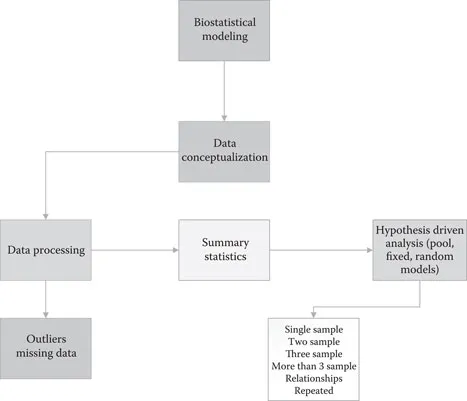
Evidence discovery requires assumptions and rationale around the data collected from research conduct or preexisting and secondary data. The reliability of evidence assumes an unbiased sample in order to ensure adequate generalizability.
The process of evidence discovery thus requires data processing, which is often ignored, data description via graphical presentation and summary statistics, and then hypotheses testing and interpretation. This section deals with biostatistical reasoning, categorical, and continuous data appraisal. The specific-hypothesis testing involves samples and relationships.
image figs2_1.webp

4Statistical considerations in clinical research

4.1Introduction

Conducting research centers on (a) conceptualization, (b) design process, and (c) statistical inference. Once the design is completed, the study is performed, and the data are collected, entered into the database, and edited, the next step is data analysis, which yields the study results. The initial step in the analysis, also termed preanalysis screening, is to obtain the summary statistics with frequency distribution (number and percentage) for discrete data and mean and standard deviation for continuous data. Therefore, the type of distribution or measurement scale (continuous, discrete) determines the nature of the descriptive summary or statistics.
In clinical research, we focus on a sample of patients and not the entire population of patients with a given condition. We use a random sample to ensure that every individual in the population has an equal and independent chance of being selected. Consider a study conducted to examine the association between residual postoperative Cobb angle and the prevalence of deep wound infection after posterior spine fusion among children with cerebral palsy. Of the 264 patients studied, 22 developed deep wound infection. The residual postoperative Cobb angle was compared between cases and noncases, and the difference in the mean Cobb angle was found. The next step was to determine whether the mean difference between the cases and noncases was due to chance alone. Since the sample studied was a random sample and the 264 patients represented the population of children with cerebral palsy, statistical significance must be considered using a probability model. The application of the probability model, which is indicative of how likely it is that we would obtain a certain mean difference in Cobb angle between cases and noncases in a sample of 264 patients if there were no real difference between the cases and noncases in the entire population of children with cerebral palsy who have undergone surgery for spinal deformity correction, reflects the notion of inferential statistics.
In the previous chapters (Section I), we presented data cleaning and editing, preanalysis screening, and hypothesis-specific test notions. These aspects of clinical research are required in the study protocol, and clinical investigators are required to develop and utilize a manual of procedures in addressing these issues. This chapter is concerned with the illustrative approach to understanding how sense is made from data through the steps outlined in various techniques of hypothesis testing. We attempt to present reliable and valid scientific research as that which applies appropriate statistical techniques in drawing evidence from the data. Statistics is presented as an informational science, with the purpose being to make sense of accurate data, since statistical methods, no matter how sophisticated, cannot generate valid and reliable evidence from an inaccurate measurement or poorly designed study.
Box 4.1Notion of Statistics
  • Statistics is a highly developed information science.
  • It is involved with the study of inferential processes, especially the planning and analysis of experiments, surveys or observational studies.a
  • The study of how information should be employed to reflect on, and give guidance for action in a practical situation involving uncertainty.b
  • A way of thinking or an approach to everyday problems that relies heavily on designed data production. It is essential in that its proper usability minimizes the chance of drawing incorrect conclusions from data.c
a V. Barnett, Comparative Statistical Inference, 2nd ed. (New York: Wiley, 1982).
b S. Stigler, The History of Statistics (Cambridge, MA: Belknap Press, 1986).
c S. Piantadosi, Clinical Trials, 2nd ed. (Hoboken, New Jersey: John Wiley & Sons, 2005).
The technique to be used in producing the result of a study or to test the proposed hypothesis depends on (a) design, (b) scales of measurement of the variables, (c) the assumption underlying the distribution of the ...

Table of contents

  1. Cover
  2. Half Title Page
  3. Series Page
  4. Title Page
  5. Copyright Page
  6. Dedication
  7. Contents
  8. Foreword
  9. Preface
  10. Acknowledgments
  11. Author
  12. Introduction
  13. References
  14. Section I Design process
  15. Section II Biostatistical modeling
  16. Appendix
  17. Index

Frequently asked questions

Yes, you can cancel anytime from the Subscription tab in your account settings on the Perlego website. Your subscription will stay active until the end of your current billing period. Learn how to cancel your subscription
No, books cannot be downloaded as external files, such as PDFs, for use outside of Perlego. However, you can download books within the Perlego app for offline reading on mobile or tablet. Learn how to download books offline
Perlego offers two plans: Essential and Complete
  • Essential is ideal for learners and professionals who enjoy exploring a wide range of subjects. Access the Essential Library with 800,000+ trusted titles and best-sellers across business, personal growth, and the humanities. Includes unlimited reading time and Standard Read Aloud voice.
  • Complete: Perfect for advanced learners and researchers needing full, unrestricted access. Unlock 1.5M+ books across hundreds of subjects, including academic and specialized titles. The Complete Plan also includes advanced features like Premium Read Aloud and Research Assistant.
Both plans are available with monthly, semester, or annual billing cycles.
We are an online textbook subscription service, where you can get access to an entire online library for less than the price of a single book per month. With over 1.5 million books across 990+ topics, we’ve got you covered! Learn about our mission
Look out for the read-aloud symbol on your next book to see if you can listen to it. The read-aloud tool reads text aloud for you, highlighting the text as it is being read. You can pause it, speed it up and slow it down. Learn more about Read Aloud
Yes! You can use the Perlego app on both iOS and Android devices to read anytime, anywhere — even offline. Perfect for commutes or when you’re on the go.
Please note we cannot support devices running on iOS 13 and Android 7 or earlier. Learn more about using the app
Yes, you can access Applied Biostatistical Principles and Concepts by Laurens Holmes, Jr. in PDF and/or ePUB format, as well as other popular books in Medicine & Probability & Statistics. We have over 1.5 million books available in our catalogue for you to explore.