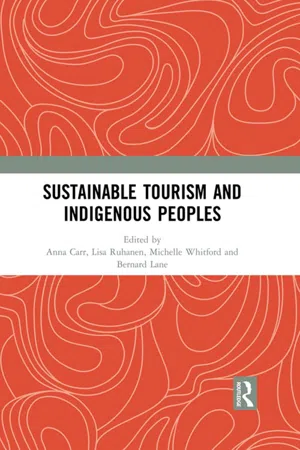
This book provides a comprehensive, detailed and insight rich review of both the positive (capacity building, cultural conservation and economic opportunities) and negative (commodification, cultural change and possible loss of ownership and control) aspects of tourism development in indigenous communities. The relationship between tourism and indigenous people provides the ultimate test of sustainable tourism as a concept for tourism management and cultural conservation. The chapters range geographically from Central and North America, through Africa, and Asia to Australia. Issues covered include governance and engagement, research, minority language issues, visitor codes of conduct, trail development, Indigenous product design, Indigenous urban festivals, Indigenous values and capitalism, gentrification, heritage interpretation, marketing, demand, world views and representation. This book was originally published as a special issue of the Journal of Sustainable Tourism.
eBook - ePub
Sustainable Tourism and Indigenous Peoples
- 318 pages
- English
- ePUB (mobile friendly)
- Available on iOS & Android
eBook - ePub
Sustainable Tourism and Indigenous Peoples
Indigenous peoples and tourism: the challenges and opportunities for sustainable tourism
Anna Carr, Lisa Ruhanen and Michelle Whitford
ABSTRACT
The Indigenous tourism focus of the 16 papers in this special issue provides readers with an opportunity to explore the dynamics behind an array of issues pertaining to sustainable Indigenous tourism. These papers not only provide a long overdue balance to the far too common, negatively biased media reports about Indigenous peoples and their communities but also highlight the capacity of tourism as an effective tool for realizing sustainable Indigenous development. Throughout the papers reviewed in detail here, readers are reminded of the positive (capacity building) and negative (commodification) realities of Indigenous tourism development. Concomitantly, readers are privy to the practical and theoretical contributions pertaining to the management of cultural values and Indigenous businesses and the social and economic empowerment of Indigenous groups. The main contribution of this special issue, however, is a call for increasing research by, or in collaboration with, Indigenous researchers so that Indigenous authors and editors of academic journals become the norm in academia. Ultimately, Indigenous scholars and tourism providers should be the major contributors to, and commentators about, mainstream and niche approaches to Indigenous tourism management, whilst communities gain visibility not just as the visited “Other”, but as global leaders within tourism and related sectors.
The Indigenous tourism focus of the 16 papers in this special issue provides readers with an opportunity to explore the dynamics behind an array of issues pertaining to sustainable Indigenous tourism. These papers not only provide a long overdue balance to the far too common, negatively biased media reports about Indigenous peoples and their communities but also highlight the capacity of tourism as an effective tool for realizing sustainable Indigenous development. Throughout the papers reviewed in detail here, readers are reminded of the positive (capacity building) and negative (commodification) realities of Indigenous tourism development. Concomitantly, readers are privy to the practical and theoretical contributions pertaining to the management of cultural values and Indigenous businesses and the social and economic empowerment of Indigenous groups. The main contribution of this special issue, however, is a call for increasing research by, or in collaboration with, Indigenous researchers so that Indigenous authors and editors of academic journals become the norm in academia. Ultimately, Indigenous scholars and tourism providers should be the major contributors to, and commentators about, mainstream and niche approaches to Indigenous tourism management, whilst communities gain visibility not just as the visited “Other”, but as global leaders within tourism and related sectors.
Introduction
This special issue introductory paper provides readers with a contextual overview of indigeneity and Indigenous tourism. Additionally, it examines the complex and continually evolving relationship between Indigenous tourism and the concepts and practices of sustainable tourism, before reviewing the 16 other papers in this special issue. This paper is written by the special issue’s guest editors who, collectively, have over 50 years of experience in leading theoretical and applied Indigenous tourism research projects that have focused on a wide range of issues, and also in teaching and supervising both undergraduate and postgraduate projects centered on and around various aspects of Indigenous tourism. As researchers, the guest editors have worked collaboratively with Indigenous organizations including WINTA (World Indigenous Tourism Alliance), KUMA (Southern Māori Business Network Te Kupeka Umaka Māori Ki Araiteuru), Te Ana Whakairo (Ngai Tahu Māori Rock Art Trust) in New Zealand; and in Australia, the Australian Institute of Aboriginal and Torres Strait Islanders Studies, Torres Strait Regional Authority, Indigenous Business Australia and the Indigenous community organization, First Contact Inc. A combination of personal ancestry, respect for and empathy with Indigenous values provides the authors with an opportunity, both individually and collectively to continue to develop a passionate and continually evolving academic relationship with the complex, fluid and globally significant field of study identified as Indigenous tourism.
The study of Indigenous tourism
What makes the development of Indigenous tourism unique and thus, of special interest to academic researchers? From both praxis and theoretical perspectives, the intangible and tangible manifestations of Indigenous tourism development have gained an academic following since the mid-twentieth century. For instance, anthropologists and sociologists were amongst the earliest academics to explore a range of theoretical dimensions of Indigenous cultures such as identity, empowerment and authenticity. Ethnographic researchers were arguably the forerunners of studies focusing on the impacts of tourism on Indigenous peoples. Identified impacts of Indigenous tourism included issues pertaining to acculturation and commodification of culture and thus increasingly, research focused on (among other things), mitigating these negative impacts and identifying ways to ensure tourists had the opportunity to have meaningful experiences of “other cultures, in purer, simpler lifestyles” (MacCannell, 1976, p. 8). The early work of Almagor (1985), Cohen (1979) and Graburn (1976) in particular, must be credited with elevating the significance of Indigenous tourism research and paving the way for future scholars whose research interests are located in the study field of Indigenous tourism.
Globally, Indigenous tourism is commonly viewed as a means of facilitating socio-economic benefits to Indigenous individuals, communities and host regions. Like all forms of tourism, the development, implementation and management of Indigenous tourism should arguably be underpinned by the principles of sustainable development and natural resource management. From the early 1990s, researchers have produced seminal texts and/or journal articles about various dimensions of Indigenous tourism (see Altman & Finlayson, 1993; Bunten & Graburn, 2009; Butler & Hinch, 1996; Notzke, 1999, 2004; Ryan & Aicken, 2005; Smith, 1989, 1996; Smith & Brent, 2001; Smith & Richards, 2013; Sofield, 1993; Zeppel, 2006). Early works, such as these, have to varying degrees, been underpinned by the principles of sustainability and thus often espoused development that not only facilitates the economic well-being of Indigenous peoples and ensures conservation of Indigenous cultural landscapes and the environment, but also (and above all), ensures tourism development is used as a positive opportunity for enhancing the social, cultural and place identity of Indigenous peoples (Amoamo & Thompson, 2011; Bunten & Graburn, 2009; Carr, 2004; Lemelin, Thompson-Carr, Johnson, Stewart, & Dawson, 2013; Shackley, 2001; Smith & Richards, 2013; Sofield, 1991, 1993, 2003; Sofield & Birtles, 1996; Spark, 2002; Thompson, 2007; Thompson, 2013). These researchers explored issues around economic prosperity, tensions associated with the marketing of culture, enhancement of the socio-economic well-being of Indigenous peoples and challenges within the broader contexts of environmental, economic social and cultural sustainability when pursuing sustainable livelihoods. A recurring theme emerging from many of these studies (and others), was an underpinning notion that all communities (whether developing tourism or other industries, and/or despite whether the community is located remotely or in densely urbanized areas), often share common challenges and/or aspirations pertaining to the development of opportunities to (among other things), nurture healthy families or other groupings, facilitate employment, improve health and provide recreation and education opportunities for community members.
“Indigenous” or “ethnic” tourism?
Many of the aforementioned challenges and issues facing Indigenous communities are equally important to non-Indigenous communities, especially those that host cultural and/or ethnic tourism experiences. The question here then, is what constitutes Indigenous tourism and in this instance, what are the parameters the editors considered when defining “Indigenous” and “Indigenous tourism” for this special issue?
Arguably there is substantial overlap when considering cultural and/or community-based tourism (CBT), as many of the concerns facing Indigenous peoples stem from shared human values, experiences and realities affecting communities worldwide. Ethnic communities may be migrant and thus not Indigenous per se. They usually are comprised of cultural groups commonly linked by racial characteristics, language, beliefs and kinship lines. They may have common origins other than kinship, such as nationality or socially shared individual constructions of their ethnic identity (Stone, 2003). Indigenous peoples may also belong to a particular ethnic or cultural group and their self-identity can be very dynamic and complex, often fluidly interpreted with many young Indigenous peoples defying being constrained to one particular definition that may essentialize them as “Indigenous”. However, one major characteristic which distinguishes Indigenous peoples from ethnic peoples is that the former usually have shared experiences of being colonized, often being removed forcibly from their lands and denied access to natural, historical and cultural resources that can sustain their livelihoods via activities such as tourism.
Within academic texts, the use of the terms “Indigenous” and “non-Indigenous” have thus been regularly used to describe the difference between the original inhabitants of a landscape and those people who are not the original inhabitants. According to Hinch and Butler (1996, p. 9), ‘the umbrella term of Indigenous people is used to describe races of people who are endemic or native to a destination region’ as opposed to “ethnic” communities who may inhabit an area they have migrated to. In contrast, “non-Indigenous” people are recognized as not having the continual history of occupying land prior to colonization and could be migrants (with another cultural or ethnic ancestry) who have also been colonized, or the colonizers or descendants of colonizing settlers themselves. Moreover, non-Indigenous inhabitants have usually been associated with Western societies originating from within European cultural and values systems (Tuhiwai Smith, 1999, 2012) whereas the Indigenous are “pre-existing peoples” at a time of colonization (Goehring, 1993, p. 4).
While numerous scholars have provided us with a cache of definitions pertaining to what constitutes “Indigenous”, there is little doubt that academic debate on the issue will continue, even with the United Nation’s Declaration being used for guidance because, as Indigenous academic Professor Linda Tuhiwai Smith explains, the term “Indigenous” is problematic:
…it appears to collectivise many distinct populations whose experiences under imperialism have been vastly different. Other collective terms also in use refer to ‘First Peoples’ or ‘Native Peoples’, ‘First Nations’ or ‘People of the Land’, ‘Aboriginals’ or ‘Fourth World Peoples’ (Tuhiwai Smith, 1999, p. 6).
Sustainable tourism and Indigenous peoples
This Journal of Sustainable Tourism (JOST) special issue explores the interrelationships between sustainable tourism development and Indigenous peoples. The “Indigenous” focus of the 16 papers in this issue provides an opportunity to explore the dynamics behind sustainable Indigenous tourism development. The underpinning principles of the collective research clearly resonate with the “manifestations” of the United Nations (UN) Declaration of the Rights of Indigenous Peoples (UN, 2016) from 2007. The UN Declaration was notable for: “Affirming that Indigenous peoples are equal to all other peoples, while recognizing the right of all peoples to be different, to consider themselves different, and to be respected as such”. Moreover, many of the “rights” in the Declaration underpin issues discussed in the special issue papers, including the rights to lands and territories (Articles 10 and 25), the use and revitalization of languages or recognition of place names (Article 13), involvement in decision-making processes (Article 18), involvement in development and employment opportunities (Articles 20, 21) and most significantly, the numerous Articles advocating Indigenous rights to lands, territories and natural or cultural resources and those which advocate cultural heritage traditions and revitalization (Article 11.1) and (Article 31.1). For instance, the latter advocates “Indigenous peoples have the right to maintain, control, protect and develop their cultural heritage, traditional knowledge and traditional cultural expressions, as well as the manifestations of their sciences, technologies and cultures, including human and genetic resources, seeds, medicines, knowledge of the properties of fauna and flora, oral traditions, literatures, designs, sports and traditional games and visual and performing arts”.
Over 65 abstracts were submitted in the initial call for papers, the outcome of which is this double special issue, with 16 published papers presenting relevant, insightful research to an international audience of scholars, students, tourism practitioners and hopefully, community members in areas frequented by tourism activities. A special feature of the issue is the research papers provide a long overdue balance to habitually biased media reports about communities of Indigenous peoples who are too often depicted in a negative light. For instance, the papers overall, recognize that tourism can (and does) provide a positive development stage for indigeneity. Discussions include (among other things), the capacity of Indigenous tourism to nurture cultural arts, language revitalization and traditions (countering and enabling an escape from a “victim” narrative). Additionally, there is discussion focusing on the impetus for developing Indigenous tourism ventures, which is usually based on tourism’s ability to create employment, often in non-urban locations where other employment opportunities are limited.
Other contributions to the special issue include discursive papers which seek to engage readers to think deeply about theoretical and practical issues facing Indigenous communities and many of the papers provide solutions for Indigenous tourism planning, for instance by testing methodologies for collaborative research with Indigenous communities. The papers also present the complexity of multi-faceted, yet diverse issues facing Indigenous peoples seeking economic empowerment or revitalization of their cultural identity through the provision of visitor services or experiences. All the papers are intertwined by a history of academic research on the topic and there is a recurrence of references to foundational tourism studies that have informed the papers’ literature reviews, demonstrating the value of those early critical studies. Papers’ discussions link several core issues including the value of Indigenous knowledge and cultural traditions (empowerment), governance and planning (implementation), and product development which touches on facets of cultural revitalization, heritage interpretation and authenticity (innovation). Geographically, thematically and theoretically, the papers adopt different perspectives and as each Indigenous group’s circumstance is culturally laden and influenced by their political and social histories, there is no one story, no “one fix” and no easy solutions for many of the negative circumstances facing Indigenous peoples or communities.
The initial papers in the special issue synthesize and review common issues in Indigenous tourism research (Whitford & Ruhanen, 2016) and provide international case studies with implications for best practice (Fletcher, Pforr, & Brueckner, 2016; Pereiro, 2016; Reggers, Grabowski, Wearing, Chatterton, & Schweinsberg, 2016; Whitney-Squire, 2016). Other contributions present research that ranges from visitors’ experiences of Indigenous events (Higgins-Desbiolles, 2016) to reflections on how policy-makers or managers can influence the recognition of Indigenous cultural manifestations and values within tourism settings including protected natural areas (Hillmer-Pegram, 2016; Shultis & Heffner, 2016; Walker & Moscardo, 2016). Contributors also posit research questions that are the outcome of direct collaboration with Indigenous peoples (Espeso-Molinero, Carlisle, & Pastor-Alfonso, 2016; Holmes, Grimwood, King, & the Lutsel K’e Dene First Nation, 2016; Reggers et al., 2016; Whitney-Squire, 2016). Several p...
Table of contents
- Cover
- Half Title
- Title Page
- Copyright
- Contents
- Citation Information
- Notes on Contributors
- 1. Indigenous peoples and tourism: the challenges and opportunities for sustainable tourism
- 2. Indigenous tourism research, past and present: where to from here?
- 3. Factors influencing Indigenous engagement in tourism development: an international perspective
- 4. A review of Indigenous tourism in Latin America: reflections on an anthropological study of Guna tourism (Panama)
- 5. Exploring outcomes of community-based tourism on the Kokoda Track, Papua New Guinea: a longitudinal study of Participatory Rural Appraisal techniques
- 6. Sustaining local language relationships through indigenous community-based tourism initiatives
- 7. Creating an Indigenized visitor code of conduct: the development of Denesoline self-determination for sustainable tourism
- 8. Integrating Indigenous values with capitalism through tourism: Alaskan experiences and outstanding issues
- 9. Contradictions of capitalism in the South African Kalahari: Indigenous Bushmen, their brand and baasskap in tourism
- 10. Hegemonic and emerging concepts of conservation: a critical examination of barriers to incorporating Indigenous perspectives in protected area conservation policies and practice
- 11. Moving beyond sense of place to care of place: the role of Indigenous values and interpretation in promoting transformative change in tourists’ place images and personal values
- 12. The role of self-gentrification in sustainable tourism: Indigenous entrepreneurship at Honghe Hani Rice Terraces World Heritage Site, China
- 13. Sustaining spirit: a review and analysis of an urban Indigenous Australian cultural festival
- 14. Beyond whiteness: a comparative analysis of representations of Aboriginality in tourism destination images in New South Wales, Australia
- 15. Sustainability and Indigenous tourism insights from social media: worldview differences, cultural friction and negotiation
- 16. Knowledge dialogue through Indigenous tourism product design: a collaborative research process with the Lacandon of Chiapas, Mexico
- 17. Domestic demand for Indigenous tourism in Australia: understanding intention to participate
- Index
Trusted by 375,005 students
Access to over 1.5 million titles for a fair monthly price.
Study more efficiently using our study tools.
Frequently asked questions
Yes, you can cancel anytime from the Subscription tab in your account settings on the Perlego website. Your subscription will stay active until the end of your current billing period. Learn how to cancel your subscription
No, books cannot be downloaded as external files, such as PDFs, for use outside of Perlego. However, you can download books within the Perlego app for offline reading on mobile or tablet. Learn how to download books offline
Perlego offers two plans: Essential and Complete
- Essential is ideal for learners and professionals who enjoy exploring a wide range of subjects. Access the Essential Library with 800,000+ trusted titles and best-sellers across business, personal growth, and the humanities. Includes unlimited reading time and Standard Read Aloud voice.
- Complete: Perfect for advanced learners and researchers needing full, unrestricted access. Unlock 1.5M+ books across hundreds of subjects, including academic and specialized titles. The Complete Plan also includes advanced features like Premium Read Aloud and Research Assistant.
We are an online textbook subscription service, where you can get access to an entire online library for less than the price of a single book per month. With over 1.5 million books across 990+ topics, we’ve got you covered! Learn about our mission
Look out for the read-aloud symbol on your next book to see if you can listen to it. The read-aloud tool reads text aloud for you, highlighting the text as it is being read. You can pause it, speed it up and slow it down. Learn more about Read Aloud
Yes! You can use the Perlego app on both iOS and Android devices to read anytime, anywhere — even offline. Perfect for commutes or when you’re on the go.
Please note we cannot support devices running on iOS 13 and Android 7 or earlier. Learn more about using the app
Please note we cannot support devices running on iOS 13 and Android 7 or earlier. Learn more about using the app
Yes, you can access Sustainable Tourism and Indigenous Peoples by Anna Carr, Lisa Ruhanen, Michelle Whitford, Bernard Lane, Anna Carr,Lisa Ruhanen,Michelle Whitford,Bernard Lane in PDF and/or ePUB format, as well as other popular books in Business & Hospitality, Travel & Tourism Industry. We have over 1.5 million books available in our catalogue for you to explore.