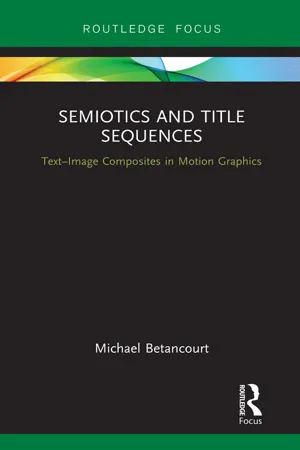
Title sequences are the most obvious place where photography and typography combine on-screen, yet they are also a commonly neglected part of film studies. Semiotics and Title Sequences presents the first theoretical model and historical consideration of how text and image combine to create meaning in title sequences for film and television, before extending its analysis to include subtitles, intertitles, and the narrative role for typography. Detailed close readings of classic films starting with The Cabinet of Dr. Caligari, and including To Kill A Mockingbird, Dr. Strangelove, and The Good, the Bad and the Ugly, along with designs from television programs such as Magnum P.I., Castle, and Vikings present a critical assessment of title sequences as both an independent art form and an introduction to the film that follows.
eBook - ePub
Semiotics and Title Sequences
Text-Image Composites in Motion Graphics
- 146 pages
- English
- ePUB (mobile friendly)
- Available on iOS & Android
eBook - ePub
About this book
Information
1
This book emerged from fragmentary work done over several years concerned with the relationship between meaning and form in title sequence designs (mostly) produced for feature films and television programs in the United States. Some of the individual close readings that appear in this book have been published as self-contained considerations of specific title designs, while for many others, this is their first time appearing publicly. The foundations of this analysis lie with the history of title designs in film, television, and video games developed in my monograph The History of Motion Graphics: From Avant-Garde to Industry in the United States. Proposing a general semiotic theory for title sequences and other arrangements of text and image on-screen originates with this same analysis and research. However, the application of semiotics to composites of text–imagery is not limited to title designs, but can be applied to all motion graphics such as subtitles, intertitles, as well as any other text on-screen, and potentially even to similar visual structures in graphic design. The three general modes presented in this study are easily recognizable in title sequences. The critical extension of these same structures to describing text–image composites, such as subtitles, follows from these more prominent applications: title sequences offer the greatest variety of uses and designs employing the three fundamental modes. The proposed semiotic theory of text–image composition is generalized from studies of particular designs chosen for their typicality.
All title sequences are marginal productions—whether produced for film, television, video games, or any other media—these paratexts1 come at either the start or end of the narrative, attached to yet also independent of the main production. Yet they occupy a difficult middle ground between being autonomous and integrated; they are not independent productions, but are often made independently of the drama or narrative.2 The careful, close consideration of these designs illuminates the complexity of this dynamic, allowing for a theoretical understanding of the semiotic relationships possible with composites of text and image. While the consideration of title sequences is the main focus of this analysis, it also includes the logical extension of this theory into title montages, subtitles, and related forms combining text and image.
Although sound and music also play a major (and prominent) role in the design, production, and organization of title sequences (and all motion graphics generally), this study is not primarily focused on the semiotics of audio-visual relationships. Their discussion are en passant observations included in the interests of thoroughness: the soundtrack is part of the meaning emergent from title sequences, yet a full and complete consideration of sound is beyond the scope of the present analysis—the essential element of title design is text, not sound. The theory proposed in this book is concerned with the on-screen relationship and organization of text in relation to a background image. Some title designs are elaborately synchronized to their score, while others are silent. Both the soundtrack and background images can be removed from the title sequence without fundamentally destroying what defines the title sequence as a title—but to remove the type transforms the title design into something else—an animated film, or perhaps a standard montage. Even in the title design used for the television program Castle that has no credits and only concludes with an animated logo, the presence of the logo (the text) is the necessary and sufficient condition required for the sequence being identified as a title sequence. Text is the crucial element that cannot be removed, but the semiotics surrounding it are neither critically well described nor comprehensively theorized.
Yet, the title sequence is a hybrid construction and this intermedial nature is a mixture of music, written language (texts), and visual materials of various types, both live action and animated, composited to create the singular units called “title cards.” Their organization into the totality of a title sequence is more than just an arbitrary arrangement of pieces or a montage of shots. The order of the cards, their duration, the size of names, and their separation/combination into each card is governed by a maze of traditions, contractual obligations, and individual temperaments. While these factors constrain the design, limiting and focusing it in advance of its production in ways separate from the actual title sequence, the finished result is other than simply a sum of these varied and cacophonous demands. A close reading thus comes as the preferred solution to address these complexities, allowing for a consideration of each design as an artifact requiring its own nuanced analysis in context with other similar designs, while allowing for the generalizations that link theory to practice.
Commonalities of approach and engagement emerge from these repeated considerations: the present theorization follows from individual analyses augmented by contextual research across the history and range of title designs made in the United States, rather than being limited to just the already-known work of “star” designers, or those famous designs created by uncredited designers working on well-known and regarded films. This analysis focuses on a variety of typical designs from film and television chosen precisely because they can serve as general examples of type. This selection process required looking at a broad range of designs with as much attention paid to monotonous, minor works as to major, well-known designs. By including these other sequences that are commonly ignored as uninteresting and insignificant because they do not offer much for a close reading, the proposed semiotic theory for composites of text and image is meant to be general in scope: the meaning-producing modes described by this analysis of title sequence designs can be extended to include any composites of text and image, not just those employed by/in motion pictures.
Theory and Design
When theories of design address typography, the tendency is to consider legibility and then move on to other, more general and abstract approaches to composition and organization. This concern with formal principles of arrangement is accompanied by a metaphysical conception of design devoid of cultural signification. It is an approach to typographics that systematically ignores and rejects the significance of even clearly symbolic imagery. Paul Rand, a prolific theorist of this approach, is typical in his off-hand dismissal of self-evident religious iconography in Thoughts on Design (1970):
It is significant that the crucifix, aside from its religious implications, is a demonstration of perfect form as well—a union of the aggressive vertical (male) and the passive horizontal (female). It is not too farfetched to infer that these formal relations have at least something to do with its enduring quality.3
Rand’s formalist metaphysics elides the central place this religious symbol has in relation to the various Christian faiths in favor of a sexist overlay of his own symbolic metaphysics onto a cultural artifact. This totalizing conception of formalism necessarily destroys the historical and enduring factors of iconography and tradition, replacing them with his own invention. It is a constructive denial that negates earlier symbolisms and meanings since it enables the development of his theory without concern for the complexities of semiotics and exigencies of established meaning and tradition that constrain interpretation. The approach that Rand adopts is common in theorizations of design: they tend towards this precise formalist vacuum when confronting established meaning and symbolic form. These constraints become especially apparent when design theory encounters typography.
Gygory Kepes’s series of monographs on various aspects of design published throughout his career are strikingly devoid of considerations of typography. Neither his anthologies such as Sign Image Symbol (1966) nor his own book Language of Vision (1959) contain theoretical analyses of typography in design. The closest discussion in his anthologies appears in the article “Case Study: Symbols for Industrial Use” by industrial designer Henry Dreyfuss that presents a discussion of his own work with developing symbols for use on machinery. Dreyfuss does not propose a theory, offering instead only a series of personal guidelines and examples he used in his work.
Even in contemporary studies of graphic design, the focus tends towards a formalist discussion of potential arrangements and structural organization rather than theory. In Modern Typography Robin Kinross presents a historical account of how typography developed over the five centuries from Guttenberg’s press to the present day. This focus on formal development is common. Even when theories such as deconstruction are considered in Ellen Lupton and Abbott Miller’s Design Writing Research: Writing on Graphic Design, published in 1996, their study does not engage in theory or theorizing design, but describes what theory might provide to a critical understanding of design; however, their analysis is confined to the introduction. It is a history tempered by theoretical questions, not a theory engaged with or of design. The rest of the book returns to model examples chosen for their formal development and arrangement of graphics and type. The introductory theoretical foundation defines concepts that provide a critical context for their close analysis of particular designs without proposing general principles. While Lupton and Miller’s introduction identifies a material linkage between the organization of typography and its meaning that is independent of the words themselves, their approach remains taxonomic:
Spacing and punctuation, borders and frames: these are the territory of typography and graphic design, those marginal arts that render texts and images readable. The substance of typography lies not in the alphabet as such—the generic forms of characters and their conventional uses—but rather in the framework and specific graphic forms that materialize the system of writing. Design and typography work at the edges of writing, determining the shape and style of letters, the spaces between them, and their placement on the page. Typography, from its position at the margins of communication, has moved writing away from speech.4
They recognize the importance of design as a mediation of meaning, but fall back into the traditional formalist approach; the theory their discussion implies never emerges. Lupton and Miller’s analysis in Design Writing Research: Writing on Graphic Design is typical of how theory appears in discussion of design: it does not theorize as such—instead of theory, these books collect and organize hierarchies of material, formal taxonomies of examples, which are then arranged and considered as a lexicon of model approaches, commonly presented as historical accounts of exceptional designs produced by skilled practitioners. Their audience is specifically practitioners; thus, rather than providing a thorough theory, it suggests a useful and intelligent history of graphic design’s encounter with post-modernism. Their considerations of model designs is focused on how they have revealed, revised, or challenged accepted rules—but does not address the underlying theoretical issues: what are these rules, why do they function as they do?
As film historian Jan-Christopher Horak noted in his book Saul Bass: Anatomy of Film Design, there are no academic theories of film titles, and the formal consideration of kinetic typography or its role in design is rare. The relative independence of title sequence designs from the dramatic narratives that follow them has allowed a degree of formal experimentation atypical of these productions generally. Yet, formal theories of film title design are also notably absent from film theory: in place of such considerations are a collection of traditional views about the “ideal” relationship between title sequence and dramatic narrative that have been circulating since at least the 1950s; Georg Stanitzek’s analysis in his article “Reading the Title Sequence (Vorspann, Génèrique)” is typical, providing a series of observations that affirm these established traditions. Film studies tends to consider title design as a variety of paratext: a reflection on the main production following (or separate from) the title design, as a subservient form best understood through its narrative relationship to the primary production.5 Approaching title sequences as unique objects,6 rather than developing any general theories of their design or constitution, follows the traditions of graphic design that focuses on models to emulate. Other books on film titles, such as Uncredited: Graphic Design and Opening Titles in Movies by Gemma Solana and Antonio Boneu, are illustrated surveys of interesting designs: what established hagiographies of title designs provide is a specific collection of noteworthy designers—Saul Bass, Maurice Binder, Pablo Ferro, et al. who also typically received prominent, on-screen credit for their work. Critical discussions such as Anna Zagala’s brief article “The Edges of Film” in Sense of Cinema are cursory, offering only suggestions that a theoretical analysis of title sequences is possible:
Films variously incorporate titles as discrete and separate sequences preceding the live action, as text superimposed over early, often ambient, establishing shots, or combine these two approaches in hybrid forms. The diverse approaches to film title design reflects not only innovation but also a certain dis-ease. In film title sequences the relationship between image and type is always an uneasy one. Foucault in his essay on Magritte’s painting “This is not a pipe” characterizes the relationship between text and image in Western painting as necessarily hierarchical in which one is always dominated by the other. Foucault acknowledges that this relationship is rarely stable but that what is vital is that the verbal signs and visual representations are never given at once. It’s a dynamic that Deleuze, writing on Foucault, aptly describes as an “audiovisual battle.”7
This quote contains her entire comments on a theoretical approach to title design. And while her recognition that Michel Foucault’s discussion of calligrams in This is Not a Pipe also provides a reference point for the current examination, her observations are not developed beyond what appears in this quotation. Her limited the...
Table of contents
- Cover
- Title
- Copyright
- Dedication
- Contents
- List of Figures
- Acknowledgments
- 1
- 2
- 3
- 4
- 5
- 6
- Index
Trusted by 375,005 students
Access to over 1.5 million titles for a fair monthly price.
Study more efficiently using our study tools.
Frequently asked questions
Yes, you can cancel anytime from the Subscription tab in your account settings on the Perlego website. Your subscription will stay active until the end of your current billing period. Learn how to cancel your subscription
No, books cannot be downloaded as external files, such as PDFs, for use outside of Perlego. However, you can download books within the Perlego app for offline reading on mobile or tablet. Learn how to download books offline
Perlego offers two plans: Essential and Complete
- Essential is ideal for learners and professionals who enjoy exploring a wide range of subjects. Access the Essential Library with 800,000+ trusted titles and best-sellers across business, personal growth, and the humanities. Includes unlimited reading time and Standard Read Aloud voice.
- Complete: Perfect for advanced learners and researchers needing full, unrestricted access. Unlock 1.5M+ books across hundreds of subjects, including academic and specialized titles. The Complete Plan also includes advanced features like Premium Read Aloud and Research Assistant.
We are an online textbook subscription service, where you can get access to an entire online library for less than the price of a single book per month. With over 1.5 million books across 990+ topics, we’ve got you covered! Learn about our mission
Look out for the read-aloud symbol on your next book to see if you can listen to it. The read-aloud tool reads text aloud for you, highlighting the text as it is being read. You can pause it, speed it up and slow it down. Learn more about Read Aloud
Yes! You can use the Perlego app on both iOS and Android devices to read anytime, anywhere — even offline. Perfect for commutes or when you’re on the go.
Please note we cannot support devices running on iOS 13 and Android 7 or earlier. Learn more about using the app
Please note we cannot support devices running on iOS 13 and Android 7 or earlier. Learn more about using the app
Yes, you can access Semiotics and Title Sequences by Michael Betancourt in PDF and/or ePUB format, as well as other popular books in Media & Performing Arts & Film & Video. We have over 1.5 million books available in our catalogue for you to explore.