![]()
1
Spread of Buddhism
Regional patterns
The expansion of Buddhism is often seen as originating in the Ganga Valley, and then expanding across the subcontinent as also Asia. This model is largely based on later textual references to sites associated with the life of the Buddha and assumes that Buddhism was a single unified entity, a hypothesis that may be dated to Alexander Cunningham’s archaeological search for the historical Buddha in the 19th century. It is not validated by the textual evidence that underscores the development of the Buddha’s life story well into the first millennium CE, a period antedating the proliferation of monastic sites. Given the presence of several monastic orders and lineages, the expansion process was clearly far more complex than a simple matter of diffusion of the religion from sites in the Ganga Valley.1
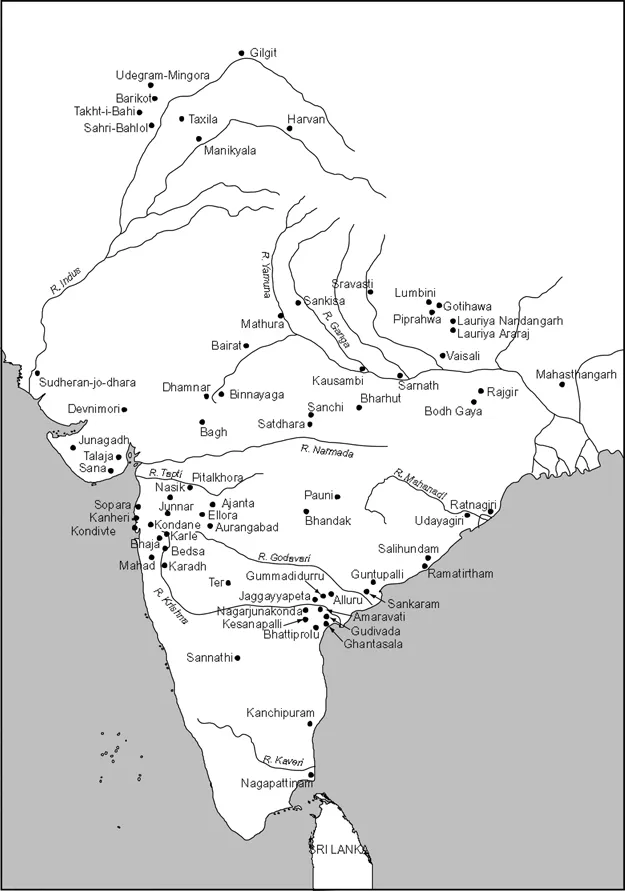
In this chapter, I suggest that a key agency for the spread of Buddhism was that of the Sangha itself and its members, the learned monks and nuns (Fig. 1.1). An alternative scheme of categorization of sites is proposed in terms of the physical location of Buddhist monastic complexes such as in river valleys, coastal locations and hills. The Sanskrit and Pali terms used in texts are vihāra and ārāma, which translate as places of pleasure and gardens.2 I start with a discussion on the agency for the spread of Buddhism across the subcontinent and then move to peninsular India in order to emphasize the latter’s maritime orientation and changing patterns for the growth and transformation of monastic sites, while the final section discusses the location of monastic sites in the foothills of the Himalayas, which have continued well into the present.
Those monks who created the Buddhist sutras had a very clear idea about the formalization of the new texts. The idea of remembering the places where the Buddha was supposed to have delivered a certain sutra at the beginning of each individual text was certainly an innovation. This happy decision to provide the texts with a geographical
Figure 1.1 Map showing distribution of Buddhist sites in the subcontinent
frame, quite in contrast to the earlier Vedic literature where very little is found on topography, preserved many place names of both villages and towns in the Buddhist literature. In addition, the wording introducing these place names tells us much about the development of the literary form of early Buddhist texts and about the historical memory of the early authors.3
The history of Buddha dhamma is not a history of ‘sects’ in the sense of broad-based lay groups, as in Reformation Europe. Instead, it is a history of monastic orders or nikāyas and 18 nikāyas are referred to in the Canon dated to the first century BCE. A nikāya is best described as a monastic order, and its lineage was transmitted through ordination within the Sangha. Members of a nikāya observed a shared code of rules for monks and nuns, the Prātimokṣa.4 It is also evident that different schools and doctrines of Buddhism coexisted at monastic sites without the followers making a distinction between the diverse traditions, and hence argues against a chronological framing of the so-called sects or schools.5 Gregory Schopen has convincingly shown the active participation of Buddhist clergy in the stupa and image cult and their mobility based on data from inscriptions, which refer to donations by monks and nuns.6 Thus, it is time to interrogate chronological terms such as Hinayana, Mahayana and Vajrayana, which are often seen as exclusive blocs or sects in the history of Buddhism.7
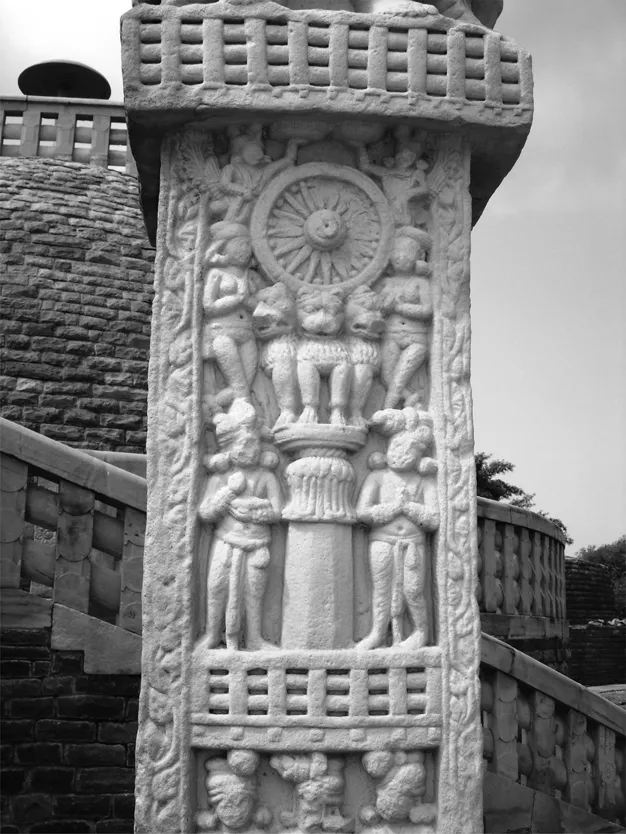
An issue that has continued to be debated is the nature of Ashoka’s dhamma, especially since Buddhist writings have associated it with the expansion of Buddha dhamma and kept the tradition of Ashoka alive. A large corpus of Buddhist writings developed around the legend of dhammarāja Ashoka.8 No doubt, the link with the Mauryan King Ashoka remains strong, especially since many of the sites marked by pillars or rock edicts later developed into flourishing monastic sites. Ashoka set up at least 20 pillars, including those inscribed with his edicts. The locations of these extend over the northern parts of the Indian subcontinent from the Nepal Terai to the districts of Champaran and Muzaffarpur in north Bihar, Sarnath near Varanasi and Kausambi near Allahabad, in the Meerut and Hissar districts and at Sanchi in central India. Nevertheless, it is abundantly clear from subsequent copies, later inscriptions engraved on many of the pillars and the shifting of pillars to other locations that a rich oral tradition had emerged around these, which helped keep the memory of the Mauryan king alive throughout history (Fig. 1.2).
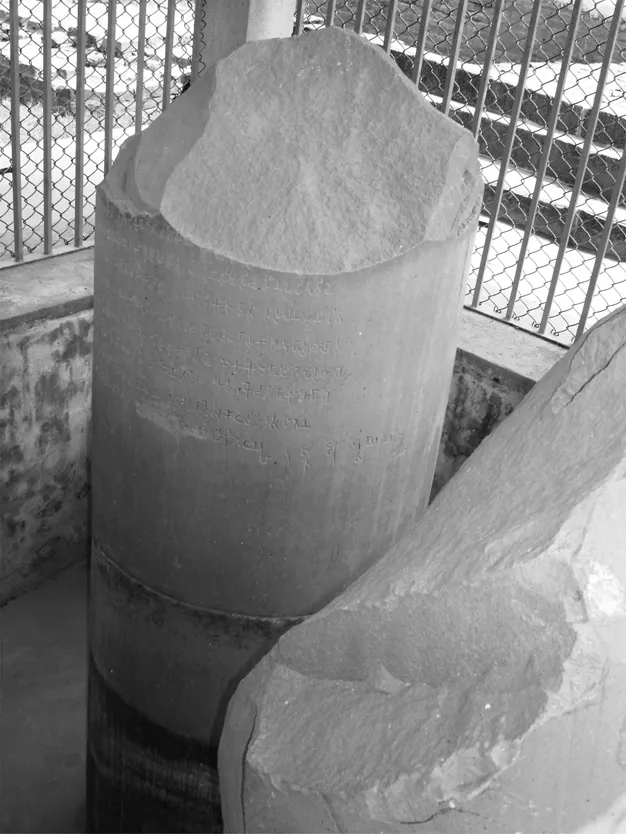
Early 20th-century archaeological excavations indicate that the first monument raised at Sarnath was an Ashokan pillar and an apsidal shrine was subsequently built in its vicinity (Fig. 1.3).9 The excavations
Figure 1.2 Worship of the Ashokan pillar as shown at Stupa 3, Sanchi
indicate that around the middle of the first millennium CE, the inscribed portion of the pillar was covered under a floor. This is further corroborated by a late Gupta period inscription on the pillar.10 After this political initiative, only a few additions were made in the next two centuries,
Figure 1.3 Ashokan pillar at Sarnath unearthed during archaeological excavations in the early 20th century
including the dozen railing pillars (dated about the first century BCE) discovered near the Dhamekh stupa and some inscriptions. In the early centuries of the Common Era, Sarnath seems to have been enriched with new monasteries as well as a number of images including the red sandstone preaching Buddha established by Bhikshu Bala of Mathura. However, it was in the fourth to the sixth centuries CE that Sarnath reached a high watermark with a majority of the buildings dated to the middle of the first millennium CE, including the gigantic Dhamekh stupa. Also ascribable to this period are a number of sculptures and inscriptions as well as numerous renovations and restorations. Hence, over the centuries, an overall expansion occurred at the site of Sarnath, which continued well into the 12th century.
The last historical record from Sarnath is the 12th-century inscription on a rectangular slab of sandstone written in Sanskrit. It consists of 26 verses and gives the genealogy of Kumaradevi, the queen of Govindachandra whose inscriptions range from 1114 to 1154 CE. Verse 21 mentions that the queen built a vihara at Dharmacakra or modern Sarnath and that she restored the image of Śrī Dharmacakra Jina or Lord of the Wheel of Law as it had existed in the days of dharma Ashoka. The inscription was composed by the poet Srikunda and engraved by the mason Vāmana. This 12th-century reference to the memory of the Mauryan King Ashoka indicates the longevity of the association of the king with major Buddhist sites in the Ganga Valley.
Another issue relates to differences between contemporary sites. In an earlier paper, I have highlighted characteristic and unique features of two near-contemporary Buddhist sites across the subcontinent, such as Kanheri on Salsette island off the west coast of India and Amaravati in the Krishna Valley in Andhra Pradesh in southeast India, and suggested that the cultural antecedents as evident in the archaeological record help explain diversity.11 Amaravati and Kanheri provide the largest number of epigraphs in their respective regions, but an analysis of the inscriptions shows several contrasts; for example, unlike Amaravati, there is no evidence for royal patronage at Kanheri. Thus, there is a need to interrogate the agency for the spread of Buddhism as the existing models are inadequate to explain the proliferation of monastic sites in the early centuries of the Common Era and their sustained maritime orientation along both the east and west coasts of the Indian subcontinent.
The agency for the spread of Buddhism
An appropriate example to start with is the hill of Sanchi on the banks of the river Betwa in central India. Although the place is not connected to any incident from the Buddha’s life, the main stupa was located in the vicinity of an Ashokan pillar and is one of several groups of stupas within a 10-kilometre radius, viz. at Sonari, Satdhara, Bhojpur and Andher. There is evidence for at least 16 dams built to provide irrigation facilities for rice cultivation in the area.12 The number of inscribed relic caskets found at Sanchi is striking and have been identified as those of Buddhist monks and teachers of the Hemavata School.13 Clearly, learned teachers and members of the Buddhist Sangha played a major role in the establishment of monastic sites and the spread of the religion.
Alexander Cunningham was perhaps the first to remark on the widespread distribution across north India of gigantic Buddhist images made of red sandstone at Mathura.14 Lohuizen-de Leeuw added to this list and has shown that images from Mathura have been found over an extensive area stretching from Chandraketugarh in Bengal in the east to Butkara and Shaikhan Dheri in the north-west; from Lumbini and Tilaurakot in the north-east to Amaravati in the south. The spread in the west is defined by sites such as Osian and Noh.15 Within this wide cultural sphere of Mathura, certain images stand out such as the huge Buddha images which are inscribed and dated; these provide important clues as to the agency involved in the transportation and installation of the Buddha images.
Schopen has argued that as in the case of the Buddhist monastic complexes at Bharhut and Sanchi, at Mathura, the western Deccan caves and Amaravati also, the donative inscriptions where the name of the donor has been preserved indicate that almost half of the donors were monks or nuns.16 Members of the Buddhist Sangha not only contributed to the setting up of stupas and images, but more importantly also controlled them.17 Many of them indicate their knowledge of religious texts by use of terms such as bhāṇaka (reciter), caturvidya (who knows the fourfold scriptures), dharmakathika (preacher of dharma), prāhaṇīkas (practisers of meditation) and trepiṭakas (those knowledgeable in the Tipitakas). These examples show the active role played by monks and nuns in merit-making activities connected with the stupa cult and the cult of images and their close association in all these with the laity. In the context of the inscriptions from Mathura, it is pertinent that at least two-thirds of the inscriptions that refer to the setting up of images and where the name of the donor survives are by monks and nuns. Thus, the data from inscribed and dated Buddha images show that monks and nuns were actively involved in setting up of images and introducing their worship. Bhiksu Bala and his pupils were known to have set up images of the Buddha at Sarnath, Kausambi and Sravasti in the Ganga Valley. It is also evident from the inscriptions that puja was performed often for the welfare and happiness of one’s parents18 and companions.19 This was true also for north-western India and the Deccan where monks intro...