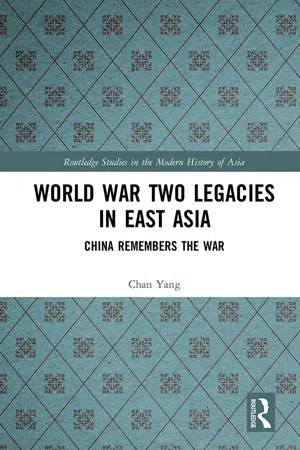
How to remember World War Two in East Asia is a huge source of friction between China and Japan, causing major diplomatic and political difficulties right up to the present. As this book shows, however, there is also disagreement within these countries as to how to remember the war, which in the case of China began immediately after the war and lasted with varying degrees of intensity until the famous "textbook incident" of 1982 marked the beginning of a more strongly anti-Japanese position. Based on extensive original research, the book explores how China's remembrance of the war has evolved over time. It not only explores the roles played by the national as well as local state actors in the formation of the Chinese war memory, but also pays attention to the individual Chinese people. It considers particular aspects of commemoration in China, explores the corresponding situation in Japan and discusses the continuing impact on the relationship between the two countries.
- 226 pages
- English
- ePUB (mobile friendly)
- Available on iOS & Android
eBook - ePub
About this book
Information
1 Introduction
A new approach to the Sino–Japanese history problem
On 24 September 1972 a Japanese press group that was visiting China was guided to the Marco Polo Bridge in Beijing. This trip was not included in the official schedule but was arranged at the delegation’s request.1 Most of the journalists, who were reporting the forthcoming negotiations on Sino–Japanese normalisation, experienced a moment of catharsis in this place on the outskirts of Beijing that, in 1937, had witnessed the beginning of an eight-year full-scale war between China and Japan. The next day, Tada Minoru 多田実, a senior journalist from the group and an ex-student soldier who had fought on Iwa Jima island during the Pacific War, wrote a sentimental article in Yomiuri Shinbun, just before the Japanese prime minister, Tanaka Kakuei, arrived in Beijing.2 He retraced the Marco Polo Bridge Incident and pointed out the importance of the legacy of the Fifteen-Year War in the relationship between the two countries, stating that an equal, peaceful and friendly Sino–Japanese relationship could only be achieved if the Japanese could truly repent of their wartime wrongdoings and overcome the wartime past. He thus suggested that, as a representative of the Japanese people, the first thing Premier Tanaka should do when he arrived in China was to sincerely apologise to the Chinese people.
On 29 September 1972, China and Japan signed the Joint Communiqué of the Government of Japan and the Government of the PRC, which normalised diplomatic relations between the two nations. Although not quite in the way that Tada had wished, Tanaka did offer a sort of apology in the communiqué: ‘the Japanese side is keenly conscious of the responsibility for the serious damage that Japan caused in the past to the Chinese people through war, and deeply reproaches itself’.3 Furthermore, the Chinese side renounced its claim to war reparations to show that they accepted the Japanese apology. By sealing the communiqué, Japan and China normalised their relationship. However, they did not achieve a true post-war reconciliation.
Both Japan’s apology and China’s forgiveness eventually became mere formalities. The legacy of the Fifteen-Year War, which has still not yet been properly overcome, became a hidden problem in the 1972 Sino–Japanese normalisation, as Tada had warned. Since then, disputes surrounding the history of the Fifteen-Year War have frequently, and sometimes destructively, disrupted the relationship between the two nations. In addition to various chronic war-related controversies, like the Nanjing Massacre debate, the issue of remembrance of the war has sparked large-scale protests and disturbances: for instance, the textbook incidents and the anti-Japanese demonstrations by Chinese students in the 1980s. The 1982 Textbook Incident is generally considered to have been the first large-scale diplomatic conflict to arise between Japan and China (also involving several other Asian countries) over the wartime history. It occurred in the summer of 1982 when the governments of the PRC and other East Asian countries strongly upbraided the Japanese government for its alleged attempt to distort the history of the Fifteen-Year War in Japanese school textbooks. Although the incident was settled by the Japanese Ministry of Education’s compromise, as reflected in its new textbook authorisation criterion (widely known as the ‘Neighbouring Country Clause’), which was adopted in November 1982, similar conflicts continue to arise.4 In the new millennium, these conflicts have become increasingly two-way: anti-Japanese and anti-Chinese movements have both broken out (for example, the dispute over the Diaoyu/Senkaku Islands in 2010).
Disputes like these are often referred to as manifestations of the Sino–Japanese history problem. More exactly, the Sino–Japanese history problem is the clash between China and Japan over ‘the history of Japanese aggression against China during the half-century before’, and especially during the Fifteen-Year War, which ‘has developed into a vicious cycle of emotional outbursts’.5
The 1982 Textbook Incident was a watershed moment, in terms of the nature and scale of the Sino–Japanese history problem. Since then, it is observable that the war history-related problems have developed into a special, yet serious, element of Sino–Japanese relations. Contemporary Sino–Japanese relations exist on a number of levels: the military level, the diplomatic/political level, the economic level and the human/individual level. The history problem overshadows all of these factors, and at the same time it is affected by these factors. The problem, needless to say, is not only seriously damaging Sino–Japanese interaction, it is also tangibly affecting East Asian stability.
Why did the 1972 normalisation not lead to a Sino–Japanese post-war reconciliation? How has the Sino–Japanese history problem arisen? The history problem between China and Japan was first studied academically by a number of political scientists dealing with Sino–Japanese bilateral relations. The approach taken by these academics to probing the origins of the Sino–Japanese history problem has been insightful. However, by only examining a few influential diplomatic conflicts over the wartime history issue, and focusing exclusively on the decision-makers – as if they are the only decisive factors in causing or resolving the problem – these studies have paid little attention to the social and historical soil nurturing the problem.6
A relatively new kind of scholarship, which applies the Western concept ‘collective memory’ or ‘collective remembrance’ to the East Asian context, and which sees the current Sino–Japanese history problem and memories of the Fifteen-Year War as inseparable, has been developed by a few researchers, mainly working in the fields of political science, history and philosophy. The concept ‘collective memory’ emerged in early twentieth-century France, as a radical response to cognitive psychology, which posits that memory is a ‘solitary act’ and is independent from the social context. Collective memory can be defined as the memory of a group of people, typically passed from one generation to the next, which is greater than the sum of individual memories.7 It took a long time for this concept to be applied to the study of war memory. The pioneer of collective memory studies was sociologist Maurice Halbwachs.8 One of Halbwachs’ assertions is that individual memory only reflects the viewpoint of the collective memory, which is continuously subject to innumerable criticisms. This approach overemphasises the collectiveness of the memory, and fails to recognise sufficiently an individual’s ability to remember. Thus, speaking about collective war memory is problematic, as collective war memory is ‘not what everybody thinks about war; it is a phrase without purchase when we try to disentangle the behaviour of different groups within the collective.’9 Although this remains unresolved, several imperfect strategies for coping with the dilemma of how to bridge collective memory and personal memory have been developed.
One of the strategies adopted in this book is to shift the focus from the content of ‘collective memory’ to the action of ‘collective recollection’, by integrating the findings of cognitive psychology and sociology.10 Specifically, the book distinguishes ‘collective remembrance’ from ‘collective memory’. The former refers to public recollection, which means the action by groups and individuals in public of gathering bits and pieces of the past and joining them together. The latter is considered to be the product of collective remembrance. (These two terms are used interchangeably in this book: I use the term ‘memory’ normally when I discuss other scholars’ works which have used this term, or when I talk about ‘memory’ itself – the product of ‘remembrance’). The actions of agents are the linkage between individual memory and socially determined memory. Individuals, associations, state governments, and even inter-state institutes – and anyone who has input into the national memory – are defined as agents, in the sense of homo agens (man as an acting being).
The perspective of the new scholarship as regards the formation of the history problem can be summarised as follows: due to an evolutionary process since the end of the Fifteen-Year War, the Chinese and Japanese versions of the war have become divergent and problematic for each other. The divergence between the two nations’ current problematic forms of remembrance of the war gives rise to conflict between the Japanese and Chinese over the war history – and, ultimately, gives rise to the frequent manifestations of the ‘history problem’ that take place. What, then, are the problematic aspects of current Chinese and Japanese Fifteen-Year-War remembrance? How have the different forms of Chinese and Japanese war remembrance evolved into the current problematic versions? Why and how have these two memories clashed?
The numerous atrocities committed by Japan during the war, and the heroic wartime resistance, make up the major part of current Chinese war remembrance. The problems with this perspective are the prevalent feelings of hatred towards the Japanese, as well as the condemnation of the ‘Japanese devil’, as a result of Chinese suffering during the war, and the exaggeration of Chinese heroism (such as in unrealistic portrayals in Chinese TV dramas of the Chinese resistance as super-hero-type characters and Japanese soldiers as very cruel but also weak invaders – a portrayal that is now often criticised by Chinese audiences themselves). One thing worth mentioning in this context is the relativity of the word ‘problematic’. The PRC’s remembrance of the Fifteen-Year War is problematic for the Japanese, but it is not necessarily problematic for other countries, such as, say, South Korea.
Meanwhile, the current form of Japanese war remembrance is more complicated because of its ‘contested nature’. Namely, in Japan there is no unified or dominant theme of war remembrance, as there is in Germany (overcoming the past), or in China (resistance, hatred and condemnation). In his empirical research within Japan, Seaton identifies five primary groups and their versions of war remembrance: progressives, progressive-leaning groups, the ‘don’t knows and don’t cares’ group, conservatives and nationalists/revisionists.11 The problematic aspects of the nationalists’ war remembrance (glorifying the ‘Great East Asia War’) and the revisionists’ war remembrance (denying the atrocities) are easily seen by outsiders as the dominant theme in Japanese war remembrance. The problem manifested by the ‘don’t know and don’t care’ group – amnesia – is often criticised as well. However, the real worrying problem with respect to Japanese war remembrance is the victim mentality – a mentality that is demonstrated by most Japanese people. Shimazu implies that by placing the burden of war responsibility on the shoulders of the military and others, the Japanese can be anointed forever as victims of the war. Moreover, this intensely myopic victim mentality has come at the cost of ignoring the real victims of Japanese aggression, especially in Asia.
To uncover how the Chinese and Japanese war remembrance have evolved into the current problematic versions, it is necessary to pin down the origins of the formation of these problematic war memories, by examining the historical evolution of Japanese and Chinese war remembrance.
Several distinctive phases of Japanese war remembrance before 1982 can be identified. During the war, ordinary Japanese people did not learn of the various atrocities committed by the military in China – not only as a result of the state’s censorship, but also because the nation as a whole was unwilling to learn about them due to the ultra-nationalist education and propagandistic mobilisation conducted by the Japanese authorities.12
After the end of the war on 15 August 1945, there was a short period during which most Japanese started to reflect on their wartime behaviour and to discuss the issue of war responsibility in a very diverse yet progressive way.13 The democratic reforms and war tribunals established by the General Headquarters (GHQ) (the US-led occupation authority in Japan) – especially the International Military Tribunal for the Far East (IMTFE) – are considered to be the most important contributor to this trend. Nevertheless, the IMTFE’s decision not to put the Emperor Hirohito on trial and to use the punishment of a few military leaders to ‘clean up’ the crimes committed by the Japanese nation ‘reinforced a strong popular inclination to ignore what the men of Yamato had done to others in their frantic quest for empire and security’.14 That is, the formation of the most worrying problem of the Japanese war memory – victim mentality – can also be attributed to the GHQ. Still, some scholars consider that although the IMTFE inculcated the victim mentality in Japan, this mentality was not imposed on the Japanese but was willingly accepted by them, because such a perspective suited Japan, as a country that desperately wanted to break with its past.15
After 1947, with the onset of the Cold War, there was an obvious reversal of the GHQ’s reformative policy, which returned the conservatives – who favoured a form of war remembrance that asserted great national pride – to power.16 In April 1952, the foreign occupation was ended and Japan regained its independence. The Japanese conservative government embarked in earnest on its policy of nurturing Japanese patriotism. Education was targeted and in October 1956 the Ministry of Education issued a decree on textbook certification to curtail leftist textbooks. The government also started to use war commemoration days to construct a national community with a shared form of remembrance of the Fifteen-Year War. At the same time, the Japanese victim mentality became further entrenched – especially after Hiroshima and Nagasaki entered the national narrative and became a symbol of national suffering, bolstered by the 1954 Lucky Dragon incident (a Japanese fishing boat, the Lucky Dragon, was contaminated by nuclear fallout from an American hydrogen bomb test at Bikini Atoll).17
Despite t...
Table of contents
- Cover
- Half Title
- Title Page
- Copyright Page
- Table of Contents
- List of illustrations
- Note on Chinese and Japanese word usage
- Note on the terminology used to refer to the war
- Preface
- 1. Introduction
- 2. Remembrance of the war and Sino–Japanese relations
- 3. The necessity of commemorating the war: Honouring the martyrs
- 4. The benefit of remembering the war: Using the past to serve the present
- 5. Beyond the state: Non-official agents of the Fifteen-Year-War memory
- 6. Conclusion
- Bibliography
- Index
Trusted by 375,005 students
Access to over 1.5 million titles for a fair monthly price.
Study more efficiently using our study tools.
Frequently asked questions
Yes, you can cancel anytime from the Subscription tab in your account settings on the Perlego website. Your subscription will stay active until the end of your current billing period. Learn how to cancel your subscription
No, books cannot be downloaded as external files, such as PDFs, for use outside of Perlego. However, you can download books within the Perlego app for offline reading on mobile or tablet. Learn how to download books offline
We are an online textbook subscription service, where you can get access to an entire online library for less than the price of a single book per month. With over 1.5 million books across 990+ topics, we’ve got you covered! Learn about our mission
Look out for the read-aloud symbol on your next book to see if you can listen to it. The read-aloud tool reads text aloud for you, highlighting the text as it is being read. You can pause it, speed it up and slow it down. Learn more about Read Aloud
Yes! You can use the Perlego app on both iOS and Android devices to read anytime, anywhere — even offline. Perfect for commutes or when you’re on the go.
Please note we cannot support devices running on iOS 13 and Android 7 or earlier. Learn more about using the app
Please note we cannot support devices running on iOS 13 and Android 7 or earlier. Learn more about using the app
Yes, you can access World War Two Legacies in East Asia by Chan Yang in PDF and/or ePUB format, as well as other popular books in Social Sciences & Ethnic Studies. We have over 1.5 million books available in our catalogue for you to explore.