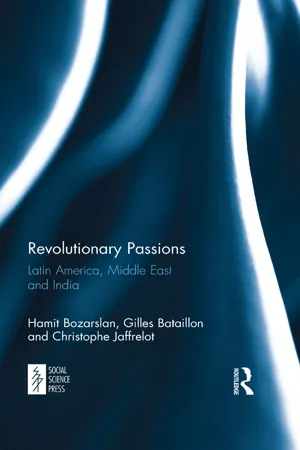
Europe has been the chief arena of revolutionary passions since the end of the eighteenth century. During this same period, and right up to the beginning of the twenty-first century, the non-European world, too, has resonated with coup attempts and revolutionary turmoil. How does one begin to understand these revolutionary passions? To what extent are they influenced by European matrices? Have these revolutions also themselves resulted in 'exportable models'? Three French writers look at three continents—Latin America, the Middle East and India and interrogate the revolution, with reference to and dialogue with the definitive work of Francois Furet, who wrote The Passing of an Illusion: The Idea of Communism in the Twentieth Century. Interestingly, the original French book Passions révolutionnaires was written in 1995, just after the fall of the Berlin wall. Whether nationalist, religious, proletarian, international, anti-colonial or simply liberty and equality, whether violent or fought passively, the Revolution as a concept and a fact, whether past, present or future, remains a critical reference point for our societies.
eBook - ePub
Revolutionary Passions
Latin America, Middle East and India
- 202 pages
- English
- ePUB (mobile friendly)
- Available on iOS & Android
eBook - ePub
Revolutionary Passions
Latin America, Middle East and India
chapter 1
FrançOis Furet: The past Of an Illusion and The Revolutionary Enigma
Before analysing the contribution of The Past of an Illusion by François Furet to the understanding of revolutionary passions and phenomena, let us briefly explain how we will read the text and then locate the context in which it was written.
One should make it clear at the outset that while the Past is considered a ‘stand-alone’ work, since it deals with a particular topic, and provides the framework and appropriate arguments, to understand the role of the French Revolution, it cannot be separated from Furet’s entire body of work on the 20th century. A number of ideas developed in depth in the Past are, in fact, implicit, sometimes as sub-text in previous studies. This continuity makes inevitable the journeys back and forth in an exhaustive work produced over four decades.
Without underrating this work, the present contribution does not wish, however, to reproduce Furet’s interpretation (or rather interpretations) of the revolutionary phenomenon.1 Starting from the approach he develops, we would rather place the revolutionary passions and phenomena – two subjects of complementary research but nevertheless distinct – as ‘enigmas’ of social science. We are aware of the risks of such a decision; it inevitably puts the work being analysed under critical observation and it leads, to its conclusion, by translating it into a language which is not at all that of the author.
Furet who is the interpreter, engaged in analysing two revolutions of universal significance, suggests a series of guardrails for his readers. We hope that we will not be doing him a disservice when we say that the comparison between 1789 and 1917, whether explicit or implicit, is only a valid exercise if it serves to fathom what in fact radically differentiates the two revolutions.
We shall return to this point in greater detail; here we shall only point out that this unique character of the two revolutions does not mean that there was no link between them. It is evident, for example, that the Russian Revolution was born in a Europe, reconfigured by the French Revolution. Similarly, there is absolutely no doubt that the people of 1917 are cast in the imagination of those of 1789 to the point of having ‘acquired the power to play any role that the great drama of history would assign them, and in case there is no role other than that of a traitor, they would rather accept it with enthusiasm in order to be a part of the spectacle’.2 Getting back to the Russian Revolution, it could not exercise a similar ‘charm’, particularly in France, simply because it was able to capitalize on the prestige that the ‘Mother-Revolution’ of 1789 conferred on it. What Alphonse Aulard, renowned historian and activist of human rights and democracy, ‘compares, what he defends in the two revolutions, the French and the Russian’, says Furet, ‘is simply that they are not comparable on a philosophical plane. It is quite simply that they are both revolutions’ (XX S, 587). In spite of these links, established by authorization or revolutionary fetishism, 1917 remains specific for its context, autonomous in its dynamics and in its apathy which will, eventually lead it to scuttle it. In continuation of this argument, I would like to add that if the French Revolution offers a referential matrix to a number of revolutions or drastic change of regimes across the world, it does not hold the ‘code’ of intelligibility, either of its entire history or of one of its episodes, constituting the Republican, Terrorist, Thermidorian, Brumarian, or even the Warrior.
For Furet, a revolution is first a social and a political phenomenon; in other words, by the plurality of interpretations that it makes possible, by the complexity of the field of research that it offers, it exercises a renewed fascination for successive generations of researchers. Turning to concepts like fact or enigma, constitutes in itself a double invitation: it revives, on the one hand, the necessity to historicize each and every revolution (XXS, 397); on the other, it emphasizes that to arrive there, one must first proceed towards a ‘complexity of implementation’3, consequently liberating the historical reading from both the philosophy of history, and from the ‘religion of history’ (XXS, 981).4 There is no doubt that each revolution enables one to understand, starting with the crisis it is born of, the power structures and modes of legitimization of the previous regime that it overthrows, but none has the authority to disclose the future historical plan, national or universal.
If revolutions, observed over time and in more than one region share overall features such as contesting political legitimacy and establishing countervailing powers based on street force, and they seem to give grounds to understand them through a stereotypical trajectory, they still fail to follow any law of universal historical necessity; nor can they, even taken as a whole, offer readers any keys to understand better the ‘evolution of humanity’.
Therefore to question revolution, positions it among in the range of issues covered by the social sciences. The act of revolution offers a chance to social scientists to understand concepts such as breakdown or rupture or the undefined. As Peter Berger, one of the greatest present-day sociologists, clarifies, which I interpret here somewhat freely before citing it in the margin, the social sciences are assigned the task of comprehending and explaining the established order, known as the authority, where every institution rests upon regulated power structures.5
The Social Sciences which have their origins in positivism face difficulties in grasping radical de-reglementation or rupture in situations where authority itself dissolves or where submission ceases to be a habitus, where the new builds on a movement not controlled by a single actor; when coercion and violence can co-exist within one single act. Despite so much ambiguity and contradiction and indecision, these can also end by launching processes and opening up a ‘new order’. The work of Furet is interesting in this particular study, as it helps in the understanding of these complex processes.
FURET’S PASSION
As to the context of the writing of the Past, one must, first of all, find out the reasons that prompted a chronicler of the French Revolution to embark on a subject as difficult as communism and to devote his time to produce a work, that was, to use one of his cherished expressions, ‘written somewhat haphazardly’ (écrit à la diable). A second question also comes up: why does his book intend to cover so many subjects – from the establishment of the Soviet system to the internal history of Bolshevism, from the history of totalitarianism to the cowardice of the democracies, as during the Spanish Civil War, from the generations of Europeans committed to defending the USSR to the hopes it aroused far beyond Marxist circles?
Three additional answers seem possible here. In the first place, let us keep in mind that for, Furet, as for Tocqueville – who, along with Françoise Mélonio, wrote the preface to his book – studying history ‘is studying politics by other means’ (T, IX). The ‘journalistic’ texts he wrote from the 50s till the end (of his life), indeed, prove that he was passionate about politics, however, unlike his distant predecessor, he had absolutely no plan of making a career out of it.) Addressing these and other questions in this work, he was, so to say, in ‘his element’. In the second place, as he himself makes it clear in his preface, with The Past, Furet puts an end to a personal experience, several decades old, marked alternately by commitment within the Communist Party, before distancing himself because of dissension and finally, a complete break from the communist tradition. But the third reason, which appears central to us, and which pushed him to engage himself in this huge task, rested in his passionate desire to urgently address this topic. The ‘Communist ideal’, so evident till just yesterday, was destined for a terrifying decline from (1989–91), and its critics, on the right, and one often forgets, on the left, had already become largely inaudible. Since the short turning point of this decade, indeed, the specialists had to mobilize all the resources hermeneutics had to offer in order to grasp the evolution of the communist syntax during the 20th century. Furet felt the urgent need to write on the significance of the ‘Communist ideal’ – on how much it had meant just a short time back, and how it could become so insignificant in a relatively short period.
Furet is one of the rare intellectuals we know to give such a lot of importance to paradoxes, and as a serious student of Tocqueville, to put himself in a paradoxical methodological position in order to be able to make them meaningful.6 This approach is increased twofold and is made complex by the relations of proximity and distance that it maintains with its subject. He is an eminent member of a generation of historians who had the ‘happy life’, at least on the professional and intellectual plane (A5), but he is not an ‘authorized’ historian of his subject. He is familiar with the thoughts and work of a number of contemporary Left thinkers of the century about whom he speaks with fascination and sometimes also with admiration (Rosa Luxemburg, Georg Lukács …), but he is no longer the player of the history that he traces. He retains the orientation, shared by so many friends and colleagues (XXS, 512)7 of ‘having lived in an illusion’, but the historian also knows well that it was this illusion that produced a reality.
It mobilized more than a generation of supporters, coming from diverse backgrounds, who helped in the formation of social circles, in the elaboration of a tradition, both militant and intellectual, a way of thought, a habitus that compelled hundreds of thousands of people across the world to sacrifice their lives for the cause.
The tensions that are there throughout The Past from the beginning to the end are, therefore, as much the internal tensions of the man as those of his subject. To understand them, it would be proper to put oneself, if only for a moment, in this incredible period that began in 1989 with the fall of the communist regimes in East Europe and closed with the banning of the Communist Party in the USSR (which bourgeois democracy would have dared this act?) followed by the dissolution of the Empire in 1991. Whether they were cynics or sincere, henceforth, no one in Moscow finds in the doctrine of struggle on which had founded a system, their system, anything but a lie. The Communist parties, these ‘wholesale grocers’ and ‘brand ambassadors’, specializing in ‘one single dish’ regarding their interpretation of Soviet history (XXS, 317) did not allow for the legacy of a past so closely linked to Moscow.
The acknowledgement of illusion is, therefore, unanimous within the communist camp. Certainly, the historian’s work begins only after the strong verdict of those who are personally interested. Once it is accepted, it is the duty of the historian to get back to the ‘real’, in other words, to the ‘experience’ of this ‘illusion’, to construct it as a subject of research and then to understand it, starting from the present as well as the past. But, these two periods of time have never appeared as Siamese twins. Rendering it meaningless, the present eats into the past which, for the historian, still remains overloaded with meaning. Far from signifying an end to the revolution8, it merrily demolishes the edifice constructed by its immediate past (XXS, 510) and, flushed with an euphoric sentiment worthy of revolutionary intoxication, the people of East Europe celebrate the ‘pure negation of the times they have lived through’ (XXS, 415). All reference to socialism disappears by itself to make way for a deafening, even shameless homage, of capitalism, held in contempt only till the other day. On the one hand, the withering of the past has such a searing intensity that one cannot even talk about a past regime9; on the other, the history of the 20th century is likely to become purely and simply absurd if one glosses over it.
It is precisely this paradox that Furet grapples with. His ambition is not to bring out a black list that would refer to a reified ‘communism’, free from all burden, historical, social, economic, as being responsible for all the misery of mankind from Cambodia to Ethiopia. Seen from this perspective, one cannot agree with the remark of Enzo Traverso10: ‘The Past of an Illusion reveals the arrogance of the conqueror, The Age of the Extremes is written by someone, defeated, who does not renounce his fight. Contrary to the opinion of several commentators, the melancholy, the legacy of a century of lost battles tinge the pages of Hobsbawm, not those of Furet […]. Furet wrote in defence of liberal capitalism; Hobsbawm wrote a melancholic apology of communism’.
One does not need to recall Furet’s powerful commentaries on ‘liberal capitalism’. The reader will easily find them in the two collections used in this article. One must, on the other hand, make it clear that, along with a reading of The Past, from the perspective of the political right, a simultaneous reading from the left is also possible, as in his writings Furet relies heavily on the criticisms that a number of dissident intellectuals directed at the USSR in the 20th century. Moreover, Furet, like Hobsbawm, unanimously regarded as one of the greatest historians of our time, as are a number of other intellectual figures, from Aron, who was only marginally involved with the Left, to Bourdieu, who never broke away with the Left, and lived through the 20th century in its quasi-totality or in the second half refusing to give in to any kind of cynicism, …. A reflexive rupture, and state of permanent ‘disquiet’, which renders them the honourable members of a single community in our eyes.
REVOLUTION AS A HEURISTIC SUBJECT FOR RESEARCH IN THE SOCIAL SCIENCES
One shall not insist here on the plurality of meaning that the term revolution implies. For the sake of convenience, we shall define it as a long-lasting crisis of governance, where an established power loses its legitimacy as it is no longer in a position to command submission from its subjects and, conversely, where a number of actors, without any institutional legitimacy, have their say in the matter, elabor...
Table of contents
- Cover
- Half Title
- Title Page
- Copyright Page
- Table of Contents
- Introduction
- 1. François Furet: The Past of an Illusion and The Revolutionary Enigma
- 2. Two Revolutions—Cuba 1959 and Nicaragua 1979: From the War Against Tyranny to Totalitarian Dicatatorship
- 3. The Ups and Downs of Revolutionary Passions of the Middle East
- 4. The Making of Indian Revolutionaries (1885–1931)
- 5. What is Revolution All About? Postscript: Reflections
- Bibliography
Trusted by 375,005 students
Access to over 1.5 million titles for a fair monthly price.
Study more efficiently using our study tools.
Frequently asked questions
Yes, you can cancel anytime from the Subscription tab in your account settings on the Perlego website. Your subscription will stay active until the end of your current billing period. Learn how to cancel your subscription
No, books cannot be downloaded as external files, such as PDFs, for use outside of Perlego. However, you can download books within the Perlego app for offline reading on mobile or tablet. Learn how to download books offline
Perlego offers two plans: Essential and Complete
- Essential is ideal for learners and professionals who enjoy exploring a wide range of subjects. Access the Essential Library with 800,000+ trusted titles and best-sellers across business, personal growth, and the humanities. Includes unlimited reading time and Standard Read Aloud voice.
- Complete: Perfect for advanced learners and researchers needing full, unrestricted access. Unlock 1.5M+ books across hundreds of subjects, including academic and specialized titles. The Complete Plan also includes advanced features like Premium Read Aloud and Research Assistant.
We are an online textbook subscription service, where you can get access to an entire online library for less than the price of a single book per month. With over 1.5 million books across 990+ topics, we’ve got you covered! Learn about our mission
Look out for the read-aloud symbol on your next book to see if you can listen to it. The read-aloud tool reads text aloud for you, highlighting the text as it is being read. You can pause it, speed it up and slow it down. Learn more about Read Aloud
Yes! You can use the Perlego app on both iOS and Android devices to read anytime, anywhere — even offline. Perfect for commutes or when you’re on the go.
Please note we cannot support devices running on iOS 13 and Android 7 or earlier. Learn more about using the app
Please note we cannot support devices running on iOS 13 and Android 7 or earlier. Learn more about using the app
Yes, you can access Revolutionary Passions by Hamit Bozarslan,Gilles Bataillon,Christophe Jaffrelot in PDF and/or ePUB format, as well as other popular books in History & World History. We have over 1.5 million books available in our catalogue for you to explore.