eBook - ePub
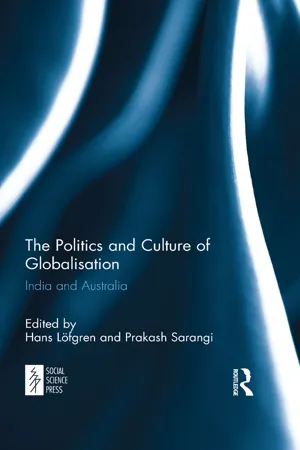
The Politics and Culture of Globalisation
India and Australia
- 352 pages
- English
- ePUB (mobile friendly)
- Available on iOS & Android
eBook - ePub
About this book
We experience the culture of globalisation every time we visit a Tandoori restaurant in Chicago, or a Pizza Hut in Hyderabad, or as we watch Bollywood films in Australia. Globalisation is a label used for a wide range of political, social and cultural phenomena, many of which are explored in this volume. The Politics and Culture of Globalisation: India and Australia brings together Indian and Australian experts in the fields of political science, international relations, philosophy, cultural theory and political economy. Its timeliness and unifying theme derive from comparisons between Indian and Australian perspectives, and analyses by Australian writers on developments in India. Indian-Australian relations are explored in several chapters. The neo-liberal form of globalisation is a key focus of critique in this volume. Several chapters examine the search for alternative forms of governance as the nation-state undergoes profound change due to global interconnectedness.
Information
Introduction
Dynamics and Dilemmas of Globalisation
Globalisation is an elusive and contested concept, yet one with descriptive and intuitive plausibility.1 We experience the economic and cultural dimensions of global interdependencies everyday—whether in an Udipi restaurant in Chicago, or a Pizza Hut in Hyderabad, or as consumers of Bollywood films in Australia. We may dislike many aspects of globalisation, but to change it we need to ‘analyse it in such a way as to clarify the manner in which it can be changed’ (Sutcliffe 2002:41). The aim of this volume is to critically examine the dynamics and dilemmas of globalisation with a particular focus on India and Australia. Its distinctive contribution is to bring a juxtaposition of Indian and Australian perspectives to bear on interpretations of globalisation and some of its specific manifestations. It offers a broad-ranging interdisciplinary study that confirms the unfolding of a profound, though indeterminate transformation of governance.
THE AMBIGUITIES OF GLOBALISATION
The globalisation concept is a label often used for a wide range of phenomena and is not a theory or explanation. Globalisation can be conceived of as ‘the complex, emergent product of many different forces operating on many scales’ (Jessop 2008: 179). As such, globalisation does not point to an intrinsic logic that inexorably drives societies along or towards a single path of economic and political development. Admittedly, there is a correlation between the rise of globalisation since the 1980s and both neo-liberal public policy and neo-liberalism as a doctrine of the free market. This doctrine ‘holds that the social good will be maximized by maximizing the reach and frequency of market transactions, and it seeks to bring all human action into the domain of the market’ (Harvey 2005a: 3).
Neo-liberalism was diffused universally in the period after the collapse of communism, gaining influence not only in the countries of Anglo-American capitalism and in the developing world, but also in ‘coordinated market economies’ with a social democratic or corporatist orientation, such as Germany and Sweden. Indeed, as Perry Anderson sees it, no ‘systematic rival outlooks’ remained as neo-liberalism emerged as ‘the most successful ideology in world history’ (2000: 17). But the past decade has seen an upsurge of doubt and critiques and a renewal of interest in state regulation. Oppositional movements and alternative interpretations of globalisation have proliferated. These alternative perspectives do not necessarily reject globalisation, understood as global interconnectedness. Hardt and Negri’s analysis of Empire (2000) is but one of a number of oppositional interpretations of globalisation that point to globalisation’s potentiality for human emancipation.
Neo-liberal policies have brought havoc to prior institutional arrangements, notably the ‘embedded liberalism’ of Keynesianism and social democracy. But resistance, and economic, social and environmental crises, such as climate change, make the minimal state of neo-liberal orthodoxy only one of a range of possible outcomes, and a highly unstable one at that. That globalisation is compatible with different governance arrangements is the premise of the ‘models of capitalism’ literature (Hall & Soskice 2001). In this perspective, notwithstanding a history of strong state promotion of national development, Australia belongs today within the category of ‘liberal market economies’, as distinct from the ‘coordinated’ systems of countries like Germany or Japan. India does not readily fit into this categorisation, which is employed to capture the diversity of advanced capitalism. If anything, India presents a unique though unstable model of its own. It has experienced the strong inroad of neo-liberalism since 1991, but this process is uneven, contested and volatile.
Many of the chapters in this volume critically interrogate the neo-liberal form of globalisation; others examine the search for alternative forms of governance. With social life infused by ‘the global’, several contributors employ the notion of cosmopolitanism as a framework for thinking about governance and political community. In this perspective, human beings everywhere belong ‘to a single moral realm in which each person is equally worthy of respect and consideration’ (Held 2003: 470).
In the neo-liberal perspective, there is little scope for alternative social and economic arrangements, notwithstanding the centrality of liberty and choice in its discourse. Nevertheless, Geoffrey Stokes identifies a shift in the climate of ideas in Australia from a widespread acceptance of the inevitability of neo-liberal globalisation to a ‘discourse of doubt’. He points to growing anxiety within economic, political and media elites that this form of globalisation may be derailed. In India, elite apprehensions are of a different complexion. Here the concern is with the impediments to the full-scale implementation of neo-liberal restructuring. In particular, the vibrancy of electoral politics and widespread poverty in the rural hinterlands obstruct the consistent application of neo-liberal policy prescriptions. The acute tensions and growing insecurities associated with full-scale integration of India into the global capitalist system are examined in the chapter by B. Ramesh Babu, which highlights the failures of a state that is at the same time ‘too big’ and ‘too small’. The vision of small government bears no relationship to the historical–empirical reality of the Indian state almost twenty years after the neo-liberal turn. Yet this state, according to Babu, remains strikingly ineffective in dealing with a multitude of external and domestic challenges.
The international debate on cosmopolitanism represents one stream of the upsurge of interest in critical interpretations of globalisation. Stan van Hooft in this volume explores the tensions arising from a cosmopolitan ethics of universal morality and liberal ideals of politics. If people everywhere have the same moral standing, how can we tolerate practices in other cultures that we perceive as contrary to our moral commitments? How do we know that such disapproval does not shade into unwarranted interference and moralism? At issue is the extent to which social values continue to be contextually relative. One specific value, the notion of justice, is critically assessed in the context of globalisation and cosmopolitanism by Michael Leahy. He provides a powerful analysis of a particular understanding of cosmopolitanism, that of Ulrich Beck, criticising it as ‘incapable of accommodating the diversity commonly found in modern democracies’. Leahy’s conclusion resonates in the Indian context of communal strife when he writes that ‘national and religious divisions … are best addressed by urging relevant communities to find the resources in their own traditions to overcome those divisions, not, as Beck prescribes, by urging them to detach themselves from those traditions’. A. Raghuramaraju introduces a compelling distinction between globalisation and cultural imperialism, and identifies a tension between the western dogma of change and an eastern ontology that privileges permanence. He refers to globalisation as ‘totalising’ in the West, while meeting ‘stiff local resistance’ in India. But as advanced high-tech capitalism drives an unremitting transformation of social conditions, there are streams of popular doubt also in countries like Australia, albeit not so directly grounded in any particular conception of permanent values.
Nor do developments in governance necessarily conform to neo-liberal prescriptions, as Sudha Mohan and Kevin O’Toole demonstrate. On the basis of accounts of urban and rural local governance in India and Australia, they show that territoriality is as important as ever. Indeed, globalisation has triggered collective responses that open up opportunities for community engagement and democratic participation. Similarly, Harihar Bhattacharyya identifies a rejuvenation of states’ rights within India’s system of federalism, albeit in a process which is predominantly market-oriented. Yet the sheer force and vitality of state-level politics in India confirms the open-endedness of political and social struggles. The case of left governments—and social movements—in India demonstrates that globalisation has not extinguished the struggle between different visions of governance. The outcome of such struggles may well approximate the neo-liberal model of small government and business-friendly regulation, and in India communalism and corruption are an ever-present hazard. But such outcomes are not inevitable, and the contributions by Mohan and O’Toole render visible the potential for more authentic local democracy. Transformations of local governance occur within nested multi-level processes of global interconnectedness. It is the changing role of nation-states and national politics, however, that has attracted most attention in the globalisation literature, and this is the focus of several chapters in this volume.
STATES AND TRANSFORMATIONS IN GOVERNANCE
It is a commonplace notion that globalisation has weakened the capacity of nation-states to regulate citizens and economic activity within their territorial boundaries. Global interconnectedness has reduced border controls that earlier served to restrict transactions in goods and services, production factors and technology, and ideas and cultural interchange. The growth of new centres of public authority above and below the state, together with the importance of multinational companies and non-governmental organisations and affiliations, has eroded the state’s authority. We are witnessing the emergence of new multi-level governance arrangements as nation-states engage in multi-layered exchange and collaboration with public and private agencies (Hay 2008).
This has led to much discussion about changes in the role and authority of the state, and widespread agreement that domestic and international policy and politics have come to be increasingly intertwined. The notion of multi-level governance has taken the debate well beyond the simplistic proposition of the decline of the nation-state. It is now generally acknowledged that the state has an enduring capacity to shape the direction of domestic and international politics. States have been reluctant to submit their disputes with other states to arbitration by any superior authority, and the imperative to maintain territorial integrity and sovereignty has not diminished. Thus Australia and other countries retain very strict controls on the cross-border movement of people. Border conflicts remain a threat in some parts of the world, such as Africa and South Asia. The assertion by India and Pakistan of the right to nuclear weapons constitutes a powerful assertion of autonomy.
The centrality of the state in economic development is illustrated most starkly by the success of government-managed capitalism in China. ‘The remarkable thing about China is that it has achieved integration with the world economy despite having ignored these [neo-liberal] rules—and indeed because it did so’ (Rodrik 2007: 239). Similarly, governments play a strong economic role in Russia, Singapore, Malaysia and elsewhere. The emergence of sovereign wealth funds (state-controlled investment pools) is another indication of the economic role of states, as is the renewed emphasis in western liberal economies on regulation in the wake of the sub-prime credit crisis of 2008 (Blackburn 2008). Indeed, an article in The Wall Street Journal details ‘mounting indications that governments are on the ascendant’ (Davis 2008). At the time of writing in October 2008, the global financial crisis had escalated to the point of triggering massive market interventions by the United States and several European governments. Throughout the OECD, tax revenues were higher in 2005, as a proportion of the domestic economy, than ten years earlier—a compelling pointer to the persistence of the structural power of the state (Davis 2008).
Notwithstanding contrary perceptions, the welfare state is not in universal decline; if anything, social safety nets are being constructed in many emerging economies (Brooks & Manza 2006; Montanari et al. 2007; Yih-Jiunn & Yeun-wen 2007). There is also a strong government focus on universities and the R&D system, training and education, support for entrepreneurship and the commercialisation of science, and the availability of finance and business-friendly taxation systems. Protection of a country’s language, culture and traditions contributes in the long run to the competitiveness of a country’s own firms. There remains too a need to defend society against violence within and beyond the nation’s territory.
INTERNATIONAL RELATIONS AND THE COMPETITION STATE
States today do not generally compete for territory, as in the period of nineteenth-century imperialism, though this claim is partially qualified by the invasion of Iraq. ‘Failed states’, such as Somalia and several South Pacific countries on Australia’s doorstep, present difficult challenges for the international community. Geopolitical tensions have not ceased, but the end of the Cold War created opportunities, in some parts of the world, for closer and mutually beneficial international relations. This is demonstrated by the growth of stronger relations between India and Australia since the 1990s. Y. Yagama Reddy and J.D. Kenneth Boutin shed light on this trend by showing how relations between these two countries have advanced beyond an earlier phase of indifference. They detail the expansion of contacts and mutual understanding between India and Australia, including the growth in Indian emigration to Australia. This volume in itself is an expression of a growing interest in both countries in interaction in the fields of education and academic research. Gary Smith emphasises the potential convergence of policies flowing from complementary interests and ideals anchored in shared regional and global strategic outlooks. He argues that the economic rise of India puts pressure on Australia to engage more actively with this powerful neighbour. Two opportunities are identified: he puts a strong case for Australia to sponsor India’s entry into the Asia-Pacific Economic Cooperation (APEC) framework, and points to a joint interest in the control of nuclear proliferation. These chapters suggest the opportunities, but also limits, of bilateralism in international politics. This is because the issues are global, and no country can afford to define its policies narrowly in terms of its own strategic and economic interests.
It has been noted already that nation-states retain a strong role in economic development. Indeed, there is new or reinvigorated state activity in many areas of business support and regulation (Schneiderman 2008). Multinational corporations for their part require stable political environments and favourable regulatory conditions, including business-friendly patent and labour laws and the provision of social and physical infrastructure. The reconfiguration of government activities along these lines is conceptualised by some analysts as the emergence of the competition state (Cerny 2000; Jessop 2002).
The principal role of this type of state is not to make markets more ‘open’ but to foster conditions favourable to innovation and learning, which in turn is seen as a principal means of promoting economic competitiveness. According to Cerny and Jessop, the Keynesian national welfare states that evolved in the advanced capitalist world post-1945 have gradually been transformed. The agencies of the competition state, now also discernible in emerging economies such as India, Singapore and Brazil, operate to foster and directly support capital accumulation, with a particular emphasis on supply-side measures to enhance innovation and competitiveness. Instead of state ownership of basic or strategic industries, and regulatory interventions for the purpose of economic autonomy, the policies of the competition state require flexible responses to conditions in international markets. As Jessop sees it, the...
Table of contents
- Cover
- Half Title
- Title Page
- Copyright Page
- Table of Contents
- 1. Introduction: Dynamics and Dilemmas of Globalisation
- Section 1: Making Sense of Globalisation
- Section 2: Governance and Globalisation
- Section 3: Experiencing Globalisation
- Section 4: Globalisation, Foreign Relations and Security
- List of Contributors
- Index
Trusted by 375,005 students
Access to over 1.5 million titles for a fair monthly price.
Study more efficiently using our study tools.
Frequently asked questions
Yes, you can cancel anytime from the Subscription tab in your account settings on the Perlego website. Your subscription will stay active until the end of your current billing period. Learn how to cancel your subscription
No, books cannot be downloaded as external files, such as PDFs, for use outside of Perlego. However, you can download books within the Perlego app for offline reading on mobile or tablet. Learn how to download books offline
Perlego offers two plans: Essential and Complete
- Essential is ideal for learners and professionals who enjoy exploring a wide range of subjects. Access the Essential Library with 800,000+ trusted titles and best-sellers across business, personal growth, and the humanities. Includes unlimited reading time and Standard Read Aloud voice.
- Complete: Perfect for advanced learners and researchers needing full, unrestricted access. Unlock 1.5M+ books across hundreds of subjects, including academic and specialized titles. The Complete Plan also includes advanced features like Premium Read Aloud and Research Assistant.
We are an online textbook subscription service, where you can get access to an entire online library for less than the price of a single book per month. With over 1.5 million books across 990+ topics, we’ve got you covered! Learn about our mission
Look out for the read-aloud symbol on your next book to see if you can listen to it. The read-aloud tool reads text aloud for you, highlighting the text as it is being read. You can pause it, speed it up and slow it down. Learn more about Read Aloud
Yes! You can use the Perlego app on both iOS and Android devices to read anytime, anywhere — even offline. Perfect for commutes or when you’re on the go.
Please note we cannot support devices running on iOS 13 and Android 7 or earlier. Learn more about using the app
Please note we cannot support devices running on iOS 13 and Android 7 or earlier. Learn more about using the app
Yes, you can access The Politics and Culture of Globalisation by Hans Löfgren,Prakash Sarangi in PDF and/or ePUB format, as well as other popular books in Politics & International Relations & Global Politics. We have over 1.5 million books available in our catalogue for you to explore.