- 120 pages
- English
- ePUB (mobile friendly)
- Available on iOS & Android
eBook - ePub
About this book
This concise, easy-to-follow book stimulates interest and develops proficiency in statisticalanalysis. Packed full of helpful exercises-covering a wide variety of conditions,random patterns, and simple models-Understanding Randomness presents a logical sequenceof study, through practice in interpreting random noise before progressing on toreal life problems ... demonstrates proper applications of numerous techniques throughworked out problems ... facilitates further work in statistics, keyed to standard references. . . and strengthens experience with unexpected results-fundamental for workingwith random events.Understanding Randomness serves as vital supplementary reading for both graduate andundergraduate students of statistics-with a standard statistics course as a prerequisiteandas a primary source for exercises in statistics laboratories. Moreover, it is importantfor industrial and mathematical training courses and society or association seminars, aswell as an invaluable workbook for statisticians, biostatisticians, biometricians, socialscientists concerned with improving their data analysis techniques-or anyone dealingwith evaluation of experimental data!
Information
1
Uniform Distributions
INTRODUCTION
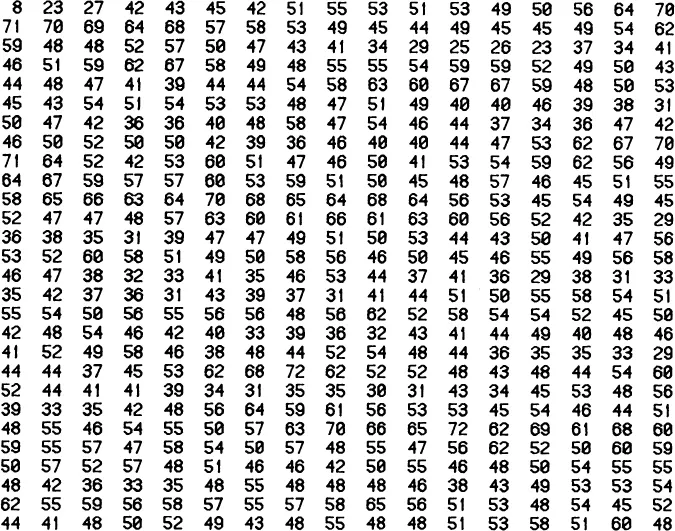
Statistical theory and practice are based upon the recognition that “randomness” can mean many things and be described by a wide range of probability distributions. Perhaps the simplest form of randomness is the uniform distribution. In this chapter, that means a set of two-digit random variables where every integer from 0 to 99 has an equal probability of occurring. This equal probability property describes the marginal distribution of the numbers in Tables 1.1, 1.2, and 1.3. That is, if you were to pick a single number “at random” from any of those tables, you have one chance in a hundred that it will be a given value chosen beforehand. However, statistical practice deals with collections of numbers, and a second property of “randomness” concerns how well consecutive numbers are “connected,” how well one can predict the next number from a previous sequence of numbers. In Table 1.1, where there is no such “connection,” all values are statistically independent. In Tables 1.2 and 1.3, each number is correlated with the number that occurs before it in the same row. For Table 1.2, the correlation is mild, for Table 1.3 strong. The exercises in this chapter are designed to give the student a feel for both the uniform distribution and statistical independence.
TABLE 1.1 Uniformly Distributed Independent R.V.
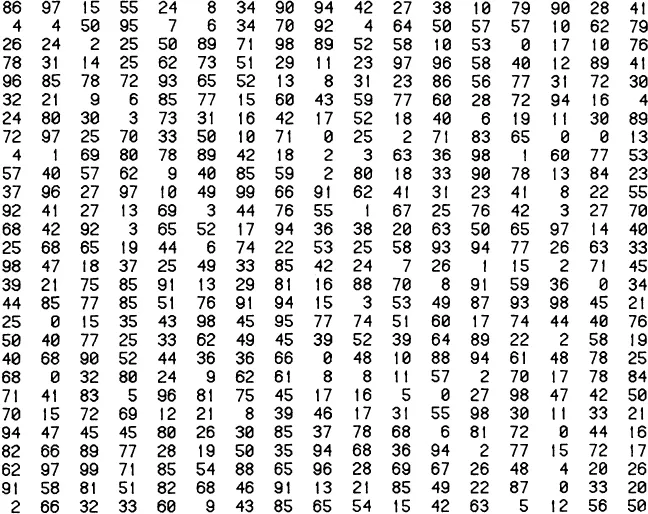
TABLE 1.2 Uniformly Distributed Mildly Dependent R.V.’s
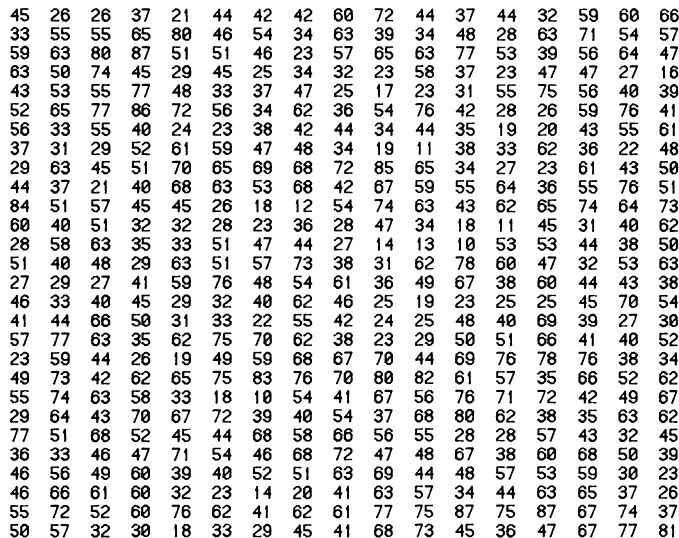
TABLE 1.3 Uniformly Distributed Strongly Dependent.R.V.
EXERCISES
EXERCISE 1.1: Browsing
Table 1.1 consists of uniformly distributed independent two-digit numbers. Examine it for “patterns.” The human eye is capable of seeing patterns in a way that cannot be duplicated by any computer program. Look for unusually high frequencies of specific digits or pairs of digits. Look for unexpectedly frequent reoccurrences of pairs of numbers. For instance, note how often a number ending in “8” occurs, how often it seems to occur in a small block of consecutive numbers. Note how often numbers “close together” in value seem too close together on the table.
Do not be influenced by the knowledge that these are independent uniform random numbers. There are patterns here, and a good statistician should have a feel for what kinds and frequencies of patterns occur as the purely fortuitous result of random noise.
EXERCISE 1.2: Testing Frequencies--Null Hypothesis True
Pick a two-digit number at random from Table 1.1. Use the first digit to locate the row and the second one to locate the column at which to start this exercise in Table 1.1. Going from left to right and then down to the next line, count out 30 groups of five two-digit numbers, broken into subsets of 10 groups each. “Wrap around” to the beginning of the table if necessary. For each group of five numbers, tally how many of them are even, so that each subset of ten groups will give you a certain number of groups with 0, 1, 2, 3, 4, or 5 even numbers. You will then have samples of size 10, 20 (two subsets), and 30 (three subsets) of a binomial variable with n = 5 and p = 0.5. Use two different tests of goodness of fit (such as the Pearson Chi Square, Likelihood Ratio, Discrete Kolomogorov) to test the hypotheses:
- Binomial with n - 5 and p = 0.5.
- Binomial with n = 5 and p estimated from the data.
- Normally distributed with mean 2.5 and variance 1.25.
EXERCISE 1.3: Testing Frequencies--Null Hypothesis Moderately False
As in Exercise 1.2, pick a two-digit number at random from Table 1.1 to identify the starting place in Table 1.1 and count out 30 groups of five numbers each (“wrapping around” to the beginning of the table if necessary). Tally the number of times each group of five has 0, 1, 2, 3, 4, or 5 numbers less than 31. As in Exercise 1.2, collect these tallies into subsets so that you have one subset of 10, two subsets (20), and all three subsets (30). Test the following hypotheses with at least one goodness of fit test:
- Binomial with n = 5 and p = 0.5.
- Binomial with n = 5 and p estimated from the data.
- Normally distributed with mean 2.5 and variance 1.25.
- Normally distributed with mean 2.5 and variance estimated from the data.
EXERCISE 1.4: Testing Frequencies--Null Hypothesis Markedly False
As in Exercises 1.2 and 1.3, choose a number at random from Table 1.1 and let it identify your starting place. Count out 30 groups of five numbers in Table 1.1 (“wrapping around” to the beginning if necessary). Tally the numbers of groups with 0, 1, 2, 3, 4, or 5 numbers less than 11. As in Exercises...
Table of contents
- Cover Page
- Halftitle Page
- Title Page
- Copyright Page
- Dedication
- Contents
- PREFACE
- Introduction
- Chapter 1. Uniform Distributions
- Chapter 2. Single Samples of Continuously Distributed Random Variables with Positive Skew
- Chapter 3. Paired Data
- Chapter 4. Contingency Tables
- Chapter 5. Models Versus Data
- Chapter 6. Real Life Data
Trusted by 375,005 students
Access to over 1.5 million titles for a fair monthly price.
Study more efficiently using our study tools.
Frequently asked questions
Yes, you can cancel anytime from the Subscription tab in your account settings on the Perlego website. Your subscription will stay active until the end of your current billing period. Learn how to cancel your subscription
No, books cannot be downloaded as external files, such as PDFs, for use outside of Perlego. However, you can download books within the Perlego app for offline reading on mobile or tablet. Learn how to download books offline
Perlego offers two plans: Essential and Complete
- Essential is ideal for learners and professionals who enjoy exploring a wide range of subjects. Access the Essential Library with 800,000+ trusted titles and best-sellers across business, personal growth, and the humanities. Includes unlimited reading time and Standard Read Aloud voice.
- Complete: Perfect for advanced learners and researchers needing full, unrestricted access. Unlock 1.5M+ books across hundreds of subjects, including academic and specialized titles. The Complete Plan also includes advanced features like Premium Read Aloud and Research Assistant.
We are an online textbook subscription service, where you can get access to an entire online library for less than the price of a single book per month. With over 1.5 million books across 990+ topics, we’ve got you covered! Learn about our mission
Look out for the read-aloud symbol on your next book to see if you can listen to it. The read-aloud tool reads text aloud for you, highlighting the text as it is being read. You can pause it, speed it up and slow it down. Learn more about Read Aloud
Yes! You can use the Perlego app on both iOS and Android devices to read anytime, anywhere — even offline. Perfect for commutes or when you’re on the go.
Please note we cannot support devices running on iOS 13 and Android 7 or earlier. Learn more about using the app
Please note we cannot support devices running on iOS 13 and Android 7 or earlier. Learn more about using the app
Yes, you can access Understanding Randomness by David S. Salsburg,Salsburg in PDF and/or ePUB format, as well as other popular books in Mathematics & Probability & Statistics. We have over 1.5 million books available in our catalogue for you to explore.