eBook - ePub
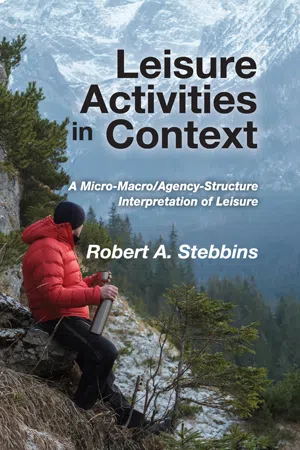
Leisure Activities in Context
A Micro-Macro/Agency-Structure Interpretation of Leisure
- 198 pages
- English
- ePUB (mobile friendly)
- Available on iOS & Android
eBook - ePub
Leisure Activities in Context
A Micro-Macro/Agency-Structure Interpretation of Leisure
About this book
There have been many analyses of leisure, drawing on the social, historical, cultural, temporal, and geographical contexts in which acts of leisure are pursued. Yet these studies lack a theoretical framework that can explain how leisure studies interact in various social contexts (cultural, temporal, or geographical), or as Robert A. Stebbins conceptualizes it, at levels of society. Here Stebbins explores leisure studies at society's micro, meso, and macro levels. He considers all three as they manifest themselves in the everyday pursuit of leisure, while focusing on the heretofore neglected middle, which he calls the meso side of life. Stebbins not only draws these perspectives together, but does something no one else has: he focuses on the big picture of leisure. Leisure Activities in Context examines the entire micro-macro/agency-structure dimension, using theory and research from leisure studies and the sociology of leisure as the vehicles to accomplish this. This book will be a useful theoretical sourcebook on the study of leisure because it provides a blueprint of issues that scholars and students can use to draw deeper meaning from their own studies, and a framework for future research.
Information
1
Studying the Contexts of Leisure: Basic Concepts
The main goal of this book is to place the personal experience of leisure participation in the broader frame of the micro-, meso-, and macro-contexts in which leisure is pursued. I want to show how that experience is shaped by those contexts and how the contexts are shaped by the leisure experiences and the parallel agency of participants in leisure activities. In the present chapter, we look at the basic concepts needed for an effective study of the contexts of leisure. These include a definition of leisure, which is followed by a discussion of the centrality of activity, personal agency, and self-efficacy. The rewards of satisfaction and fulfillment are considered next, with this leading to the macro- or micro/structure-agency debate and on to leisure constraints and facilitators. The chapter closes with a précis of the serious leisure perspective (SLP). Culture is also a basic concept, but one so broad that is it is best discussed in conjunction with the various contextual points of view of which it is an important part.
Defining Leisure
The definition of leisure presented below is intended to bridge the individual and contextual approaches, with both being equally important in defining leisure. From these two angles, leisure is both seen and experienced by the individual participant and seen as embedded in the wider social, cultural, historical, and geographical world. Earlier I tackled the problem of defining leisure from these two angles (Stebbins, 2012). A condensed, dictionary-style definition of leisure emerged from that undertaking: uncoerced, contextually framed activity engaged in during free time, which people want to do and, using their abilities and resources, actually do in either a satisfying or a fulfilling way (or both) (modified from Stebbins, 2005a, and subsequent publications).1 “Free time” in this book (it is further defined in Chapter 6 and in Stebbins, 2012, Chapter. 2) is time away from unpleasant, or disagreeable, obligation, with pleasant obligation being treated of here as essentially leisure. In other words Homo otiosus, leisure man (Stebbins, 2013a), feels no significant coercion to enact the activity in question. Some kinds of work—described later as “devotee work”—can be conceived of as pleasant obligation, in that such workers though they must make a living performing their work, do this in a highly intrinsically appealing pursuit. Work of this sort is also essentially leisure, and will be treated of as such in this book. This definition is compatible with the SLP, particularly since the latter stresses human agency, or “intentionality” (Rojek, 2010, p. 6)—what “people want to do”—and distinguishes the satisfaction gained from casual leisure vis-à-vis the fulfilment flowing from the serious form.
Note that reference to “free choice”—a long-standing component of standard definitions of leisure—is for reasons discussed more fully elsewhere (Stebbins, 2005a), deliberately omitted from this definition. Generally put, choice is never wholly free, but rather hedged about with all sorts of contextual conditions. This situation renders this concept and allied ones, such as freedom and state of mind useless as essential elements of a basic definition (Juniu & Henderson, 2001). Note, too, that there is no reference in this definition to the moral basis of leisure as being one of its distinguishing features. In other words, contrary to some claims made in the past (e.g., Kaplan, 1960, pp. 22–25), leisure according to the SLP may be either deviant or nondeviant (see Chapter 9 of the present volume).
Uncoerced, people in leisure believe they are doing something they are not pushed to do, something they are not disagreeably obliged to do. In this definition, emphasis is ipso facto on the positive side of life, the acting individual, and the play of human agency. This in no way denies that there may be things people want to do but cannot do because of any number of constraints on choice, because of limiting social and personal conditions; for example, aptitude, ability, socialized leisure tastes, knowledge of available activities, and accessibility of activities. In other words, when using this definition of leisure, whose central ingredient is lack of coercion, we must be sure to understand leisure activities in relation to their larger personal, structural, cultural, and historical background, their context. In addition, it follows that leisure is not really freely chosen, as some observers have argued (e.g., Parker, 1983, pp. 8–9; Kelly, 1990, p. 7), since choice of activity is significantly shaped by this context.
Nor may free time, as conventionally defined, be treated of here as synonymous with leisure. We can be bored in our free time, which can result from inactivity (“nothing to do”) or from activity, which alas, is uninteresting, unstimulating. The same can, of course, happen at work and in obligated non-work settings. Since boredom is decidedly a negative state of mind, it can be argued that, logically, it is not leisure at all. For leisure is typically conceived of as a positive mindset, composed of, among other sentiments, pleasant expectations and recollections of activities and situations. Of course, it happens at times that expectations turn out to be unrealistic, and we get bored (or perhaps angry, frightened, or embarrassed) with the activity in question, transforming it in our view into something quite other than leisure. In addition, all this may happen in free time, which exemplifies well how such time can occupy a broader area of life than leisure, which is nested within it (Stebbins, 2003).
Leisure as Activity
Our condensed definition refers to “uncoerced activity.” An activity is a type of pursuit, wherein participants in it mentally or physically (often both) think or do something, motivated by the hope of achieving a desired end. Life is filled with activities, both pleasant and unpleasant: sleeping, mowing the lawn, taking the train to work, having a tooth filled, eating lunch, playing tennis matches, running a meeting, and on and on. Activities, as this list illustrates, may be categorized as work, leisure, or non-work obligation. They are, furthermore, general. In some instances, they refer to the behavioral side of recognizable roles, for example commuter, tennis player, and chair of a meeting. In others we may recognize the activity, but not conceive of it so formally as a role, exemplified in someone sleeping, mowing a lawn, or eating lunch (not as patron in a restaurant).
The concept of activity is an abstraction, and as such, one broader than that of role. In other words, roles are associated with particular statuses, or positions, in society, whereas with activities, some are status based, while others are not. For instance, sleeper is not a status, even if sleeping is an activity. It is likewise with lawn mower (person). Sociologists, anthropologists, and psychologists tend to see social relations in terms of roles, and as a result, overlook activities whether aligned with a role or not. Meanwhile certain important parts of life consist of engaging in activities not recognized as roles. Where would many of us be could we not routinely sleep or eat lunch?
Moreover, another dimension separates role and activity, namely, that of statics and dynamics. Roles are static whereas activities are dynamic.2 Roles, classically conceived of, are relatively inactive expectations for behavior, whereas in activities, people are actually behaving, mentally or physically thinking or doing things to achieve certain ends. This dynamic quality provides a powerful explanatory link between an activity and a person’s motivation to participate in it. Nevertheless, the idea of role is useful, since participants do encounter role expectations in certain activities (e.g., those in sport, work, and volunteering). Although the concept of activity does not include these expectations, in its dynamism, it can, much more effectively than role, account for invention and human agency.
Both concepts are critical in this book, which leads to our first key point: roles and activities link the individual with certain structural aspects of the meso (more fully explained in Chapter 3) and macro contexts in which the roles and activities are carried out. In fact, roles and activities, as will become evident in later chapters, are often central points of operation for groups, organizations, social movements, and the like. Furthermore, both concepts are linchpins linking the social individual with his internal psychology, with his personality, motivation, attitudes, emotions, and so on. This book moves more deeply into the social and away from the psychological, but the importance of the latter in explaining human behavior cannot be overestimated. Moreover, it is a vital part of the SLP (see Stebbins, 2007/2015; 2009a).
This definition of activity gets further refined in the concept of core activity: a distinctive set of interrelated actions or steps that must be followed to achieve the outcome or product that a participant seeks. As with general activities, core activities are pursued in work, leisure, and non-work obligation. Consider some examples in serious leisure: a core activity of alpine skiing is descending snow-covered slopes, in cabinet making it is shaping and finishing wood, and in volunteer fire-fighting is putting out blazes and rescuing people from them. In each case, the participant takes several interrelated steps to successfully ski downhill, make a cabinet, or rescue someone. In casual leisure core activities, which are much less complex than in serious leisure, are exemplified in the actions required to hold sociable conversations with friends, savor beautiful scenery, and offer simple volunteer services (e.g., handing out leaflets, directing traffic in a theater parking lot, or clearing snow off the neighborhood hockey rink). Work-related core activities are seen in, for instance, the actions of a surgeon during an operation or the improvisations on a melody by a jazz clarinettist. The core activity in mowing a lawn (non-work obligation) is pushing or riding the mower. Executing an attractive core activity and its component steps and actions is a main feature drawing participants to the general activity encompassing it, because this core directly enables them to reach a cherished goal. It is the opposite for disagreeable core activities. In short, the core activity has motivational value of its own, even if more strongly held for some activities than others and even if some activities are disagreeable, but still have to be done.
Core activities can be classified as simple or complex, the two concepts finding their place at opposite poles of a continuum. The location of a core activity on this continuum partially explains its appeal or lack thereof. Most casual leisure is comprised of a set of simple core activities. Here Homo otiosus need only turn on the television set, observe the scenery, drink the glass of wine (no oenophile is he), or gossip about someone. Complexity in casual leisure increases slightly when playing a board game using dice, participating in a Hash House Harrier treasure hunt, or serving as a casual volunteer by, say, collecting bottles for the Scouts or making tea and coffee after a religious service. In addition, Harrison’s (2001) study of upper-middle-class Canadian mass tourists revealed a certain level of complexity in their sensual experience of the touristic sites they visited. For people craving the simple things in life, this is the kind of leisure to head for. The other two domains abound with equivalent simple core activities, as in the work of a parking lot attendant (receiving cash/making change) or the efforts of a householder whose non-work obligation of the day is raking leaves.
So, if complexity is what people want, they must look elsewhere. Leisure projects are necessarily more complex than casual leisure activities. The types of projects listed later in this chapter provide, I believe, ample proof of that. Nonetheless, they are not nearly as complex as the core activities around which serious leisure revolves. The accumulated knowledge, skill, training, and experience of, for instance, the amateur trumpet player, hobbyist stamp collector, and volunteer emergency medical worker are vast, and defy full description of how they are applied during conduct of the core activity. Of course, neophytes in the serious leisure activities lack these acquisitions, though it is unquestionably their intention to acquire them to a level where they will feel fulfilled. As with simple core activities, complex equivalents also exist in the other two domains. Examples in work include the two earlier examples of the surgeon and the jazz clarinettist. In the non-work domain, two common examples demonstrate a noticeable level of complexity: driving in city traffic and for some people, preparing the annual income tax return.
Activity as just defined is, by and large, a foreign idea in psychology, anthropology, and sociology. Sure, scholars there sometimes talk about, for instance, criminal, political, or economic activity, but in so doing, they are referring, in general terms, to a broad category of behavior, not a particular set of actions comprising a pursuit. Instead, our positive concept of activity knows its greatest currency in the interdisciplinary fields of leisure studies and physical education and, more recently, kinesiology. In addition, I suspect that the first adopted the idea from the second. There has always been, in physical education, discussion of and research on activities promoting conditioning, exercise, outdoor interests, human movement, and so on.
Self-Efficacy and Personal Agency
Self-efficacy and personal agency are two main avenues leading to fulfillment. Psychologist Albert Bandura pioneered the concept of self-efficacy, defining it as “people’s beliefs in their capabilities to produce desired effects by their own actions” (Bandura, 1997, p. vii). He argued that people develop “efficacy expectations” bearing on particular goals they hope to realize and on what they must do to achieve this. These expectations are based on the capabilities individuals believe they have to accomplish the goals they are pursuing in a particular setting. Bandura says that efficacy expectations constitute the cognitive state immediately preceding goal-directed actions. Additionally efficacy is enhanced to the extent that people’s locus of control is high; in other words they sense that their activities result from their own efforts rather than from such impersonal forces as fate, luck, and chance (Rotter, 1990).
A principal interest in this book can be expressed as the second key point: belief in one’s own micro-contextual self-efficacy is necessary to pursue in a fulfilling way at the meso and macro levels particular activities in serious leisure or devotee work. This belief in oneself is born of the numerous routine successes that accumulate with the enduring, systematic pursuit of an activity. Encouragement from others who also partake of it or who are otherwise close associates of the participant is another source of such efficacy.
In leisure studies, personal agency is both a social arrangement for enabling and a personal capacity for putting into effect what an individual intends to do. The individual thus enabled (not constrained) by society can become his own agent in producing the intended outcome. Here agency refers to seizing the initiative to reach a goal, short or long term. It includes figuring out how to reach the goal, which includes organizing to this end oneself and such relevant other entities as individuals, organizations, groups, and social networks. Agency rests on the participant’s sense of self-efficacy and control in planning, organizing, working with others, and so on. Thus, a concert violinist can only perform her concerto when accompanied by an orchestra guided by its conductor, a quarterback in American football cannot express his agency as a passer unless there is a teammate downfield trying to catch the ball that person is passing. Agency is also at work when a participant arranges for necessary resources.
It is through particular activities that people, propelled by their own agency and belief in their own efficacy, find positive things in life, which they blend and balance with the negative, or disagreeably obligatory, things they must also deal with Un-coerced, people in leisure believe they are doing something they are not pushed to do, something they are not disagreeably obliged to do. In this definition, emphasis is ipso facto on acting individuals and on their self-direction through personal agency.
Agency and Structure
Given the scope of this book, a few words on personal agency and its relationship to social structure are in order. Martin Hewson (2010, p. 13) says of agency: “it is the condition of activity rather than passivity. It refers to the experience of acting, doing things, making things happen, exerting power, being a subject of events, or controlling things. This is one aspect of human experience.” His conceptualization of agency is designed to set it within sociology’s long-standing debate on the freedom of human behavior as agency vis-à-vis the limits imposed on it by social structure (e.g., Giddens, 1986). Hewson’s definition is of necessity quite general; agency is viewed broadly as a condition of activity as opposed to passivity.
Agency conceived of in leisure studies revolves around a different and more specific theoretic interest, namely, explaining how people fired by their own initiative pursue, or fail to pursue, particular free-time activi...
Table of contents
- Cover
- Half Title
- Title Page
- Copyright Page
- Dedication
- Table of Contents
- Acknowledgments
- Introduction
- 1. Studying the Contexts of Leisure: Basic Concepts
- 2. Three Domains
- 3. The Meso Context
- 4. Formal Organizations: Macro Context
- 5. Noninstitutionalized Macro Context: Social Movements and Tribes
- 6. Temporal Context
- 7. Geographical Context
- 8. Historical Context
- 9. Deviant Leisure Interests and Social Issues
- 10. Conclusions
- Bibliography
- Index
Trusted by 375,005 students
Access to over 1.5 million titles for a fair monthly price.
Study more efficiently using our study tools.
Frequently asked questions
Yes, you can cancel anytime from the Subscription tab in your account settings on the Perlego website. Your subscription will stay active until the end of your current billing period. Learn how to cancel your subscription
No, books cannot be downloaded as external files, such as PDFs, for use outside of Perlego. However, you can download books within the Perlego app for offline reading on mobile or tablet. Learn how to download books offline
Perlego offers two plans: Essential and Complete
- Essential is ideal for learners and professionals who enjoy exploring a wide range of subjects. Access the Essential Library with 800,000+ trusted titles and best-sellers across business, personal growth, and the humanities. Includes unlimited reading time and Standard Read Aloud voice.
- Complete: Perfect for advanced learners and researchers needing full, unrestricted access. Unlock 1.5M+ books across hundreds of subjects, including academic and specialized titles. The Complete Plan also includes advanced features like Premium Read Aloud and Research Assistant.
We are an online textbook subscription service, where you can get access to an entire online library for less than the price of a single book per month. With over 1.5 million books across 990+ topics, we’ve got you covered! Learn about our mission
Look out for the read-aloud symbol on your next book to see if you can listen to it. The read-aloud tool reads text aloud for you, highlighting the text as it is being read. You can pause it, speed it up and slow it down. Learn more about Read Aloud
Yes! You can use the Perlego app on both iOS and Android devices to read anytime, anywhere — even offline. Perfect for commutes or when you’re on the go.
Please note we cannot support devices running on iOS 13 and Android 7 or earlier. Learn more about using the app
Please note we cannot support devices running on iOS 13 and Android 7 or earlier. Learn more about using the app
Yes, you can access Leisure Activities in Context by Robert A. Stebbins in PDF and/or ePUB format, as well as other popular books in Social Sciences & Sociology. We have over 1.5 million books available in our catalogue for you to explore.