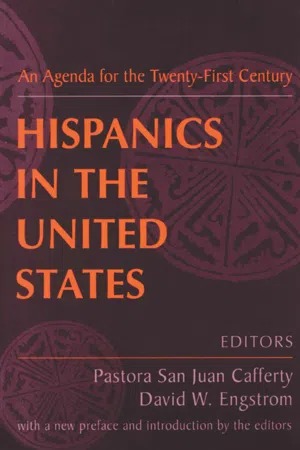
Hispanics in the United States represents a collective exploration providing a basic foundation of the information available to understand Hispanics in the United States and create an effective policy agenda. Hispanics are projected to be the largest minority group in the United States in the twenty-first century. The contributions define an agenda which will be useful for students, scholars, service practitioners, political activists, as well as policy makers. The opening essays define the diversity of the Hispanic experience in America and put each of the other essays within a larger context. This edition adds a new introduction by the editors incorporating and evaluating the implications of the results of the national 2000 census. The book is organized into two sections: the first establishes the historical, demographic, religious, and cultural context of Hispanics in the United States. The second describes the major issues facing this population in the American social structure, specifically the areas of health care, the labor market, criminal justice, social welfare, and education. The work concludes with a discussion of the role played by Hispanics in the political life of the nation. The contributors, all of whom are scholars with demonstrated competence in the areas, include: Teresa A. Sullivan, David Maldonado, Melissa Roderick, Barry Chiswick, Michael Hurst, Zulema Suarez, Alvin Korte, Katie McDonough, Cruz Reynoso, and Christine Marie Sierra, as well as David Engstrom and Pastora San Juan Cafferty. Together they have produced a book which will be extremely useful to anyone developing public policies and creating social interventions at either the national or local levels during the coming decade. This new edition is a valuable contributor to discussions about the issues defining the population that will be the largest minority group in the United States in this century.
- 363 pages
- English
- ePUB (mobile friendly)
- Available on iOS & Android
eBook - ePub
About this book
Information
Subtopic
Social PolicyIndex
Social Sciences1
A Demographic Portrait
More than 500 years ago, a Hispanic influence was first felt in the New World of the Americas. The Spanish Empire spread the language and culture of Spain to nearly all of South America, most of Central America, and the southern third of North America. Today, at the brink of the twenty-first century, Hispanic influence is being felt in the United States in a new and vibrant way. This influence comes about primarily through the demographic impact of Hispanics—that is, the number and composition of their population, their migration, and their growth. This chapter presents a demographic portrait of the Hispanic population.
The Hispanic population of the United States comprises more than 29 million people, about 11 percent of the national population; they are the fastest growing minority group in the United States. Table 1.1 shows the fraction of the United States population that is Hispanic, and it also shows the increase from 1990 to 2000 in the proportion of the population that is Hispanic. For reasons of size and rapid growth alone, the Hispanic population would deserve the attention of policy makers and analysts. The Hispanic population grew by 53 percent during the 1980s and then by another 27 percent between 1990 and 1996.1 If Census Bureau projections are correct (see table 1.1), by 2020 Hispanics will number 52 million persons and 16.3 percent of the population, and by 2050 they will number 97 million persons and constitute 24.5 percent of the United States population.2
As this chapter explains, the Hispanic population is growing both through immigration (movement across national boundaries) and through natural increase (the number of births in excess of the number of deaths). About one-third of the population growth can be attributed to immigration; the remaining two-thirds is due to natural increase. Contrary to many myths about Hispanics, the Hispanic population is relatively young, urban, and very diverse. These myths are discussed and compared with the facts later in this chapter. First, though, we need to discuss the term Hispanic, which is itself somewhat controversial.
Table 1.1 Resident Population of the United States, 1990 and 2000 (percentages)

Who Are the Hispanics?
The term Hispanic is used by government agencies and others to describe persons who themselves or whose ancestors were born into a Spanish-speaking community. The statisticians’ intention was to develop a nonpejorative term that could include persons born in the United States but descended from Spanish-speaking peoples, as well as immigrants from Spain, Mexico, countries in the Caribbean and Central America, and South America except for Brazil. (Brazil and Portugal are technically not included because the people in those countries speak Portuguese rather than Spanish.)
Because the Hispanic term is rooted in the use of a language rather than in race, persons of Hispanic origin have varied skin color. Some Hispanics consider themselves White, and they may have blue eyes and blonde or red hair. Other Hispanics are descended from ancestors who were brought from Africa as slaves; they are dark-skinned and may identify their race as Black. Still other Hispanics, descended from the original peoples of North and South America, may be brown-skinned. Moreover, although the Hispanic term is based on language use, persons from Spanish-speaking countries may speak other languages instead of or in addition to Spanish. Many immigrants from Central America, for example, speak an Indian language instead of Spanish, but they are still considered Hispanic. Thus, this single term describes a diverse group of individuals.
Other terms are also in common use within the Hispanic community. Some Southwestern Hispanics, especially those whose families have lived there since Spanish colonial times, prefer the terms Spanish, Spanish-American, or Hispano. Many persons of Mexican origin prefer the term Mexican-American, and some younger Mexican-Americans prefer the terms Chicano, Xicanoy or Mexicano. People who come from other Latin American countries may prefer terms that refer to their country of origin, such as Cuban-American, Cubano, or Dominican. The term Puertorrequeho is sometimes used to refer to persons from Puerto Rico. Finally, some commentators prefer the term Latino to refer generally to persons who are from or descended from peoples in Spanishspeaking countries of the Americas.
The nationality of the Hispanic population differs quite a bit by region of residence within the United States, and thus there also are some differences in the terms used in various regions. In the Western states, where 45 percent of the Hispanic-origin population lives (and 58 percent of the Mexican-origin population), the terms Latino and Chicano have gained some currency. The second largest Hispanic region is the South (especially Florida), where 30 percent of all Hispanics and 71 percent of Cubans live. Here the terms that define the specific nationality are often used. The Northeast accounts for about 17 percent of the Hispanic population and 69 percent of the Puerto Rican population. Here the term Puertorrequeho is common, although other nationalities are also identified. Only 7 percent of the Hispanic population lives in the Midwest, and no single nationality group is concentrated there, so the term Hispanic is most often used.
Use of the term Hispanic may create an emergent ethnic identity among persons who might otherwise have thought of themselves as Mexican or Puerto Rican or Cuban.3 This identity, which is constructed through the statistics and official rhetoric, may nevertheless be adopted by persons who bear the label in the general society. A similar process occurred among Italian immigrants in the last century, and it might be happening among Asian-Americans today: persons who had identified themselves by smaller places of origin (nation, province, city) become identified by the larger society in terms of a larger place of origin and thereafter adopt that identity developed by others.
In government data, such as the 1990 census and subsequent population surveys, individuals designate themselves in terms of both race and Hispanic origin. This self-identification ensures that persons are classified in the way that they themselves prefer. In some earlier censuses, the government also tried other techniques, including classifying persons as Hispanic if they had Spanish surnames. This latter procedure is now rarely used by statistical agencies. Intermarriage may lead Hispanic women to take non-Hispanic surnames, and some surnames are shared by Hispanics and by other nationalities (for example, the surname Martin). Some Hispanic immigrants change their names or anglicize them: for example, substituting the name “King” for the Hispanic “Rey,” which means king. Self-identification is preferred to the surname identifier as a more accurate means of measurement. For vital statistics data, such as birth certificates and death certificates, members of the family provide information on whether a person is Hispanic. Thus, a baby who is classified as Hispanic has been so identified by her mother. On death certificates, a funeral director sometimes provides ethnic identification, but may be mistaken about the identity the decedent preferred.
Hispanic origin is not considered to be a racial category, although the term “Mexican” was once used as a racial category (in the census of 1930). The U.S. Census and most other government surveys today provide both a racial identifier and a Hispanic-origin identifier for each individual. Persons who call themselves Hispanic may be from any racial group. Use of the racial category “other” has been increasing among Hispanics, perhaps because they do not feel comfortable with existing racial categories.
A 1997 government report discussed in some detail the advantages and disadvantages of various terms for accurate collection of statistics.4 This report and many similar studies indicate the significance of heterogeneity within the Hispanic population. This heterogeneity should not be overlooked; use of the broad term Hispanic conceals much of the internal diversity within the Hispanic population.
This chapter uses the word Hispanic, the term most often used in demographic studies. However, readers should remember that other researchers may use different terms to refer to the same population. This chapter compares data for Hispanics with data for non-Hispanic Whites and Blacks. Readers should remember that the data for Hispanics come from the self-report question on Hispanic origin, and the data on Whites and Blacks come from the self-report question on race. These comparisons, then, do not involve mutually exclusive categories of the population. Some people report themselves as both White and Hispanic, and others report themselves as both Black and Hispanic.
A Thumbnail Sketch
Four major groupings of Hispanics are commonly discussed in the literature: Mexican-Americans, Puerto Ricans, Cuban-Americans, and Central and South Americans. In this section, each of these groups is briefly highlighted and described. There is also a group of “other Hispanics” that includes Dominicans (who are sometimes counted with Central America or with South America), Spaniards from Spain, and a variety of persons who report themselves as “Spanish” or “Spanish-American.” These “other Hispanics” are not separately discussed. As previously mentioned, Brazilians and Portuguese are excluded from these tabulations because they use the Portuguese language rather than Spanish.
Mexican-Americans
The Hispanic population in the United States originated from many different countries, but Mexico is the most important country of origin. A little more than 61 percent of Hispanics are of Mexican origin. In the early nineteenth century, most of what are now the southwestern states were part of Mexico. Through war, annexation, and purchase, these portions of Mexico became part of the United States. Some of the Hispanic population of states such as California, Arizona, New Mexico, and Texas dates from these colonial times.
By 1990, about 13.4 million Americans identified themselves as Mexican-American, and 4.3 million of them were actually born in Mexico.5 The remaining 9.1 million are the children of persons who were born in Mexico. Mexican-Americans who were born in the United States are U.S. citizens by birth. Almost 1 million Mexican-Americans who were born in Mexico are citizens by naturalization.
Although Mexican-Americans have been in the Southwest since colonial times, there is a significant recent immigration flow from Mexico. Nearly one-third of all the Mexican immigrants who were counted in the 1990 census had entered the United States since 1985. Mexico’s significance as a country of origin remained strong in the 1990s as well. In 1994, Mexico was the largest sending country of immigrants, with 111,400 Mexicans legally admitted to the United States.6 Mexicans were also believed to be the largest single group of undocumented immigrants, with the INS estimating that 2.7 million Mexicans were undocumented in 1996.7
Mexican-Americans live all over the United States, but the largest concentrations are found in California, Texas, and other southwestern states; Illinois also has a large Mexican-origin population. Several of the fastest-growing states between 1990 and 1995, including Texas, New Mexico, Arizona, C...
Table of contents
- Cover Page
- Title Page
- Copyright Page
- Contents
- List of Tables
- Preface
- Introduction
- Chapter 1 A Demographic Portrait
- Chapter 2 Hispanic Immigration at the New Millennium
- Chapter 3 The Language Question
- Chapter 4 The Changing Religious Practice of Hispanics
- Chapter 5 Hispanics and Education
- Chapter 6 Hispanics and the American Labor Market
- Chapter 7 Hispanics and Health Care
- Chapter 8 Hispanics and the Social Welfare System
- Chapter 9 Hispanics and the Criminal Justice System
- Chapter 10 Hispanics and the Political Process
- About the Contributors
- Index
Trusted by 375,005 students
Access to over 1.5 million titles for a fair monthly price.
Study more efficiently using our study tools.
Frequently asked questions
Yes, you can cancel anytime from the Subscription tab in your account settings on the Perlego website. Your subscription will stay active until the end of your current billing period. Learn how to cancel your subscription
No, books cannot be downloaded as external files, such as PDFs, for use outside of Perlego. However, you can download books within the Perlego app for offline reading on mobile or tablet. Learn how to download books offline
Perlego offers two plans: Essential and Complete
- Essential is ideal for learners and professionals who enjoy exploring a wide range of subjects. Access the Essential Library with 800,000+ trusted titles and best-sellers across business, personal growth, and the humanities. Includes unlimited reading time and Standard Read Aloud voice.
- Complete: Perfect for advanced learners and researchers needing full, unrestricted access. Unlock 1.5M+ books across hundreds of subjects, including academic and specialized titles. The Complete Plan also includes advanced features like Premium Read Aloud and Research Assistant.
We are an online textbook subscription service, where you can get access to an entire online library for less than the price of a single book per month. With over 1.5 million books across 990+ topics, we’ve got you covered! Learn about our mission
Look out for the read-aloud symbol on your next book to see if you can listen to it. The read-aloud tool reads text aloud for you, highlighting the text as it is being read. You can pause it, speed it up and slow it down. Learn more about Read Aloud
Yes! You can use the Perlego app on both iOS and Android devices to read anytime, anywhere — even offline. Perfect for commutes or when you’re on the go.
Please note we cannot support devices running on iOS 13 and Android 7 or earlier. Learn more about using the app
Please note we cannot support devices running on iOS 13 and Android 7 or earlier. Learn more about using the app
Yes, you can access Hispanics in the United States by David Engstrom in PDF and/or ePUB format, as well as other popular books in Social Sciences & Social Policy. We have over 1.5 million books available in our catalogue for you to explore.