- 296 pages
- English
- ePUB (mobile friendly)
- Available on iOS & Android
eBook - ePub
About this book
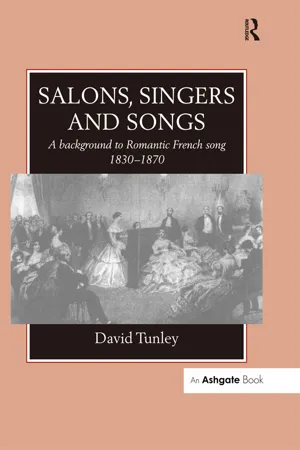
Music! It is the great pleasure of this city, the great occupation of the drawing-rooms, which have banished politics, and which have renounced literature, from ennui. Jules Janin, An American in Paris, 1843 Afternoon and evening entertainments in the drawing rooms of the aristocracy and upper middle classes were a staple of cultural life in nineteenth-century Paris. Music was often a feature of these occasions and private salons provided important opportunities for musicians, especially singers, to develop their careers. Such recitals included excerpts from favourite operas, but also the more traditional forms of French song, the romance and its successor the m die. Drawing on extensive research into the musical press of the period, David Tunley paints a vivid portrait of the nineteenth-century Parisien salons and the performers who sang in them. Against this colourful backdrop, he discusses the development of French romantic song, with its hallmarks of simplicity and clarity of diction. Combined with Italian influences and the impression made by Schubert's songs, the French romance developed into a form with greater complexity - the m die. Salons, Singers and Songs describes this transformation and the seeds it sowed for music by later composers such as Faur Duparc and Debussy.
Information
CHAPTER ONE
Musical Paris
‘Music! it is the great pleasure of this city, the great occupation of the drawing-rooms, which have banished politics, and which have renounced literature, from ennui.’, observed the American in Paris in Jules Janin’s book of the same name written in the early 1840s.1 It was not a description likely to please Janin’s fellow writers who, on the whole, considered music to be a barrier to conversation and who tended to exclude it from their own salons. According to Daudet, most literary people held music in horror, citing Gautier, for example, who was supposed to have described it as the most disagreeable of all the noises.2
About the same time, in a derisive article about the plethora of uninformed musical journals then appearing in Paris, Henri Blanchard suggested that the reason for music’s popularity was because politics had gone off the boil, religion interested few people and literature was no longer an essential nourishment for lively minds, having degenerated into serialized novels and into vaudevilles. Thus it was, he claimed, that music now preoccupied all classes of society.3
The ‘invasion of music’ into the salons of the fashionable world, banishing dance (which it was claimed had once been the primary amusement) was the topic for the first editorial of the journal Le Dilettante des salons,4 which first appeared in 1838. It ascribed several causes to this.
… first of all the real or affected seriousness of most of our young people, who find the pleasure of dancing ill-befitting the ideas of progress and regeneration which are hovering, they say, over modern societies; but such change is attributable above all to the taste for music, which is spreading daily throughout all classes, and which is becoming almost a necessity, by virtue of the charm that it exerts and the reward that it gives to those who cultivate it successfully.5
It is clear from reviews, diaries and letters that the Parisian salons were contributing to the revival of Paris as the centre of musical Europe, regaining the reputation that the capital had once enjoyed before the French Revolution. If their contribution was modest in the overall scene, the salons nevertheless mirrored the musical ferment that followed the accession of Louis-Philippe.
A few months before the revolution that brought Louis-Philippe to the throne in 1830, François-Joseph Fétis had contemplated the musical scene around him.
It is a recognized fact, which would be unnecessary to prove, that each year music in France is making rapid and noticeable progress. New schools and philharmonic societies are being established everywhere, taste is being formed, and appreciation of music is acquiring that perfection which only habit can bring. What for so long opposed the development of music was the attitude of men occupied with public affairs who believed that cultivation of the arts was little needed by the State, while those who were still imbued with the prejudices of the ancien régime maintained that such activities should be left to the professionals. But since a new generation has arisen and a universal thirst for knowledge has spread throughout society, music has taken up its rights again and has accordingly become an indispensable part, or at least, a useful accessory of education. And if anyone doubts this, he would find material proof of it in the growth of schools [of music], and in the manufacture of instruments which are multiplying in every part of France. Finally, there is a crowd of teachers who can scarcely cope with the enormous number of students.6
Some forty years earlier it had not only been the dismantling of the social system and its tradition of musical patronage that had created a crisis for musicians during the early years of the Revolution; it was also the attitude of the new political leaders who saw music primarily as a vehicle for propaganda. No matter their personal inclinations, poet and composer alike had been harnessed to writing for the ‘public-good’, resulting in a plethora of rousing, large-scale odes in praise of liberty or the pagan goddess of agriculture. As for Napoleon Bonaparte, his musical tastes were so decidedly towards Italian opera that a distinctively French school had little encouragement during his reign as the first Emperor of France. It had a greater chance with the Restoration of the monarchy following Napoleon’s downfall in 1815.
Nevertheless, as Jean Mongrédien has shown, during the troubled early years music lovers were not denied opportunities to hear music, even if public concerts were primarily, as he suggests, occasions to see and be seen, and where individual programmes depended for their success upon a variety of music and performers, the ranks of whom almost always included some singers.7 Mongrédien has pointed to the extraordinarily large number of orchestras that are tantalizingly glimpsed in the documents in the early years of the Revolution, but about which little is known. From the Restoration onwards, however, were to be sown the strong seeds of the later growth, most notably the revival of the Concerts des Amateurs (1825) and the establishment of the Société des Concerts du Conservatoire (1828).
Amongst these seeds was the revival of the Parisian salon tradition, which, because of its previous association with rank and wealth (although not exclusively so), had been broken in the early years of the Revolution. For so long an intrinsic part of French intellectual and artistic life, salons in Paris and elsewhere soon re-emerged following the death of Robespierre, many of them opening their doors to music for their guests. In examining the documents of the period Mongrédien has concluded that the list of salons that offered music during the time of the First Empire would be far longer than usually imagined. Although the quality of their offerings may often have been questionable, in some the presence of musicians of the calibre of the violinist Pierre Baillot (who, amongst other things, instituted a subscription series of chamber music from 1814 onwards) was sufficient guarantee of high standard.8 Twenty years later his chamber music recitals – lasting two-and-a-half hours – were attracting six to seven hundred people, a situation that Fétis declared would have been impossible ten years before.9 The significance of the salons to music in Paris in the years leading up to 1830 may be gauged by the Revue musicale where it claimed in one of its issues that salon recitals had become so fashionable as to substitute for regular recitals.10 Such a fashion was not to last for long, but nevertheless the salons were to remain an important element in Parisian musical life throughout the century. However, it was the proliferation of professional performances in the theatres and commercial concert rooms that provided the real marker of progress, and Fétis had good cause for optimism about the future of music in the capital as he contemplated the musical scene unfolding in Paris during the 1830 season.11
The 1830 Season
Now in their third year, the programmes presented by the Société des Concerts du Conservatoire, founded by the violinist/conductor François Habeneck, continued to be the most important orchestral events in Paris. They were devoted primarily to the works of Beethoven, and during the 1830 season, beginning on 21 February, Habeneck conducted eight of the nine symphonies, the ‘Choral’ symphony waiting for its Paris première until the following season. As well as its six ‘regular’ events the Société des Concerts presented three ‘concerts spirituels’ during Easter, and a ‘royal command’ performance. Usually including a symphony and an overture by Beethoven, the ‘regular’ concerts, which took place on Sunday from 2.00 p.m., always included a variety of other items. The programme presented on Sunday 25 April is typical. It started with a Haydn Symphony and concluded with Beethoven’s Symphony no. 2. In between were choral works: Ave verum (Mozart) and Gloria (Beethoven), and three solos: one for bassoon, one for violin and one for voice.
For those whose tastes inclined towards sacred choral music, especially from earlier periods, there were the programmes presented by another major organization, the Institution royale de musique religieuse de France founded in 1817 by Alexandre Choron. He had set himself against the prevailing taste for Italian opera, and as a teaching establishment his school was the only rival to the Conservatoire. Far more limited in its activities than the Conservatoire, the Institution trained a number of musicians featured in this book, including the celebrated tenor Gilbert Duprez. During the 1829/30 season the Institution royale presented some 13 concerts, given by professionals and advanced students. Although some of these concerts involved repeat performances the solid choral repertoire, given over a period of just a few months, is impressive by any standards. Handel was strongly represented: Alessandro, Judas Maccabeus, Alexander’s Feast and Samson. Performances of these and works by C. P. E. Bach, Mozart, Haydn and Graun, as well as by sixteenth-century composers such as Palestrina and Jannequin clearly established Choron’s school as an organization of prime musical and educational importance. Its closure soon after this season was a great blow to the artistic life of the city, and its demise was mourned for many years.
That winter season also saw the appearance of a new series of monthly concerts. These were given by the recently formed Athénée musicale which met in the Salle de Saint-Jean of the Hôtel-de-Ville under the auspices of the Prefect of the Seine. The organization had been founded in 1829 both for pedagogy and performance and was a star for some years in the musical firmament. Like many concerts at this time the programmes were immensely long. The third concert in their series was typical:
Scène (Eiwart) on the subject of L’exilé, sung by Cambon
Symphonie concertante (Tulou) for flute, oboe, horn & bassoon soloists: Coche, Biters, Callant, Rickmans
Fantaisie for piano (Payer), played by Rickmans
Variations for alto bassoon, (no composer given), played by Rickmans, accompanied by his son aged 8
Unnamed work, played by Ourry, ist Violin of the Italian Opera, London
Romance (Panseron), sung by Cambon
Italian aria (Raoul), sung by Mlle. Beck
Overture for orchestra (Rigel)
Fantaisie for harpe (Bochsa), arr. for orchestra [and harp], by Barbiguier, played by Mme Barbiguier
Aria from Le barbier de Seville (Rossini), sung by Mlle. Olivier of the Théâtre des Nouveautés
Aria, ‘Mon enfant, plus de tendres fleurettes’ from Les noces de Figaro (Mozart), sung by Heurteau
Hate scene from Armide (Lully) sung by Mme Kretschmer
Underworld scene from Armide (Gluck) sung by Mlle. Bolard, with orchestra
Aria from Armida (Rossini) sung by Mlle. Kunzé with orchestra12
It can be seen that there were some items of exceptional interest, such as the three extracts from settings of the opera Armide by Lully, Gluck and Rossini. At the next month’s concert two songs from Berlioz’ recently composed Mélodies irlandais were to be performed.
Other organizations active during that winter season were the Gymnase musicale, the Société musicale des amateurs, the Société libre des Beaux-Arts and the Société Académique des Enfants d’Apollon. With the exception of the Société Académique des Enfants d’Apollon, which had been founded in the first half of the previous century, others had been in existence for only a year or two.
But above all, Paris was a city of theatres. Of some 26 that were active at the beginning of the nineteenth century Napoleon Bonaparte had allowed only a few to remain open, ostensibly to ‘protect literary taste’ (as Fétis scornfully described this action in his the Revue musicale of 1829).13 The five surviving major theatres were the Comédie-Française, Théâtre de l’Odéon and, for operas, the Opéra, Opéra-Comique and the Théâtre-Italien. Others, which often staged works that required music, were the Théâtre de l’Ambigu, Gaîté, Variétés and Vaudeville. After the fall of Napoleon’s Empire new theatres were opened and by the 1830s 17 theatres operated in Paris alone. This, of course, increased as the years went by, a picture mirrored throughout France.
At the beginning of 1830 a Parisian could have turned to the Opéra, the Opéra-Comique or the Théâtre-Italien for the pleasures of either opera or ballet. The Opéra and the Théâtre-Italien each played three nights of the week on alternate nights while the Opéra-Comique, with an enormous repertoire, played every night of the week during its season. From January to June 1830...
Table of contents
- Cover
- Half Title
- Dedication
- Title Page
- Copyright Page
- Table of Contents
- Introduction
- Abbreviations
- 1 Musical Paris
- 2 The Salons and their Music
- 3 Singers in the Salons
- 4 The All-pervasive Romance
- 5 The Romance and Romanticism
- 6 Paris Discovers the Songs of Schubert
- 7 Romance into Mélodic
- 8 Reaching out to Full Bloom
- 9 Postscript
- A List of private salon recitals in Paris 1834–1870 compiled from reports in the Revue et Gazette musicale, Le Ménestrel, and Le Monde musical
- B Schubert’s solo songs, published by Richault
- C Extracts from L’Art de chanter les Romances, les Chansonnettes et les Nocturnes et généralement toute la musique de salon … par A. Romagnesi (1846)
- D The publication of Monpou’s L’Andalouse as described in J. Stadler, ‘La Première Romance’, L’Echo musical, 1 September 1839
- E Extract from Chapter XXI of Jules Janin’s The American in Paris (London, 1843)
- Bibliography
- Index
Trusted by 375,005 students
Access to over 1.5 million titles for a fair monthly price.
Study more efficiently using our study tools.
Frequently asked questions
Yes, you can cancel anytime from the Subscription tab in your account settings on the Perlego website. Your subscription will stay active until the end of your current billing period. Learn how to cancel your subscription
No, books cannot be downloaded as external files, such as PDFs, for use outside of Perlego. However, you can download books within the Perlego app for offline reading on mobile or tablet. Learn how to download books offline
Perlego offers two plans: Essential and Complete
- Essential is ideal for learners and professionals who enjoy exploring a wide range of subjects. Access the Essential Library with 800,000+ trusted titles and best-sellers across business, personal growth, and the humanities. Includes unlimited reading time and Standard Read Aloud voice.
- Complete: Perfect for advanced learners and researchers needing full, unrestricted access. Unlock 1.5M+ books across hundreds of subjects, including academic and specialized titles. The Complete Plan also includes advanced features like Premium Read Aloud and Research Assistant.
We are an online textbook subscription service, where you can get access to an entire online library for less than the price of a single book per month. With over 1.5 million books across 990+ topics, we’ve got you covered! Learn about our mission
Look out for the read-aloud symbol on your next book to see if you can listen to it. The read-aloud tool reads text aloud for you, highlighting the text as it is being read. You can pause it, speed it up and slow it down. Learn more about Read Aloud
Yes! You can use the Perlego app on both iOS and Android devices to read anytime, anywhere — even offline. Perfect for commutes or when you’re on the go.
Please note we cannot support devices running on iOS 13 and Android 7 or earlier. Learn more about using the app
Please note we cannot support devices running on iOS 13 and Android 7 or earlier. Learn more about using the app
Yes, you can access Salons, Singers and Songs by David Tunley in PDF and/or ePUB format, as well as other popular books in Media & Performing Arts & Music. We have over 1.5 million books available in our catalogue for you to explore.