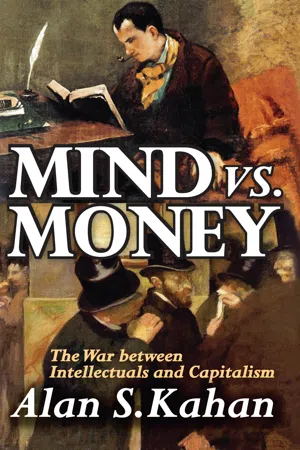
Mind vs. Money
For over 150 years, Western intellectuals have been at war with capitalism. The consequences have often been disastrous for all concerned. It is time the world realized it was at war. It is long past time for a truce.
The German philosopher Hegel said that the owl of wisdom only flies after sunset. By this he meant that we only really understand events, even ones that last a long time, when they are over. The hostility of a considerable portion of the Western intellectual elite towards capitalism has been a constant factor in modern history, sometimes with disastrous results, yet somehow escaped notice. But when an ongoing conflict lasts 150 years, we ought to be able to recognize it.
For the past 150 years, numerous Western intellectuals have trumpeted their contempt for capitalism and capitalists. They have written novels, plays, and manifestos to demonstrate the evils of the economic system in which they live. Dislike and contempt for the “bourgeoisie,” for the middle classes, for industry and commerce have been prominent among leading Western writers and artists. They have been expressed by personalities as diverse as Gustave Flaubert and Karl Marx, T. S. Eliot and Friedrich Nietzsche, Ezra Pound and Pablo Picasso. It would not be hard to add another hundred famous names to this list, from Matthew Arnold to Emile Zola, and many will be found in the following chapters. Not all Western intellectuals have hated capitalism, probably not even the majority—no one has ever counted how many intellectuals there are, let alone polled them. But it is certain that a great number, and those not the least influential, have felt this way.
Such intellectuals have expressed their rejection of capitalism through participation in many different movements, including nationalism, anti-Semitism, socialism, fascism, communism, and the counterculture. Anti-capitalism continues to take new forms today. The anti-globalization, Green, communitarian, and New Age movements are examples. Intellectuals have given all of them strength, legitimacy and leadership they would otherwise have lacked. What unites the radical intellectuals of the nineteenth century, the communist and fascist sympathizers of the twentieth, and the anti-globalization protestors of the twenty-first, along with many other intellectuals, is their rejection of capitalism. The more thoroughly one is an intellectual, the more likely one is to be thoroughly opposed to capitalism.
Capitalism puts many intellectuals into permanent opposition. Only the form of that opposition varies. Not all intellectuals who reject capitalism have an alternative in mind. Just as many people regard their system of government as illegitimate without having more than a hazy idea of a better one, so many intellectuals regard capitalism as illegitimate without necessarily favoring socialism or having another replacement ready to hand. One can criticize human faults without knowing how to eliminate them. Intellectuals who reject capitalism are often in this position. It does not make their criticism any less harsh.
In the days of communism and fascism, the war between mind and money was fought with deadly weapons. Millions of people died as a result, in concentration camps, gulags, and famines. They may again, unless we learn a better way to deal with the conflict. For the moment, however, mind has turned to a different kind of weapon in its perennial struggle against money. Now the war between mind and money is mostly fought as a struggle over culture and lifestyle. Culture wars are preferable to shooting wars. But even if we are lucky, and the war between mind and money remains a cultural cold war, we will still pay a high price for the conflict. Today, one of the deepest divides in Western culture is between those who despise and distrust business and those who can’t understand why they do. Throughout the Western world, societies remain divided between those who practice capitalism and those who condemn it. We talk past each other, and then complain that we can’t find common ground. Intellectuals and businessmen live in mutual incomprehension. In myriad forms, on myriad fronts, the battle between mind and money goes on, as it has for the last 150 years. The war between mind and money is the great unresolved conflict of modern Western society. Its death toll has been high, and may yet go higher. To have a hope of ending it, we must first understand it.
Why do so many intellectuals hate capitalism? What is wrong with it? To many intellectuals, the answers to these questions are so obvious that they are not worth asking. The reasons they feel this way are part of their very identity. They derive from the role intellectuals play in modern societies, and from the historical traditions that inspire them. Intellectuals’ identity, their social situation, and their history are the point of departure for their assaults on capitalism.
By “capitalism,” for which I will occasionally substitute the less politically-charged term “commercial society,” I mean the sum total of a way of organizing economic production, and the people, technology and values most closely associated with that form of production. To put it another way, capitalism equals a free market economy + modern technologies + the middle classes + the set of values and attitudes associated with them. Typical anti-capitalist intellectuals may not attack all aspects of capitalism, but they reject at least one, and often more. They may wish to abolish private property, or preserve it while abolishing big business and modern technology. They may make big-time stock speculators or small-town shopkeepers the chief targets of their wrath, or regard both as slaves of Mammon. Sometimes intellectuals want to replace capitalism with something else. Sometimes they disdain capitalists while being resigned to the system. There is a broad spectrum of intellectual opposition to capitalism. It varies in both kind and intensity, but it is always there. Many intellectuals don’t like capitalism. They almost never have. They never will. Sometimes they find an audience.
Does this constitute a war? Sometimes it kills people, sometimes not. Sometimes capitalism is for a time overturned—mostly not. The intensity of the conflict rises and falls over time, as does the intensity of intellectuals’ anti-capitalist sentiments. Those intellectuals most violently opposed to capitalism are usually a minority of those who disdain capitalists. Some may wish to quibble over whether “war” is the right word for a perennial conflict waged more often with insults than with guns. None can dispute the conflict’s existence, duration, and importance. It is all part of the same struggle, that of mind vs. money.
Who Are the “Intellectuals”?
To understand intellectuals’ hostility towards capitalism, we must understand who “intellectuals” are. Responding to a similar question about how to define a notoriously slippery term, a justice of the United States Supreme Court once said that while he couldn’t define pornography, he knew it when he saw it. It is not hard to identify intellectuals this way, but an understanding of the conflict between mind and money requires a more lengthy analysis of what makes an intellectual and how intellectuals fit, or don’t fit, into modern society.
What is an intellectual? How do you recognize one? A short answer is that the modern intelligentsia is composed of academia plus bohemia, that is, of professors, writers, and artists. But this answer, while short and simple, is also vague, and, strictly speaking, inaccurate. Many professors, writers, and artists are not intellectuals, while many people outside these professions are. An English professor is more likely to be an intellectual than is a plumber or an accountant, but not all English professors are intellectuals, and some intellectuals are plumbers.
There are three ways to distinguish intellectuals that together give us insight into why intellectuals dislike capitalism—the social, the linguistic, and the moral. The social signs like occupation and education are the ones that first strike the eye, although they are less important than the kind of language a person uses, and above all the kinds of moral attitude they have.
Socially, intellectuals can often be distinguished by their occupations and their education. The occupations intellectuals practice have changed over time. In the nineteenth century, bohemia, that is, independent writers and artists, novelists and journalists and poets, made up a much larger portion of the intellectual class than did academia. Until the late nineteenth century there were very few professors, even in Europe. In 1860, England, France, and Germany could count fewer than 3,500 university faculty among them, versus more than 10,000 writers and editors. By comparison, in 2004 there were 1.6 million “post-secondary teachers” in the United States versus about 320,000 “writers and editors.” The change in proportion, as well as in number, has been enormous. A twenty-first-century list of professions in which American and European intellectuals congregate would include professors of humanities and the social sciences, now the largest single group, along with other concentrations in media, publishing, non-profit work, some church organizations, and writers and critics. It is above all the elites of these professions who are most likely to be intellectuals—and correspondingly most likely to be opposed to capitalism.1
One thing that hasn’t changed from the nineteenth century to the present is what intellectuals don’t do for a living. They are not part of the business world. As a general rule the more distant from the process of production and trade, and the more permanent this isolation, the more willing a social group is to be radically anti-capitalist. This is why intellectuals have often been more hostile to capitalism than people who work on the assembly line.
The other social marker for intellectuals, along with occupation, is education. One thing intellectuals have had in common throughout history is an advanced education. Bohemians may drop out of college, but one way or another they have learned what they need outside the classroom. Through their education, intellectuals have attained a mastery of certain cultural values, acquired a cultural capital. But intellectuals are not an economic class. Like medieval nobles, intellectuals derive their identity from their status, not their money. Their education is a crucial part of how they get their status. Over the course of the twentieth century, this status has increasingly required academic proof in the form of a college degree, and increasingly an advanced degree (bohemians partly excepted). Proving one’s educational pedigree has replaced proving one’s noble ancestry.2
What matters most, however, is not the degree, it is the kind of education received. Before 1914, a high school diploma of the correct kind, involving lots of study of Greek and Latin, was often all the formal education many intellectuals had. Today, the vast majority of people with college degrees are not intellectuals, because they do not have the right kind of education. The kind of education necessary to make an intellectual has always been centered around the liberal arts. As etymologists love to repeat, “liberal” derives from the Latin liber, “free,” and the liberal arts are those subjects suitable for a free person to study. In the ancient world a free person, unlike a slave, was presumed to be someone who did not need to work for a living, and thus the subjects included in a liberal education had no direct professional purpose. The canonical texts from the Greco-Roman world that were the basis for advanced education through World War I were anything but friendly to commerce. The divorce between elite education and business is of long standing in Western society.
Advanced education has always been a necessary, never a sufficient qualification for being an intellectual. Education and occupation need to be supplemented by more intimate traits, such as language and attitudes, before we identify someone as an intellectual. Indeed, intellectuals betray themselves well before an observer has had time to learn what they do for a living or whether they have a Ph.D. By and large, when you see one, hear one, or read one, you know one. Modern Western intellectuals use a common language that distinguishes them from non-intellectuals.
Intellectuals, whether they speak English, French, or German, use a special kind of language: careful critical discourse (CCD). In CCD, if you say something, you must be prepared to prove it by giving reasons, not by appeals to higher authority. For an intellectual, nothing can be justified simply by an appeal to authority or tradition. True, it gives weight to an intellectual’s argument to quote Plato or Kant in its favor. But CCD never considers an authority beyond challenge—in principle anything and anyone is subject to being corrected.3 You can never say something “just because it’s my opinion.” In the language of CCD, you are only entitled to have an opinion if you can justify it. This is democratic in one sense, but aristocratic in another, since not everyone is capable of making the kind of argument careful critical discourse requires, and those who can’t don’t get to vote: “Intellectuals have long believed that those who know the rule, who know the theory by which they act, are superior because they lead an ‘examined’ life.…” If you don’t talk right, intellectuals will look down on you because you are not using CCD to justify your actions or beliefs. This is another way in which modern intellectuals form a kind of aristocracy. In return, intellectuals are often disdained as “highbrows” by those who find CCD alien and alienating. This linguistic divide is one source of the hostility between mind and money.4
If one thinks of intellectuals as the people who use this kind of language, the people who follow the rules of this game, one can see how certain groups stand at the fuzzy periphery of the intelligentsia, for example clergy who refer to revelation as unchallengeable authority—although the meaning of revealed scripture may remain open to debate following the rules of careful critical discourse. The more fundamentalist the clergy, the less they believe interpretation is open to debate, the less chance there is that they are intellectuals. Another way in which CCD distinguishes the intellectual from the generic clergyman or teacher is that its critical function is dedicated to creating new truths, and new language, not just passing on old traditions. Part of being an intellectual in the modern world is to aspire to originality. Both because of their bias in favor of innovation, and because of their willingness to criticize old ways of doing things, intellectuals can be very useful in capitalist society.5
Are scientists or engineers intellectuals? They certainly want to make new discoveries, but in a sense much of science and technology does not use critical language in ordinary circumstances, and thus it is sometimes unclear whether they are intellectuals. Scientists generally agree about so many things that for them there are large areas that are effectively beyond debate. On the other hand, when experiments give unexpected results, scientists use critical discourse to resolve their problems. Perhaps because they use critical discourse relatively rarely, scientists and technicians are the intellectuals least likely to be hostile to capitalism, basically because they are the least intellectual of intellectuals. Which is not to deny that many of those engaged in “basic research” look down on those who work in “applied” fields, partly because of the assoc...