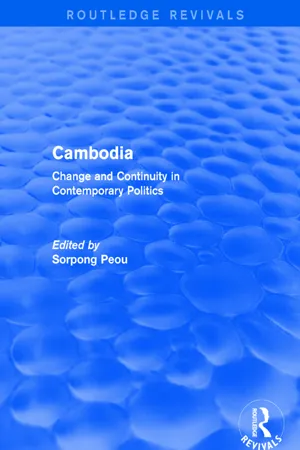
This title was first published in 2001. This text offers a comprehensive view of controversial issues surrounding Cambodia's past, present and possible future development. It brings together a selection of journal articles about the wartorn country to examine critical issues concerning change and continuity in contemporary Cambodian politics. The book covers violence, war and peace, the Constitution, human rights and the pursuit of justice, democratic development and dilemmas, gender and ethnic relations and economic development and problems. These themes should be instructive for scholars, policymakers and interested individuals dealing with what has been termed "triple transition": from armed conflict to the end of violent hostility, from political authoritarianism to liberal democracy and from socialist economic systems to market-driven or capitalist ones. The book shows that the trajectory towards peace, democracy and sustainable development is complex, full of dangers and in need of careful management.
- 596 pages
- English
- ePUB (mobile friendly)
- Available on iOS & Android
eBook - ePub
About this book
Information
Part I
Perspectives on Violence and War: The Elusive Search for Peace?
[1]
THE CAMBODIA SETTLEMENT AGREEMENTS
On October 23, 1991, representatives of nineteen states participating in the Paris Conference on Cambodia signed a set of accords aimed at ending the twenty-year-old conflict in that country.1 The solemn ceremony at the Kleber Center in Paris marked the conclusion of over three years of intensive negotiations at a variety of levels, including interfactional, regional and international, to end one of the world's most tragic regional disputes. It also signaled the beginning of an unprecedented role for the United Nations in the resolution of such conflicts.
The long, sad history of the Cambodian conflict required any comprehensive settlement to address numerous elements: a civil war among four factions, each of which had taken a turn at governing the country since its independence from France; invasion by a neighboring state seeking regional hegemony; external assistance to the factions; support of the belligerents by the major powers; a history of gross violations of human rights; a vast refugee problem; and a devastated economy requiring massive reconstruction. The settlement agreements confront these problems through reliance on, and reaffirmation of, existing norms of international law and through the creation of new regimes and institutions that could form important precedents for future conflicts. Established concepts such as neutrality proved critical in serving as the legal bases for certain aspects of the settlement; but the agreements chart new waters in fashioning a legal framework for the enhanced United Nations role in implementing the settlement.
This article presents a legal analysis of the Paris agreements by examining them from four perspectives. First, it explicates the agreements to convey their structure and content. Because the accords are lengthy, and at times opaque, redundant or apparently unexceptionable, a distillation for those not familiar with the Cambodian peace process is required. Historical and negotiating background is offered where needed to reveal the underlying issues addressed in the texts. Second, the legal obligations in the agreements are interpreted to give a practical sense of the parties’ duties where the texts do not make them clear. The extent to which the signatories must alter their conduct to fulfill their new international commitments is indicated in this context. Third, I identify areas where the accords rely upon precedents in earlier arrangements to settle regional disputes and thus contribute to the corpus of legal agreements for this purpose. These precedents include both norms of customary international law and practical mechanisms for creating peace on the ground. Fourth, the article discusses those aspects of the Paris agreements whose legal bases transcend traditional conceptions in international law or involve innovative undertakings by the signatory states. The Cambodian accords suggest, for example, new dimensions for recognition, sovereignty and emerging human rights norms.
In part I, I review the essential elements of the Cambodian conflict, the negotiating process that culminated in the Paris texts, and the basic structure of the accords. Parts II, III and IV contain analysis of each of the three main texts signed in Paris—two legal agreements and a political declaration—from the perspectives noted above. In part V, I summarize implementation of the agreement to date and, in part VI, conclude with some observations on the Cambodian peace process and the accords as models for handling other disputes.
I. HISTORICAL BACKGROUND
The Paris accords of 1991 represent the latest and most ambitious attempt to end a decades-old conflict rooted in events within and outside Cambodia.2 Cambodia's history since World War II has been marked by a series of domestic crises, as well as involvement in confrontations outside its borders. From 1941 to 1970, Cambodia was ruled by Norodom Sihanouk, the country's hereditary king, initially under French and Japanese rule, and after 1953 as an independent state. Cambodia's link with the future of postwar Indochina and legal accords related to that region was evidenced at the 1954 Geneva Conference on Indochina. Although primarily devoted to the French-Vietnamese conflict, the conference also produced an agreement between the Royal Khmer Government and Vietnamese-supported resistance forces that was aimed at ending Cambodia's internal conflict,3 and a unilateral statement by Cambodia regarding its future status.4 Two statements by France5 and the conference's final declaration promised an end to foreign interference in Indochina.6 However, neither the Geneva accords nor Sihanouk's attempts to insulate Cambodia from neighboring hostilities averted continued domestic instability during the 1960s.
The Period 1970–1989
In March 1970, Sihanouk was overthrown by General Lon Nol, which ushered in authoritarian rule under the name of the Khmer Republic. After five years of struggle between Lon Nol's forces and the insurgents of the Communist Party of Kampuchea (the Khmer Rouge) in alliance with Sihanouk, the Khmer Rouge gained control of Cambodia by April of 1975. The Khmer Rouge government ruled Cambodia—renaming it Democratic Kampuchea—from April 1975 until its ouster by Vietnamese troops in January 1979. During this period, the regime attempted a total restructuring of Khmer society, including rejection of all foreign influences and heavy reliance on a communal agrarian economy.7 The atrocities committed during this period constitute one of the worst cases of state-sponsored killing and other violations of human rights of this century and resulted in the loss of a considerable portion of Cambodia's population to execution, starvation, exhaustion or disease.8
On December 25, 1978, partly in response to cross-border raids by Democratic Kampuchea, Vietnam invaded Cambodia and by January 9, 1979, had seized Phnom Penh. The invasion heralded the fourth government to control Cambodia since independence, that of the Vietnamese-supported regime known until 1989 as the People's Republic of Kampuchea (PRK). The Khmer Rouge occupied small rural areas, principally near the Thai-Cambodian border; hundreds of thousands of Cambodians fled to Thailand and the West. Despite a call by the United Nations General Assembly for the withdrawal of all “foreign forces”9 and its refusal to accept the PRK's credentials,10 the regime retained control—with the help of Vietnamese forces—of most of Cambodia throughout the 1980s.
The United Nations had devoted little attention to Cambodia during the Khmer Rouge years;11 the Vietnamese invasion, however, spurred the first international attempt to resolve the conflict since the Geneva accords. In 1980 the General Assembly decided to convene an international conference “with the aim of finding a comprehensive political settlement of the Kampuchean problem.”12 The International Conference on Kampuchea met in New York from July 13 to 17, 1981. Seventy-nine states attended, including Democratic Kampuchea, but Vietnam and other Soviet bloc states boycotted the conference, which focused on the Vietnamese invasion, not the atrocities of the Khmer Rouge. The conference's Declaration on Kampuchea stressed the need to restore Cambodia's sovereignty and territorial integrity but scarcely mentioned human rights.13 The conference also created an ad hoc committee to undertake peace efforts on behalf of the conference;14 the committee met throughout the 1980s but made little progress toward a settlement. The General Assembly kept the situation in Cambodia on its agenda, passing annual resolutions (over the objections of the Soviet bloc) identifying the withdrawal of all foreign forces as the first component of any lasting peace in Cambodia.15 In addition, the Secretary-General dispatched his Special Representative to the region, who met with regional actors and developed his own framework for a settlement.
The peace process that led to the Paris accords started with face-to-face meetings between Prince Sihanouk and PRK Prime Minister Hun Sen in December 1987 and January 1988, followed by the convening by the Government of Indonesia of the Jakarta Informal Meeting (JIM I) on July 25–28, 1988. This meeting marked the first time the parties most directly involved in the conflict—the four Cambodian factions,16 Cambodia's two Indochinese neighbors, and the six states of the Association of Southeast Asian Nations (ASEAN)17—discussed the elements of a settlement. The resulting communiqué outlined those areas that all could agree were the key components of a comprehensive solution.18 The JIM met again on February 19–21, 1989, further elaborating the terms of a settlement.19 The two JIM meetings were designed to start a process of reconciliation between the PRK and the resistance that would be endorsed later at an international conference.
The Paris Conference on Cambodia
After the success of JIMs I and II in at least bringing the parties together on certain points, the announcement by Vietnam in April 1989 that it would withdraw its troops from Cambodia by the end of September 1989, and another Sihanouk–Hun Sen meeting, the Governments of France and Indonesia agreed in 1989 to convene a new international conference to reach a comprehensive settlement to the Cambodian conflict, including its internal and international dimensions. The Paris Conference on Cambodia included the four Cambodian factions and all other countries with a strong political or historical interest in the Cambodian conflict: the ASEAN states, the five permanent members of the UN Security Council, and Vietnam, Laos, Japan, Australia, India and Canada.20 Zimbabwe was invited as the presiding member of the Non-Aligned Movement, and the UN Secretary-General and his Sp...
Table of contents
- Cover
- Half title
- Title Page
- Copyright Page
- Table of Contents
- Acknowledgements
- Series Preface
- Introduction
- Part I Perspectives On Violence And War: The Elusive Search For Peace?
- Part II Perspectives On Legal Development: Theconstitution, Human Rights Issues And The Pursuit Of Justice
- Part III Perspectives On Political Development: Towards A Triumph Of Liberal Democracy?
- Part IV Perspectives On Gender And Racial Relations: Towards Social Harmony And Peace?
- Part V Perspectives On Economic Development: Towards Prosperity?
- Name Index
Trusted by 375,005 students
Access to over 1.5 million titles for a fair monthly price.
Study more efficiently using our study tools.
Frequently asked questions
Yes, you can cancel anytime from the Subscription tab in your account settings on the Perlego website. Your subscription will stay active until the end of your current billing period. Learn how to cancel your subscription
No, books cannot be downloaded as external files, such as PDFs, for use outside of Perlego. However, you can download books within the Perlego app for offline reading on mobile or tablet. Learn how to download books offline
Perlego offers two plans: Essential and Complete
- Essential is ideal for learners and professionals who enjoy exploring a wide range of subjects. Access the Essential Library with 800,000+ trusted titles and best-sellers across business, personal growth, and the humanities. Includes unlimited reading time and Standard Read Aloud voice.
- Complete: Perfect for advanced learners and researchers needing full, unrestricted access. Unlock 1.5M+ books across hundreds of subjects, including academic and specialized titles. The Complete Plan also includes advanced features like Premium Read Aloud and Research Assistant.
We are an online textbook subscription service, where you can get access to an entire online library for less than the price of a single book per month. With over 1.5 million books across 990+ topics, we’ve got you covered! Learn about our mission
Look out for the read-aloud symbol on your next book to see if you can listen to it. The read-aloud tool reads text aloud for you, highlighting the text as it is being read. You can pause it, speed it up and slow it down. Learn more about Read Aloud
Yes! You can use the Perlego app on both iOS and Android devices to read anytime, anywhere — even offline. Perfect for commutes or when you’re on the go.
Please note we cannot support devices running on iOS 13 and Android 7 or earlier. Learn more about using the app
Please note we cannot support devices running on iOS 13 and Android 7 or earlier. Learn more about using the app
Yes, you can access Cambodia by Sorpong Peou in PDF and/or ePUB format, as well as other popular books in Social Sciences & Sociology. We have over 1.5 million books available in our catalogue for you to explore.