![]()
1 | Fundamentals of Solar Radiation |
The Sun remains fixed in the center of the circle of heavenly bodies, without changing its place; and the Earth, turning upon itself, moves round the Sun.
—Galileo Galilei, 1615
1.1 THE SUN AS A STAR
Earth orbits a star, the sun, which is the ultimate source of all energy driving the process of animate and inanimate life cycles on the planet. The sun’s nuclear furnace continually fills the volume of surrounding space with energetic elementary particles and photons of electromagnetic radiation. The sun’s electromagnetic spectrum spans an enormous range of wavelengths of frequencies of radiation, from gamma and x-rays, to ultraviolet (UV), visible, infrared (IR), and radio waves. For the purposes of this book, we are interested in so-called optical solar radiation, from the UV wavelengths to the near- and mid-infrared wavelengths that Earth’s atmosphere allows to reach the ground. We denote this region of interest as optical solar radiation even though only a subset of the spectrum, that within the photopic response of the human eye, is “optically visible.” The details of the distribution of optical radiation as a function of wavelength are discussed in this chapter.
1.2 THE EARTH AND THE SUN
1.2.1 THE ORBIT AND ROTATION OF THE EARTH
Earth orbits the sun in a very slightly elliptical orbit, with an eccentricity ε (ratio of major to minor axis) of 0.0167. Earth also rotates once every 23 h 56 min, with respect to the distant stars (a sidereal day), and a period of 24.0 h (the definition of the solar day) about an axis titled at an angle of 23.5° to the plane of that orbit. The average distance between the Earth and the sun is the astronomical unit (AU) of 93 million miles (or 149,597,870.7 km).
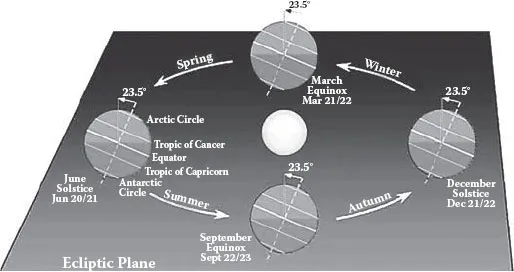
The tilted axis of rotation produces the seasonal weather changes we experience, as shown in Figure 1.1. That tilt also causes the daily changes in the points on the horizon where the sun rises and sets, the path of the sun through the sky dome, and the period of daylight to change throughout the year. The eccentricity of the orbit produces changes in the Earth–Sun distance, or “radius vector” r, with respect to the mean distance of 1 AU. The closest approach of the Earth to the sun (perihelion = 147.09 × 10⁶ km) is around the first week in January, and the greatest Earth–Sun distance (152.1 × 10⁶ km) is around the first week of July. The actual dates vary from year to year, depending on leap years, and small cumulative geophysical or gravitational influences [1].
FIGURE 1.1 Earth’s orbit and the seasons. (From Wikipedia, http://upload.wikimedia.org/wikipedia/commons/thumb/f/f0/Seasons1.svg/700px-Seasons1.svg.png.)
1.2.2 THE SUN AND INTENSITY OF EXTRATERRESTRIAL SOLAR RADIATION
Earth intercepts only a minute fraction of the energy radiated by the sun into the surrounding spherical volume of space. The “flux density” or “intensity” of the radiation, in terms of watts per square meter of area (Wm2) at distance R from the sun falls off as 1/R2. Investigation of the intensity Io of the solar radiation at the average distance of the Earth’s orbit, or so-called extraterrestrial radiation (ETR), has long been a subject of scientific investigation. During the space age, satellite-based estimates of the intensity of solar radiation at 1 AU vary around Io = 1366 Wm2 with an uncertainty of about ±7 Wm2. For most of the period from 1970 to 2010, the accepted value of Io was 1366.1 Wm2 [2,3].
In 2011, instrumentation issues with historical measurements in conjunction with new measurements from space produced a value of Io = 1361 Wm2 [4]. Note that this difference amounts to ±0.5%, and the choice of Io in the model scenarios that follow change depending on which value of Io the user selects.
The eccentric Earth orbit results in a +3% increase in the solar radiation intensity at perihelion and a –3% decrease at aphelion. This variation can be accounted for by relying on detailed astronomical calculations such as appear in the annual astronomical or nautical almanacs published for astronomers and navigators relying on classical techniques [5,6]. Two popular equatio...