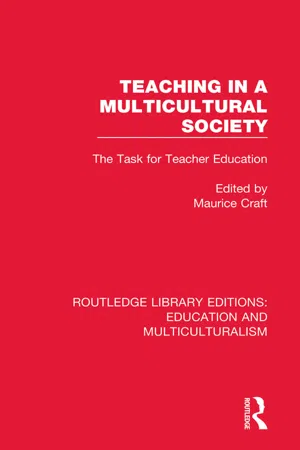
Originally published in 1981. This book authoritatively and comprehensively documents the extent of the response to the changing responsibilities of initial and in-service teacher education in a multicultural society. It look at provisions and perceptions of need and indicates future avenues of development. The papers were presented at a national seminar held at Nottingham University in April 1981.
- 200 pages
- English
- ePUB (mobile friendly)
- Available on iOS & Android
eBook - ePub
About this book
Information
Chapter One
RECOGNITION OF NEED
Maurice Craft
This opening Chapter reviews the growing recognition of a need for the more informed preparation of teachers in a multicultural society, maps the response, and suggests some next steps.
The changing social composition of the nation’s schools from the early 1960s has been reflected in a steady output of official reports, books and research papers which now comprise quite a substantial literature. It is a literature which reflects, on the one hand, a continuing confusion about overall aims in multiracial (or as it has since become known, multicultural) education, and on the other a continuing concern about the nature and extent of provision in schools and in teacher education. The two are naturally related.
To take the question of overall aims, put simply, are schools being asked to facilitate the speedy assimilation of culturally and linguistically distinctive pupils to the majority culture, or is there a more ‘pluralistic’ purpose? If it is the former, provision will be mainly concerned with the ‘special needs’ of immigrant or second generation children, with matters of language and literacy for example. If it is the latter, schools will be more concerned to acquaint all their pupils with the diverse origins of all members of our society, and to convey an appreciation of the intrinsic validity of different cultures. In this case, the curriculum for all pupils will be placed under review, not simply the curriculum for the newcomers. The emphasis in each case is clearly quite different.
At the outset, with the arrival of the first wave of immigrant children from southern Asia and the Caribbean, the overall aim was strongly assimilationist. Immigrant children were deliberately spread throughout an Authority’s schools. Some LEAs made efforts through withdrawal classes or special centres to cope with language and other basic skills, while others adopted a ‘colour blind’ policy and awaited full acculturation through the passing of time. The objectives for teacher education were therefore quite clear : those serving teachers working in schools with immigrant pupils should attend in-service courses on special needs, if available; but initial training need not do more than offer special options for students with a particular interest. However, pluralist views emerged quite early on. An increasing trickle of references to the need to prepare all children for life in a multicultural society began to appear, and with it the call for compulsory work in multicultural education in all initial training, in addition to specialist options and in-service training.
In this opening Chapter, the growing recognition of a need for the more informed preparation of teachers in a culturally plural society is examined through a review of the literature of the time. The confusion of overall aims and the consequent controversy in relation to policy and provision will appear and reappear. But perhaps the most insistent feature of the literature is the sheer repetition among the various commentaries. Whatever we have been trying to do, whether to assimilate our new citizens or to feel our way to a pluralist view, it is profoundly depressing to find the same kinds of recommendations for action appearing time and time again. The reasons for this would require a far more prolonged analysis than is possible here. But the failure to undertake even the beginnings of a rational clarification of aims, although understandable in such a politically volatile area, has given the impression of drift and may have contributed to the growing intractability of our problems in multicultural education. Undoubtedly, the slowness of education (and particularly of teacher education) to respond to the changing social composition of the schools, has been related to the uncertainty about aims referred to above. But the preoccupation of teacher educators with the revolution in the structure and content of teacher training since 1960 has possibly also been a factor. A third element must relate to the attitudes of teachers, and the wide variation in the degree to which they have perceived multicultural education as either a clear or a desirable aim for schooling.
This chapter therefore begins with a brief review of early expressions of need in initial and in-service teacher training, and an appraisal of more recent reports. This is followed by a detailed examination of such evidence as exists regarding provision in initial and in-service training, from the 1960s to the present; and then by a brief discussion, first, of comments which have been made about teacher attitudes and the take-up of in-service courses, and second, of the initial vs in-service debate. Finally, I have included a number of suggestions for future policy.
Early Expressions of Need
Patterson’s (1963) study of W.Indians in Britain was one of the earliest reports to call attention to the key role of education in preparing children for membership of a multicultural society, and to urge the full participation of teachers in reviewing a largely ethnocentric curriculum. “Somehow it should be possible to find space in the training college syllabus for a course in race and human relations”, she wrote. But in fact it took us a little time to find space, and to begin to think beyond a more limited, ‘special needs of immigrants’ perspective. Bowker (1968), writing of the “obvious need for teachers to be as fully equipped as possible to understand the problems faced by members of immigrant minority groups”, commented on “the sad fact … that many students pass through our colleges of education unaware that such problems exist”. In 1969, E.J.B. Rose’s landmark study of British race relations confirmed this gloomy picture. “Institutes of education”, he reported, “were slow to respond to the need for teachers prepared to work with immigrant children, including E2L work”, and an Authority like Birmingham built up its own team of peripatetic specialists. Elsewhere, groups of teachers came together voluntarily in workshops and conferences to exchange practical ideas and ‘emergency do-it-yourself’ techniques.
In 1970, Bhatnagar’s research in a multi-ethnic school called attention to the fact that many immigrant children arrive in Britain with very different educational and social backgrounds.
“Some of them come from rural, pre-industrial cultures and move straight into the classroom in the middle of the industrial Midlands. The point that they may need different teaching methods, educational aids, and classroom organisation seems to have been completely lost on their teachers. Few teachers have been trained to cope with immigrant children [and] … special courses … will have to be provided on a far more extensive scale than they are now”.
The Schools Council reported in 1970 on immigrant children in infant schools (a study of 11 LEAs), and observed that little short-course provision for infant teachers had so far been made, although things were rather better in areas of high concentration where a specialist adviser had been appointed. This enquiry also reported that “many colleges do not yet do enough to prepare their students for this work”, despite the strategic importance of tackling special needs at this early age, and the likelihood that many young teachers would take up first posts in these areas (Schools Council 1970a). (Virtually the same comments were offered five years later by the Bullock Report in respect of the training of nursery and infant teachers (DES 1975, para. 20.15)).
All these observations are typical of the ‘compensatory’ view of the earlier days, when many of the ethnic minority children in our schools were born overseas. But they have been echoed down the years both by those concerned about the special needs of minority group children, and by those advocating change in the curriculum for all children in a multicultural society. The Select Committee on Race Relations and Immigration (1969), for example, took in both objectives:
“We would like to see every college of education in the country teaching its students something about race relations, and the problems of immigrants. To say that there is no need to educate all students about such matters because, as one college has said, ‘very few of our students go into schools where they are likely to meet mixed classes’, is to miss the point. Teachers should be equipped to prepare all their children for life in a multicultural society”. (Op.cit., para 214).
Townsend’s (1971) landmark study, a national survey of the LEA response to the changing situation in the schools reported that, “repeatedly on visiting schools with immigrant pupils, research officers heard comments from LEA officers and head teachers about the lack of preparation of many teachers for a new and difficult task,” even staff in special language centres and classes. In their second major survey, this time of the internal organisation of 230 primary and secondary schools with varying proportions of ethnic minority pupils, Townsend and Brittan (1972) again concluded that an outstanding feature of the staffing of these schools was their lack of adequate preparation for teaching in multiracial schools. “Neither initial nor in-service training is meeting the urgent needs of teachers for greater knowledge of immigrant backgrounds and of suitable techniques for use in the classroom”, they said. And going on to a broader and less problem-oriented view:
“… there is a valid argument that not all students will become teachers in multiracial schools. There is an equally valid argument that all students in colleges of education are expected to become teachers in a multiracial Britain, but this did not seem to have been reflected in the courses of the probationer teachers in the sample”. (Op.cit., pp. 138-139).
And so it goes on. The HMI Survey of the educational progress of immigrant pupils in 54 secondary schools in 16 LEAs, published in 1972, expressed disappointment at the schools’ response, and expressed the hope that an increasing number of LEA in-service courses would offer teachers the guidance required; and that young graduates, in particular, would be offered the appropriate training in their PGCE courses (DES 1972a). The 1973 Reports of the Select Committee on Race Relations and Immigration, recommended that “students at colleges of education should be made aware that, wherever they teach, they will be doing so in a multicultural society”, and that “this should be reflected not so much in special courses, but throughout the training, more particularly in such aspects of it as the sociology of education” (op.cit., para. 114); they also recommended an expansion of in-service provision to meet the special needs of minority group children. In 1974 came the CRC/ATCDE Report, a significant policy statement signalling the end of the ‘education of immigrants’ approach, as such a large proportion of minority children were now indigenous Britons, arguing for a more pluralistic view and outlining detailed programmes of work at initial and in-service levels (op.cit., 1974).
More Recent Reports
The Bullock Report on language teaching appeared in 1975, and devoted a long chapter to ethnic minority children, making numerous observations on relevant needs in initial and in-service training with particular reference to language teaching, ethnocentric school books, and attitudes to dialect variations (DES 1975). In 1977 the ‘Green Paper’ which followed the former Prime Minister’s call for a public debate on education in his Ruskin College speech, reiterated the concerns which had already been expressed a decade earlier. “The Secretary of State”, it reads, “shares the misgivings of those who believe that too many entrants to the teaching profession have inadequate experience and understanding of the world outside education, including its multicultural and multiracial aspects …”, and it recommended a high priority for in-service work “in relation to the special problems of multiracial schools, immigrant communities and schools in deprived inner urban areas” (DES 1977). Another 1977 reminder of what still remained to be done was produced by the Community Relations Commission in its Report to the Home Secretary on urban deprivation and racial inequality. This report cited the views of a sample of teachers who “felt inadequately trained for their work in multiracial schools, and many felt they received insufficient support or guidance from the local authority”. There was also “a high degree of demand for an increased level of initial and in-service training of teachers to give them the skills needed to teach in multiracial schools” (CRC 1977).
In 1979 came the publication of an HMI enquiry into developments in the B.Ed. degree course, a study of 3 polytechnics and 12 colleges. This reported that the treatment of education in a multicultural society was ‘superficial or non-existent’; and “the compulsory elements of most courses did not … bring students towards much awareness of the special needs of certain categories of children, in particular those with a cultural background different from that of the majority or those whose learning was otherwise handicapped”. Expertise it seems was usually present in most colleges, but it was made available chiefly in optional courses. “Yet such needs as these,” the rep...
Table of contents
- Cover
- Half Title
- Title Page
- Copyright Page
- Table of Contents
- Editor’s Preface
- Contributors
- 1 Recognition of Need
- 2 Aims and Objectives
- Discussion
- 3 The Research Context
- Discussion
- 4 Present Provision in Initial Training
- Discussion
- 5 Present Provision in In-Service Training
- Discussion
- 6 Views from Teacher Education
- Discussion
- 7 Perceptions of Need by Teachers
- Discussion
- 8 An LEA Viewpoint
- Discussion
- 9 An HMI Perspective
- Discussion
- 10 Overview
- Appendix A: The CRE Advisory Group on Teacher Education
- Appendix B: Seminar Participants
- Index
Trusted by 375,005 students
Access to over 1.5 million titles for a fair monthly price.
Study more efficiently using our study tools.
Frequently asked questions
Yes, you can cancel anytime from the Subscription tab in your account settings on the Perlego website. Your subscription will stay active until the end of your current billing period. Learn how to cancel your subscription
No, books cannot be downloaded as external files, such as PDFs, for use outside of Perlego. However, you can download books within the Perlego app for offline reading on mobile or tablet. Learn how to download books offline
Perlego offers two plans: Essential and Complete
- Essential is ideal for learners and professionals who enjoy exploring a wide range of subjects. Access the Essential Library with 800,000+ trusted titles and best-sellers across business, personal growth, and the humanities. Includes unlimited reading time and Standard Read Aloud voice.
- Complete: Perfect for advanced learners and researchers needing full, unrestricted access. Unlock 1.5M+ books across hundreds of subjects, including academic and specialized titles. The Complete Plan also includes advanced features like Premium Read Aloud and Research Assistant.
We are an online textbook subscription service, where you can get access to an entire online library for less than the price of a single book per month. With over 1.5 million books across 990+ topics, we’ve got you covered! Learn about our mission
Look out for the read-aloud symbol on your next book to see if you can listen to it. The read-aloud tool reads text aloud for you, highlighting the text as it is being read. You can pause it, speed it up and slow it down. Learn more about Read Aloud
Yes! You can use the Perlego app on both iOS and Android devices to read anytime, anywhere — even offline. Perfect for commutes or when you’re on the go.
Please note we cannot support devices running on iOS 13 and Android 7 or earlier. Learn more about using the app
Please note we cannot support devices running on iOS 13 and Android 7 or earlier. Learn more about using the app
Yes, you can access Teaching in a Multicultural Society by Maurice Craft in PDF and/or ePUB format, as well as other popular books in Education & Education General. We have over 1.5 million books available in our catalogue for you to explore.