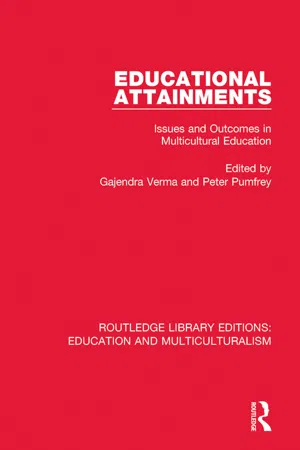
Originally published in 1988. This book presents an account of some of the challenges to society involved in multicultural education, together with recent empirical evidence concerning the educational attainments of British pupils of Afro-Caribbean, Asian and British origins. Promising policies and practices are identified. Individuals from different ethnic groups and professional orientations have contributed to this book. The first six chapters are devoted to contemporary, complex and controversial issues; the final six chapters present empirical evidence from national and local studies.
eBook - ePub
Educational Attainments
Issues and Outcomes in Multicultural Education
- 186 pages
- English
- ePUB (mobile friendly)
- Available on iOS & Android
eBook - ePub
Educational Attainments
Issues and Outcomes in Multicultural Education
About this book
Information
PART 1
ISSUES
1 Issues in Multicultural Education
Gajendra K. Verma
In many Western countries there has been explicit concern in recent years about the emerging ‘pluralist’ composition of society. It has arisen out of the demographic, social and cultural changes brought about by the process of post-war migration. There have been, and continue to be, discussion and arguments as to the most appropriate way of responding to such changes. A major part of the debate has centred on the role of education.
In a multicultural, multiethnic society such as the UK the population is composed of a number of distinct social, cultural, religious and linguistic groups and this presents a new reality for the educational system as a whole. Attempts by some educationalists to analyze the nature of society and evolve an appropriate response have been constantly frustrated by the social context in which the system of education exists and operates. As we all know, an educational system does not exist in a historical and social vacuum. It functions within the framework of specific attitudes, values and norms as determined by the dominant culture.
The British educational system is no exception. Its deep monocultural orientation is evident in aims, objectives, contents, methods and the assessment procedures of formal education. For example, if we examine the syllabus of history, geography, religious education, art and other subjects we find that other countries and cultures, particularly non-Western, are often dismissed as ‘primitive’ and are of ‘inferior’ quality or irrelevant.
Our research with 9–13-year-old children showed that people from the Third World are perceived by white children as members of underdeveloped continents who are primitive, battling unsuccessfully against their environment (Verma and Mallick, 1984). In terms of economy, life-styles, eurocentrism and stereotyping, white children described people from the Third World in a negative way. The study also confirmed the general belief that the process of transmission of images and perceptions from book to child is mediated through the presence of the teacher who interprets the material to the child in varying ways, based on underlying assumptions.
Books are crucial resources in curriculum responses to the challenge of multiculturalism in British schools. Teachers are crucially important too in interpreting textbooks to pupils. Unfortunately, the evidence to date suggests that only a minority of teachers approach this task in an unbiased or unprejudiced way.
What we select, how we organize schooling, how teaching is implemented in a multicultural setting, all embody ethnocentric overtones to a lesser or greater degree. Our schooling also reflects the values and value orientations of our respective societies. It seems an inescapable fact that schooling has a lot to do with reinforcing and developing children’s stereotyped attitudes towards other people from ethnic groups. Understanding the process may provide a clue to ways in which teachers can counter the serious effects of ethnocentrism.
The white children educated by the use of the monocultural curriculum will perceive their black peers through the lens of stereotypes. Many white teachers have also been educated in a similar environment and consequently share the children’s insensitivity. It is not surprising therefore that many ethnic minority children underachieve within the British educational system. Such a pattern emerged both in the Committee of Inquiry (1985) and in the Report of the Brent Independent Investigation (1986). There is sufficient evidence in the literature to suggest that the British educational system has so far failed to concern itself with the preparation of all individuals to live in a society composed of varied races, cultures, social norms and life styles — each different but interdependent.
Having sketched out the broad educational context we must now turn our attention to some of the issues in the education of ethnic minorities.
Issues in Schooling of Ethnic Minorities
Although we have used the term ‘ethnic minorities’ we shall be concentrating on Afro-Caribbeans and Asians, since the main issue central to the multicultural debate has been about the education of children of Afro-Caribbean and Asian origins in British schools. This has prompted a number of questions and debates about how these children are fitted to the prevailing education system and its expectations, and on the other hand, how the education system can best be modified to meet the particular needs of a multicultural society. Such debates have covered much more than educational issues, extending to, for instance, racial prejudice in society and the socio-economic political consciousness in the country that affects all individuals. However, our particular aim here is to examine some of the educational issues that affect educational attainments of ethnic minority pupils in British schools.
The general trend of most studies has been to suggest that children of Afro-Caribbean and Asian origins are performing less well than their white counterparts. Some researchers studying the area in depth have identified a wide range of factors involved in the process of educational attainment; they have also emphasized the complexity of the issue (Tomlinson, 1983; Verma, 1986). Parental and community concern over poor educational attainments of ethnic minority children, particularly West Indians, was one of the major contributing factors in the establishment of, first, the Rampton Committee in 1979 and its successor, the Swann Committee in 1981.
Among the questions that the Swann Committee considered was whether some ethnic groups underachieve within the British educational system. And if they do, what factors contribute to underachievement? The Committee examined a whole range of factors such as disadvantageous social and economic circumstances, parental attitudes, the school curriculum, the appropriateness of the assessment procedures used for special education placement, the needs of minority groups, racial prejudice inside schools and in society at large. The Swann Report explicitly reminds us that biases in the educational system have contributed to this failure of ethnic minority children to achieve their full potential (Committee of Inquiry, 1985). It further adds that the educational system can do justice by replacing the present monocultural with multicultural and antiracist education. Such an education, according to the Report, aims to cultivate equal respect for, and a sensitive understanding of, all cultures. (See Chapter 6.)
The Swann Report acknowledges that the ethnic minority children, particularly the West Indian and the Bangladeshis, grossly underachieve in British schools. Amongst many possible explanations it admits that racism in British society in general and in the schools in particular, is one of the most important reasons for this. The Report states that issues confronting ethnic minority children cannot be solved without changing the basic fabric of mainstream education.
It is clear from the analysis so far that in a plural society education should be appropriate to the needs and aspirations of all ethnic and cultural groups. In that sense multicultural education is the logical and practical extension of the philosophy of pluralism. However, there are both proponents and critics of the concept and practice of multicultural education. Perhaps the most optimistic view of multicultural education has been taken by the Rampton Committee (Committee of Inquiry, 1981,) which states that ‘a theory and practice of a multicultural approach to education’ exists (p. 71). On the other hand, Stone (1981) rejects multicultural education as a distraction from the primary function of schooling. She argues that it is poor schooling which has to be blamed for any educational problems experienced by black pupils in British schools. According to her, multicultural education is simply a sham, a cheap education by which the oppression of black children is compounded.
In spite of the negative evaluation of the idea of multicultural education by some writers an obvious advantage is that it avoids the unfortunate connotations associated with ‘race’. Furthermore, the idea of multicultural education is likely to appeal to those who appreciate cultural diversity. However, a model of multicultural education based on the equal power of cultural and ethnic groups within a particular society, is intrinsically attractive, and refreshingly innovative in its implications for the reform of British society (Verma and Bagley, 1984).
Language and Multicultural Education
Few educationalists would disagree that language is the primary vehicle for the maintenance of one’s own culture. Language is a means to achieve identity, and a means to recover self-esteem. Ghuman (1975), in comparing the qualities of thinking displayed by different cultural and ethnic groups in a multicultural context, concluded that:
If we accept the important role of language in the development of higher cognitive processes, further attention has to be paid to the improvement of the children’s oral and written language.
The most recent concept introduced in the field of multicultural education is ‘Mother-tongue’ teaching. On 25 July 1977 the Council of the EEC adopted the directive that ethnic minorities have a right to the maintenance of their home language and culture through the school system of a member-state.
The debate for and against mother-tongue teaching is still continuing. However, for some ethnic groups another language may have greater social prestige, for example, learning a community language. In spite of the negative reactions from certain sections of the British population, support for mother-tongue has come from several local education authorities.
For each child his or her native language is a precious birthright. In a multicultural society, therefore, a child’s first language should be his or her traditional cultural language. English, the lingua franca, should be introduced when formal schooling begins; but the onset of schooling should not imply the subordination of the child’s native language. That language too should be fostered within the educational system and incorporated into the curriculum of the multicultural school.
Attitudes of Teachers
Another issue closely bound up with multicultural education is the attitudes of teachers. There can hardly be a school in Britain today which does not contain some ethnic minority pupils. One of the functions of education is to prepare all pupils for life in a multicultural society, in which the identities and aspirations of all ethnic groups must be respected and balanced in a manner which is compatible with principles of social justice. If some teachers are racially prejudiced, either in an active or a passive manner, how can they fulfil their role as educators in a plural society?
Pupils are labelled as ‘stupid’ or ‘bad’ everyday — both on the basis of test scores, and on the basis of teachers’ attitudes and perceptions. Research shows that this labelling process is even more evident where pupils come from ethnic minority groups. They are often stereotyped as being different and to some extent ‘inferior’, and this in turn influences teachers’ attitudes and behaviour towards them. On the other hand, some teachers deliberately ignore the culture and ethnicity of their pupils and tend to impose values and norms of the dominant culture on all children.
Teacher attitudes and expectations are shown to be of primary significance with regard to achievement/underachievement of pupils. This is borne out by an analysis of data, drawn from the National Child Development Survey, on West Indian children (Bagley, 1982). The findings showed that by the time some children were 7 years old, teachers’ highly negative views had not only led to a marked degree of underachievement among them but such views had also led to a substantial number of black children being placed, or recommended for placement, in ESN schools.
Teacher expectation that ethnic minority pupils, particularly West Indians, are likely to achieve poorly at school has also been identified by the Rampton Inquiry (Committee of Inquiry, 1981).
Again it has repeatedly been pointed out to us that low expectations of the academic ability of West Indian pupils by teachers can often prove a self-fulfilling prophecy. Many teachers feel that West Indians are unlikely to achieve in academic terms but may have high expectations of their potential in areas such as sport, dance, drama and art. If these particular skills are unduly emphasized there is a risk of establishing a view of West Indian children that may become a stereo...
Table of contents
- Cover
- Half Title
- Title Page
- Copyright Page
- Table of Contents
- Acknowledgements
- Introduction
- Part I Issues
- 1 Issues in Multicultural Education
- 2 Monitoring the Reading Attainments of Children from Minority Ethnic Groups: LEA Practices
- 3 Developing Bilingual Children’s English in School
- 4 Racism Awareness: Training, Education and Accountability
- 5 The Swann Report and Ethnic Minority Attainment
- 6 Policies and Promising Practices in Education
- Part 2 Outcomes
- 7 West Indian and Asian Children’s Educational Attainment
- 8 Educational Achievement of Ethnic Minority Children in a Midlands Town
- 9 Black Pupils’ Progress in Secondary School
- 10 Inner City Adolescents: Unequal Opportunities?
- 11 Self-Esteem and Educational Achievement in British Young South Asians
- 12 The Brent Inquiry: Findings and Implications
- Notes on Contributors
- Index
Trusted by 375,005 students
Access to over 1.5 million titles for a fair monthly price.
Study more efficiently using our study tools.
Frequently asked questions
Yes, you can cancel anytime from the Subscription tab in your account settings on the Perlego website. Your subscription will stay active until the end of your current billing period. Learn how to cancel your subscription
No, books cannot be downloaded as external files, such as PDFs, for use outside of Perlego. However, you can download books within the Perlego app for offline reading on mobile or tablet. Learn how to download books offline
Perlego offers two plans: Essential and Complete
- Essential is ideal for learners and professionals who enjoy exploring a wide range of subjects. Access the Essential Library with 800,000+ trusted titles and best-sellers across business, personal growth, and the humanities. Includes unlimited reading time and Standard Read Aloud voice.
- Complete: Perfect for advanced learners and researchers needing full, unrestricted access. Unlock 1.5M+ books across hundreds of subjects, including academic and specialized titles. The Complete Plan also includes advanced features like Premium Read Aloud and Research Assistant.
We are an online textbook subscription service, where you can get access to an entire online library for less than the price of a single book per month. With over 1.5 million books across 990+ topics, we’ve got you covered! Learn about our mission
Look out for the read-aloud symbol on your next book to see if you can listen to it. The read-aloud tool reads text aloud for you, highlighting the text as it is being read. You can pause it, speed it up and slow it down. Learn more about Read Aloud
Yes! You can use the Perlego app on both iOS and Android devices to read anytime, anywhere — even offline. Perfect for commutes or when you’re on the go.
Please note we cannot support devices running on iOS 13 and Android 7 or earlier. Learn more about using the app
Please note we cannot support devices running on iOS 13 and Android 7 or earlier. Learn more about using the app
Yes, you can access Educational Attainments by Gajendra Verma,Peter Pumfrey,Gajendra K. Verma,Peter D. Pumfrey in PDF and/or ePUB format, as well as other popular books in Education & Education General. We have over 1.5 million books available in our catalogue for you to explore.